
Are you surprised? The government has all but put out the welcome matt.
In addition to Iran, hackers from North Korea and Russia have already started targeting organizations that work closely with 2020 presidential candidates. – NY Times
Are you surprised? The government has all but put out the welcome matt.
In addition to Iran, hackers from North Korea and Russia have already started targeting organizations that work closely with 2020 presidential candidates. – NY Times
The road to a credible China trade deal just got a bit narrower and bumpier after President Trump all but recruited China for his 2020 campaign. China may not accept but they do now have a tremendous amount of more leverage. Don’t tell that to Mr. Market, which closed at its high of the day, however.
It is also going to be hard for the body politic to now trust that POTUS is not self dealing in trade negotiations. whether true or not. Perception is everything in politics.

The rabbit hole just gets deeper and darker every day, and the path to extraction goes more foggy on the hour.
“China should start an investigation into the Bidens,” Trump said in remarks to reporters outside the White House. Trump said he hadn’t directly asked Chinese President Xi Jinping to investigate Biden and his son Hunter but it’s “certainly something we could start thinking about.” – AP
We do wonder how long the American public will maintain confidence in POTUS to negotiate for them in good faith, especially now to secure a “good” trade deal for the country? If the Trump team makes concessions to China, it could raise doubts they went easy in order to get some oppo for his campaign, for example. That weakens the American negotiating position and lessens the chance of a deal.
Update 8:04 pm Eastern
This just in,
During a phone call with Xi on June 18, Trump raised Biden’s political prospects as well as those of Sen. Elizabeth Warren, who by then had started rising in the polls, according to two people familiar with the discussion. In that call, Trump also told Xi he would remain quiet on Hong Kong protests as trade talks progressed. – CNN
Elizabeth Warren?
The fact he sold the young people fighting for democracy in Hong Kong down the river is no surprise to us. We posted about this in August. See here.
Biden And The Swamp
We have no doubt the arms of the People’s Liberation Army (PLA) intelligence agency, including the MSS, have the sophistication and technology to cook up, say, a deep fake video of Hunter Biden even bribing Jesus and generating a viral sensation on social media.
Or the Chinese could blackmail the Trump administration with the threat of releasing propaganda, such as a deep fake video of one of the negotiators offering a quid pro quo, say, easing up on Huawei for help with the campaign.
Yes, the whole Biden story of working for a Ukrainian gas company thing is extremely swampy, but not illegal, and will, if not already, hurt Uncle Joe’s campaign.
Ivanka’s China Trademarks
Hunter Biden’s swampiness pales in comparison to that of POTUS and family, however,
President Donald Trump’s daughter and senior advisor, Ivanka Trump, last month won initial approval from the Chinese government for 16 new trademarks, covering a wide range of products that include “voting machines.”
Since she has retained her foreign trademarks, the public will continue to have to ask whether President Trump has made foreign policy decisions in the interest of his and his family’s businesses,” CREW said in a post. “Her trademarks remain a potential conflict of interest as she continues to work on policy in the White House and meet with foreign leaders.” – CNBC
Seriously, voting machines?
The above graft may be downright illegal if not unconstitutional. Doubt if the Department of Justice will investigate it, however.
We leave you with the following tweet sent out this morning by the Chairman of the U.S. Government’s Federal Election Committee, Ellen Weintraub, just shortly after President Trump recruited China to his campaign.
For the Fox News viewers, if you’re listening, President Trump is reaching out to China for help on his campaign. That is the Chinese Communist Party (CCP)!
Does Trump Have A Samson Complex?
It is hard to comprehend the current state of American politics, especially after what President Trump did today. It appears now even the Drudge Report, which has a tremendous influence on the Alt-Right and led the charge on the Clinton impeachment, is starting to turn on him.
We saw how the President seemed to throw the VEEP under the bus the other day.
This leads us to ask the question: Does the President of the United States have a Samson Complex and is hellbent on taking down everyone and everything down with him?
…the life story of a psychotherapy patient to that of biblical Samson reveals that both men suffer from a behavioural disturbance, manifested in the compulsion to re-enact the experience of betrayal by women [Nancy Pelosi?], followed by destructive attacks of rage against others, and ultimately against their own tormented selves. — Journal Of Medical Psychology
Rick Wilson, the Republican strategist seems to think so. Similar to the biblical story, where the blinded and shorn Samson says, “Let me die with the Philistines,” and then brings down the temple on himself and everyone else present, Wilson thinks POTUS will do the same, at the very least to the Republicans.
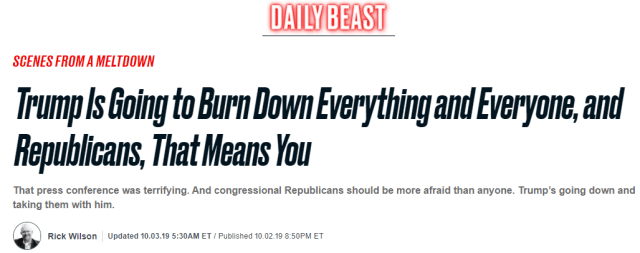
See the full article here.
Here is synopsis from Newsweek.
“Trump is a suicide bomber, and you’ve strapped yourselves to him so tightly that when he explodes, you’re going out to meet the 72 porn stars of the Trumpian afterlife with him. (Spoiler alert: They all look like Ivanka.)
“Trump’s manic performance Wednesday was distressing to watch, even for his supporters. Far from being the master of transgressive politics, his anger and frustration are evident and ugly. He’s lost control of the story and of himself.
“Trump can’t keep the process running on his terms and his timetable, and it’s driving him deeper into what I call the Eccentric Dictator Phase of his Presidency.” — Newsweek

In keeping the commitment we made to our readers in the post, America’s Perilous Path Of Wealth Distribution, we follow up with some additional and interesting data on wealth distribution in the United States. If you haven’t read Sunday’s post, run don’t walk to gather some background for the following data. See here.
Here’s the summary section,
Summary
The following tables illustrate and present the aggregate wealth data from the Fed’s new Distributional Financial Accounts (DFA). Note we use the terms “wealth” and “net worth” interchangeably.
Wealth Distribution By Percentile

This table was in our original post.
Key Takeaways
Wealth Distribution By Growth Rates By Percentile Group

Key Takeaways
Wealth Distribution As A Percent Of GDP Growth By Percentile Group
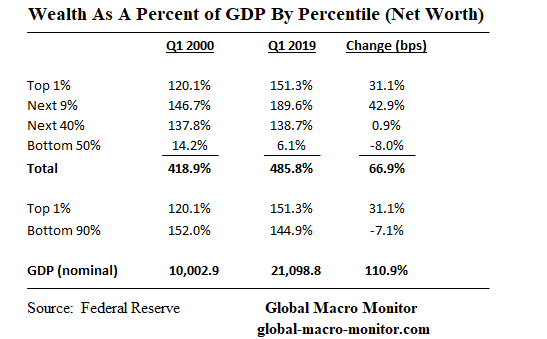
Key Takeaways
Distribution Of Wealth Gains By Percentile Group
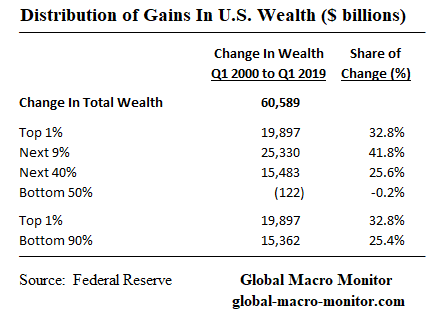
Key Takeaways
Note the data are not drawn from a panel study, which is a particular design of data where each unit of analysis is followed at specified intervals over a long period. That is many of the households in each percentile moved into other percentiles over the period.
Upshot
Long pitchforks.
Stay tuned for a couple more posts on Wealth Distribution in America.
We are almost out of free lunches, folks, and will be posting only sporadically unless your support increases. Donate whatever you think is fair by clicking on the PayPal button just below the Twitter and search icons on the upper right-hand side of the blog. You do not need a PayPal account and can use almost any credit card.
Don’t be a free rider. Thanks, so much.

When a headline like this appears in the Washington Post it is probably is no longer a 6 Sigma event, i.e, the odds of it happening are 500 million to 1.
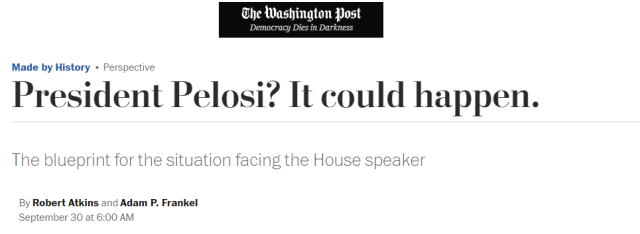
Recall the political scenario we laid out in May 2017,
Contemplate this 6 sigma scenario:
Bad news for Trump continues to leak out and staffers and acquaintances are indicted all through the rest of 2017 and 2018. The Democrats take the House and Senate in a landslide in November 2018.
Impeachment charges are brought both against President Trump and Vice President Pence, say, as a co-conspirator on obstruction of justice charges in the firing of James Comey.
It’s 2019 and the Dems control the House and the Senate with comfortable majorities.
The House impeaches the President and Vice President. The Senate convicts both.
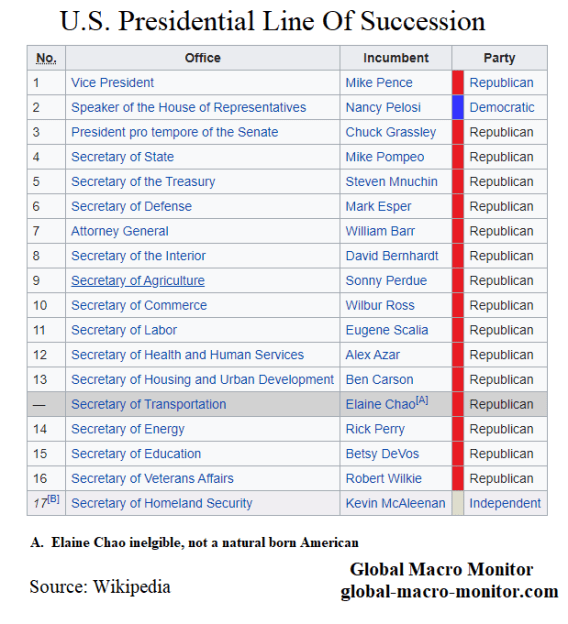
Who is next in line to assume the Presidency? The Speaker of the House, Nancy Pelosi? – Global Macro Monitor, May 18, 2017
Maybe the scenario is now a 4 Sigma event, or 16k to 1 odds.
This new scandal is unraveling quickly and has now sucked in Secretary of State Pompeo, who is 4th in the line of presidential succession.
Nothing but crickets from Vice President Pence since the news of the Ukraine scandal broke and after what appeared to be President Trump throwing him under the bus.
Civil War
If, now the 4 Sigma event, does seem to be even remotely close to becoming The Event, it’s time to fear the American Street, folks.
We wonder who are the 3 percent of American adults who own a collective 133m firearms – half of America’s total gun stock? We do have our suspicions.
Who knows what he is thinking, but POTUS does seem to be already dog-whistling.

At best, this is incredibly irresponsible and totally reckless, and could even be grounds for impeachment.
One Of Our 2019 Tail Events
In early January we posted, 2019’s Five Most Mispriced Tail Events. The top of the list?
Trump Leaves Office By Year-End
There is only one thing Trump likes more than power – money. As his legal troubles grow exponentially in 2019, the president has an epiphany that he could lose all his wealth. He cuts a Spiro Agnew-like deal and resigns from office in return for leniency. The markets rally into the announcement but Trump doesn’t go easy and dog whistles to his base as he hits the exit. The U.S. experiences a period of political and social instability. Stocks sell-off hard.
Does anyone have a clue how fragile, unstable, and how thin the ice just might be?
Do you think any of this is priced? If feels like things are about to get nonlinear.
Summary
Wealth Tax Talk
We hear a lot these days about wealth taxes. A new wealth tax on the upper echelons of the top 1% of wealthiest households will likely be at the center of the 2020 presidential campaign.
This kind of rhetoric and these ideas just don’t happen in a vacuum and are gaining political momentum. Our analysis will illustrate how it is based and moored in the two-decade-long change in the country’s distribution of wealth.
The prediction markets now give Elizabeth Warren a 50 percent probability of winning the Democratic nomination compared to only 21 percent for Joe Biden.

Here is a little snippet of Elizabeth Warren’s plan for a wealth tax from her campaign website.
..an Ultra-Millionaire Tax on America’s 75,000 richest families to produce trillions that can be used to build an economy that works for everyone — elizabethwarren.com
During the next week, we will present a series of posts analyzing wealth distribution in the United States, which seems to have reached a political tipping point. The top 1% of American households now have more wealth than the bottom 90% compared to 79 percent of the bottom 90% in Q1 2000.
In this post, we briefly present some data and charts on the growing wealth inequality between the top 1% and the bottom 50% of U.S. households.
Changes In Wealth For Average Household
Just a few caveats before looking at the following charts.
First, see our post, Be Skeptics Of Macro Data In The Two-Speed Economy, warning about looking at averages when data distributions are so skewed. This is illustrated in the bible of wealth distribution, the Fed’s Survey of Consumer Finances (SCF),
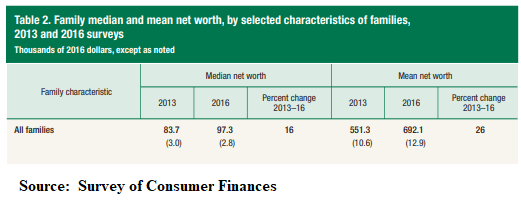
Note the significant differences between the average and median data points, which is the result of the top-heavy distribution of wealth in the U.S. where 70 percent of household wealth is now held by the top 10%, pulling up and distorting the average.
Second, our estimate of the number of households, which we have sourced from the Census Bureau and extrapolated for the current year. There is an ongoing debate about what constitutes a household and a family. Nevertheless, we are very confident our estimates in the following two charts are very good and close approximations of the data that will be eventually published in the next SCF, which should be out in a year or two.
The Raw Data
The following table illustrates the aggregate wealth data from the Fed’s new Distributional Financial Accounts (DFA). Note we use the terms “wealth” and “net worth” interchangeably.

Though the DFA time series begins in 1989, we use Q1 2000 as our base year not only because it represents the beginning of the new Millenium but it was also the quarter of peak aggregate nominal wealth for the bottom 50% of households.
Key Takeaway
The most stunning takeaway, at least for us, from the table is that the nominal aggregate wealth of the bottom 50% has declined, underscore fallen in nominal terms, over the past 19 years. That is almost a 10 percent decline while, at the same time, the wealth of the top 1% has increased by 166 percent. The share of the total household wealth of the bottom 50% has dropped from a mere 3.4 percent in 2000 to 1.3 percent in Q1 2019.
The aggregate wealth of the top 1% relative to the bottom 50% has increased from a factor of 8.5 to 24.6 from Q1 2000 to Q1 2019. Stunning and politically dangerous.
The data are even starker when taking into account that household formation has grown by over 20 percent since the beginning of 2000.


Go no further to understand America’s rising populism and growing political conflict than the above two charts. It also illustrates the country’s two-speed economy and the sharp contrast of the economic well being of the top percentile groups and the bottom 50% of U.S. households.
Real-World Example Of Wealth Decimation
It is hard to comprehend the decimation in purchasing power of the wealth of the average household on the other side of middle from 2000 to 2019 but let us help with a simple real-life example.
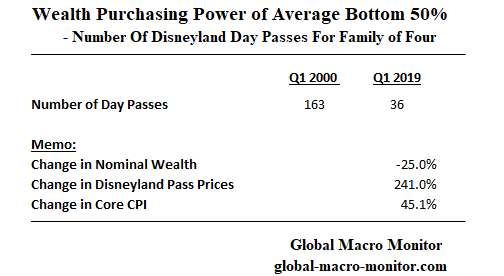
In 2000, the average wealth per household of the bottom 50%, assuming a family of four, could purchase 163 day passes at Disneyland. In 2019, however, given the decline in nominal wealth and the increase in Disneyland ticket prices, which have outpaced core CPI by more than 5x, fell to just 36 days.
Official Inflation Data Flawed
Just an aside, the relative increase in Disney tickets illustrates why we are so skeptical of and think the official inflation data calculated by the government underestimates real-world price increases, which are what truly matter with respect to a consumer’s real purchasing power.
Yes, we do understand relative price changes and that Samsung large screen televisions are much less expensive than they were in 2000.
Another Data Caveat
One should not make the mistake of viewing the above comparisons as a panel study. That is there is no doubt that some households were in the bottom 50% in 2000 are now in the top 1%, and vice versa.
In addition, the data are averaged with a range from a deeply negative net worth for the lowest percentiles of the bottom 50% to around $100k of the top percentile of the bottom 50%. Ditto for the top 1% where a few of the highest percentile households hold over $100 billion in wealth and the lowest of the top 1%, i.e., the 99th percentile of all U.S. households, is just over $10 million.
Keep that in perspective, folks, during your meditation on the data.
Why The Wealth Divergence?
One, or the major factor of the wealth divergence is that the returns earned on assets such as stocks, bonds, and equity in private businesses have greatly exceeded the growth of wages, which have been nothing short been dismal over the past 20 years. The several rounds of quantitative easing (QE) and the subsequent asset inflation have greatly contributed to the problem, increasing the support for some kind of a People’s QE.
We also illustrated in an earlier post how debt-laden the bottom 50% is relative to other percentile groups.

Upshot
So, there you have it, folks.
It doesn’t take a Ph.D. economist or political scientist to understand what, we believe, is the biggest problem in today’s political economy. Just contemplate and study the few charts and data points above.
It will certainly be one of the main drivers of the 2020 presidential election and the winner will most likely be the candidate who convinces the majority of the electoral college or voters in the swing states, that he/she can best fix the problem or, more darker, is better at exploiting the rage against it. Yikes!
Either way, we suspect the 2020 campaign will be very ugly.
The concept of fairness in the distribution of resources is not just political but the literature increasingly shows is more innate. The perception of fairness also triggers more cooperation and helps an economy and society become more efficient and run more smoothly.
See our June post, The Innate Angst Of Inequality, or take a few minutes to view the video in the Appendix at the bottom of this post.
Can Markets Handle A Hard-Left Turn?
We are not so sure asset markets can handle and sustain a hard-left political turn. We are fairly certain, however, the current trajectory of the distribution of household wealth is not politically sustainable.
We are hoping for new policies that focus more on equitable growth, pulling the lower middle and bottom 50% of households up to close the wealth gap rather a radical redistribution of wealth program. The quickest but ugliest path to close the wealth gap is for both public and private equity markets to take, say, a 50 percent hit, which will end up hurting the most vulnerable.
I recall a conversation with one of my lefty political science professors during the dot.com crash. I asked if he was happy that the wealth gap between the richest man in the world at the time, Bill Gates, and the poorest person (maybe it was me) was cut in half with the crash of the Nasdaq. He responded, “no, let’s not do it that way.” Good for him.
Wealth Tax As An Investment In Social Stability
Nevertheless, some sort of redistribution of wealth from the uber-wealthy is inevitable, in our opinion. After all, the top of the top 1% have taken down an extraordinarily disproportionate share of the increase in total household wealth since 2000. They should view some sort of a wealth tax as an investment in the country’s social infrastructure and political stability in order to protect the totality of their asset holdings.
Whatever the scenario, the markets are vulnerable and to extract ourselves from this mess it is going to take some very effective and competent leadership with lots of nuance and finesse. Apollo 13 like leadership and finesse.
…to return the [Apollo 13] astronauts safely, a new return trajectory had to be calculated and that is where his education in physics, as well as his experience at NASA, came into play. Calculating that return trajectory was like threading a needle from 70 feet away, he said. “We had to be accurate.”
“Apollo 13 was a test of real leadership and how we took a potential tragedy and turned it into a success,” he said. “All of us had a conviction to ride Apollo 13 to the end. We never thought we couldn’t do it.’ — Cherokee Phoenix
Stay tuned for more data posts. Long pitchforks and water cannons, for now.
We are almost out of free lunches, folks, and will be posting only sporadically unless your support increases. Donate whatever you think is fair by clicking on the PayPal button just below the Twitter and search icons on the upper right-hand side of the blog. You do not need a PayPal account and can use almost any credit card.
Don’t be a free rider. Thanks, so much.
Appendix
So we missed by a week or two.
Coming “Summer Political Discontent?”
There will be some political instability into a second referendum vote as the Brexiteers take to the street. Depending on how things shape up with President Trump’s legal troubles, we may be moving into a transatlantic “summer of discontent,” where the U.K. and U.S. experience a bout of political and social instability. – GMM, March 13, 2019
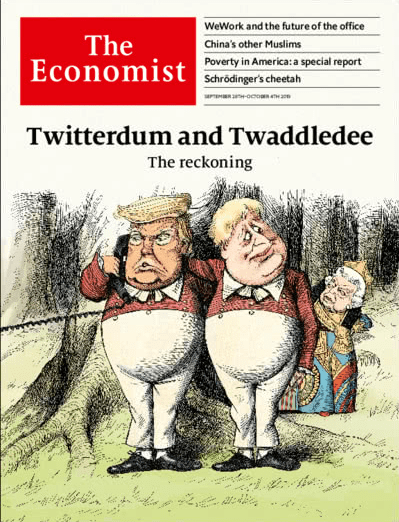
Buckle up for the coming Political Oktoberfest on both sides of the pond. Impeachment for Twitterdum and a vote of no confidence for Twaddledee and an early election on the docket.
The prediction markets now put the probability of impeachment at 70 percent and no BREXIT by November 1 at 78 percent.
Bad Things Happen During Impeachments
Noted in our analysis are the two big “coincidences” of bad things concurrently occurring at tipping points during the two impeachment proceedings. The Russian default on the same day President Clinton confessed to the grand jury and the OPEC oil embargo during the same week of Watergate’s Saturday Night Massacre. Coincidences?
Bad things tend to happen in the world when the U.S. administration is distracted and looks weakened by political scandal. And, believe us, there is a legion of bad things out there just waiting to happen, all of which are stock market negative. — GMM, May 2017
Moreover, see How Presidential Scandal Endangers Global Stability
We just found this tidbit of history from Politico of how during the Watergate scandal the Nixon administration was melting down and the President retreated to self-medication,
The Nixon administration began disintegrating—the president unable to play his role as the leader of the nation and the free world—at 7:55 p.m. on October 11, 1973.
The newly appointed secretary of state, Henry Kissinger, picked up his telephone. His trusted aide at the National Security Council, Brent Scowcroft, was on the line from the White House. The Arab-Israeli war of 1973 was in its fifth day, escalating toward a global crisis and a potential nuclear conflict.
SCOWCROFT: The switchboard just got a call from 10 Downing Street to inquire whether the president would be available for a call within 30 minutes from the prime minister. The subject would be the Middle East.
KISSINGER: Can we tell them no? When I talked to the president he was loaded.
President Richard Nixon—ravaged by more than four years of war in Vietnam, 15 months of Watergate investigations and countless nights of intense insomnia—was incapacitated. – Politico
Wow! POTUS was hammered as the world spiraled toward nuclear conflict and incapable of taking “the call.”
This further confirms our suspicions that domestic political scandals, such as Watergate, distorts and weakens the global perception — and maybe not just perception — of U.S. leadership in the world. And contributed, at least, partially, to the 1973 Yom Kippur War and subsequent economic crisis caused by the related OPEC embargo.
It was only nine days later after the above account by Politico the Saturday Night Massacre took place.
If past is prologue, as Trumpgate thickens we suspect the world may become more unstable.
…Thank goodness President Trump doesn’t drink, but he does seem to find release — i.e., self-medicate — through his Twitter account. And recent history shows that one “bad” tweet can do more damage and be more self-destructive to a Presidency than, say, five martinis. Gulp! — GMM, May 2017
Stocks are reeling from the following headline.

The White House is weighing some curbs on U.S. investments in China, a source familiar with the matter told CNBC. This discussion includes possibly blocking all U.S. financial investments in Chinese companies, the source said.
It’s in the preliminary stages and nothing has been decided, the source said. There’s also no time frame for their implementation, the source added. – CNBC
We don’t think the U.S. is in a strong position to start a war on capital flows given its very weak net international investment position (NIIP), which now exceeds a negative $10 trillion dollars. Capital inflows help keep U.S. asset markets afloat and finance budget deficits.
Net International Investment Poistion
The difference between a country’s external financial assets and liabilities is its net international investment position (NIIP). A country’s external debt includes both its government debt and private debt, and similarly its public and privately held (by its legal residents) external assets are also taken into account when calculating its NIIP. Note that commodities, as well as currencies tend to follow cyclical patterns, whereby they undergo significant valuation changes, of which is reflected in NIIP.
A country’s international investment position (IIP) is a financial statement setting out the value and composition of that country’s external financial assets and liabilities. A positive NIIP value indicates a nation is a creditor nation, while a negative value indicates it is a debtor nation. – Wikipedia
Slouching Toward Socialism
The trade war, the political manipulation of imports and exports, and the threat of managing capital flows are just too much of a slouch toward socialism, in our book.

Do you think the SEC has the same concern of protecting the public from overhyped and overvalued IPOs that owners dump on the public? Think loss-making Uber, which is down 30 percent since its IPO and WeWork, almost. Just askin’.
We are almost out of free lunches, folks, and will be posting only sporadically unless your support increases. Donate whatever you think is fair by clicking on the PayPal button just below the Twitter and search icons on the upper right-hand side of the blog. You do not need a PayPal account and can use almost any credit card.
Don’t be a free rider. Thanks, so much.
Sit up and listen, folks. We may be in the midst of a Black Swan event.
Nobody knows for certain what is creating the turmoil in the repo and money markets but we suspect much of it has to do with the increase of the trillion-dollar-plus budget deficits during an economic expansion, i.e., pro-cyclical budget deficits, which have been very rare. We have been pounding this theme over the past month. See our last post here.
If you want some context and a comprehensive understanding of the changing dynamics of financing the budget deficit and the structure of the Treasury market, go to our tome, The Gathering Storm In The Treasury Market. That piece was posted last September, just before the spike in the 10-year Treasury yield, which caused the Q4 stock market crash.
The upshot of the post was that the technical factors of the Treasury market, supply and demand, are rapidly changing and the natural path of real interest rates are higher, and there are consequences to financial repression. We underestimated just how sensitive global markets were to an even 50 bps increase in long-term bond yields but we did hedge ourselves,
All bets off given a geopolitical shock — we are concerned how quickly U.S.-China relations are moving south; a collapse in stock prices, or a sharp slowdown in economic activity. Haven flows will likely swamp the structural factors pressuring yields higher. – GMM, August 24, 2018
So, here we are, one year later with yields 150 bps lower but the Treasury still is in need of $1 trillion in annual financing. We believe the distortions are now showing up in the money markets as interest rates cannot move higher to their steady-state normal equilibrium levels because markets perceive there is too much debt in the global financial system.
If you squeeze a balloon, the pressure and bulge shows up elsewhere. Classic Le Chatelier’s principle
The Bloomie opinion page also seems to get it.

I’d offer another angle that’s largely flown under the radar: The chaos in repo markets was a long time coming given the widening U.S. budget deficits and the lenders that are financing that shortfall.
Deficits, while nothing new, add up over time. And while they declined each year from 2011 through 2015, both overall and as a percentage of gross domestic product, the gap has widened again under President Donald Trump. Put it all together, and the amount of U.S. Treasury securities outstanding has roughly tripled since the financial crisis:
This growth was mostly under control in the years after the financial crisis because the Fed had been buying up large chunks of the Treasury market through its quantitative easing programs. But it was gradually reducing the size of its balance sheet from late 2017 until July, precisely at the same time that the Treasury Department was increasing the size of its monthly auctions to finance the bigger budget shortfalls. All told, the Fed now holds about $2.1 trillion of Treasuries, down from almost $2.5 trillion previously: – Bloomberg
Central Banks Financing U.S. Budget Deficit
Since around 2000, when the Federal budget was in surplus, the U.S. government has leaned heavily on foreign central banks and then the Fed post-GFC to plug it growing fiscal gap. The Fed cannot finance the government directly by participating in the monthly auctions (unless rolling over SOMA portfolio) but do so indirectly in their secondary market purchases either through QE, and, now we argue through open market operations OMO, which, we suspect, will soon morph into POMO and another permanent round of QE. This is now taking place when the annualized core CPI over the past three months is running at 3.4 percent.
Note, at the end of July, the Fed and foreign central banks held almost 50 percent of all marketable Treasury notes and bonds outstanding. That is just stunning.
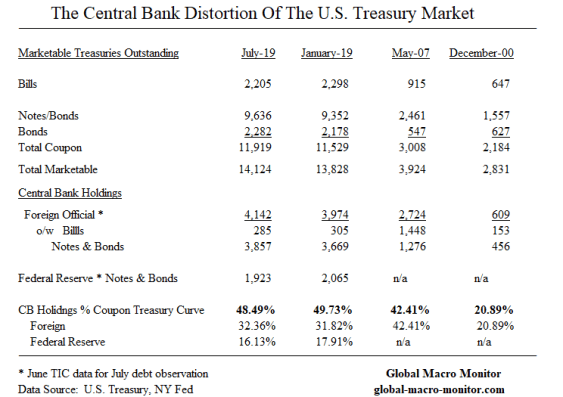
The central bank financing of the U.S. government has freed up funds and liquidity to power other asset markets and capital spending, or buybacks.
Central Banks Pulling Back
The Fed and the big central banks that matter and are scaleable – China and Japan – have pulled back their purchases of Treasuries at the same time interest rates have fallen way below, what we believe is their equilibrium technical level to clear the market. Think, rent control.
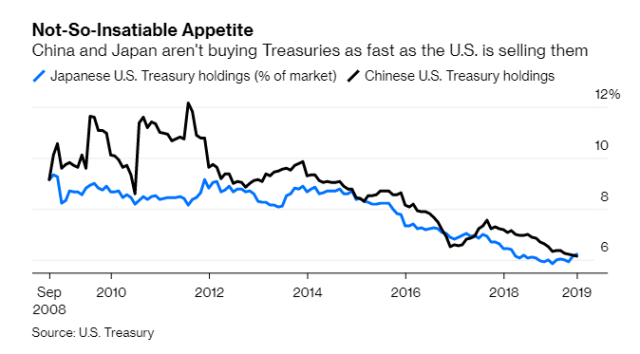
Source: Bloomberg
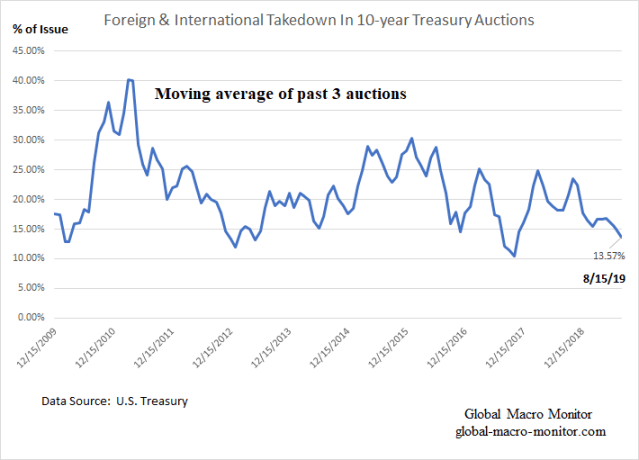
Even the narrative that foreigners are chasing Treasuries for yield doesn’t seem to be backed up by data — at least the 10-year note — from the recent monthly auctions. As of the issuance date on August 15th, foreigners were allotted just 13.6 percent on average over the past three auctions.
In fact, the August 15th (August 7 auction date) issuance allotted only 12.02 percent to foreigners and international buyers, the lowest since September 2016.
Bad Timing
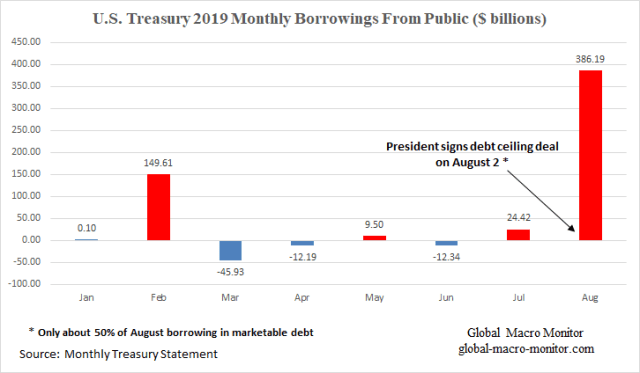
Bad timing as the Treasury, who had been forced to finance its budget shortfall prior to August by running down its balances at the Fed and by other means due to the debt ceiling, borrowed almost $400 billion from the public in August. That may, underscore may, have shocked the financial system. Kind of like the pressure building up on a beachball, which is held underwater then suddenly released.
The Treasury is pretty good at managing its borrowing to maintain market stability and issued around $200 billion of $386 billion in the form of nonmarketable General Account Series debt to the public. These Treasuries are usually issued to intragovernmental agencies – i,e, nonpublic — such as the Social Security trust funds
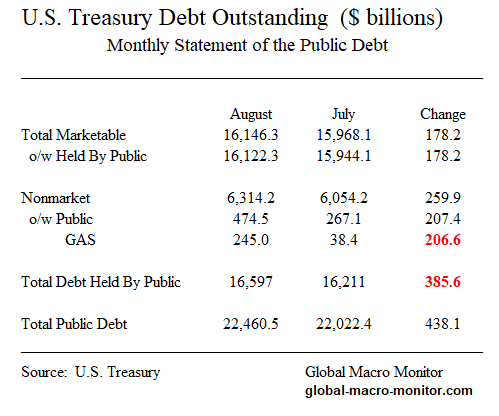
Who took down the $200 billion of GAS? We suspect it is a fudge factor account and we have reached out to Treasury trying to nail it down. Will let you know as soon as we find the answer.
Banks Getting Stuffed
Moreover, it does seem banks, including primary dealers, are choking on Treasury securities.
So if it’s not the Fed, it’s not China and it’s not Japan, where are all these Treasuries going?
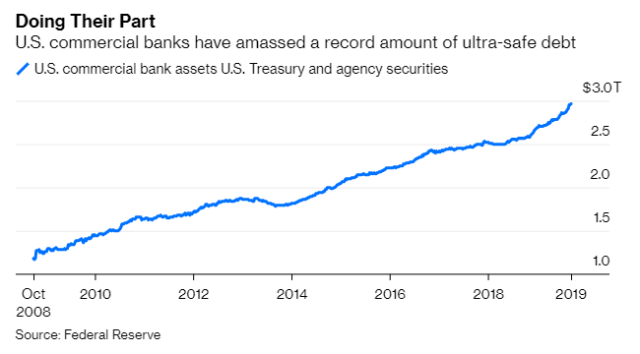
U.S. commercial banks are certainly a place to start looking. They’ve done their part since the financial crisis, but especially lately, with holdings of Treasuries and agency securities climbing to almost $3 trillion as of Sept. 11:
Primary dealers, a select subset of banks that are obligated to bid at Treasury auctions, were saddled earlier this year with the most Treasuries ever — an outright position of almost $300 billion. Even now, their holdings are more than double what they were a year ago as they’re required to take down larger pieces of the U.S. government’s debt sales.
There are simply too many bonds (or, in the language of the repo market, “collateral”) sloshing around in the financial system and not enough cash on the other side of the trade. America’s budget deficits are being financed domestically and leading to a relentless drain on reserves – Bloomberg
So there you have it, folks, it’s not rocket science.
Too much supply in all the wrong places and not enough demand from all the right places. If rates were allowed to go to their natural equilibrium level, demand for Treasuries would increase from natural buyers and I seriously doubt the money market markets would be seizing up. But, as we know from Q4 2018, interest rates can’t go up because the stock and asset markets will and did crash.
The End Game
We have been concerned for quite some time about the financing of big budget deficits, and we mean big – the deficit from October to August 2019 is equivalent to the combined GDPs of Austria, Ireland, and the Czech Republic, especially given the distortion of global interest rates,
A question has been nagging us for some time. If the current sovereign yields are repressed and fake, many of which are negative, can the borrowers issue any significant amount of new debt at these current yields? Especially to long-term holders?
We are just thinking out loud here but our priors are that of the Big Three — U.S., Germany, and Japan — which have relatively transparent markets as opposed to China, the U.S. is the only government that needs to issue a significant supply of debt and bonds into the market. – GMM, Aug 6th
It doesn’t surprise us one bit the turmoil taking place in the money market though we thought the pressure would show up more in the monthly auctions. It could be the banks are being stuffed to window dress the auctions. Maybe, we don’t know.
We will find out soon as the Treasury will have to ramp up its net new issuance after their creative cash flow management during this year’s debt ceiling negotiations. We seriously doubt they can without another round of quantitative easing, and that monetization just may be the beginning of the end of dollar hegemony and set us on the happy road to higher inflation, which everyone seems to be wishing for. Not us, by the way – GMM, August 6th
If we are right, the turmoil in the money markets is more of a structural problem, which may, periodically, calm down depending on the matching of public and sector cash flows or the distortions may show up elsewhere and in other markets.
It does seem, however, the day of reckoning has or is coming soon on the deficit/debt-bomb so many have been warning about for so long. Of course, they will say nobody saw it coming.
The only real political choice will be to monetize the deficits, which will only significantly increase economic and financial distortions, further expanding the minefield of potential Black Swans.
I took so much incoming for this part of a post (reposted yesterday) I wrote back in May 2017. People would look at me as I was crazy when I laid out the unlikely scenario, which, I admit, was written mainly for intellectual entertainment for political junkies.
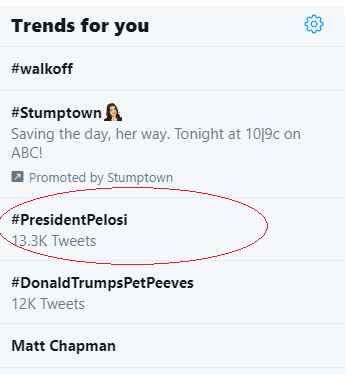
It won’t happen but it’s hard to believe it is now trending on Twitter after President Trump appeared to throw Mike Pence under the bus today, which led to the following tweet by Harvard Law Prof, Lawrence Tribe.
The 6 Sigma Event: President Pelosi in 2019
Finally, you know we like to think outside the box here at the Global Macro Monitor and live in the fat tails.
Contemplate this 6 sigma scenario:
Bad news for Trump continues to leak out and staffers and acquaintances are indicted all through the rest of 2017 and 2018. The Democrats take the House and Senate in a landslide in November 2018.
Impeachment charges are brought both against President Trump and Vice President Pence, say, as a co-conspirator on obstruction of justice charges in the firing of James Comey.
It’s 2019 and the Dems control the House and the Senate with comfortable majorities.
The House impeaches the President and Vice President. The Senate convicts both.
Who is next in line to assume the Presidency? The Speaker of the House, Nancy Pelosi?
The probability? Six sigma or about 2 * 10^-9 or two in a billion. Most likely, even much, much lower.
Hey, but good stuff for a political thriller or fodder for the House of Cards, no? – GMM, May 18, 2017

 Global Macro Monitor