Emerging Market Sub-Zero Corporates

Stunning.  Kind of gums up the valuation models, no?

What have the CenBanks wrought?

  • The amount of negative-yielding corporate bonds almost tripled to $109 billion from a week ago
  • Sovereign bonds with sub-zero rates climbed about 50% to $136 billion

Corporate heavyweights such as China Everbright Bank Co. and Petroleo Brasileiro SA, and sovereigns including Poland and Hungary have seen their rates drop below zero after a dovish turn at Federal Reserve and the European Central Bank sparked a mad dash for yield. Emerging-market bonds handed investors 3.5% over the past two months, more than a percentage point above returns on U.S. Treasuries, according to Bloomberg Barclays indexes. – Bloomberg

Posted in Capital Flows, Credit, Uncategorized | Tagged | 1 Comment

What Keeps The Credit Markets Up At Night

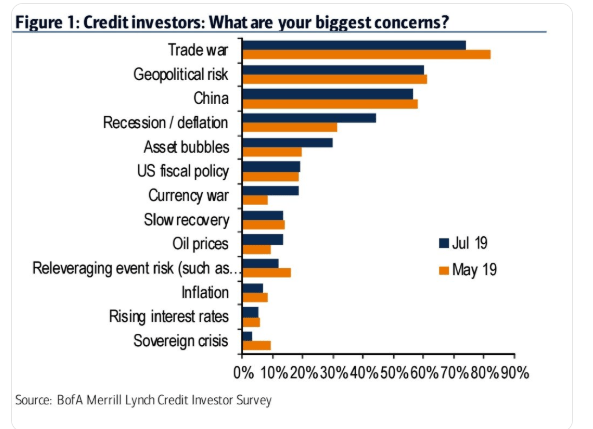
Credit investors rank their concerns, which are almost identical to ours.  That makes us a little nervous to be bearish.  Prefer to catch the off-radar incoming.

Credit Market Concerns

Hat Tip:  Chi @chigrl


Posted in Charts, Tail Risk, Uncategorized | Tagged , | 1 Comment

The Bear On The Balcony At Bretton Woods

Ursa Major waits patiently as she watches over,  in amazement, the yield chasing salmon in a panic buying frenzy over fears of NIRP, ZIRP. negative and near zero bond yields forever and ever.

The Bear on the Balcony is giving,

…them a little more room to run, setting her entry and stop levels, and placing her finger on the trigger.  Letting the market tell her when it’s time to fire.

She knows it’s close to feeding time and ready to hunt at S&P 3025-3100 or if the salmon retreat and begin to swim downstream in earnest.   But, also wise enough to remain flexible to retreat if the salmon really lose their minds and jump the 3125 S&P level, where the oxygen in the bubble becomes a little too thin to hunt or that this time is really different, where the fish know something that she doesn’t.

Ursa’s preference is to pickoff the salmon as they swim upstream to the 3100 level rather than chasing them downstream.

An Omen?

Could the Bear on the Balcony be an omen and confirmation of the major motivation of our bearish view?  That is, the tectonic plates of the western liberal international economic order, which has been in place since the end of World War ll, are breaking apart and moving in the wrong direction.  And, no, we do not mean San Francisco Liberals.

Bretton Woods

The balcony where Ursa is mapping her shorting strategy is at the same hotel that hosted the Bretton Woods Conference in July 1944, where the post-war liberal international economic order was born.  The legendary economist, John Maynard Keynes, represented the British government at the conference, which also gave birth to the International Monetary Fund and World Bank.

Hollywood can’t make this stuff up.

Black Bear.png


Posted in Bonds, Uncategorized | Tagged | 13 Comments

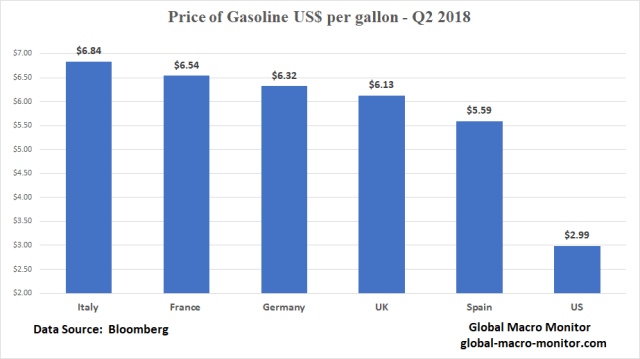
Small Car Big Car: Preferences Or Relative Price?

To paraphrase Freud (maybe),

Sometimes the economics is just the economics. 


Small Car Size


Small Car Size_Gas Price


Posted in Economics, Uncategorized | Tagged , | Leave a comment

The Fruits of Free-Trade

Snapped this tonight hoping and praying the liberal trading order doesn’t collapse in the next few years.  My real income — purchasing power — is much higher due to trade with other nations.

I also get the satisfaction of, say, eating fresh grapes in the deep of winter imported from Chile and have fresh cut flowers from Ecuador on our Christmas dinner table   Franky, I don’t feel “ripped off” by either.

CAFTA-DR

Did you know Guatemala is a partner in a free trade agreement with the United States?

On August 5, 2004, the United States and the Dominican Republic-Central America-United States Free Trade Agreement (CAFTA-DR) with five Central American countries (Costa Rica, El Salvador, Guatemala, Honduras, and Nicaragua) and the Dominican Republic (the Parties). Under the Agreement, the Parties significantly liberalizes trade in goods and services.

The CAFTA-DR also includes important disciplines relating to: customs administration and trade facilitation, technical barriers to trade, government procurement, investment, telecommunications, electronic commerce, intellectual property rights, transparency and labor and environmental protection.

The Agreement entered into force for the United States and El Salvador on March 1, 2006; for, Honduras and Nicaragua on Aril 1 2006; and for Guatemala on July 1, 2006. The CAFTA-DR entered into force for the Dominican Republic on March 1, 2007, and for Costa Rica on January 1, 2009.  – USTR

How Trade Creates Jobs In the Nontradeable Sector

My higher real income provides the financial firepower to purchase more local goods, which create more jobs and income for our local residents, such as the bartender who pours my beer and receives a bigger tip.    Most are winners in this transaction except the American plantain farmer, for example.

Trade Adjustment Assistance (TAA) 

Free-trade is a tough sell politically these days but I am willing to pay a little extra for those plantains from Guatemala, as long it is not structured as a tariff, earmarked for an adjustment fund to help the American plantain farmers (if there are any) displaced by trade.

The current TAA program is a joke, is grossly underfunded, and needs to be revamped or replaced with a much more efficient and effective program.   Politicians on both sides turned their backs on those displaced by trade failing to beef up TAA.  Then came the political blowback and now we are paying the price, especially many of our farmers.

The protectionists are also just as guilty, in our book, for not understanding the trajectory of the global economy.  Let’s see how things work out if they get their way.

If my cost of living increases by 30 percent, I better get a comparable rise in income or none of the goods that are being protected will be bought.  Everyone will be worse off.

Here’s to hoping we don’t commit economic suicide by letting our political passions get the better of us shutting down the global trading system.  It’s not a done deal but we worry it’s getting close to midnight.

Bring It

Okay.  Bring on the comments and emails about “globalists” and “that is the traditional and archaic way of looking at the global trading system,” yadda, yadda.   We’re big girls and boys and can take it.

file-2[11755].jpeg

Posted in Trade War, Uncategorized | Tagged , , | Leave a comment

President Trump Is Not Your Father’s Conservative

Summary

  • The U.S. government’s cumulative monthly deficits in the first 29 months of the Trump Administration has almost doubled from the prior 29 months
  • The sum of monthly deficits totaled $1.08 trillion during the period Sep. ’14 to Jan ’17 and has increased to $2.03 trillion in the 29 months from Feb ’17 to Jun ’19, rising from 5.9 percent of GDP to 10.1 percent of GDP.  A significant increase
  • The efficacy and efficiency of fiscal stimulus and deficit spending appear to be diminishing.  For every dollar of deficit spending from Sep ’14 to Jan ’17 nominal GDP increased by $1.32 compared to $1.08 in the period Feb ’17 to Jun ‘19
  • This raises a red flag that the U.S. and the world may be entering a debt trap similar to the monetary liquidity trap the world currently finds itself
  • The fight over raising the national debt ceiling is heating up as the Treasury has warned Congress it may run out of money by September
  • We layout, what we believe, is the grand narrative driving global markets in the first half of the post before diving deep into our analysis of the U.S. budget

I’m the king of debt. I’m great with debt. Nobody knows debt better than me. I’ve made a fortune by using debt, and if things don’t work out I renegotiate the debt. I mean, that’s a smart thing, not a stupid thing. – Donald J. Trump, June 2016

Nobody cares about debt and deficits anymore.  Until they will.

The King Of Debt needs to get on with negotiating an increase in the debt ceiling before the government runs out of cash in September,

“It’s one of those cartoonish anvil-over-head moments,” one senior GOP congressional aide told CNN. “We all look around knowingly like ‘Man, we’re about to get crushed by this,’ but nobody’s really sure how to get out from underneath it right now.”  CNN

Grand Narrative & Why Interest Rates Can’t Move Higher

Debt stocks are becoming so large interest rates cannot rise to their equilibrium levels as the amount of global debt is not sustainable with higher rates, which would seriously destabilize the global economy and markets.

Global Debt_July13

The major debtor governments‘ net interest payments would skyrocket, budget deficits would balloon, forcing deep spending cuts, and/or larger deficit financing, more monetization (most likely), and higher interest rates.  Wash, rinse, repeat.  The classic debt doom loop.

Higher long-term interest rates will also trigger a real come-to-Jesus moment for asset valuations.

Q4 2019 Mini-Bear Market

The markets’ nervousness over such a scenario was evident in Q4 2018 when U.S. 10-year yields broke out in late September and triggered the sharp and swift 20 percent sell-off in the S&P500 until the Fed was beaten into submission.  The Q4 reckoning, albeit temporary,  was just an appetizer for the full course coarse meal, which will inevitably be served up.

GMM Pop Quiz 

Q: Why do dogs lick their….uh…um…….tails?
A: Because they can.

Q: Why don’t interest rates go up? 
A: Because they can’t.  

Excuse a little more diversion as we turn up the mood music and further set the narrative for our analysis of the current U.S. budget situation.

Global Bond Market Sucked Into A Black Hole Of Negative Yields

The total stock of negative-yielding debt is now is around $13 trillion dollars, including benchmark sovereign bonds in Japan, Switzerland, Germany, France, and the Netherlands,  and even in some emerging markets.  All of the Czech Republic euro bonds, for example, now trade with negative yields.  That is just stunning.

Value of Negative Yield Debt_July13

Though all of the U.S. government’s $16 trillion-plus marketable debt still trades with a positive yield, the cost of hedging out the currency risk for foreign buyers pushes the effective yield into negative territory,

Hedged European investors now earn a roughly minus-0.5 per cent yield on a 10-year US Treasury on a three-month rolling basis, according to Bloomberg data, compared to an unhedged yield of 2.58 per cent. Hedged Japanese investors earn minus -0.3 per cent.  –  FT, April 17th 

The rising cost of currency hedges has forced many European investors to abandon the U.S. and chase yield in the eurozone periphery and Eastern European emerging markets bonds, and also to take on more unhedged currency risk in their portfolios.

Italian 10-year bond yields are now trading 30 bps through U.S. 10-year yields.  Never thought I would live to see that.

Yes, we get it, different currency, interest rate parity, yadda, yadda, yadda.

Do you really think the risk of another existential crisis in the eurozone in the next ten years is that low?  And that eurozone policymakers have more firepower to fight the next crisis, which will most likely be triggered by politics?


Interest rates_July13

The increase in unhedged currency positions in global bond portfolios also significantly elevates the risk of a volatility spike in global capital flows and the currency markets.  Recall the Tequilla, Asian and Russian crises of the late 1990s

Sovereign Borrowers Have Found A New Revenue Source

Moreover, if the rush to sub-zero percent continues, some of these government borrowers — can’t even rule out the U.S. G — are going to be convinced they have found a new source of revenue to finance profligacy.  Generate more revenue by running bigger budget deficits to accelerate the expansion of negative-yielding debt.

It’s a wonderful thing to have your creditors pay you to borrow from them,

In Germany, 85% of the government bond market is underwater. That means investors effectively pay the German government 0.2% for the privilege of buying its benchmark bonds; the government keeps 2 euros for every 1,000 euros borrowed over a period of 10 years. — Bloomberg

The new zoom loop, folks.  It’s a no-brainer!

Maybe that’s the genius of the Trump administration and what it is counting on by beating on Chairman Powell?   Blowing up the budget deficit with the hope of generating revenues on soon to be negative-yielding debt.

Reading More Kafka

That’s why we are reading more Kafka these days.  His writings keep us open and flexible to the fact that just when we think peak absurdity has been reached in the bizarro world and bizarro times in which we now live, there is another bizarro dimension out there to write the next chapter.

Asset Markets Have A Napolean Complex: A World Of Shortages 

Seriously, the world’s not that hard to figure out.   The metanarrative of the markets is we now live in a world with some serious shortages in key major asset classes.

We have posted several pieces on this new supply-side economics.
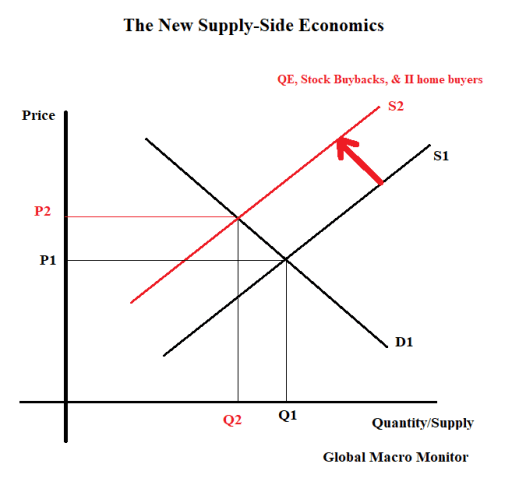
Supply-Side Stocks_Economics

Because demand and supply curves are theoretical models and not observable, one should always suspect a negative supply shock (shift in the supply curve up and to the left) when prices are rising and quantity/volume declining.

Risk-Free And Stocks

The global central banks have generated a shortage of so-called “risk-free” and high-quality fixed-income assets with their massive asset purchases over the years, officially depressing key benchmark interest rates.  The financial repression currently taking place in global markets makes North Korea look like Woodstock, circa 1969.

Corporations have taken advantage of the low-interest rates by borrowing and buying back their stocks creating a relative shortage of public equities.

Risk-Taking, More Saving, And Less Consumption

Mrs. Watanabe, the Belgium dentists, and all those widows and orphans now receive zero percent (or close to and some negative) on their CDs and savings accounts,  suffering a shortage of income from relatively safe assets.  They are forced into risky assets, such as stocks and 100-year Argentine bonds to pay for groceries and to keep the lights on.  More demand for risk, though under duress, and less supply of assets for sale.

It doesn’t take a genius.  True north for asset prices.

At least until Wylie E. Coyote has his epiphany that gravity is not fake news.

Moreover, many of these historically conservative investors, such as the graying Mrs. Watanable and the Belgium dentists, are forced to cut back on consumption to save more for and stretch their retirement funds,  slowing economic growth, which works counter to the very policy goals of repressing interest rates in the first place.

Private Equity Shifts Residential Housing Supply Curve Big Left

Helped by the foreclosure crisis, private equity and investors have become the largest holders of single-family homes taking them off the market and converting to rentals, shifting the supply curve of the existing homes big left. This has driven up prices and helped to create a shortage of entry and mid-level single-family homes for young families.  The cost of building new homes has also skyrocketed due to shortages of buildable land and construction labor.  Higher prices, lower volumes – a classic negative supply shock.

All taking place as the financial world goes virtual with AA – Automation, and Algos.

Efficient markets?

What is the message of the market?

You have got to be shitting me.

The global asset markets are joined at the hip with the global economy in some serious funk and one strange and dangerous feedback loop.

Napolean’s Achilles Heel

Did you catch the Achilles heel in all this?

All that corporate debt issuance may be the beast that comes back to haunt the global markets.  And when it does comes back, who will be the buyers?  The JP Morgan and the Goldie bond desk?   Good luck with that.

I have no doubt the same words uttered by one of my corporate bond traders during a major financial meltdown when I asked how his market was doing will once again show up in some tweet gone viral,

“My market’s fine.  Prices are holding up because there’s no bid.” 

The system is not that stable, folks.  Yield chasers are skating on ice, which is much thinner than it looks.

Wish we could pinpoint the exact date when it cracks.  We would buy you all yachts with what is left after first helping the less fortunate, who will be hurt the most when the music stops.

We think it’s much closer than the lathered up bulls think.

As always, we reserve the right to be wrong.

Enough.

Time to move to a topic with less conjecture, that is more factual and backed by hard data.

The Trump Deficits 

We felt very Kafkaesque this afternoon when we came across the following data from the U.S. Treasury, which we present to you tonight.   We were prompted by today’s Wall Street Journal article,

In the 12 months that ended in June, the deficit totaled $919 billion, a 22.6% increase from the same period a year earlier. As a share of gross domestic product, the year-over-year deficit totaled 4.4%, much higher than the previous 12 months.  –  WSJ, July 11th

We downloaded the data from the Treasury and started crunching.

Comparing Trump Deficits To Obama’s

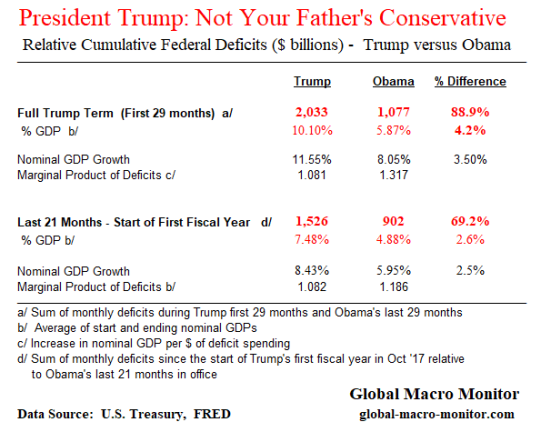
We have juxtaposed the cumulative Federal deficits of President Trump in his first 29 months in office, and also the 21 months since the month of his first full fiscal year, which began October 2017,  with similar similar periods of the Obama administration.   The current administration can argue they inherited the 2017 fiscal year budget and should not be held responsible for that year’s red ink.  We concur so we present you both periods

We compare the Trump and Obama deficits not only because we need a point of reference but also President Trump likes to tout his economic performance relative to his predecessors.

T_O_Deficit Table_Chart

The data show that the cumulative monthly deficits during President Trump’s first 29 months in office have almost doubled those of President Obama’s last 29 months, increasing from $1.1 trillion to $2.0 trillion, or 5.9 percent to 10.1 percent of GDP.   The increase is not insignificant.
T_O_Deficit Table

During the 21 months since Trump’s first full fiscal year in office, the cumulative monthly deficits have increased from $902 billion in Obama’s last 21 months to $1.53 trillion, or 4.8 percent to 7.5 percent of GDP.  The increase has occurred even as nominal GDP grew at a 2.5 percent faster clip.   In today’s economy, the norm is for a much smaller budget deficit, or even a surplus as deficits should be declining in proportion to GDP with faster nominal economic growth.

One major caveat is the seasonality in the budget data.  For example,  April is a month of huge budget surpluses as revenues flood into Treasury to meet the April 15th tax filing deadline.  This may or may not affect our timeframes and calculations, which may cause the data to look more favorable for one administration. We will take a look at it later but suspect the impact is marginal and de minimis, however, and have no idea which, and how each administration’s cumulative deficit is affected.

Marginal Product Of The Deficit (MPOD)

We also calculate the marginal product of the deficits, which attempts to measure the efficiency of deficit spending and the impact of the stimulus.  That is, how much does the nominal GDP increase given each dollar of deficit spending?  It’s a crude and rude measure, suffers from many shortcomings,  but interesting, nonetheless.   It is also very similar to the concept of the  Incremental Capital Output Ratio (ICOR).

Red Flag Warning

The data show it is taking more and more of deficit spending or an increase in debt to generate an additional dollar of nominal GDP.   In the full 29 month period, Obama’s MPOD was 1.32, which translates — for every dollar of deficit spending or increase in debt, nominal GDP increased by $1.32.  The MPOD under Trump drops to 1.08, which illustrates the diminishing efficacy of fiscal stimulus.

Note the Treasury can and does temporarily finance itself not just by issuing new debt but by running down its cash balance at the Fed or by other means, such as running arrears on certain payments.  This is a very small fraction of their financing over the longer-term and really only matters during debt ceiling fights, like in the now.

There is a legion of possible reasons for the decline in the MPODs, such as how tax cuts are allocated, how, where, when and in what sectors the increased spending takes place, is the public spending investment or consumption, too much existing debt, or it could be just noise.  We will leave it to the academics and Ph.D. dissertations to nail it down and deal with the other issues, such as the relative seasonalities in the different data series,

Take heed, however, the U.S. and world may be or have already entered a debt trap just as it similarly finds itself — more so for the rest of the world — in a monetary policy liquidity trap.

Conclusion

The data couldn’t be more clear.  President Trump is no traditional conservative.  Not concerned about the deficit or the increase in the national debt.  The data speak louder than words in tweets.

The above analysis reminds me of a modern-day version of the old LBJ-Barry Goldwater political colloquialism,

In November 1964, my liberal friends told me if I voted for Barry Goldwater,  there would be a major escalation in Vietnam.  I voted for Barry Goldwater and, sure as night follows day, we got the escalation in Vietnam.  

The modern-day version goes something like this,

In November 2016, my conservative and Tea Party friends told me if I voted for Bernie, the budget deficit would explode and the national debt would skyrocket.  I voted for Bernie and…..    Do I need to finish?

Debt Ceiling

Finally, keep the debt ceiling debate on your radar, folks.

Treasury Secretary Steven Mnuchin warned House Speaker Nancy Pelosi that the government may run out of cash in early September if Congress doesn’t raise U.S. borrowing authority. — Bloomberg 

The jousting continues,

“I am personally convinced that we should act on the caps and the debt ceiling,” Pelosi told reporters, “prior to recess.”

For a brief time, White House negotiators agreed the two issues should be coupled, but they have since started to change their minds as a deal with Democrats on the top-line spending numbers has proved elusive.

They are now worried that a spending deal with Pelosi will add more than $300 billion to the deficit over the next two years and damage Trump’s reputation as a fiscal conservative with Republican voters.

By separating the debt limit from the spending talks, White House negotiators believe they will have more leverage to press Democrats to accept a smaller spending increase for domestic programs.

But congressional Republicans are warning the White House that a vote on just the debt limit would invite trouble.  — The Hill

The White House worried about the “damage to Trump’s reputation as a fiscal conservative with Republican voters?”    I want some of the Tea that party is drinking.

There it is, folks, one small step beyond peak absurdity and one great leap into that next bizarro dimension waiting for the next chapter to be written.

Let’s keep it real. Show me the money data!

Appendix

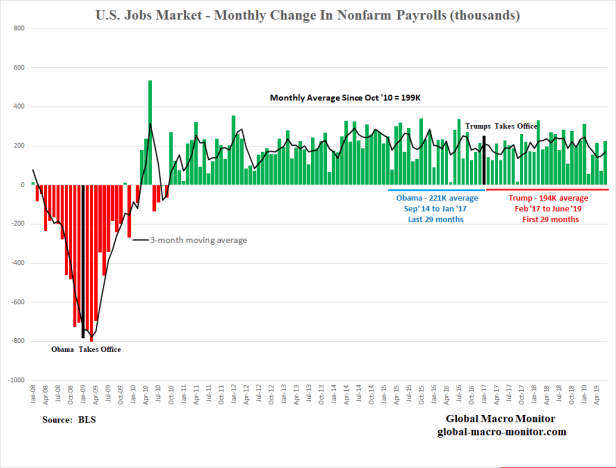
Why do we look at the Obama administration’s last months rather than the first months in office?  The two economic environments we compare need to be and are very similar.  Obama assumed office during an economic collapse and it took many months for the nation to stabilize.

Notice The Continuity In The  Job Markets Over Past Five Years? 
Trump_Obama_Jobs_Series

Fiscal Years 2018 and 2019 – The Last 21 Months

T_O_Deficit_Montly Treasury Statement_1

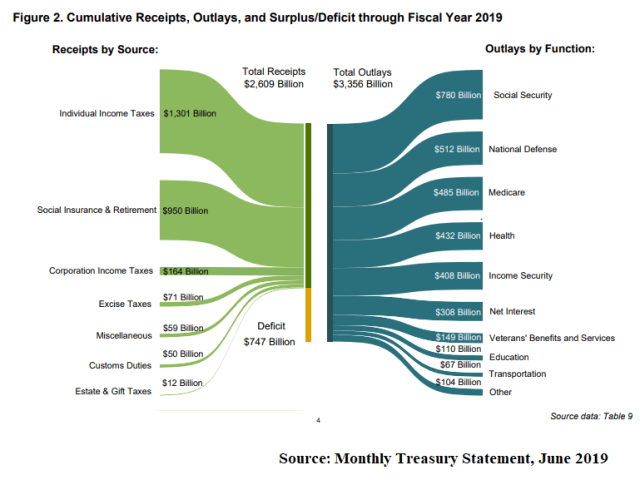
Sources Of Federal Revenues And Outlays – Fiscal Year 2019
T_O_Deficit_Montly Treasury Statement_2

Hat Tip: Professor Greg Mankiw, Harvard University

DC48C4BA-8D62-482C-A3DF-7727A8C261B9

Posted in Budget Deficit, Charts, Uncategorized | Tagged , , | 4 Comments

Need Inspiration After Dropping Fiddy Large To The ‘Bots?

Next time you need to pick your ass up off the matt after dropping a tenth of a yard (or a fraction thereof ) to the market you can always come back these videos for motivation.

Please disregard if you have never had a losing trade.

What a story about the Jimmy V Award recipient, Rob Mendez, at the ESPYS last night.  Awesome, stuff!  Take the 10 minutes for both vids.


Posted in Uncategorized | Leave a comment

Fading A China Trade Deal

Trump is going to have to cave on some major issues as it appears China is gearing up to play hardball and is ready to rumble in the next round of negotiations.  The Ministry of Commerce announced this morning the “talks will be held in the spirit of equality and mutual respect, and that China’s core issues must be resolved.”

But even the doves in the Trump administration seem to be growing increasingly pessimistic and lowering expectations.

Kudlow: U.S. may never reach trade deal with China

“When you get down to the last 10 percent, seven-yard line, it’s tough,” he added, referring to the negotiations. – Larry Kudlow, Politico

China is sensing that patience is running thin in America over Trump’s trade war.

While rural Americans were some of Trump’s biggest supporters, they are losing patience with a year long trade war that the Trump administration has reached an impasse without closing a deal with China. – Global Times

China can play the long game and Xi is also probably studying U.S. political polls, smells blood, and sees a president growing desperate for a deal.  Moreover, the polls in the states that matter most for re-election continue to get worse for the President.

This story just broke tonight in the Washington Post,

The Trump administration is increasingly concerned about prospects for a trade deal with China, amid an unexpected reshuffling of the Chinese negotiating team and a lack of progress on core issues since the Group of 20 summit in Japan, according to U.S. officials and senior Republicans briefed on the discussions.

…“This has to be seen as a loss of confidence in Liu He and the desire of the leadership to bring in someone more politically savvy,” said Dennis Wilder, a former China analyst at the Central Intelligence Agency. “I am sure his instructions are to get tougher with the U.S.”  –Washington Post

Can Trump afford to cave now going into the campaign?

The only thing predictable about the President is he doesn’t like to appear weak.  But, then again, he has the ability to convince himself that weakness is strength in the classic Orwellian sense.

North Korea

Go no further than taking a few steps north of the 38th parallel if you need confirmation. Bloomberg now reports that the Trump administration is mulling over suspending some sanctions on North Korea,

The U.S. is considering suspending some sanctions on North Korea for 12 to 18 months in exchange for a freeze on the country’s nuclear weapons program, the Yonhap News Agency reported. = Bloomberg

That is a big concession and far cry from total denuclearization,

President Trump said late Saturday that North Korea must “denuke” before any talks with the U.S.. – The Hill, March 4, 2018

It is clear, at least to us, politics is driving President Trump to make concessions in order to announce another Potemkin deal and declare victory.  You can’t entirely rule out the same with a China deal but the President will likely be hammered from both sides for caving on trade.

Get Shorty

We are getting very close to sequel time, folks  – Get Shorty 2.0   Everyone is lathered up over the Fed and very few realize the extreme valuations levels of the major macro metrics.

It’s also unprecedented for the Fed to begin cutting rates so close to an all-time high in the stock market.  The exception was July 1995 but we don’t sense the economy is on the eve of another 1990’s economic and technological boom.

Give them a little more room to run, set your entry and stop levels, and place your finger on the trigger.  Let the market then tell you when it’s time to fire.

Finally, if you need more comfort for the bear view, we advise never betting against the hedge fund great, Paul Singer.


Posted in Equities, Politics, Trade War, Uncategorized | Tagged , | 10 Comments

Maybe 25 bps

This should be baked in, and even a bit disappointing, but, like my Australian Shepherd, markets like to run.  Though hard to predict for how long.

Since our May meeting, however, these crosscurrents have reemerged, creating greater uncertainty. Apparent progress on trade turned to greater uncertainty, and our contacts in business and agriculture report heightened concerns over trade developments. Growth indicators from around the world have disappointed on net, raising concerns that weakness in the global economy will continue to affect the U.S. economy. These concerns may have contributed to the drop in business confidence in some recent surveys and may have started to show through to incoming data.

In our June meeting statement, we indicated that, in light of increased uncertainties about the economic outlook and muted inflation pressures, we would closely monitor the implications of incoming information for the economic outlook and would act as appropriate to sustain the expansion. Many FOMC participants saw that the case for a somewhat more accommodative monetary policy had strengthened. Since then, based on incoming data and other developments, it appears that uncertainties around trade tensions and concerns about the strength of the global economy continue to weigh on the U.S. economic outlook. Inflation pressures remain muted. – Chairman Powell, Semiannual Monetary Policy Report to the Congress

Posted in Monetary Policy, Uncategorized | Leave a comment

Ross Perot And Me

R.I.P, Ross Perot.

The Butterfly Effect Again

If not for Ross Perot’s decision to run for president as a third-party candidate in 1992, there would be no President Bill Clinton, no candidate Hillary, and probably no President Trump.

Politics is a process. There would be no LBJ without FDR. There wouldn’t be a Reagan revolution without Barry Goldwater. And it’s possible there wouldn’t be a Trump presidency without Perot. – Boston Globe


1992_Election

Perot won almost 20 percent of the popular vote in the 1992 presidential election, which the Bush family and many analysts believe much of his votes were siphoned from the incumbent, President George H.W. Bush.   Bill Clinton won 43 percent of the popular vote, the second-lowest in modern presidential politics; second only to the Woodrow Wilson in 1912, who squared off with Teddy Roosevelt as the Bull Moose candidate and the incumbent, President William Howard Taft.

1912_Election

National Debt And NAFTA

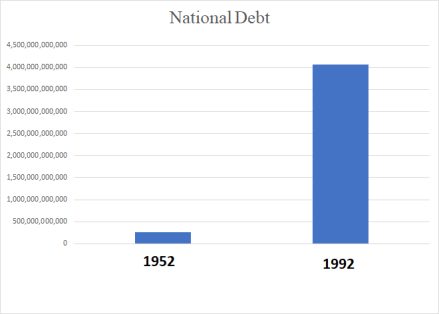
During Perot’s candidacy, which was centrally focused on the increase in the national debt and his opposition to NAFTA, I was always baffled by his presentations about the increase in debt.  He often compared the then-current debt stock with that of prior years without context, taking into account the growth in the size of the economy and inflation.  It was perplexing to see charts such as the following presented on national television, as he, at the same time, pounded the table about “that giant sucking sound you hear is NAFTA taking away U.S. jobs.”   The press rarely questioned his presentations.

Perot_debt

Ironically, he wasn’t wrong on both counts.

Though he failed to normalize the debt data – he may or may not have understood the flawed analysis  — the public debt has outpaced the growth of the economy and inflation and now stands in excess of 100 percent of GDP.

NAFTA did destroy good-paying jobs though others were created, which we believe made the trade treaty a net positive.  The American government dropped the ball, however, looking the other way and abandoning those hurt by free-trade rather than investing in the human capital and social infrastructure to help those displaced adjust to the new globalized world.  And here we are, the political mess that we find ourselves.

My Day With Ross

Let me share with you an incredible encounter I had with Ross Perot on Capitol Hill.

He was testifying against one of the many sovereign bailouts of the 1990s at a Senate Banking Committee hearing, which I was attending as the head of the emerging market bond trading desk at a Wall Street investment bank.   Perot testified that the currency that was getting hammered and needed billions of dollars of support from the U.S. government wasn’t the only world currency in trouble:

“The Canadian dollar, the Italian lira, the Swedish krona… all are in trouble.”

After his testimony, he was holding a press conference in the hallway just adjacent to the committee hearing room.   Surrounded by several cameras with the bright lights glaring,  there was Ross holding court with at least ten reporters.

I walked to the back of the scrum and shouted out the question,

Mr. Perot,  are you shorting the Italian lira?

I struck a raw nerve as all hell then broke loose.  Perot was not a good trader and had lost money years earlier shorting Citibank believing the bank was insolvent due to a large “Third World” debt portfolio, which he believed would never be paid back.  I just couldn’t help myself.

Mr. Perot’s face turned bright red as he shot back,

What!!!  Absolutely not. Do you have any more trick questions?

He then stepped forward to confront me, getting right in my face like Billy Martin, the old manager of the Yankees, going after an umpire.

Perot_Martin.png

His face was less than six inches from mine. His head was shaking with anger and I could see the red of his eyes.  He was kind of short and was looking straight up into my face.  To say he was pissed off is a gross understatement.

“You boys up there on Wall Street sit in your air-conditioned offices on the 50th floor and wreak havoc down on these countries with your short-selling.”

As I was taking the wrath of Ross Perot, I noticed out of the corner of my eye all the cameras had turned on us filming our little encounter, which I feared would be on that night’s national news.

What was I really feeling at that moment?  I couldn’t believe I had drawn blood from the famous H. Ross Perot.

Phone Home

In the cab (no Uber back then) on the way to the airport, I called back to the office to warn my boss about what he might see on the news later in the day and the blowback that may be coming our way from the bank’s public relations department.

I never did see the footage, but years later I was at a baseball game with a cousin, who lived in North Carolina at the time of the event.  He told me how he turned on the nightly news years earlier only to witness Ross Perot ripping me a new a-hole.

R.I.P.

Well done, Ross, I still feel it.  Never agreed with you on much but always admired and respected your fight.  R.I.P.

Posted in Politics, Uncategorized | Tagged , | 1 Comment