The Brexit Dynamic

Interesting take on Brexit from the people that matter.

The main reason why Parliament is having such a tough go at Brexit is that many Brits have changed their positions and would now reverse their vote from leave to remain. Exactly why it is inevitable a now much more informed electorate will push the Parliament to introduce a second referendum.  Make sure to listen to the full video.

We believe cable will move to at least 1.35 on the announcement, or hint thereof a second referendum, the Brexiteers then take to the streets with the political instability increasing volatility (the bad kind) in the pound, before the move to 1.45ish on an overwhelming remain victory.

Posted in Uncategorized | Leave a comment

Loving The Masters

Posted in Uncategorized | 1 Comment

Shrinkflation?

Banannas_Shrinkflation.png

Hit Tip:  El-Elrian

We have always been critical of how the government measures inflation and are flabbergasted by this constant fear and loathing of the talking heads the economy is in or on the brink of deflation,

If Mohamed purchased those bananas at Trader Joe’s —  the famous $.19 bananas — it is a classic example of shrinkflation, which is hard to calculate as the “same for less”
is a bit more complicated to measure and easier to hide a price hike than as “more for the same.”

Relative Prices Versus Inflation 

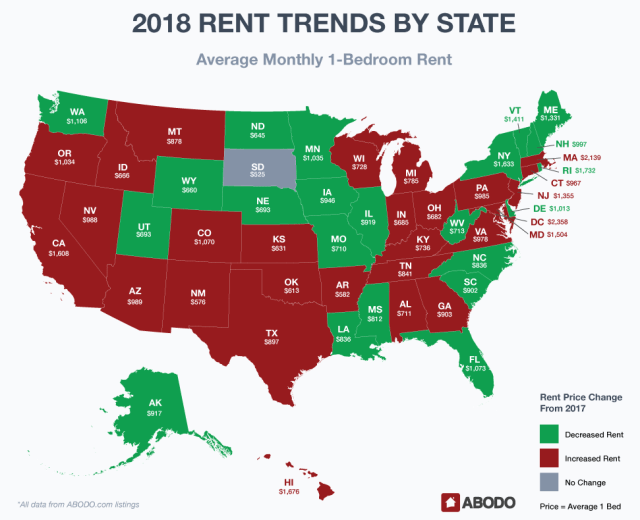
Moreover, some, including possibly the next Fed governor, can’t seem to distinguish the difference from a change in relative prices to a rise in the general price index, or what is defined as inflation.  We concede the above banana example is a hypothetical but we honestly believe true inflation, that is actual prices paid for the same amount of goods or services, unadjusted for “quality” or no hedonic tricks, is higher and more ubiquitous than reported.   Yes, some gym memberships are cheaper but rent for the average Jane and Joe consumer continues to rise at a fairly rapid clip.

Rents

Rampell Learns Moore

Watch how Washington Post reporter Catherine Rampell owns Stephen Moore, who was recently nominated for the Fed board,  2 minutes into the video.  Moore, wrongly or falsely claims the economy is in deflation and appears to say the Fed rate hike in December is causing soybean prices to fall?   Are you freaking kidding me?

Rampell is spot on that soybean, and many other farm prices including wheat, are falling and weak because of Trump’s trade wars.   The Fed driving down soybeans?  What a joke!

Nasty Business — Politics Ain’t Beanbag

We don’t hold back on our view that Moore is unqualified for the Fed, is a complete economic ignoramus, or in Irish, and total Idjit.  Nothing personal to Moore and all is directed at his professional qualifications but it must be argued in the context of the bloodsport of a political cage fight.  A very nasty place to do business, indeed.

We were some of the first to raise the flag on Moore.  Here’s more on Moore, here and here and here.

The reason for our nastiness is that the stakes are so high.

Dollar At Stake

We are not in Kansas anymore, Toto, and Fed appointments are so much more than just appointing the local dog catcher.

We believe the reserve status of the U.S. dollar is at stake and the credibility of U.S. policy is slowly being chipped away,  which will determine the difference between the next QE driving asset prices higher or turning the U.S. into Venezuela.


Posted in Uncategorized | 4 Comments

BFTP: Masters Week: Jack and German POWs

BFTP: Blast From The Past

Getting long Tiger for an ‘86 Jack-like comeback…

Posted on

Masters_ImageAnswer to yesterday’s Masters quiz question:

Anthony Kim posted 11 birdies in the second round of the 2009 Masters.

Here’s some more 19th hole fodder to impress your buddies and something I bet you didn’t know about Augusta:  German POWs  from nearby Camp Gordon built the bridge over Rae’s Creek next to the 13th tee box during WWII.  They were part of Rommel’s Panzer division in North Africa responsible for building bridges to enable tanks to cross rivers.

While Augusta National is famed for its almost unnaturally beautiful flora, as it turns out some rather interesting fauna once called the course home as well: 200 heads of cattle and more than 1,400 turkeys. From 1943 until late 1944, Augusta National was closed for play and transformed into a farm of sorts to help support the war effort. Some of the turkeys were given to club members during Christmas (meat rations were in effect) while the rest were sold to local residents to help fund the club. And the cows? Well, they acted as natural lawnmowers but also inflicted quite a bit of damage to Augusta National, devouring many of the course’s famed plants and shrubs.

To help repair cattle-related damage and revive Augusta National for its reopening, 42 German prisoners of war from nearby Camp Gordon were shuttled back and forth to work on the course.

Writes John Strege in “When War Played Through: Golf During World War II:”

“The POWs had been with the engineering crew serving Rommel, the Desert Fox, in North Africa, part of the Panzer division responsible for building bridges that enabled German tanks to cross rivers. It was a useful skill for the renovation work to be done at Augusta National. The Germans were asked to erect a bridge over Rae’s Creek adjacent to the tee box at the thirteenth hole.”

The Masters resumed at Augusta National — now free of German prisoners and barnyard animals — in 1946. And interestingly enough, the Supreme Commander of the Allied Forces in Europe during World War II, Dwight D. Eisenhower, later became a member of Augusta National. Two Augusta National landmarks bearing Eisenhower’s name still stand today: the Eisenhower Tree (a loblolly pine at the 17th hole that the former president and avid golfer repeatedly struck with golf balls and requested be cut down; photo above) and the Eisenhower Cabin (built in the 1950s according to Secret Service security guidelines by the club for the former president’s visits).

(click here if video is not observable)

Posted in Masters | Tagged , , , | 2 Comments

Robots Are Coming For Steph Curry

Posted in Technology | Tagged , , , | Leave a comment

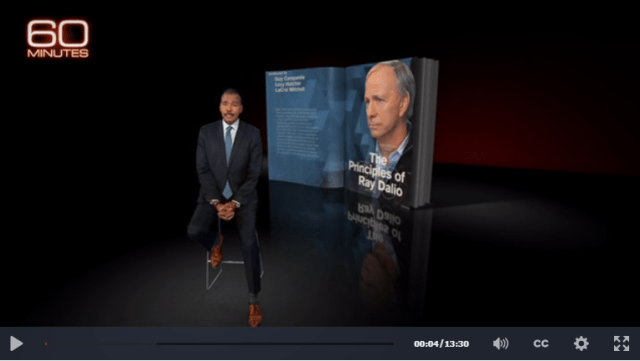
Ray Dalio says wealth inequality is a national emergency

The founder of the most successful hedge fund in the world says capitalism needs to be reformed and that the American dream is lost.  – 60 Minutes

Dalio_60 Minutes

Click here for the full interview

Posted in Economics, Politics, Uncategorized, Whales | Tagged , , | Leave a comment

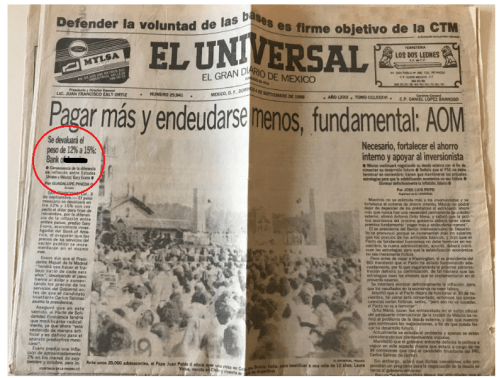
When Mexico’s President Tried To Get Me Fired

Apr4_El Uni

The Lunch That Changed My Career

Shortly after joining a major money center bank as a young twenty-something economist, fresh from grad school and the World Bank, my boss instructed me to have lunch with two women, who were touring the country as part of a U.S. State Department program, which hosted foreign professionals.   Though I recall the bank picked up the check, it was a very expensive lunch, nonetheless, as it almost ended my career just as it was getting started.

The only details I had going into the lunch were that one person was an economist from Mexico and the other an interpreter from the U.S. State Department.   No problem.  Economists love a free lunch.

Exchanging Views On The Mexican Economy

I covered Mexico for the bank and we had a great conversation over lunch about politics, economics and the future of Mexico.  I don’t recall ever discussing the name of her employer.  I assumed she worked for the government or a private research group.

It was late August or early September, and the country had just experienced a very contentious presidential election.  The outgoing president had implemented a stabilization program to bring inflation down by fixing the peso against the dollar.  The inflation rate differential between Mexico and the U.S. remained stubbornly high, however, as in 40 percent plus, causing the peso to become increasingly overvalued

Moreover, the Ministry of Finance was notorious for its maxi currency devaluations during presidential transitions.  My Mexican friends would tell me with a straight face there was always pressure on the peso after a general election as the outgoing president was taking his money that he stole during office out of the country.  I think they truly believed it.

The Peso

The Mexican markets were very nervous at the time and my fellow economists at other major money center banks were forecasting a 50 plus percent devaluation before the new government would take power in December to bring the purchasing power of the currency back in line.  I was much less negative and understood such a large move in the peso would reverse the gains in reducing inflationary expectations and blow any credibility of the incoming government.

I had written and published how Mexico was about to get its inflation under control and the economy could then begin to emulate that of an “Asian Tiger” under the new government.  My view was much more bullish than colleagues and received a lot of pushback even within my own bank.

Doing The “Dirty Work”

While walking out to the elevator after lunch the valuation of the peso came up.  I passed her our monthly foreign exchange newsletter where I stated the outgoing government would probably move the currency slightly, around 12-15 percent,  with the current president doing the “dirty work” before the new government came to power.

Lunch over, back to work.

The Call

On a Monday afternoon, about two weeks later, I was in Washington, making due diligent calls to economists at the IMF, World Bank, and the U.S. Treasury, when I received a call from my boss.

“[Gregor],  did you hear what happened?”

“No, what’s up?”,  I replied.

“Your full name along with the bank appeared in the headline of the lead story on the front page of the Sunday edition of El Universal, quoting you saying that Mexico was about to devalue the peso”  (El Universal is or was the New York Times of Mexico at the time).

I was shocked.

Wait, there’s more.

“The President of Mexico called the CEO of the bank and wants your ass on a platter.  He is blaming you for causing the Mexican stock market to fall 10 percent today and the Banco de Mexico’s eventual loss of $1 billion in reserves defending the peso because of  ‘your big mouth’!”

I Got Screwed

My first thought was seriously?

That woman I had lunch with a few weeks earlier never revealed to me she was a journalist and quoted our entire conversation on record. WTF?

Why the hell didn’t the State Department give the bank a heads up we were meeting with a reporter with one of Mexico’s major newspapers?

Efficient Markets?

Second, there was nothing new in the article.

I had published the same story and stated the same scenario for the peso over and over for the two months after the election.  It was so common knowledge.  Furthermore, I was relatively bullish on the peso compared to economists at other money center banks.

Efficient markets, my arse.  Come on, man.

The very reason I am always long behavioral economics and short efficient markets.

“You better get back to the office, and fast,”  he warned me.

The Wisdom Of The Irish

Totally fazed, I hung up the phone and knew I was in deep shit.

I told my good friend, Desmond MAC., a great economist at the World Bank and fellow Irishman, about my now uncertain plight.  He tried to calm me down with some words of wisdom,  “[Gregor], remember the only bad publicity is an obituary.”

Nice, but it didn’t relieve my growing anxiety.

The next day I flew back home.  I walked into the office after arriving from the airport and my colleagues began joking, “ you market mover, you!”  I wasn’t amused, not one bit.

I then went into a meeting with my boss explaining there was no way that conversation would ever have been had with a journalist, much less on the record.   I then waited for the hammer to drop.

Not So Bad

I called down to our Mexico City office, where a friend said the country manager was livid, as he feared the government would retaliate by withholding business from the bank.  His own read, however,  after talking with his contacts in the Ministry of Finance, was that though the government was upset,  but not so much as the article in its totality portrayed Mexico’s future in a positive light.  Furthermore, he thought my number on the devaluation was exactly what the government was thinking and planning.   He did say, however,  the “dirty work” comment wasn’t playing well in Los Pinos.

“Banker With A Big Mouth”

Every day during the next week the Mexican ambassador to the United States was out publicly talking about the “banker with the big mouth” trying to calm the country’s markets.  I was eating humble pie all that week and took his comments in stride, still waiting for the hammer to drop ending my career as an economist just as it was getting started.

No Hammer, Persona Non Grata

The hammer never dropped.

The CEO didn’t throw me under the bus.  I thought that was kind of ballsy on his part.

I was told not to travel to Mexico for at least a year or two, however.  I was never sure if Mexico’s president officially declared me persona non grata but he did convey to our CEO I wasn’t welcome in the country.   I never came close to the Mexican border over the next year.

Later, when Mexico began their historic debt restructuring,  I worked closely and became friends with Mexico’s best and brightest, including the current Secretary-General of the OECD, Angel Gurria, and Augusten Carstens, the General Manager of the Bank of International Settlements.   Good guys.

Lesson Learned

The moral of my story is that it was one helluva lesson about dealing with the press.  It wasn’t the last time I’d be burned by a reporter, quoted with attribution when I made it clear it was only for background and off-the-record.  But, at least I always knew it was a reporter on the other side of the conversation.

I have learned through the years most all journalists are true professionals, trustworthy and very few operate on the dark side.

Ironically, the El Universal reporter had the gall to call me a few months after the article asking to do a “follow-up” piece.

Are you ‘freaking kidding me” I screamed at her and hung up faster than the collapse of Theranos!

Mexico Devalues 16 percent

Three months after the article, the new government came to power and announced Mexico’s new exchange rate policy,  which was to move the currency down against the dollar by one peso per day.  The annualized rate of devaluation equated to 16 percent.   Nailed it!

Note To Our Readers

The Global Macro Monitor website will be under construction over the next several weeks as we search and construct a “fair path” to protect our contributors from the free riders.  We have a few more posts in the pipeline but they will be few and far in between.   If you are a contributor email us and we will send out our ongoing data analysis or the research you depend on.    If not and are interested in contributing, click on the donate widget button on the right-hand side of the blog.  Cheers.     

Posted in Mexico, Uncategorized | Tagged , | 2 Comments

Yes, Virginia, There is a Santa Claus!

Virginia_Surrender


Unbelievable last two second comeback to send the Cavs to the NCAA Final against Texas Tech.


The pressure pushing down on Kyle Guy…hits six points in the last seven seconds, including three free throws with less than one second to go from down two points to win by one.  Wow!


Posted in Sports, Uncategorized | Tagged , , , | Leave a comment

The Hummingbird Project – Movie Trailer

Just back from The Hummingbird Project flick.   Man, have Wall Street movies changed.

Vincent (Jesse Eisenberg) and his cousin Anton (Alexander Skarsgard) want to run a fiber-optic cable from Kansas to stock exchange servers in New Jersey, securing a millisecond advantage over other algorithmic traders. To maximize the gain, the cable must run absolutely straight, through property, mountains and water, a colossal engineering job for which they have hired Marc (Michael Mando, from “Better Call Saul”). But their boss (Salma Hayek), soon to be former, spends heavily to stall the private-works effort.  – NY Times

Hollywood’s portrayal of Wall Street has moved from insider trading and big swinging dicks to the speed of market information — neutrinos and milliseconds — and front running investor orders.  B-o-r-i-n-g!

Jesse Eisenberg and Selma Hayek are good but no comparison to Michael Douglas and Charlie Sheen.

No “Greed is good,” no “Blue Horseshoe loves Anacott Steel” memorable lines.   The only line that stands out in The Hummingbird Project is “it’s all fake [money].”

Posted in Movies, Uncategorized | Tagged | Leave a comment

Is “Obama Envy” Driving Trump’s Call For QE4?

We are still dazed and a bit livid over President Trump’s call for QE4, and increasingly perplexed how the market just takes such absurdities, including his latest nominees to the Fed, in stride.  Is .999 percent the next target for the Fed’s IOER?

We feel as we have been transported to a parallel universe.  Facts, words, data, logic, decency, truth, nothing matters anymore.    Just make me some more Benjies!

Our revulsion to the QE4 call motivated Global Macro Monitor’s last post,  POTUS’ Morning Economic Briefing.  Have a look.

Predictive Analytics Of Trump’s Decision Making 

We have always thought if an AI predictive analytic algorithm was constructed to analyze and forecast the Trump administration’s decision-making process it would be dominated by the policy conditional,

If the Obama administration supported, proposed or implemented such a policy,  then reverse and do the opposite.  

Iran, the TPP, and Obamacare.  Shall we go on?

There is zero doubt, in our mind, Russian and Chinese government engineers have already generated such an algo or a reasonable facsimile.

S&P500 Performance 26 Months After Inauguration

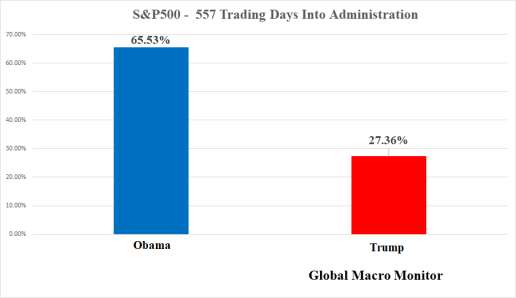
Using the above logic, the only justification we can conceive for calling for a QE4 unless Trump knows the China trade deal is toast is to further goose the stock market as Trump’s S&P is significantly lagging Obama’s market 557 trading days after the two governments came to power.  President Trump is probably aware of and likely obsessed with these relative returns.

The following chart comparing the change in both presidents S&Ps since their respective inauguration date to early April into their third year will surprise many.  We had to go back and check our calculation no less than three times.  The power of  gaslighting!

The data is especially shocking given the “the best economy ever, the greatest stock market ever” rhetoric coming from Trump and his so-called economic advisers.  That shit is getting old, folks, and really starting to wear on us.


Apr6_S&P500

Why The Obama Outperformance? 

Absolutely, there is logic in explaining the differential.

Such as Obama took office when the stock market and economy were collapsing and Trump inherited a bull market and strong economy,  so Trump’s market hasn’t experienced the “trampoline effect” that Obama’s S&P did.

But, truth, logic, facts, and data don’t matter anymore, folks.  Opinions and pronoucements are the new facts and data in the new  Oceania AmeriKa.

The V bottom 

Markets are now all about V bottom Fed bailouts.  Market Socialism is Capitalism.


Apr5_V_Bottowm


We expect the S&P500, driven by what we have tagged the Power of Zero, to close the year at around 3025, of which most of the rest of the year gains will take place in late Q3 and Q4.  We then expect a Big Dipper sell-off, say, at least 35 percent, for the reasons we have posted earlier, to a level of around 1984 for the S&P.

Can you connect the cryptic dots here?

Of course, our speculation is only a calculated guess as nobody knows the future.

BFTP 

BFTP = Blast From The Past

Reagan v Trump Macro Initial Conditions

Posted on 

We hear lots of talk these days about,  Why Donald Trump’s Market Rally Echoes Ronald Reagan’s.   

We are big fans of Chaos Theory,

Chaos theory is a branch of mathematics focused on the behavior of dynamical systems that are highly sensitive to initial conditions—a response popularly referred to as the butterfly effect.[1] Small differences in initial conditions (such as those due to rounding errors in numerical computation) yield widely diverging outcomes for such dynamical systems, rendering long-term prediction of their behavior impossible in general.

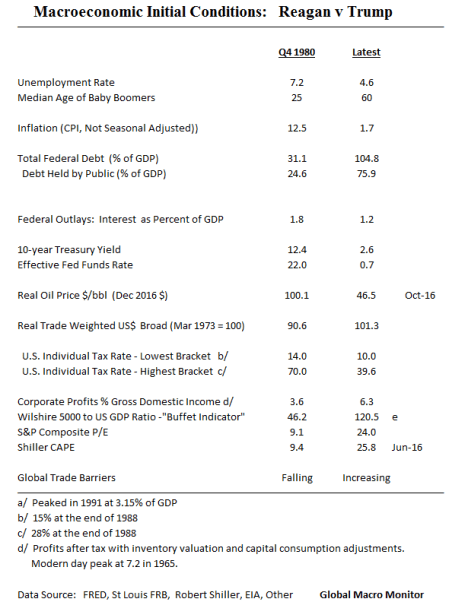
So we thought we’d take a look at the macroeconomic initial conditions at the start of the Reagan Presidency versus the incoming Trump Presidency.

Check out the data:

reagan-v-trump_initial-conditions

In most macro categories that we have researched here,  the initial conditions just aren’t there for a Reagan type bull market, in our opinion.  First, and foremost, are the monetary headwinds.

Monetary Conditions
Reagan began his Presidency with interest rates nowhere to go but south with a 22 percent Fed Funds rate and a 10-year Treasury yield of 12 1/2 percent.  Though interest rates were not the policy target of the Fed at the time,  just several months into the Reagan Presidency the 35-year bond bull market ignited and drove almost all asset prices from real estate to stocks, including the expansion of the price to earnings multiple.

The polar opposite monetary conditions exist at the advent of the Trump Presidency.  Interest rates have nowhere to go but north, we believe,  especially if Mr. Trump’s fiscal policy is implemented.

Unemployment
Mr. Trump will not have the labor slack and surplus to draw upon to drive economic growth.   The country is pretty much at full employment although the level of tautness in the labor market can be debated. This risks much higher inflation than anticipated if his policies are passed and thus a more aggressive Fed.  Also note the aging of the baby boom generation, which has driven much of the growth over the past 30 years.

Total Debt
President Reagan began his Presidency with a relatively small stock of debt.   Mr. Trump will inherit a debt-to-GDP ratio almost three times that of President Reagan.  This leaves less room for deficits as a result of his tax cuts and increased spending.   The Trump plan is to increase economic growth and thus tax revenues through supply side and micro and regulatory policy.   This is the second chance for this argument to succeed.  Watch this space.

The high debt stock, coupled with expected large deficit spending,  risks a spike in real interest rates and a sovereign credit downgrade.

Real Oil Price
President Reagan took office with a relatively high real oil price.  Note this was in an era when high oil prices were considered “bad” for the economy.   The real oil price dropped almost 75 percent in the first five years of the Reagan administration.   President Trump will inherit a real oil price half that of Mr. Reagan, coupled with the ambiguity of not knowing if higher oil prices are good or bad for the economy.  We don’t know where to go with this one.

Dollar
Mr. Trump inherits a real trade-weighted dollar a little over 10 percent stronger than President Reagan and, most likely, headed north given the world’s divergent growth and monetary policies. This could act as a headwind on corporate profits and export growth.

Individual Marginal Tax Rates
This is the pearl and central to the supply side argument.  Cutting marginal tax rates to incentivize economic behavior and growth, which will increase tax revenues that offset the revenue loss from the tax cuts.   Note,  President Reagan, cut the top rate from 70 percent to 28 percent.   That was Yuuuge!   Mr. Trump just doesn’t have the room to do such large tax cuts as he starts at a lower base with the highest tax rate at around 40 percent.

Corporate Profit Margins
President Reagan took office with a lot of corporate inefficiency and room to expand corporate profits.  It feels we are close to peak margins.   Didn’t we just have an election to improve the wages of the average worker?    Watch this space.

Stock Valuations
Much like the debt stock,  Mr. Trump will inherit a stock market that is relatively highly valued.  Note,  one of Warren Buffet’s stock market valuation metrics,  Stock Market Cap to GDP, is more than 160 percent higher now than it was when President Reagan took office.  The U.S. will need lots of economic growth to “grow” into this metric.

Conclusion
There you have it.  The macroeconomic initial conditions at the beginning of two Presidencies.   This is just our first quick whack at this analysis.

President Trump is going to have to depend on “animal spirits” to do a lot of the heavy lifting and exquisite execution of supply side, microeconomic, and regulatory reform to increase potential GDP growth.   Higher growth will increase the top line of companies and improve earnings.  But we think, after looking at the data,  the window is narrow.

Can we rally a lot?  Absolutely.  And probably will given the better business conditions initially created by regulatory reform and the fiscal stimulus.

A Reagan bull market?   We don’t think so.

By the way, and contrary to the conventional wisdom,  the Reagan bull market is only the 5th largest Presidential bull market since Teddy Roosevelt, just behind the Obama bull market.

We could be wrong and it surely hasn’t paid to short or underestimate Donald Trump.   But, he just won’t, and probably, can’t,  have the macro tailwinds that President Reagan had at his back given the initial conditions of the macro data.

Stay tuned.

 Note To Our Readers

The Global Macro Monitor website will be under construction over the next several weeks as we search and construct a “fair path” to protect our contributors from the free riders.  We have a few more posts in the pipeline but they will be few and far in between.   If you are a contributor email us and we will send out our ongoing data analysis or the research you depend on.    Cheers.     


Posted in Equities, Uncategorized | Tagged , , , | 2 Comments