Trade Talks & The Chinese New Year: The Year Of the Pig [In A Poke]

yearofthepig


‘Don’t buy a pig in a poke’ might seem odd and archaic language. It’s true that the phrase is very old, but actually it can be taken quite literally and remains good advice.

The advice being given is ‘don’t buy a pig until you have seen it’. This is enshrined in British commercial law as ‘caveat emptor’ – Latin for ‘let the buyer beware’. This remains the guiding principle of commerce in many countries and, in essence, supports the view that if you buy something you take responsibility to make sure it is what you intended to buy.  

A poke is a sack or bag. It has a French origin as ‘poque’ and, like several other French words, its diminutive is formed by adding ‘ette’ or ‘et’ – hence ‘pocket’ began life with the meaning ‘small bag’. Poke is still in use in several English-speaking countries, notably Scotland and the USA, and describes just the sort of bag that would be useful for carrying a piglet to market.

A pig that’s in a poke might turn out to be no pig at all. If a merchant tried to cheat by substituting a lower value animal, the trick could be uncovered by letting the cat out of the bag. Many other European languages have a version of this phrase – most of them translating into English as a warning not to ‘buy a cat in a bag’. The advice has stood the test of time and people have been repeating it in one form or the other for getting on for five hundred years, maybe longer.    —  phrases.org.uk

Lots of happy talk in the Oval with  the Chinese today but….  The Wall Street Journal reports,

  • At the meeting, Mr. Liu said China would buy 5 million tons of U.S. soybeans daily, a number Mr. Trump repeated, adding it would “make our farmers very happy.” The administration later clarified that China has agreed to buy an additional 5 million metric tons of soybeans—but not daily, and no time frame was specified.
  • Wednesday at the Eisenhower Executive Office Building near the White House, people briefed on the talks said. It includes more Chinese purchases of U.S. farm and energy products and promises to invite more U.S. capital into the manufacturing and financial-services sectors.
  • But the offer falls short of what Washington has been seeking.
  • The two sides are still far from a deal, and they didn’t agree Thursday to a written framework with blanks left for areas where there is disagreement—the kind of document that is standard in trade negotiations.
  • At the same time, Beijing is also unlikely to accept U.S. demands to remake its industrial policy and scale back the role of the state in the economy, said Cornell University China expert Eswar Prasad.
  • “The more likely scenario is a deal where Trump declares victory, which is relatively modest in scope, and the two sides de-escalate tension and continue discussions on complicated issues left unresolved,” said Mr. Prasad, who speaks regularly with Chinese officials.  – WSJ, Jan 31st

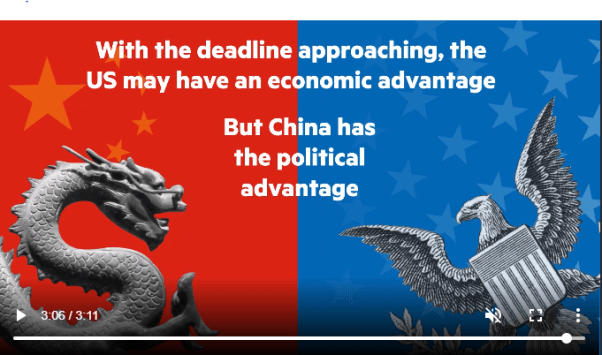
We are expecting no more than a pig in the poke in the Year of the Pig.  Of course, spun as the “greatest trade deal in the history of the world.”

There will be some Mad King risk as Trump will come under pressure for caving and to scrap the deal at the last minute as he did during the government shutdown.

The stronger the RMB, which is a real-time measurement of the country’s short-term economic prospects,  China’s negotiating leverage increases.

rmb


Don’t make this your trade strategy, Mr. President,  China is still a command economy not subject to market x/ the exchange rate.

Posted in China, Uncategorized | Tagged | 6 Comments

January In Review

The reverse image of December and 2018.   Genius markets, no?

jan_n_rev


Posted in Uncategorized, Week in Review | Tagged , | Leave a comment

The “Venda la Casa” Moment Approaches

After getting schmoked in some premature S&P shorts last week, we stated in our Week In Review over the weekend,

We expect the S&P to take out the recent high at 2675.47 and then set its sight on 2710-2720, which is the zip code of a yuuuge Fibo level and the 100-day moving average.  Probably the place to sell but will revisit when we get there.  – GMM, 

Today’s high on the S&P was 2708.95 and it’s getting real close to start thinking about posting the “For Sale” sign.  Our initial thoughts are to give the market a little more running room and to sell the “China deal is the greatest deal ever” news hype.

NFW does China do the deal Trump wants.  The president “comprehensive” deal in his informal presser this morning.  Comprehensive will not include structural reforms.

Brazil Country ETF

By the way, we wrote on New Year’s Day,

The animal spirits of a new market-friendly government should boost the BOVESPA during the administration’s honeymoon.  Brazil is our favorite stock market to start the year.

Probably the best way to play it is with the Country ETF,  EWZ, with the buy trigger at break above the 50-day at $38.99, in our opinion.   First upside target is $47.77.  After the purchase, put in the first trailing stop at $36.20.

EWZ has been correcting after the almost 40 percent six-week runup into the election. The ETF could see a measured move to $47.77-$53.38 in a timeframe dependent on how global markets fare in January.   Good risk reward with a potential 20-35 percent upside.  Not a bad day at the office.   – GMM, January 1, 2019

The Brazil Country ETF is up almost 20 percent YTD.

One of our readers, who made a whole lot of money in this trade, let’s call him King David, emailed this morning,

Bailed on EMZ this morning
David …. <s….@gmail.com>
Thu 1/31/2019 7:20 AM
.
You
.
Lost my nerve.  Nice gain up to the his point.  Probably early.
.
The King has never has been a trader but understands the trading dictum, “Bulls eat, bears eat, and pigs get slaughtered.”
.
David also wrote us a nice big check with some of his profits from that trade to keep the lights on at the Global Macro Monitor.
.
Free Riders Are A Problem  
.
Though we are quite happy with the monetary contributions to GMM in January, they were concentrated with a few readers writing some big checks.
.
Look for an announcement tomorrow on our thoughts about how we plan to deal with free riders.  You know who you are!
Posted in Uncategorized | Leave a comment

Happy Birthday, Jackie

One of the all-time great Americans.


Posted in Uncategorized | Leave a comment

Why are so many US college students homeless?

Two-speed economies everywhere you look.

Young And Left

Do you wonder why the young are moving lefty?

The one percenters better start stepping up making social investments to generate a more stable future society in order to protect their wealth.   Investments in human capital, such as means-tested free education and better healthcare.   It’s coming either way.

Good for Jamie Dimon, one of the smartest guys out there and always way out in front,  in recognizing this in his statement today.

You heard it here waaaaay first, folks, reflected in our post last year, Karl, The Comeback Kid?

Our recommendation to the one percenters and the comfortably numb retired baby boomers, who have bequeathed to and saddled the younger generations with massive pension and public sector debt liabilities?

You better Wake The F&*k Up!  – GMM,  Feb 20, 2018

And here just before the big shift left in the midterms,

We sense a political earthquake coming Tuesday.   Female, young, and left.  – GMM, Oct 31, 2018

Enter AOC & Co.

The political bozos need to stop conflating Nordic capitalism with Venezuela socialism.

Medicare (single payer) is different from the U.K. National Health System (single provider), and public healthcare is not “socialism”, where the government owns and controls the means of production.  The political dummy class need to go back to Econ 101.  The facts wouldn’t matter to them either way.

Subsidized higher education, or “free,” is about as socialist as JP Morgan’s government guarantees (FDIC) on their checking deposits.  Long “socialism” for children/short corporate “socialism.”  Or why not we all just work together?

Moreover, it is probably not that far off where the average “Jane and Joe” are gonna need subsidies to purchase their morning Starbucks nonfat, decaf, mocha latte with an organic lemon twist.  You hearin’ us, Howard?

It all has to be financed and not with a “People’s QE” lest we do become Venezuela. Sorry Bernie and my MMT brothers and sisters.  Higher marginal and wealth taxes are coming.  Be warned, be prepared.

The Socialism Of The Elites

I saw a lot of “socialism” while laying in my hospital bed over the holidays, folks.   POTUS, Cramer, and the ignoramuses on Bubble Vision pushing hard for the Fed to “socialize” the stock market losses in December.   That was truly a treat to watch.

The socialism of many, and we stress not all, of elites and their sycophants are to privatize profits and socialize losses, which was on full display during the last financial crisis and bailouts.  Pretty disgusting and not politically sustainable.

We saw the first big shock and political fallout from that policy in November 2016, which we suspect was only the beginning.  When the populists, which are really economic left in nature and anti-elite, realize Trump was/is a Trojan Horse for the one percent, we suspect there will be hell to pay.

This is not a political statement, but just our analysis.  Just as we would say the Maduro government in Venezuela has been a disaster.  Is that a political statement?  Just askin’.

Long, and getting longer pitchforks. 

Posted in Politics, Uncategorized | Tagged , | 11 Comments

The Fed Is Done…

I think I heard Powell just say in the QA that the Fed is finished raising rates.   Rather stunning given the real fed funds rate is close to zero, coupled with his statement economy is doing well.

Markets should rally on when they digest it.

Posted in Uncategorized | Leave a comment

Fed’s Failure To Communicate, Markets’ Failure To Count

Not to beat a dead horse but the following example just reinforces our last post.

What the market perceives,

Investors who are hoping the Federal Reserve signals a change or adjustment in its balance sheet policy on Wednesday are likely to be disappointed, economists said.

To reduce its $4 trillion holdings of Treasurys and mortgage-backed securities amassed during the financial crisis, the Fed has been letting $50 billion in maturing securities “roll off” its balance sheet each month.  – MarketWatch

Versus reality,

fed_11


Time to move on.

Posted in Fed, Monetary Policy, Uncategorized | Tagged , , | 1 Comment

How Chair Powell Could Spark A Massive Rally By Doing Nothing

Summary

  • The market is irrationally obsessed with the “$600 billion” annual roll-off in the Fed’s balance sheet
  • The actual reduction in the balance sheet will be much smaller and is determined by the profile of monthly Treasury and MBS securities maturing in the SOMA portfolio
  • The balance sheet reduction will not come even close to the zip code of a $600 billion annual reduction
  • The asymmetrical liability accounting of QT versus QE makes the runoff look similar to a quasi-deficit financing
  • By conveying to the market the balance sheet will not be reduced by $600 billion annually and announcing an annual cap of, say, $450 billion, the Fed Chair could spark a massive nutcracking short-covering rally, in our opinion
  • Maybe he should.  Maybe he will

It is truly stunning to watch, what some academics believe to be, an efficient market come unglued over the Fed’s “$600 billion annual balance sheet reduction”

Recall the Fed announced to its “Normalization Principles and Plans” at the June 2017 FOMC meeting,

fed_6

Source:  FOMC

Those are frickin’ caps, not levels!

The Fed began their balance sheet reduction in October 2017 and has reduced, as of January 23rd, its holdings of Treasury securities by $252 billion and MBS by $140, which is only 78.40 percent of the cumulative monthly caps mentioned in the normalization statement.  Why is this so?


fed_1

Maturity Profile Verus Monthly Caps

Simply because the balance sheet run-off depends on the profile of Treasury and MBS securities maturing in the SOMA portfolio in any given month.  For example, this month – January 2019 – only $11.7 billion of Treasury securities mature in the Fed’s SOMA portfolio, not even close to the $30 billion cap, which the market tends to get all worked up over.

Next month, however, $56 billion will mature.  The Fed will not rollover $30 billion — that is the cap will be binding — reducing the Treasury’s cash balance held at the Fed (the liability side) by $30 billion.  The remaining $26 billion will be rolled over into the February monthly Treasury auctions across a spectrum of maturities.

Only four out of the twelve months in 2019 will the $30 billion cap on Treasury securities be binding and gets better in the out years.

fed_2

The MBS portfolio is less transparent and harder to measure due to prepayment uncertainty.  Moreover, we don’t have the data on the maturity profile and use an assumption that MBS maturities are equal to around 55 percent of the Treasury securities. which has been the case since October 2017 beginning of QT.

Our estimates are very sensitive to this assumption and could likely be too low.  Only the Fed know, or knows better.

Fed’s Accounting Difference of QE versus QT

Given the asymmetric liability accounting of quantitative tightening (QT) – a reduction of Treasury cash balances at the Fed  – versus quantitative easing – an increase in bank reserves – we conclude that QT is much more like a fiscal operation than monetary policy.   There is little evidence the balance sheet reduction is restricting credit and loan creation.

The Treasury has to issue more bonds and notes to maintain its cash balances (checking account) at the Fed, which makes it similar to quasi-deficit financing.

During QE, however, the Fed bought Treasury securities in the secondary market through increasing reserves in the financial system (liability), allowing among other things, investors to reallocate into riskier securities while keeping interest rates down.

The extra liquidity in the banking system did not translate into credit expansion (an increase in endogenous money), no surprise, but counter to our expectations, no panic over money printing as it would have in an emerging market resulting hot potato money.    Ergo no goods and services inflation, only asset inflation and FOMO panic.  The advantages of a reserve currency.

We are not so sure the next round of QE will be so benign, however.  Sorry,  my MMT brothers and sisters.

Changing Mr. Market’s Perception

Nevertheless, as illustrated in the tables and chart, and unless our estimates are wrong, Mr. Powell and the FOMC can ease the market fears by simply announcing the annual cap on the balance sheet will be reduced to $450 billion from $600 billion through 2022.  Markets will rally on this nonsense even though the $600 billion annual cap was never binding in the first place, simply due to the maturity profile of the SOMA portfolio.

There are times when Mr. Market doesn’t do its homework and is repulsed by the details and the minutiae of monetary policy.  We believe this is one of those times.

fed_10

Totally absurd but it’s today’s reality and we have seen much worse.

Potemkin monetary policy.  Just as in the Korea-U.S. Free Trade Agreement.

South Korea, meanwhile, negotiated a permanent steel-tariff exemption in exchange for allowing additional U.S. auto imports. But the claim of a “renegotiated” Korea-U.S. free-trade agreement should be viewed with skepticism. U.S. automakers already don’t export the allowable number of cars into South Korea today, let alone the expanded number. And South Korean car exports, the main sources of the trade imbalance, were left alone. It was a limited, face-saving deal that everyone can tout as “preventing” a trade war.  – New Republic

Posted in Monetary Policy, Uncategorized | Tagged | Leave a comment

How A Market Trends


Posted in Uncategorized | Leave a comment

Inside China’s High-Tech Dystopia – Bloomberg

In part three of Hello World Shenzhen, Bloomberg Businessweek’s Ashlee Vance heads out into a city where you can’t use cash or credit cards, only your smartphone, where AI facial-recognition software instantly spots and tickets jaywalkers, and where at least one factory barely needs people. This is the society that China’s government and leading tech companies are racing to make a reality, with little time to question which advancements are net positives for the rest of us.

Part One – Inside China’s Future Factory
https://www.youtube.com/watch?v=eLmaI…

Part Two – China’s High Stakes Robot Wars
https://www.youtube.com/watch?v=qrhvZ…

https://www.bloomberg.com/hello-world

Posted in Automation, China, Technology, Uncategorized | Tagged , , , | Leave a comment