
There are three kinds of people: the haves, the have-nots, and the have-not-paid-for-what-they-haves. – Earl Wilson
QOTD = Quote of the Day
There are three kinds of people: the haves, the have-nots, and the have-not-paid-for-what-they-haves. – Earl Wilson
QOTD = Quote of the Day
Fantastic vid. Love that U2 twang!
SOTD = Song of the Day
The S&P closed right at or just a smidgen above its 200-day moving average. The market rally based on a government shutdown deal? Come on, man!
Another government shutdown wasn’t priced, so why should stocks move on a deal?
We wrote this weekend,
China back online this week, Mnuchin and Lighthizer to China for negotiations, mo earnings, CPI, and government funding deadline on Friday.
Senate Appropriations Chairman Richard Shelby (R-Ala.) acknowledged on Sunday that negotiations had stalled, and he put the odds of getting a deal at 50-50. – Politico, Feb 10th
It will get done. They are not that foolish. – GMM, Feb. 10th
Seems to us, the noise traders and ‘bots were caught offside.
Three Green Candles
The price action over the next few days will be key.
As we posted earlier, three green candle closes above the 200-day sets the S&P500 up to challenge the yuuge level at 2800 (see table).
The announcement of some sort of convoluted China trade or extend and pretend will be one of the biggest sell the news events in recent history. Trump is going to take some big hits for caving on the big issues after causing mucho pain to the U.S. and global economy, and American farmers, in particular. All for the promise of a few soybeans and a “pig in a poke.”
Kudos for trying though but no strategy, no disciplined message, a divided team, and telegraphing fears of a stock market meltdown advantages the Chinese negotiators.
Seriously, folks, do you really think the Middle Kingdom, with all its history and past glory, after climbing back to global superpower status, is now going to cave and give up some of its sovereignty because Trump demands it?
President Xi already seems to be preparing his population for the worst case scenario, warning of “challenging times ahead” possibly in the event Trump goes ahead with the tariff hikes. Maybe we are reading too much into it and maybe not.
Selling strength higher prices.


Interesting piece in The Hill yesterday on Venezuela by former U.S. Senator Judd Gregg, Venezuela, the Monroe Doctrine and the Roosevelt Corollary.
A must read for those interested in all things Vennie.
He refers to the Roosevelt Corollary to the Monroe Doctrine, which originated in the Venezuela debt default before last, a subject of our recent post, Venezuela, Debt, and Gunboat Diplomacy 2.0.
The Roosevelt Corollary of December 1904 stated that the United States would intervene as a last resort to ensure that other nations in the Western Hemisphere fulfilled their obligations to international creditors, and did not violate the rights of the United States or invite “foreign aggression to the detriment of the entire body of American nations.” As the corollary worked out in practice, the United States increasingly used military force to restore internal stability to nations in the region. Roosevelt declared that the United States might “exercise international police power in ‘flagrant cases of such wrongdoing or impotence.’” Over the long term the corollary had little to do with relations between the Western Hemisphere and Europe, but it did serve as justification for U.S. intervention in Cuba, Nicaragua, Haiti, and the Dominican Republic. – U.S. State Department
Recall in that piece we stated Venezuela busted sovereign bonds were tradeable but investable. Now, after U.S. Treasury restrictions, the bonds are not even tradeable.
“It is a difficult call.”
Back to Judd Gregg. It is hard to decipher what he is advocating and there is no mention of a foreign power, such as China or Russia, mingling in Venezuelan affairs which would definitely be an antecedent to invoke the Monroe Doctrine and Roosevelt Corollary for the use of force in Venezuela.
He also concludes other Latin American countries will not intervene and the U.S. will most likely have to go it alone if the Trump administration chooses military intervention.
The most interesting interpretation of the doctrine, however, came from President Theodore Roosevelt, who added what became known as the Roosevelt Corollary.
He essentially proclaimed that when there was flagrant or chaotic or despotic leadership of a Latin American country, the United States could intervene to re-establish the rule of law and democracy.
…Now we are confronted with Venezuela.
There can be no question but that Venezuela is being led by a tyrannical group of people.
…But it is fairly obvious that Maduro and his cadre are not departing. In fact, they appear to be doubling down on the oppression of the opposition.
…It could not be more apparent that if the Roosevelt Corollary is applied, the Maduro cabal qualifies for American intervention.
But is this a good course to pursue?
This is the issue that President Trump must decide. One suspects he is getting a variety of views from people such as national security advisor John Bolton and the Joint Chiefs of Staff.
It is a difficult call. – Judd Gregg, The Hill, February 11th
Sounds like things are about to get hot in Caracas. Then again, geopolitics are always hot with John Bolton at the helm of the NSC.
I miss pounding Polars in Caracas but my heart really aches for the Venezuelan people. Let’s hope their pain is almost over and Ricardo Hausman, one of my intellectual heroes as a young economist in the World Bank’s Latin American department, gets the support he needs after regime change. He and the Venezuelans will need lots.
Stay tuned.
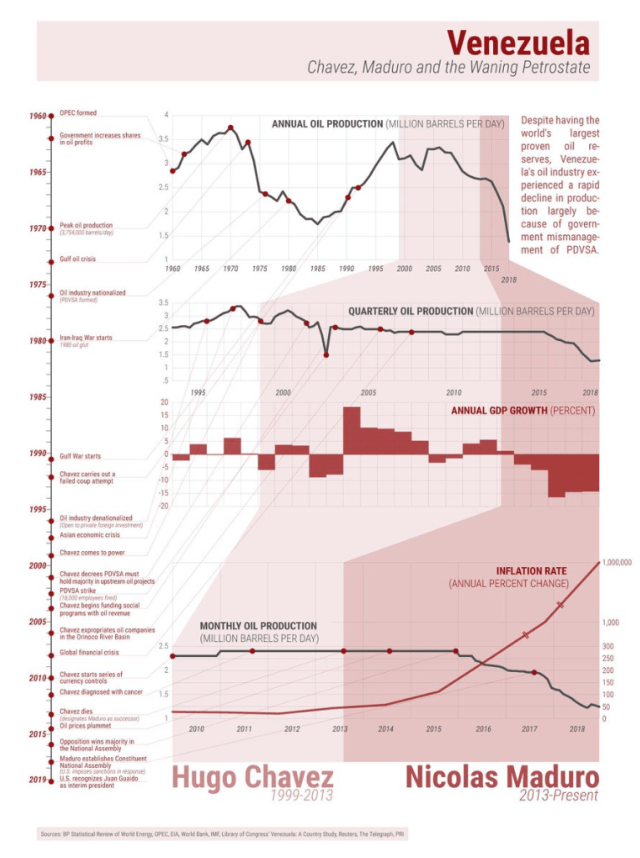
Source: The Polish Rifle
Great interview with Hall of Famer, Paul Tudor Jones (PTJ ), who has always been our fave, and even more so with what he is doing with JUST Capital. See here for the top-ranked most JUST companies.
PTJ likes U.S. stocks for technical reasons as he doesn’t know where supply is going to come from to meet another year of trillion dollar plus corporate buybacks. We like that analysis. It does assume markets are entirely inefficient and will not reprice lower based on changing fundamentals, however.
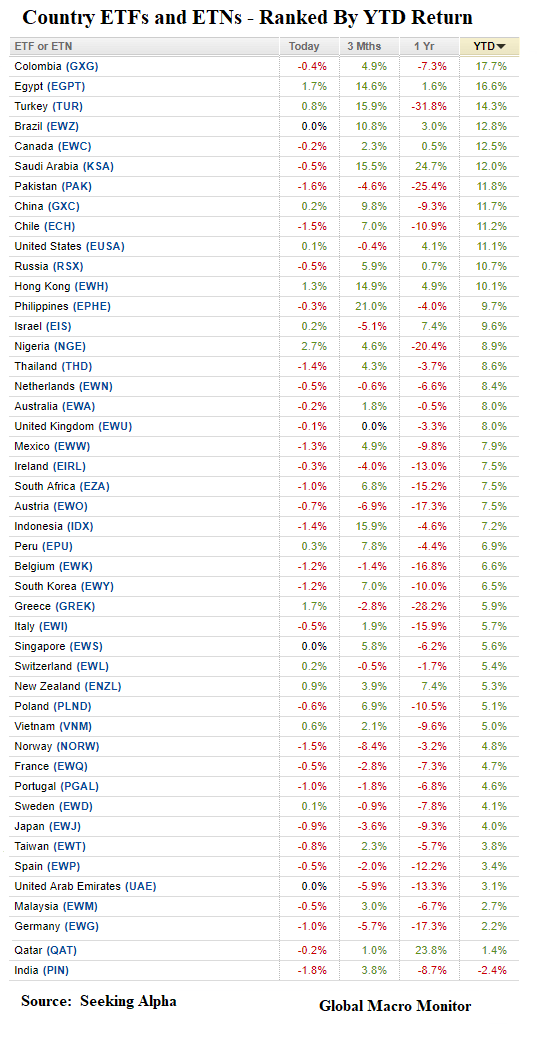
He currently likes the dollar and believes U.S. markets will outperform EM.
Click here for the interview.
Bad Call On Year-End “Melt-Up”
Even the greatest can, and often, get it wrong. He was expecting a year-end “melt-up” in 2018. You know how that played out — quite the opposite.
Indeed, billionaire US hedge fund manager Paul Tudor Jones sees the potential for a major melt-up in the US share market later this year, fuelled by this inflammatory mix of fiscal and monetary stimulus. – Financial Review, June 13, 2018
Anyone who plays this game understands you’re lucky if you get 50 percent of your trades right. Success is, at the end of the day, determined by money management. Cutting your losses quickly and letting your winners run. Easier said than done.

To the moon, Alice! – Jackie Gleason, The Honeymooners
In our New Year’s Day Year In Review post, we doubted the market’s conventional wisdom the dollar would weaken throughout the coming year. Not emphatically, but we doubted,
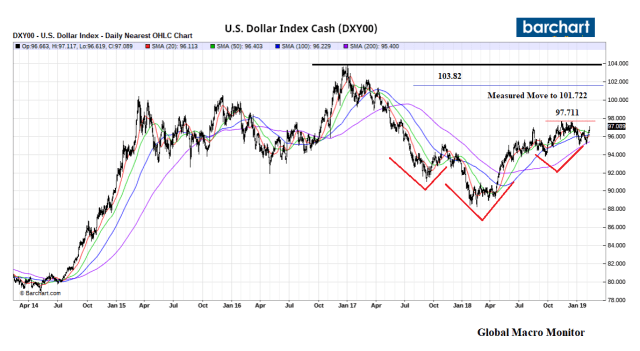
The dollar index was up over 4 percent on the year hitting a high of 97.71 in mid-December. Markets are betting on a lower dollar. Not so sure. We will watch and wait and don’t believe the U.S. is heading into a recession in 2019 – GMM, Jan 1st
The following chart explains the recent dollar strength, in our opinion, with the Dixie now trading with a 97 handle and only 0.6 percent away from its Dec 14th high at 97.711.
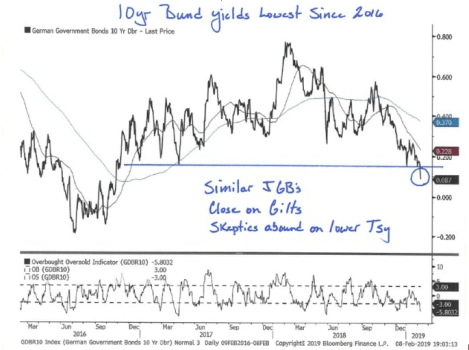
Source: Renaissance Macro
Exchange Rate Determination
We have written many pieces on what determines exchange rates. Here is a synopsis from a post last October,
We cut our teeth as a young economist on Anne Krueger‘s book, Exchange Rate Determination. The book is dated, but we highly recommend it, a good and quick read.
FX traders use many models to justify and fundamentally rationalize trades at any period in time, such as:
- GDP growth differentials;
- Interest rate differentials;
- FX reserve levels (mainly in the emerging markets, especially);
- Current account balances;
- Capital flows;
- Purchasing Power Parity (long-term model);
- Other;
- and, now, Greg’s PMI Differentials
FX traders are married to none of the above, and switch back-and-forth between the various FX models, or, at least, they act as if they do. – GMM, Oct 2nd
Traders have definitely zeroed in on recent growth and interest rate differentials and are whipping and driving their short-term positions accordingly.
We see no let-up unless the U.S. economy rolls over unexpectedly. Doubt it.
Much of the weakness in Europe is due to Germany and its trade-dependent economy. It’s possible with a China trade deal and Trump easing up could improve expectations. And pigs do fly.
We perceive the post-War order, i.e., globalization, is crumbling and markets are in complete denial or just plain ignorant. That is the major factor why we believe even long-term investors should be wary of the risk markets until assets get much cheaper. We believe they will.
Upshot
The dollar goes higher. Breaks through 97.711 high (only 0.6 percent from current levels) with a measured move to 101.722, or a move of 4.8 percent. The emerging market trade is over. Taking profits and moving on.
As always, we reserve the right to be wrong. Stay tuned.
Dangling interest rate cuts and QE or is that strawberry a China trade deal? The whining makes it seem even more real.
Wait! Is that Kramer?
Summary
Commentary: On February 3rd we posted,
Thus we expect the market to trade through the .618 Fibo at 2713 and kiss or temporarily pierce the 200-day moving average at 2740, getting the bulls Super Bowl lathered up, before reversing and setting on a new trajectory to test the December low. – GMM, Feb 3rd
Check.
We believe the index is on its way but certainly not in a straight line. Some are betting on a 1990’s melt-up as Fed will have to ease. That’s possible if the Fed begins easing with the S&P at 1000. Never have seen such nonsense, however.
The initial conditions in the 1990s couldn’t be more different than they are today. The mid-’90s was the beginning of globalization, cheap labor from China, India, and Eastern Europe. Peak America.
Now the reverse is true. The post-War order, i.e., globalization, is fading fast, and one, and the major reason we are cautious here, even as a long-term investor, and will steer clear of stocks until they get much cheaper. We are confident they will.
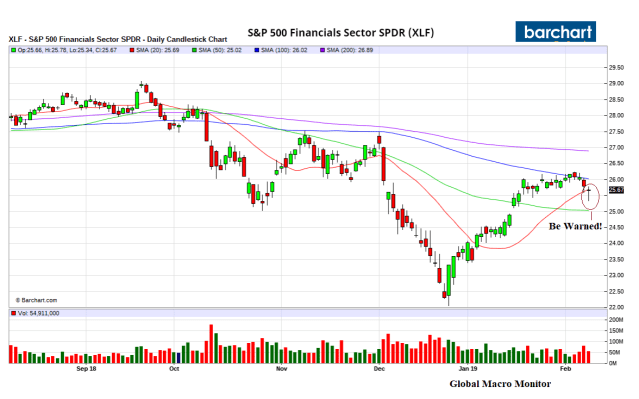
We don’t like the XLF (financials ETF) chart. Ugly Doji daily candle to end the week (see chart below) clinging to its 20-day. Watch this schpace (go lower)!
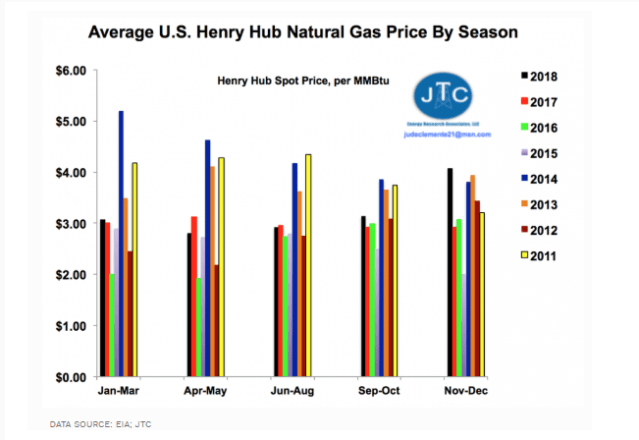
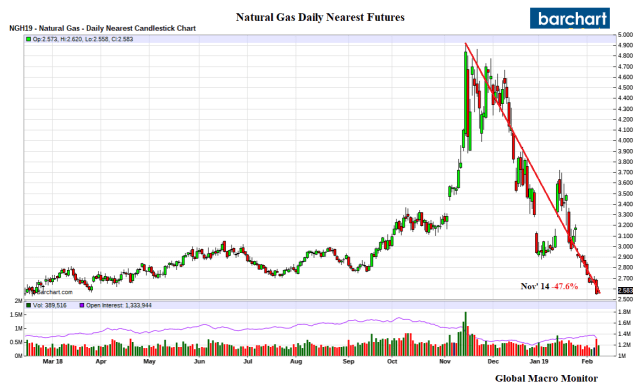
Natural gas is freakishly low here at this time of year. Yes, shale supply HELL. We think it deserves a stab down at these levels, however, but on a tight leash (which is a danger in itself as Nattie can easily, and often does, move 10% in one day). Be warned we have lost a ton of money in the “widow maker.”
China back online this week, Mnuchin and Lighthizer to China for negotiations, mo earnings, CPI, and government funding deadline on Friday.
Senate Appropriations Chairman Richard Shelby (R-Ala.) acknowledged on Sunday that negotiations had stalled, and he put the odds of getting a deal at 50-50. – Politico, Feb 10th
It will get done. They are not that foolish.
Happy hunting this week, folks.

This is rejection. Freaking stunning.


 Global Macro Monitor