

BFTP = Blast From The Past
Does it ever change?
We were going through some old posts this morning and came across this pearl from over eight years ago. Charges of socialism were also polluting the political environment back then just as they are today. Branding the other side as “socialist” is going to be the central strategy of one party in the 2020 election.
We are proud that we were way ahead of this last February. The young are left and prefer Nordic Capitalism over the American economic mishmash and they finally flexed their political muscle during the midterms, also as we expected.
Socialism Defined
We are trained economists and purists, so it pisses us off more than you know when we hear somebody called a socialist because of their support for Medicare, a 40-hour workweek, or, for that matter, government guaranteed bank checking and saving deposits, subsidies to build a new football stadium or support for mortgage interest tax write-offs. The American economy is a mix of both the private and public sector.
We define socialism as government ownership of the means of production, especially its “commanding heights.” Ironically, it does seem we are now moving toward some sort of managed international trade regime, which is about as socialist as it gets, folks.
Enough. We may have a more in-depth post on this subject over the weekend.
Keep it on your radar.
Our 2010 Mindset
When we wrote the following, our focus was on one thing, and one thing only – our trading P&L. We were whipping and driving billions back then and I think our main focus was in Apple’s stock and gold futures.
We have updated the chart, which is totally at odds with what’s currently perceived or being portrayed. Also, note we were spot on in our prediction of the 2012 presidential election, which was kind of ballsy given Obama’s approval rating was only around 45 percent at the time and heading south, and just after his record shallacking in the 2010 midterms.
The comments are hilarious, but do have some merit.
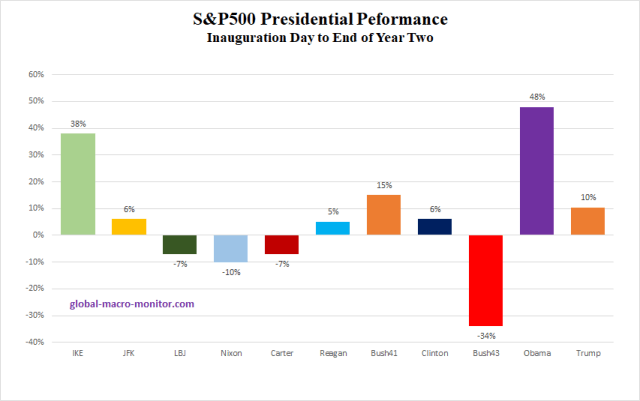
No politics or partisanship here, “just the facts ma’am”. The stock market as measured by the S&P500 is up just about 50 percent since President Obama’s inauguration to today’s close. Only Eisenhower comes close, but not even in the same zip code. A 50 percent stock move does a lot of “spreading the wealth around” and Joe the Plumber’s pension is in much better shape today than it was in November 2008!
Sure, sure, there are a ton of reasons to explain the differences, but this is politics folks! A CapEX spending led economic acceleration and pick-up in hiring in 2011, which usually follows such a strong equity performance, will make the President look unbeatable same time next year, in our opinion. Stay tuned.

…given stagnation in international reserves, there is likely an increased need for this debt to be financed domestically. – Treasury Borrowing Advisory Committee
Bonus
The genius market pundits are/will attribute today’s modest decline to the following trade tape bomb from CNBC,
Trump is ‘highly unlikely’ to meet Chinese President Xi before March trade deadline – CNBC
Sorry, the Dow was already down 250 points before the headline on global growth fears.
Nevertheless, another 500 points lower and Kudlow will be out on the North Lawn touting his optimism about a deal, no?
Chinese Game Theory
Don’t you think the Chinese negotiators know this? That is part of their game theory in the negotiations?
We maintain our position that the Trump team is outgunned; POTUS doesn’t understand trade; China is not subject to domestic political pressures to support its stock market; China is still a command economy and, in general, not subject to market discipline; Xi owns Kim Young-un and is using the North Korea Potemkin nuke deal as a pawn in a game of 3-D chess with the U.S., and, most important, and contrary to what POTUS perceives, the Chinese have little fear and respect for POTUS threats and policies.
We came across this yesterday in the Digital Journal,
The chaotic nature of the Trump administration, and its isolationist America First rhetoric haven’t impressed the Chinese. They went right ahead with the South China Sea islands project, and the “tariffs war” has achieved no major turnaround in trade policies. To put it bluntly, China obviously isn’t scared of Trump, whether he decides to fight or not. Quite the opposite; his lack of depth and amateurishness in foreign policy may be encouraging them. – Digital Journal
Having said this, we are rooting for the home team but are not that foolish to bet against the China version of Tom Brady (we learned that lesson again on Sunday and are one Benji poorer).
End Game
Cramming all of the above into a “payoff matrix“, we reach the following conclusions.
We won’t cop out to the “uncertainty” default position of most and have an opinion on the end game:
Trump caves on the big issues, such as structural reform of the Chinese economy and tech transfers and a Potemkin trade deal – a few soybeans here and there – gets done or the “pretend and extend” negotiations continue with March 1st tariff deadline pushed out.
Similar to the government shutdown, a lot of pain inflicted on the U.S. economy and individual Americans, farmers, in particular, with little to show for at the end of the day.
Alternative Scenarios
We will give an 8 percent probability Lighthizer gets all his cookies in a final deal and 12 percent Trump blows up and is “surprised” his new BFF President Xi won’t move on the big issues and goes ahead with the March 1 tariff hikes. Seat belts, please!
Bloomberg gave us a little insight into how the talks are going,
One of Donald Trump’s most persistent economic promises has been to rewrite the U.S. relationship with China. Yet as he approaches a potential deal, some of the very hawks who have cheered on the president’s trade war already fear he may end up falling short.
With less than a month before a March 1 deadline for either a deal or an increase in U.S. tariffs, hardliners inside and outside the administration fret Trump is being outplayed by Chinese President Xi Jinping and seduced by what they see as empty promises. – Bloomberg, Feb 4th
Fake news? We report, you decide!
This goat may just beat out Tom Brady as the real GOAT!
https://twitter.com/msmollyrachael/status/1092865117665005568?s=12
Can it really be this easy? Another Bull Trap With A Doji On Top?
If this bear market repeats or even rhymes with its recent history, here is the scenario:
Wednesday: The S&P500 trades through its 200-day moving average and closes with a nicely formed green candlestick or an attractive Doji.
Thursday: The market opens near Wednesday’s close, trades 10-15 points higher, gives it all back then some, only to close unched, tracing out a classic Doji candlestick. Or, follows up Wednesday’s Doji with a big sell-off back through the 200-day.
Friday: The bottom drops out of the market and breaks the 200-day.
It’s never that easy.
The market psychology has changed and believes it now owns the Fed.
China Deal
A China trade deal is going to get done as Trump will be forced to cave on the big issues and the two supers ink probably nothing more than our pig in a poke in the Year of the Pig,
One of Donald Trump’s most persistent economic promises has been to rewrite the U.S. relationship with China. Yet as he approaches a potential deal, some of the very hawks who have cheered on the president’s trade war already fear he may end up falling short.
With less than a month before a March 1 deadline for either a deal or an increase in U.S. tariffs, hardliners inside and outside the administration fret Trump is being outplayed by Chinese President Xi Jinping and seduced by what they see as empty promises. – Bloomberg, Feb 4th
“Trump is being outplayed by President Xi Jinping” has been an ongoing theme here at Global Macro Monitor. Never a political statement just analysis and sizing up the competition.
Hate to (no, not really) say it again, “you heard it here first,” folks!
Me thinks Trump & Co. are going to be played by Xi & Co. like a Chinese fiddle. – GMM, March 27th
Imagine the global chaos if Trump agrees with Xi on heads of terms and the Fox News Triumvirate — Sean, Rush, and Ann — start pounding POTUS as weak, just as they did over the first Senate government funding deal, which didn’t include a Wall. It’s always prudent to price some Mad King risk with this White House.
The Setup
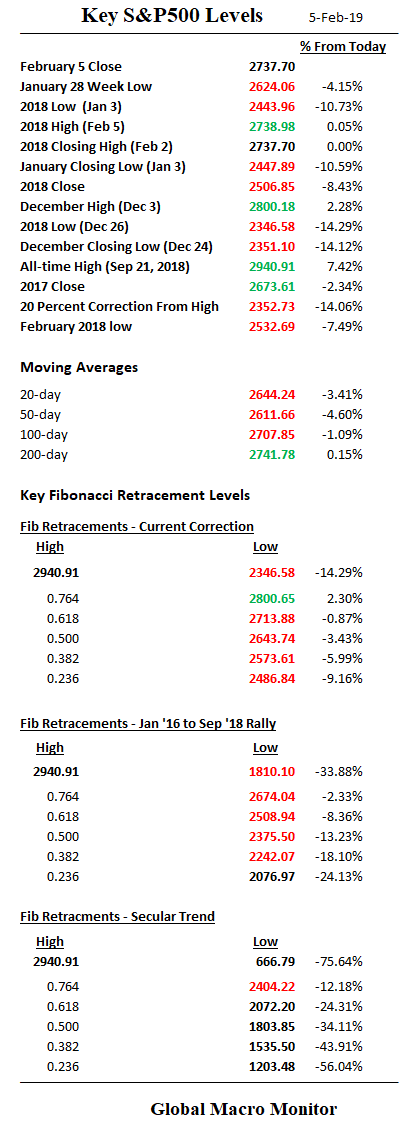
Because the S&P500 is now so overbought – the highest RSI since the market top – the risk of another facial from a short position is limited, in our opinion. Waiting for the 200-day to be penetrated, then setting a short limit order just a few points below the 200-day, right around today’s close.
The Stop Signal
Two or three green candle closes above the 200-day sets the index up to challenge the December high and key Fibo at 2800. Whoops, we were wrong again.
As always we do reserve the right to be wrong, as we, or you, or anyone else, don’t know jack scheisse about the future.
Stay frosty, comrades.


 Global Macro Monitor
16 Responses to If this is Socialism, call me Comrade
Wow. This post almost made me want to go back in time and restore the Soviet Union where I spent first 38 years of my life. Call yourself comrades or anything you want but don’t give me more socialism. Using stock market return as yardstick to prove that policies work and that one president is better than other is plain wrong. Can you say that Bush 41 was a better president than Clinton because stock market grew more? Was Comrade Brezhnev a good communist ruler because the quality of life did improve under his rule. And you know what, I bet the fastest economic growth the Soviet Union and Russia for that matter have ever experienced was under Comrade Stalin. Was he good? He started at a very low point and used all the wrong ideas and methods. But if we only judged by economic growth we should have said that he was the best. If we used the healthcare as measure, Comrade Castro would have been the winner. Not considering the starting point and ways the success was achieved is just wrong. For a fuller picture you should have the unemployment chart included as well.
As far as Joe the Plumber is concerned, does he even have a 401K? Even if he had one, he might have spent it because he does not have a job. But if he has the savings account he got zero and will be getting zero for a long time. He was robbed for you to enjoy the stock market gains. Here is where we need to start talking socialism. Exact same thing was happening in the Soviet Union. The actual prosperity, including big Swiss bank accounts, was only among the party elite, their families and close friends.