
Stunning!
Stunning!
Maybe the NFL will change rules on replay.
NFW does it even come close to the bad call that ruined the Detroit Tigers pitcher Armando Galarraga perfect game with two outs in the bottom of the ninth. That was a heartbreak hill. I think this led to instant replay in MLB.
Nevertheless, shit happens. The late, great Dwight Clark once said the “officiating will always be bad.” You need to factor that in.
Life’s not fair, sports fans. It could be worse.
There is always inequity in life. Some men are killed in a war and some men are wounded, and some men never leave the country, and some men are stationed in the Antarctic and some are stationed in San Francisco. It’s very hard in military or in personal life to assure complete equality. Life is unfair. – President Kennedy
We begin the new week with the S&P500 up over 15 percent from the December 26th intraday low at 2346.58 and sitting right at the 100-day moving average (2710.88) and the key .618 Fibo retracement at 2713.88. Last weekend we wrote,
Nevertheless, the market feels like it wants to go higher. Buoyed by the Friday’s WSJ article the Fed is rethinking the balance sheet – big hat, no cattle, in our opinion – decent earnings and better sentiment on China’s economy, which is reflected in RMB appreciation. We expect the S&P to take out the recent high at 2675.47 and then set its sight on 2710-2720, which is the zip code of a yuuuge Fibo level and the 100-day moving average. – GMM, Jan 27th
Here we are. Friday’s intraday high traded through the 2713 but couldn’t hold it.
The strong employment data, which was very noisy including furloughed Federal employees taking part-time jobs, is leading some to ask was the Fed cave premature? It could be that the policy mistake the markets were worried about in December is the exact policy – dovishness — Mr. Market, Mr. President, and Mr. Cramer were advocating.
Retrofitting Fundamentals
What we saw in December/January, folks, was the new socialism — privatizing profits and nationalizing losses. The government (in the form of the Fed) was moved into action – switching, softening its tone, or what you will — as losses of stock investors mounted. There was little domestic data to cause the Fed to switch x/ market worries and pressure from POTUS and the market cheerleaders. It was the classic case of “retrofitting fundamentals.” That is the market is going down so the economy must be going down.
China will always be China until their exchange rate and reserve position breaks. The economy weakens, President Xi dials up some public sector investment, banks fall in line and GDP increases. The RMB is strengthening so, in our opinion, it’s working.
Stocks And The Economy
The NASDAQ fell over 80 percent after the turn of the century and we had at worst a mild recession, which was caused mainly by the business sector pulling back on cap ex. and not the consumer tanking. We are in a new economy now, however, which is highly dependent on asset prices.
Fleecing Of The Millenials
Unfortunately, the policy of manipulating asset prices higher to save the economy from the Great Financial Crisis (GFC) over the past decade has created unsustainable politics
It has set the young, who own relatively few assets, versus the old, who own the most.
The Fleecing of Millennials
For Americans under the age of 40, the 21st century has resembled one long recession…
This loss of dynamism hurts millennials and the younger Generation Z, even as baby boomers are often doing O.K. Because the layoff rate has declined since 2000, most older workers have been able to hold on to their jobs. For those who are retired, their income — through a combination of Social Security and 401(k)’s — still outpaces inflation on average.
But many younger workers are struggling to launch themselves into good-paying careers. They then lack the money to buy a first home or begin investing in the stock market. Yes, older workers face their own challenges, like age discrimination. Over all, though, the generational gap in both income and wealth is growing. – NY Times

The young finally came out to vote in the 2018 midterms and they brought and will continue to bring their pitchforks. Here is the latest from the Hill,
Taxing the rich becomes hot topic of debate for 2020 hopefuls
A debate over how hard to tax the rich is taking center stage in the early days of the 2020 presidential race.
Likely candidates who are more to the left are leaning heavily on messaging that says wealthy Americans need to be taxed significantly more, and they’re backing that up with proposals to make their mark on the issue. – The Hill
We hear many in the political dumb-dumb class dismiss these policy prescriptions. Comments such as the “Democrats can’t win because they are moving too far left.” At our nicest, we would call that naive.
What if the country (the majority) is moving left, which we believe it is as the younger generations, saddled with debt and carbon from the baby boomers enter the political fray en masse. We don’t advocate for these policies at GMM, but try to anticipate and skate to where the political puck is going to be, not where it has been. You were warned, comrades.
Moreover, we’ve been writing about the coming “Clash of Generations” for years. See here.
Back To The Market
The Fed has thus far been all talk and has done nothing yet to back up its dovishness. But if the labor markets continue to tighten, and tight they are – ask any contractor trying to build or a young couple trying to buy their first home — the Fed will have to move back to a tightening bias.
We concede WalMart and the Home Depots can draw upon a pool of labor that was once the retired class as many baby boomers cannot afford to retire at 65 years-old. That is what may be happening as the experts try and discredit the Philips Curve.
We saw this all throughout the Northeast during our summer trip back to east coast.
Surprised at the poverty of seniors in New England. Most of the cashiers in retail were closer to 80 years old than 40 years old. My friends tell me one factor is simple demographics. Maine, for example, is the oldest state in the country; – GMM, August 15th
The last thing the market needs up here, after the 15 percent bounce, is a “ball busting” Fed, which is losing its cred faster than a Todd Gurley 40-yard dash. But that’s a bit way off into the future.
What Now?
One thing we have learned over the past decade of trading is that the algos love to set bull and bear traps to confound the market gurus and ruin the P&Ls of individual traders. We sense another major bull trap is forming right here.
MarketWatch had a good piece out this weekend,
Note the common and concurrent elements of the previous two big market tops (2000, 2007) versus now:
- New market highs tagging the upper monthly Bollinger band on a monthly negative RSI (relative strength index) divergence — check.
- A steep correction off the highs that breaks a multi-year trend line — check.
- A turning of the monthly MACD (Moving Average Convergence Divergence) toward south and the histogram to negative — check.
- A correction that transverses all the way from the upper monthly Bollinger band to the lower monthly Bollinger band before bouncing — check.
- A counter rally that moves all the way from the lower Bollinger band to the middle Bollinger band, the 20MA — check.
- A counter rally that produces a bump in the RSI around the middle zone, alleviating oversold conditions — check.
- All these events occurring following an extended trend of lower unemployment, signaling the coming end of a business cycle — check.
- All these events coinciding with a reversal in yields — check.
- All these events coinciding with a Federal Reserve suddenly halting its rate hike cycle — check.
I submit that the counter rally is consistent with all of those factors. Indeed, as with counter rallies in the past, this rally remains below its broken trend line. – MarketWatch
Upshot
The next big macro factor to move the market is a China trade deal.
We do expect more happy talk, though the final deal will be nothing more than a “pig in a poke“, in our opinion. Trump may also come under pressure for caving or meeting Xi “halfway” adding some Mad King risk to markets.
Thus we expect the market to trade through the .618 Fibo at 2713 and kiss or temporarily pierce the 200-day moving average at 2740, getting the bulls Super Bowl lathered up, before reversing and setting on a new trajectory to test the December low.
Big support at 2610-2625, which includes last week’s low and the 20 and 50-day moving averages.
Happy hunting this week, folks. Rams by 10.
This is will be the last actionable piece for the free riders. More to come on that.


Help keep the lights on at the Global Macro Monitor. Contribute any amount based on your perception of our value added by clicking the PayPal donate widget at the right side of the screen. You don’t need a PayPal account just a credit card. Thank you!

Stay tuned for our announcement on dealing with the free riders. Hint: “Build That Wall!” Time to step it up and make that contribution to GMM. Click on PayPal widget to the right.

Source: Holger @Schuldensuehner

Bonus
This year’s host network, CBS, is charging a record $5.25 million for just a 30-second spot during the championship match-up between the Los Angeles Rams and New England Patriots, reports CNBC’s Julia Boorstin.
That’s roughly $175,000 per second. – CNBC

‘Don’t buy a pig in a poke’ might seem odd and archaic language. It’s true that the phrase is very old, but actually it can be taken quite literally and remains good advice.
The advice being given is ‘don’t buy a pig until you have seen it’. This is enshrined in British commercial law as ‘caveat emptor’ – Latin for ‘let the buyer beware’. This remains the guiding principle of commerce in many countries and, in essence, supports the view that if you buy something you take responsibility to make sure it is what you intended to buy.
A poke is a sack or bag. It has a French origin as ‘poque’ and, like several other French words, its diminutive is formed by adding ‘ette’ or ‘et’ – hence ‘pocket’ began life with the meaning ‘small bag’. Poke is still in use in several English-speaking countries, notably Scotland and the USA, and describes just the sort of bag that would be useful for carrying a piglet to market.
A pig that’s in a poke might turn out to be no pig at all. If a merchant tried to cheat by substituting a lower value animal, the trick could be uncovered by letting the cat out of the bag. Many other European languages have a version of this phrase – most of them translating into English as a warning not to ‘buy a cat in a bag’. The advice has stood the test of time and people have been repeating it in one form or the other for getting on for five hundred years, maybe longer. — phrases.org.uk
Lots of happy talk in the Oval with the Chinese today but…. The Wall Street Journal reports,
- At the meeting, Mr. Liu said China would buy 5 million tons of U.S. soybeans daily, a number Mr. Trump repeated, adding it would “make our farmers very happy.” The administration later clarified that China has agreed to buy an additional 5 million metric tons of soybeans—but not daily, and no time frame was specified.
- Wednesday at the Eisenhower Executive Office Building near the White House, people briefed on the talks said. It includes more Chinese purchases of U.S. farm and energy products and promises to invite more U.S. capital into the manufacturing and financial-services sectors.
- But the offer falls short of what Washington has been seeking.
- The two sides are still far from a deal, and they didn’t agree Thursday to a written framework with blanks left for areas where there is disagreement—the kind of document that is standard in trade negotiations.
- At the same time, Beijing is also unlikely to accept U.S. demands to remake its industrial policy and scale back the role of the state in the economy, said Cornell University China expert Eswar Prasad.
- “The more likely scenario is a deal where Trump declares victory, which is relatively modest in scope, and the two sides de-escalate tension and continue discussions on complicated issues left unresolved,” said Mr. Prasad, who speaks regularly with Chinese officials. – WSJ, Jan 31st
We are expecting no more than a pig in the poke in the Year of the Pig. Of course, spun as the “greatest trade deal in the history of the world.”
There will be some Mad King risk as Trump will come under pressure for caving and to scrap the deal at the last minute as he did during the government shutdown.
The stronger the RMB, which is a real-time measurement of the country’s short-term economic prospects, China’s negotiating leverage increases.

Don’t make this your trade strategy, Mr. President, China is still a command economy not subject to market x/ the exchange rate.
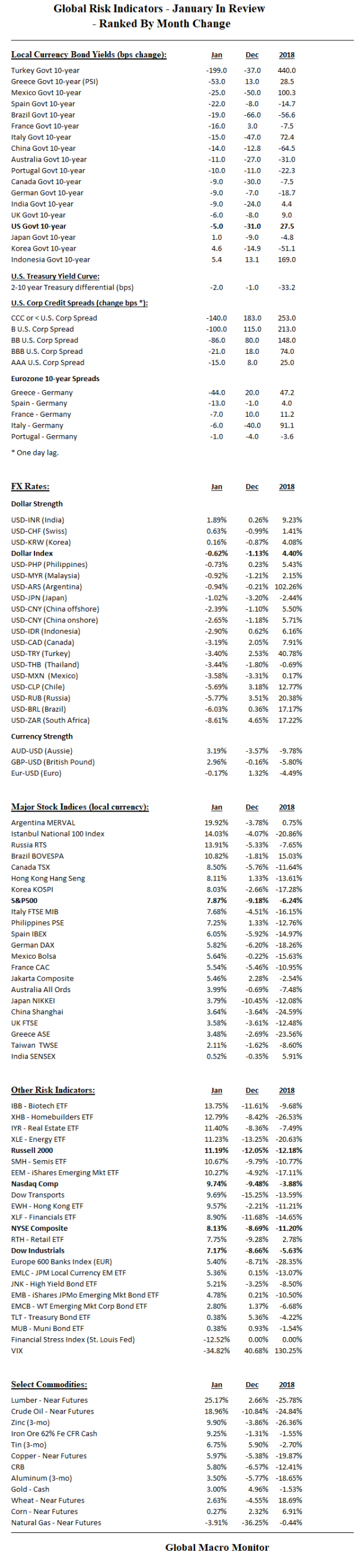
The reverse image of December and 2018. Genius markets, no?
After getting schmoked in some premature S&P shorts last week, we stated in our Week In Review over the weekend,
We expect the S&P to take out the recent high at 2675.47 and then set its sight on 2710-2720, which is the zip code of a yuuuge Fibo level and the 100-day moving average. Probably the place to sell but will revisit when we get there. – GMM,
Today’s high on the S&P was 2708.95 and it’s getting real close to start thinking about posting the “For Sale” sign. Our initial thoughts are to give the market a little more running room and to sell the “China deal is the greatest deal ever” news hype.
NFW does China do the deal Trump wants. The president “comprehensive” deal in his informal presser this morning. Comprehensive will not include structural reforms.
Brazil Country ETF
By the way, we wrote on New Year’s Day,
The animal spirits of a new market-friendly government should boost the BOVESPA during the administration’s honeymoon. Brazil is our favorite stock market to start the year.
Probably the best way to play it is with the Country ETF, EWZ, with the buy trigger at break above the 50-day at $38.99, in our opinion. First upside target is $47.77. After the purchase, put in the first trailing stop at $36.20.
EWZ has been correcting after the almost 40 percent six-week runup into the election. The ETF could see a measured move to $47.77-$53.38 in a timeframe dependent on how global markets fare in January. Good risk reward with a potential 20-35 percent upside. Not a bad day at the office. – GMM, January 1, 2019
The Brazil Country ETF is up almost 20 percent YTD.
One of our readers, who made a whole lot of money in this trade, let’s call him King David, emailed this morning,
Bailed on EMZ this morningDavid …. <s….@gmail.com>Thu 1/31/2019 7:20 AM.You.Lost my nerve. Nice gain up to the his point. Probably early.
Two-speed economies everywhere you look.
Young And Left
Do you wonder why the young are moving lefty?
The one percenters better start stepping up making social investments to generate a more stable future society in order to protect their wealth. Investments in human capital, such as means-tested free education and better healthcare. It’s coming either way.
Good for Jamie Dimon, one of the smartest guys out there and always way out in front, in recognizing this in his statement today.
You heard it here waaaaay first, folks, reflected in our post last year, Karl, The Comeback Kid?
Our recommendation to the one percenters and the comfortably
numbretired baby boomers, who have bequeathed to and saddled the younger generations with massive pension and public sector debt liabilities?You better Wake The F&*k Up! – GMM, Feb 20, 2018
And here just before the big shift left in the midterms,
We sense a political earthquake coming Tuesday. Female, young, and left. – GMM, Oct 31, 2018
Enter AOC & Co.
The political bozos need to stop conflating Nordic capitalism with Venezuela socialism.
Medicare (single payer) is different from the U.K. National Health System (single provider), and public healthcare is not “socialism”, where the government owns and controls the means of production. The political dummy class need to go back to Econ 101. The facts wouldn’t matter to them either way.
Subsidized higher education, or “free,” is about as socialist as JP Morgan’s government guarantees (FDIC) on their checking deposits. Long “socialism” for children/short corporate “socialism.” Or why not we all just work together?
Moreover, it is probably not that far off where the average “Jane and Joe” are gonna need subsidies to purchase their morning Starbucks nonfat, decaf, mocha latte with an organic lemon twist. You hearin’ us, Howard?
It all has to be financed and not with a “People’s QE” lest we do become Venezuela. Sorry Bernie and my MMT brothers and sisters. Higher marginal and wealth taxes are coming. Be warned, be prepared.
The Socialism Of The Elites
I saw a lot of “socialism” while laying in my hospital bed over the holidays, folks. POTUS, Cramer, and the ignoramuses on Bubble Vision pushing hard for the Fed to “socialize” the stock market losses in December. That was truly a treat to watch.
The socialism of many, and we stress not all, of elites and their sycophants are to privatize profits and socialize losses, which was on full display during the last financial crisis and bailouts. Pretty disgusting and not politically sustainable.
We saw the first big shock and political fallout from that policy in November 2016, which we suspect was only the beginning. When the populists, which are really economic left in nature and anti-elite, realize Trump was/is a Trojan Horse for the one percent, we suspect there will be hell to pay.
This is not a political statement, but just our analysis. Just as we would say the Maduro government in Venezuela has been a disaster. Is that a political statement? Just askin’.
Long, and getting longer pitchforks.

 Global Macro Monitor