JFK-Trump S&P Analog 2.0

MarketWatch giving us some nice props in their excellent piece today on the back of the Zero Hedge post about our JFK-Trump S&P analog, which convinced us last February that global stocks had entered in a bear market and would soon “roll-over hard.”

Back in April, the Global Macro Monitor blog, which was the first to draw the comparison, warned in an update that, if the trend in the chart below were to continue, the S&P 500 SPX, -0.34%  would soon take a big hit.

It may have taken a bit longer than expected, but the selling sure came, and the charts are now in lockstep. In fact, Wall Street has taken notice.

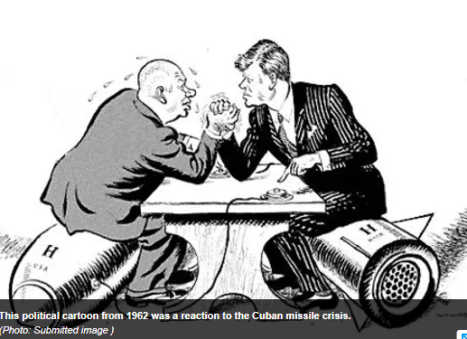
In a note shared on the Zero Hedge blog over the weekend, Goldman GS, +1.38% strategist David Kostin chimed in about how the current retreat, driven by policy concerns, mirrors the “Kennedy Slide” of 1962, which came against the backdrop of the Cuban Missile Crisis, when Kennedy demanded Soviet-leader Nikita Khrushchev remove nuclear-missile installations in Cuba…

Global Macro Monitor gave several reasons why the analog works, including geopolitical jitters, extreme valuations, inflation woes, etc. But the blogger pointed to one compelling stat, in particular: The S&P’s big move in a short period of time after each election: JFK — 30.1%, 285 days; Trump — 34.8%, 306 days.”

“Bear markets always follow bull markets and the bigger the prior move in a compressed time frame, the harder the fall,” he said. “Bear markets look for catalysts to sell, but the underlying vulnerability remains — valuation and longer-term overbought conditions.” — MarketWach,  January 14

We iced the analog after a ten percent divergence between the two S&Ps.

We updated it today for your review.

The JFK S&P bottomed in June of 1962, rallied and then retested the low in October as bear markets often do, putting in the final bottom the day after the Russians stood down during the Cuban missile crisis.

Analogs are just another tool in the quiver to guide us through the foggy and uncertain future, just as technical analysis, market gurus, fundamental reports, and preachers, who speak with conviction, do.

Don’t bet the ranch or your life on any of the above.

Eerily, in our post, 2019’s Most Mispriced Tail Events, we list as number one:  Trump won’t finish his third year in office.

1. Trump Leaves Office By Year-End
There is only one thing Trump likes more than power – money.  As his legal troubles grow exponentially in 2019, the president has an epiphany that he could lose all his wealth.  He cuts a Spiro Agnew-like deal and resigns from office in return for leniency.   The markets rally into the announcement but Trump doesn’t go easy and dog whistles to his base as he hits the exit.  The U.S. experiences a period of political and social instability.   Stocks sell-off hard. 
Global Macro Monitor, January 6

Stay tuned.

kennedy_trump


Posted in Equities, Uncategorized | Tagged , , | Leave a comment

QOTD: The Fall Of Sears And GE

The real lesson is starker. It is that no business, no matter how historically innovative or powerful, is guaranteed immortality. – Robert Samuelson

QOTD = Quote of the Day

Posted in Economics, Quote of the Day, Uncategorized | Tagged , , | Leave a comment

The Great Disruption – Gordon Brown, Project Syndicate

The collapsing post-War economic order is not even close to being on the radar of the market cheerleaders.  We think it is a yuuge structural risk.

Priced?  Are you frickin’ kidding me?

As new technologies, globalization, and growing inequality fuel a populist backlash across the West, 2018 could be remembered as a turning point for the liberal world order. Rising nationalism, widening trade wars, and the overall weakening of international cooperation are symptoms of a deeper struggle over what international arrangements will come next.

SUBSCRIBE NOW: Unrivaled Insights about the Issues Shaping your World – https://www.project-syndicate.org/ord…

Posted in Geopolitical, Politics, Uncategorized | Tagged , | Leave a comment

Sterling Set For Interesting Week

Prime minister Theresa May brings her Brexit deal to parliament on Tuesday, which is widely expected to fail.  The government will cushion the blow by removing the potential for a do deal BREXIT, in our opinion.   We believe the PM is also a closet supporter of a second referendum.

You know our view on cable.  Very bullish.

An announcement of a second referendum takes sterling to 1.35, which then consolidates, and experiences some volatility over a contentious a campaign.  As the landslide for the remainers becomes evident, cable moves to 1.50, or maybe higher.

Not without some gap risk this week, however,  as the government could fall and a new election called.   Our stop on the March contract is in 1.2633 but we will be back in at lower prices.

Nevertheless, the sterling is now our favorite global macro trade with the best risk-reward, in our opinion.  We are a little nervous the trade is getting a tad bit crowded.  It’s always good to be nervous.

bp

Posted in Currency, Uncategorized | Tagged | Leave a comment

Week In Review – January 11

Summary

  • EM bookends in local currency yields. Turkey in 33 bps, Mexico out 17 bps
  • US 10-year yields out 3 bps. Some squishy auctions last week
  • U.S. corporate credit in yuuuge
  • Euro periphery tighter
  • EM FX continues to recover
  • Dollar index still banging around in 95-97 range
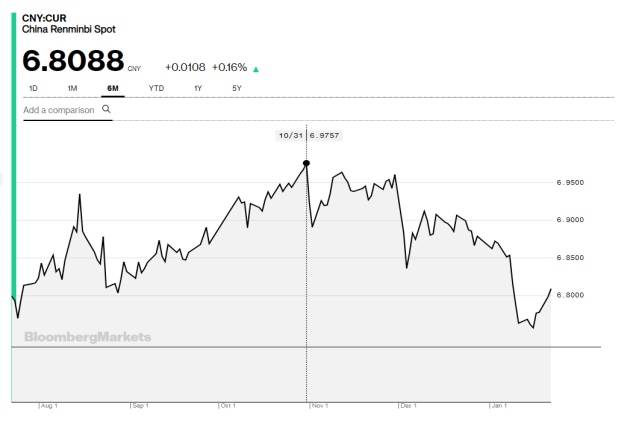
  • Big rebound in RMB
  • Aussie stronger
  • British Pound moving higher on expectations no BREXIT and a new referendum
  • Good week for stocks, led by Nikkei
  • U.S. biotech continues to ramp. ETF up over 13 percent YTD
  • Russell outperforming major U.S. indices, up almost 5 percent on the week
  • Crude bid. Up over 13 percent YTD

Commentary:  Earnings kick off with Citibank in the morning.  Stocks behaving well but we will be looking closely for a reversal signal, such as few daily Doji candlesticks, for example.  The slowing global economy is the word and a sprouting narrative that could derail the recent ramp, and generate the retest of the December low that we expect and is needed to bolster for a more sustained move higher.

Thursday’s high at 2597.82 is the level du jour and just only a gimme put from Friday’s close.  Let’s see a  convincing breakthrough and move over 2600, which opens the path to the 50-day at 2635.06, or 1.49 percent higher.  We think you are supposed to sell up there.   The level to watch to the downside is the key Fibo at 2573.61, which is now yuuge,  and if breaks, it’s time to get shorty.   We are on Doji watch, which has been the signal of the short-term top in this bear market.

Looks like the ‘bots are doing their thing in overnight futures probing the downside for real buyers.

s&p


s&p_chart


Recessions And Stock Drawdowns

tgwr_3


Yield Chase On Again, Not Sure How Long This Will Last

tgwr_1


week_2019_etfs


week_table


Help keep the lights on at the Global Macro Monitor.   Contribute any amount based on your perception of our value added by clicking the PayPal donate widget at the right side of the screen.  Thank you!

free rider_2

Posted in S&P500, Uncategorized, Week in Review | Tagged | Leave a comment

Our JFK-Trump S&P Analog Lives!

Wow!  In the words of Zero Hedge,  “bizarro.”

Zero Hedge, who has some very smart Tylers and are always kind enough to post many of our pieces, is out with a post yesterday, JFK vs Trump: The Most Bizarre S&P Analog Is Confounding Traders,

Money Quotes:

  1. Last March, we [Global Macro Monitortold readers that they need to “sit down” for what we are about to show: a chart showing the indexed “analog” performance of the S&P since the election of presidents JFK and Donald Trump. What the chart showed, is that as of March 15, 2018 the “analog” was only three bps apart on Day 338 after election day, or just a one S&P500 point difference.
  2. Commenting on the chart above, we said that it was “now make or break time for the analog”, adding that “if it is a true tracker, the S&P500 should rollover hard” soon.
  3. In retrospect it took a little longer, but the S&P indeed resumed tracked the “JFK” analog almost tick for tick, to the point where Goldman chief equity strategist David Kostin overnight pointed out the uncanny resemblance of the (indexed) S&P under Trump vs under JFK.  – Zero Hedge

Goldman, almost a year after our analysis, no doubt (we think, haven’t seen their piece) without attribution, finally catches on.  Better late than never!

Jan-Feb 2018 Vol Shock Kicks Off The Current Bear Market

The Global Macro Monitor noted the very rare volatility shock that began at the end of last January, which happened only three times in the post-War markets.  It looked very much like January 1962 vol spike that kicked off the “Kennedy slide.”  We thus began tracking the two S&P’s and developed the JFK-Trump S&P500 analog.

We were also one of the chosen few that proclaimed early in 2018 stocks were in a bear market.   We received tremendous pushback and mockery over our call and the JFK-Trump analog.  But you know what Einstein says about that, folks!

After the two S&P time series diverged by 10 percent, we put it on ice for a while.

Global Macro Monitor – “A Must Read”

This is why the Global Macro Monitor is a must read.  We don’t fly with the pack of geese; always provide an alternative and very provocative perspective; contrarian and often skeptical of the conventional wisdom;  not afraid to be wrong; not afraid to admit we wrong, which is often;  think outside the box; have zero conflicts of interest; don’t wear pom-poms and cheerleader skirts, and provide you with concrete and specific ideas to monetize what you read.

Background On the JFK-Trump S&P Analog

Last February we posted,

Historic Volatility Spike

Only three times since 1950 has intraday volatility jumped so high as measured by a modified version of the Average True Range:  1) September 1955 after an extraordinarily period of calm the S&P500 tanked on September 26th when markets opened after President Eisenhower’s heart attack on the 8th hole of Cherry Hills Country Club over the weekend. The market quickly recovered; 2) January 1962 when the “Kennedy slide” began to accelerate; and 3) the October 1987 stock market crash.

Kennedy-Trump S&P500 Analog

This market is starting to look very similar to the JFK post-election rally, top, and bear market, which eventually bottomed when Khrushchev backed down during the Cuban Missile Crisis. We will post more on the JFK-Trump S&P500 analog later in the week. – GMM, February 11

We followed it up with several posts, here, here, here, and here.

And with several of these charts,

Apr24_JFK_Trump

We also listed our reasons why the two S&P’s were tracking so closely.

Our good friend down under, Greg McKenna wants to know,

Why The Analog Works

We believe this analog is working for the following reasons:

  1. Tracks a political cycle after the election of a new president;
  2. Both S&Ps had similar big moves in a relatively short-period after election day: JFK–30.1 percent, 285 days; Trump–34.8 percent, 306 days.
  3. Both bull moves were led by tech stocks, which resulted in extreme  valuations:  JFK: Texas Instruments and Polaroid (see Zweig comments  below);  Trump – FANG.
  4. Both markets have similar domestic and geopolitical headlines:  Steel, nukes, and increased cold war/Russia/China tensions;
  5. Both have a similar macro story – inflation concerns morphing into a  growth scare.
  6. Today’s machine learning/AI algorithms search for such patterns and  trade on them.
  7. Both President Kennedy and President Trump did, and will, celebrate  Easter Sunday in Palm Beach. Yikes! That is downright scary!

The most important, in our opinion,  is #2 – the percentage move and time frame.

Bear markets always follow bull markets and the bigger the prior move in a compressed time frame, the harder the fall.  Bear markets look for catalysts to sell, but the underlying vulnerability remains — valuation and longer-term overbought conditions.

Expecting A Few Flash Crashes

We are also expecting a few flash crashes during the next few months. – GMM, March 27, 2018

Add also similar Russians 24/7, and run don’t walk to see  #1 in our 2019’s Five Most Mispriced Tail Events.  Yikes!

MarketWatch was all over the analog early on.  Replace weeks with months and Shawn‘s piece totally nailed it.


marketwatch

There you have it, folks. we were way ahead of the flock, and why the Global Macro Monitor is a must read!

We don’t want to sound like a TV evangelist but also another reason why not to be a free rider.  We know for a fact some of our readers made a ton of money trading the JFK-Trump analog. 

We rejected a firewall subscription model because our friends in the weak currency emerging market countries found the monthly nut prohibitive.  In fact, some of the countries even prohibit PayPal due to capital controls.  

Help keep the lights on at the Global Macro Monitor. 

Contribute any amount based on your perception of our value added by clicking the PayPal donate widget at the right side of the screen.  Thank you!

free rider_2

Posted in Equities, Uncategorized | Tagged , | 1 Comment

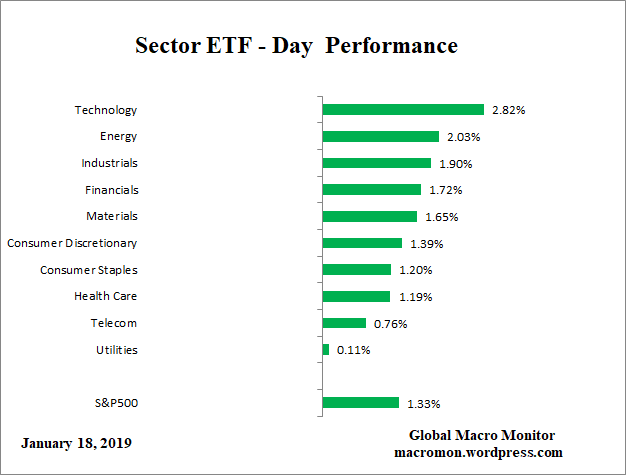
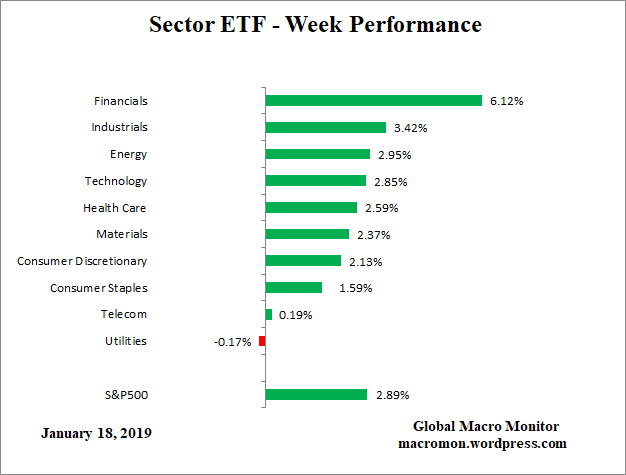
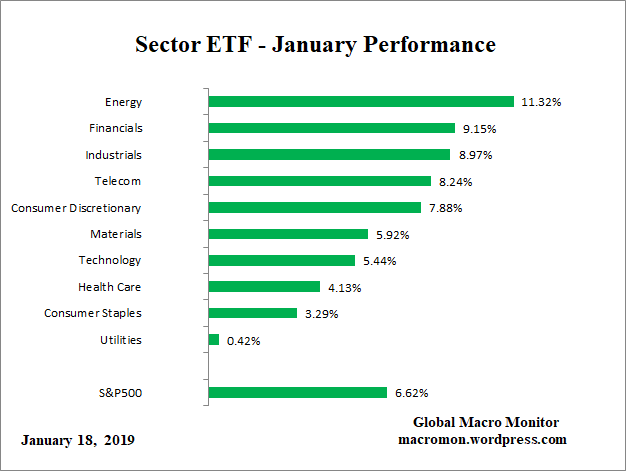
Sector ETF Performance – January 11

Help keep the lights on at the Global Macro Monitor.   Contribute any amount based on your perception of our value added by clicking the PayPal donate widget at the right side of the screen.  Thank you!

etf_d

etf_w

etf_m

free rider_2

Posted in Sector ETF Peformance, Uncategorized | Tagged | Leave a comment

Global Risk Monitor – January 11

Help keep the lights on at the Global Macro Monitor.   Contribute any amount based on your perception of our value added by clicking the PayPal donate widget at the right side of the screen.  Thank you!

riskmon_1

riskmon_2

Posted in Daily Risk Monitor, Uncategorized | Tagged , , , , , , , | Leave a comment

Inside China’s Future Factory

Over the past 40 years, the fishing village of Shenzhen has been reborn as a futuristic metropolis bursting with factories. Bloomberg Businessweek’s Ashlee Vance travels to the heart of China’s tech revolution to witness this new reality firsthand, as part of a three-episode exploration of the city. In part one of Hello World Shenzhen, Vance gets a worker’s view of life in a startup and then explores one of the city’s famous electronics markets to learn how people survive (and in some cases make fortunes) in such a frenetic, competitive environment.

https://www.bloomberg.com/hello-world

Posted in China, Manufacturing, Uncategorized | Tagged , , , | Leave a comment

Greenspan Cribbed “Irrational Exuberance” From Robert Shiller

Just cleaning up some old posts and thought you would find this one interesting.
I have always been a big fan of the Yale prof, Robert Shiller, even before his Nobel Prize.  During my Wall Street days, a Yale professor and Latin America expert worked for me and I asked her to set up a meeting with the good professor.  It was the morning after Alan Greenspan gave his “Irrational Exuberance” speech.
Here’s the story, first told by Barry Ritholtz when the Global Macro Monitor contributed to his Big Picture blog and then our post.   Enjoy.

Comments welcome.

Big Picture.png

Did Greenspan Steal the Phrase “Irrational Exuberance?”

Interesting discussion by Think Tank contributor MacroMan, who retells a story about Yale Professor Robert Shiller:

We asked him once  to visit us in our offices and the meeting took place the day after then Fed Chairman Alan Greenspan’s famous Irrational Exuberance speech in December 1996:

But how do we know when irrational exuberance has unduly escalated asset values, which then become subject to unexpected and prolonged contractions as they have in Japan over the past decade?”

The professor said he was in town to meet with Greenspan who was concerned about the run-up in stock prices. During the meeting Greenspan solicited his thoughts on why stocks were rising.  The professor answered maybe it was just “irrational exuberance” among investors. Hmmmm…

The Ambiguity of Stock Value,  December 27, 2010

In other words, Greenspan cribbed Shiller’s phrase for his speech!

Perhaps this explains why Shiller named his book “Irrational Exuberance” — he was taking back the phrase from Greenspan as his own.

Fascinating stuff . . .

gmm

The Ambiguity of Stock Value

Professor Robert Shiller,  of Yale University,  is probably best known for his book, Irrational Exuberance, which called the top of the dot.com bubble and the second edition called the top in the housing market.  During our days on Wall Street, we were big fans of Shiller’s book,  Market Volatility.

We asked him once  to visit us in our offices and the meeting took place the day after then-Fed Chairman Alan Greenspan’s famous Irrational Exuberance speech in December 1996,

But how do we know when irrational exuberance has unduly escalated asset values, which then become subject to unexpected and prolonged contractions as they have in Japan over the past decade?

The professor said he was in town to meet with Greenspan who was concerned about the run-up in stock prices.  During the meeting, Greenspan solicited his thoughts on why stocks were rising.  The professor answered maybe it was just “irrational exuberance” among investors.  Hmmmm….

We think Shiller’s best work was Market Volatility and specifically the following,

The Ambiguity of Stock Value

Stock prices are likely to be among the prices that are relatively vulnerable to purely social movements because there is no accepted theory by which to understand the worth of stocks….investors have no model or at best a very incomplete model of behavior of prices, dividend, or earnings, of speculative assets.

Shiller nails it here.  Stock values are ambiguous as there are no models to determine their “true” price. Even at the macroeconomic level, this is true and Greenspan addressed it in his Irrational Exuberance speech,

There is, regrettably, no simple model of the American economy that can effectively explain the levels of output, employment, and inflation. In principle, there may be some unbelievably complex set of equations that does that. But we have not been able to find them, and do not believe anyone else has either.

Consequently, we are led, of necessity, to employ ad hoc partial models and intensive informative analysis to aid in evaluating economic developments and implementing policy. There is no alternative to this, though we continuously seek to enhance our knowledge to match the ever growing complexity of the world economy.

So too it is with our job in forecasting asset values, which can only be done with “ad hoc partial models” in the ether of ambiguity.   Because prices are determined by simply buying and selling, we paraphrase Shiller in constructing our ad hoc model,

Stock prices are likely to be among the prices that are relatively determined by capital flows because there is no accepted theory by which to understand the worth of stocks.

In our experience getting ahead of the capital flows have been more profitable than buying what we believe to be a “cheap” stock or selling an “expensive” stock.

And that leads us to the next issue of perspective based on reference points, time frames, and historical bias.

Take a look at the three objects.   Two charts of the exact same market, the S&P500 over different time horizons;   and one picture.

Do you see an S&P500 that is overvalued?  Undervalued?  Oversold? About to roll over or break to new highs?   Do you see a young lady or an old hag?  It most likely depends on your confirmation bias.     Larry Summers, who will leave the White House at the New Year,  coauthored a paper in the late 1980s stating market volatility is caused by investors and traders with different time horizons.

But, like Keynes’ beauty contest analogy, the true question to ask for 2011 is not what we see, but what we believe the market – i.e., the dominant marginal buyers – will see.  Do they see the young lady or the old hag?

Or maybe beauty is relative, or even ambiguous,  and we have to determine which markets will be deemed the least old or the most pretty.   And that just may be the best lesson here, which we think certainly is the case for the world’s major currencies.  Dollar strength doesn’t necessarily equate to the young lady!

Posted in Monetary Policy, Quotes, Robert Shiller, Uncategorized | Tagged , , | Leave a comment