Greenspan Cribbed “Irrational Exuberance” From Robert Shiller

Just cleaning up some old posts and thought you would find this one interesting.
I have always been a big fan of the Yale prof, Robert Shiller, even before his Nobel Prize.  During my Wall Street days, a Yale professor and Latin America expert worked for me and I asked her to set up a meeting with the good professor.  It was the morning after Alan Greenspan gave his “Irrational Exuberance” speech.
Here’s the story, first told by Barry Ritholtz when the Global Macro Monitor contributed to his Big Picture blog and then our post.   Enjoy.

Comments welcome.

Big Picture.png

Did Greenspan Steal the Phrase “Irrational Exuberance?”

Interesting discussion by Think Tank contributor MacroMan, who retells a story about Yale Professor Robert Shiller:

We asked him once  to visit us in our offices and the meeting took place the day after then Fed Chairman Alan Greenspan’s famous Irrational Exuberance speech in December 1996:

But how do we know when irrational exuberance has unduly escalated asset values, which then become subject to unexpected and prolonged contractions as they have in Japan over the past decade?”

The professor said he was in town to meet with Greenspan who was concerned about the run-up in stock prices. During the meeting Greenspan solicited his thoughts on why stocks were rising.  The professor answered maybe it was just “irrational exuberance” among investors. Hmmmm…

The Ambiguity of Stock Value,  December 27, 2010

In other words, Greenspan cribbed Shiller’s phrase for his speech!

Perhaps this explains why Shiller named his book “Irrational Exuberance” — he was taking back the phrase from Greenspan as his own.

Fascinating stuff . . .

gmm

The Ambiguity of Stock Value

Professor Robert Shiller,  of Yale University,  is probably best known for his book, Irrational Exuberance, which called the top of the dot.com bubble and the second edition called the top in the housing market.  During our days on Wall Street, we were big fans of Shiller’s book,  Market Volatility.

We asked him once  to visit us in our offices and the meeting took place the day after then-Fed Chairman Alan Greenspan’s famous Irrational Exuberance speech in December 1996,

But how do we know when irrational exuberance has unduly escalated asset values, which then become subject to unexpected and prolonged contractions as they have in Japan over the past decade?

The professor said he was in town to meet with Greenspan who was concerned about the run-up in stock prices.  During the meeting, Greenspan solicited his thoughts on why stocks were rising.  The professor answered maybe it was just “irrational exuberance” among investors.  Hmmmm….

We think Shiller’s best work was Market Volatility and specifically the following,

The Ambiguity of Stock Value

Stock prices are likely to be among the prices that are relatively vulnerable to purely social movements because there is no accepted theory by which to understand the worth of stocks….investors have no model or at best a very incomplete model of behavior of prices, dividend, or earnings, of speculative assets.

Shiller nails it here.  Stock values are ambiguous as there are no models to determine their “true” price. Even at the macroeconomic level, this is true and Greenspan addressed it in his Irrational Exuberance speech,

There is, regrettably, no simple model of the American economy that can effectively explain the levels of output, employment, and inflation. In principle, there may be some unbelievably complex set of equations that does that. But we have not been able to find them, and do not believe anyone else has either.

Consequently, we are led, of necessity, to employ ad hoc partial models and intensive informative analysis to aid in evaluating economic developments and implementing policy. There is no alternative to this, though we continuously seek to enhance our knowledge to match the ever growing complexity of the world economy.

So too it is with our job in forecasting asset values, which can only be done with “ad hoc partial models” in the ether of ambiguity.   Because prices are determined by simply buying and selling, we paraphrase Shiller in constructing our ad hoc model,

Stock prices are likely to be among the prices that are relatively determined by capital flows because there is no accepted theory by which to understand the worth of stocks.

In our experience getting ahead of the capital flows have been more profitable than buying what we believe to be a “cheap” stock or selling an “expensive” stock.

And that leads us to the next issue of perspective based on reference points, time frames, and historical bias.

Take a look at the three objects.   Two charts of the exact same market, the S&P500 over different time horizons;   and one picture.

Do you see an S&P500 that is overvalued?  Undervalued?  Oversold? About to roll over or break to new highs?   Do you see a young lady or an old hag?  It most likely depends on your confirmation bias.     Larry Summers, who will leave the White House at the New Year,  coauthored a paper in the late 1980s stating market volatility is caused by investors and traders with different time horizons.

But, like Keynes’ beauty contest analogy, the true question to ask for 2011 is not what we see, but what we believe the market – i.e., the dominant marginal buyers – will see.  Do they see the young lady or the old hag?

Or maybe beauty is relative, or even ambiguous,  and we have to determine which markets will be deemed the least old or the most pretty.   And that just may be the best lesson here, which we think certainly is the case for the world’s major currencies.  Dollar strength doesn’t necessarily equate to the young lady!

Posted in Monetary Policy, Quotes, Robert Shiller, Uncategorized | Tagged , , | Leave a comment

Ten Good Weekend Reads


tgwr_4

  • Volatility: how ‘algos’ changed the rhythm of the market – FT
  • Shelter From the Storm in 2019, Barry Eichengreen – Project Syndicate
  • Seoul bears bad news for the globe – Nikkei Asian Review
  • As China’s economy gets the chills, some California firms catch a cold – LA Times
  • Why the world economy feels so fragile, Martin Wolf – FT
  • One Russian in Four Lacks an Indoor Toilet, One of Many Signs There are Now ‘Four Distinct Russias’ – Johnson’s Russia Listtgwr_2
  • Emerging Markets Get Goldilocks Feel as Risk-Buying Returns – Bloomberg
  • Even Bond Traders Don’t Believe This Rally  – Bloomberg
  • Is Apple still a ‘forever’ company? How about Facebook? – AEI
  • The fate of the dollar will shape financial markets in 2019 – Economist

Bonus

  • The hedge funds that are doing the most hiring right now – efinancialcareers
  • Lessons from history on the dangers of blind trust in data – FT
  • Will Machine Learning Transform Finance – Yale Insights
  • Xi’s US strategy recalls Mao’s ‘protracted war’ – Nikkei Asian Review
  • China’s team of crack trade negotiators will extract their ‘pound of flesh’, experts say – SCMP
  • Second Brexit referendum calls grow as Keir Starmer tells Corbyn it
    could be ONLY way out  – Express
  • Warnings From Versailles – Foreign Affairs
  • Golf-Home Owners Find Themselves in a Hole – WSJ

Tax champions: how much do the French really pay?


Help keep the lights on at the Global Macro Monitor. 

Contribute any amount based on your perception of our value added by clicking the PayPal donate widget at the right side of the screen.  Thank you!

free rider_2


Posted in Uncategorized, Weekend Reads | Tagged , , , , , , , | 2 Comments

File Under: You Heard It Here First!

See here and here.

Hat tip:  @gregorymckenna


Posted in Currency, Uncategorized | Tagged , , | Leave a comment

Hmmmm…

I’m focused on the picture in the People’s Daily tweet.  Are those what I think they are?

Posted in Black Swan Watch, China, Uncategorized | Tagged , | Leave a comment

S&P500 Key Levels

Nice price action today generating an outside day, which the textbooks tell us is a confirmation and continuation of the recent move.  No fight here.

Nevertheless, moving into the zone of heavy resistance as the S&P crosses 2600 and the 50-day and .50 Fibo at 2640ish become just a chip shot away.  Grab your gap wedge,  folks.

s&p_resist

Waiting for Godot Mr. Doji so we can sell this market.

One Note Of Caution For The Bears

We are a bit concerned and nervous waiting for our short set-up as everyone and their mother are talking about the heavy resistance at 2600-2650, and also looking for a retest of the Dec 26th low.   There will have to be some real selling up there, which we think is probable given earnings should be sufficiently negative to break some supply loose.  Stay tuned.

s&p_500_chart

s&p


Help keep the lights on at the Global Macro Monitor.  Contribute any amount based on your perception of our value added by clicking on the PayPal donate widget at the right side of the screen.  Thank you!

free rider_2

Posted in S&P500, Uncategorized | Tagged , | Leave a comment

QOTD: You Are A Badass!

Deciding means jumping in all the way, doing whatever it takes, and going after your dreams with the tenacity of a dateless cheerleader a week before prom night.  – Jen SinceroYou Are a Badass: How to Stop Doubting Your Greatness and Start Living an Awesome Life

QOTD:  Quote of the Day

Posted in Quote of the Day, Uncategorized | Tagged , , | Leave a comment

Why Communist China Has So Many Billionaires – Bloomberg

By one estimate, China mints a new billionaire every two days, far exceeding the rate of countries like the United States. But how did China remain a nominally Communist state while becoming a hotbed for billionaires-in-the-making? Bloomberg QuickTake explains how capitalist compromises and moves begun decades ago have made China the not-quite-Communist country it is today.

Video by Henry Baker, Graphics by Christian Capestany, Sylvia Yang – Bloomberg


Posted in China, Uncategorized | Tagged , , , | Leave a comment

Selling Brazil ETF

Taking profit in the Brazil ETF, EWZ, after  a tremendous run.  Out at $43.00 and will look to reload at a lower price.  Bulls eat, bears eat, and pigs get slaughtered.

Help keep the lights on at the Global Macro Monitor. 

Contribute any amount based on your perception of our value added by clicking the PayPal donate widget at the right side of the screen.  Thank you!

free rider_2

Posted in Uncategorized | Leave a comment

The Automatic Tapering Of Quantitative Tightening

We heard a market pundit today mention the Fed will soon begin to taper its reduction in the balance sheet.  The pundit seemed convinced the balance sheet reduction is on track to total $600 billion per year as far as the eye can see.  Not so, Joe!

The balance sheet reduction is on automatic pilot in so far as the monthly maturities coming due in the Fed’s SOMA portfolio of Treasury securities and MBS are not rolled over.   That is the total monthly size of QT is dependent on the maturity profile of the SOMA portfolio. The second derivative – the change of the change in the SOMA portfolio – is sharply negative as the maturity profile in each successive year gets smaller (see table).   No Fed tapering needed, Joe!

If the total Treasury maturities for any month exceed $30 billion, for example, the difference of the total less $30 billion is reinvested back into the monthly auctions across the curve.

The mechanics of the MBS run-off are more opaque as not only we don’t have any maturity data there is also uncertainty due to refinancings.   We estimate the 2019-2021 MBS run-off based on an assumption of a running rate of 52 percent of the monthly Treasury reduction, which is the ratio since the balance sheet reduction began in October 2017.

Upshot

The following table illustrates that the Fed’s balance sheet reduction naturally falls simply due to the profile of its maturities in the SOMA portfolio.  Quantitative tightening does not come close to $600 billion that the market clowns were freaking out about over Christmas.   In 2021, the balance sheet reduction is estimated to be only $254 billion, which is just 42.27 percent of the $600 billion cap!   Still, the Fed balance sheet at the end of 2021 will remain around 3.5x its pre-crisis size in 2007.

Remember the idjits proclamation , “the Fed and Jay Powell know nothing,” at the nadir of the recent crash?   What a joke!

This confirms our suspicion the market crash from October to December was likely misdiagnosed.  Maybe what ails the market is not solely a cyclical phenomenon and about the Fed,  but something more structural, such as too much new debt being floated by the Treasury and the inability of the risk-free rate to rise and find its market clearing level. More on this in a later post.

Nevertheless,  it will be interesting to see if stocks can continue to rally on, what we believe, is a false narrative.    Stay tuned.

fed_bal_roll-off

fed_bal_roll-off_2


Help keep the lights on at the Global Macro Monitor. 

Contribute any amount based on your perception of our value added by clicking the PayPal donate widget at the right side of the screen.  Thank you!

free rider_2


Posted in Monetary Policy, Uncategorized | Tagged , , | 2 Comments

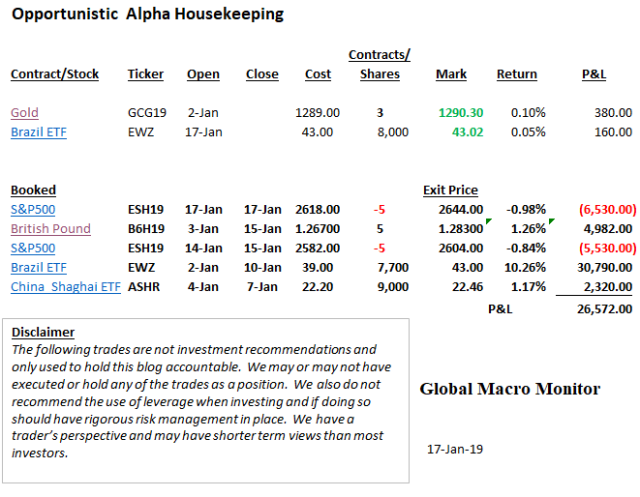
Opportunistic Alpha Housekeeping

If you haven’t noticed, we have been posting specific trade ideas with entry points, target prices, and stops.  These are not recommendations but a vehicle so that our readers can hold us more accountable for our ideas, and to also illustrate that following the Global Macro Monitor is a money maker.

Ideally, the trades will generate alpha for, say, a global macro fund, or P&L for individual traders, mainly through event-driven opportunistic trades.  Assume we have $1,000,000 in capital or trading limits,  which can be levered, mainly with futures. 

Let’s call these posts “Opportunistic Alpha.”

  • Brazil has been stunning, up 10.10 percent from our entry and 12.50 percent for the year.  Getting tempted to take half off but gotta let the winners run.
  • Gold starting to move.  Trading inversely with dollar
  • Is the U.K. getting close to calling for a second BREXIT referendum?  We think so simply due to TINA – there is no alternative.   The disaster scenario is not an option and we suspect the PM secretly wants a “People’s Vote” as an easy way out.  She has to at least appear to be placating Boris
  • We think stocks are still in a bear market and a test of the December low is a given.  Though we think a little more upside, especially on some positive trade noise, we will be looking to get shorty in the 2600-2640 range or sooner  if Mr. Doji begins to appear in the daily schticks

Looks like we left a little on the table by selling the China ETF too early.  Can get them all.

We just had a large contribution from a reader who said the Brazil ETF trade made him some nice coin and wanted to pay us for the idea.  That is exactly what we are looking for. 

A special shout out to our friend, Scott in Tasmania, who was our first contribution and jumped on it as soon as we put the PayPal widget up.  We will never forget it.   

Links to original posts for each trade:

Brazil ETF
Gold
British Pound
China ETF  – exit

strictly alpha

Help keep the lights on at the Global Macro Monitor.  Contribute any amount based on your perception of our value added by clicking on the PayPal donate widget at the right side of the screen.  Thank you!

free rider_2

Posted in Trades, Uncategorized | Tagged , | Leave a comment