QOTD: The Taiwan Strait

Repeatedly challenging our bottom line (on the Taiwan question) is extremely dangerous,  If someone attempts to split Taiwan from China, the Chinese military will take any necessary actions at any cost. – General Wei Fenghe, Chinese Defense Minister

Posted in Uncategorized | 1 Comment

Where The Next Financial Crisis Begins

We are not sure of how the next financial crisis will exactly unfold but reasonably confident it will have its roots in the following analysis.   Maybe it has already begun.

The U.S. Treasury market is the center of the financial universe and the 10-year yield is the most important price in the world, of which, all other assets are priced.   We suspect the next major financial crisis may not be in the Treasury market but will most likely emanate from it.

U.S. Public Sector Debt Increase Financed By Central Banks 

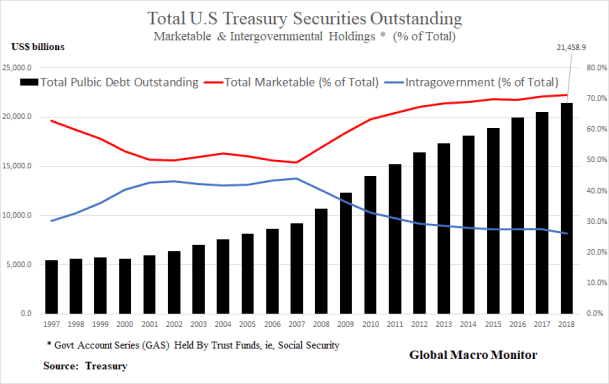
The U.S. has had a free ride for this entire century, financing its rapid runup in public sector debt,  from 58 percent of GDP at year-end 2002, to the current level of 105 percent, mostly by foreign central banks and the Fed.

Marketable debt, in particular, notes and bonds, which drive market interest rates have increased by over $9 trillion during the same period, rising from 20 percent to 55 percent of GDP.

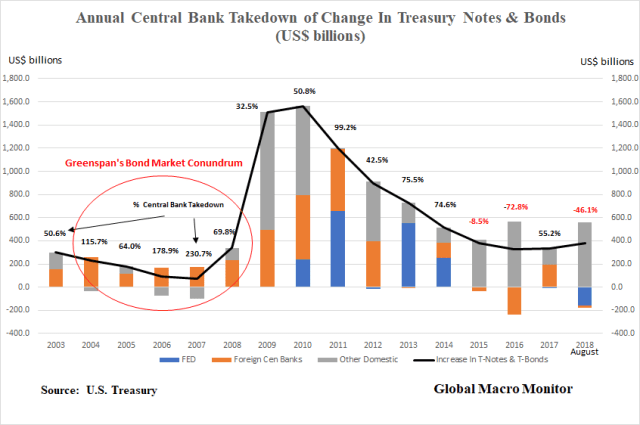
Central bank purchases, both the Fed and foreign central banks, have, on average, bought 63 percent of the annual increase in U.S. Treasury notes and bonds from 2003 to 2018.  Note their purchases can be made in the secondary market, or, in the case of foreign central banks,  in the monthly Treasury auctions.

In the shorter time horizon leading up to the end of QE3,  that is 2003 to 2014,  central banks took down, on average, the equivalent of 90 percent of the annual increase in notes and bonds.  All that mattered to the price-insensitive central banks was monetary and exchange rate policy.   Stunning.

Greenspan’s Bond Market Conundrum

The charts and data also explain what Alan Greenspan labeled the bond market conundrum just before the Great Financial Crisis (GFC).   The former Fed chairman was baffled as long-term rates hardly budged while the Fed raised the funds rate by 425 bps from 2004 to 2006, largely, to cool off the housing market.

The data show foreign central banks absorbed 120 percent of all the newly issued T-notes and bonds during the years of the Fed tightening cycle, freeing up and displacing liquidity for other asset markets, including mortgages.   Though the Fed was tight, foreign central bank flows into the U.S., coupled with Wall Street’s financial engineering, made for easy financial conditions.

Greenspan lays the blame on these flows as a significant factor as to why the Fed lost control of the yield curve.  The yield curve inverted because of these foreign capital flows and the reasoning goes that the inversion did not signal a crisis; it was a leading cause of the GFC as mortgage lending failed to slow, eventually blowing up into a massive bubble.

Because it had lost control of the yield curve,  the Fed was forced to tighten until the glass started shattering.  Boy, did it ever.

Central Bank Financing Is A Much Different Beast

The effective “free financing” of the rapid increase in the portion of the U.S debt that matters most to markets, by creditors who could not give one whit about pricing,  displaced liquidity from the Treasury market, while, at the same time,  keeping rates depressed, thus lifting other asset markets.

More importantly, central bank Treasury purchases are not a zero-sum game. There is no reallocation of assets to the Treasury market in order to make the bond buys.  The purchases are made with printed money.

Reserve Accumulation

It is a bit more complicated for foreign central banks, which accumulate reserves through currency intervention and are often forced to sterilize their purchase of dollars, and/or suffer the inflationary consequences.

Nevertheless, foreign central banks park much of their reserves in U.S. Treasury securities, mainly notes.

Times They Are A-Changin’

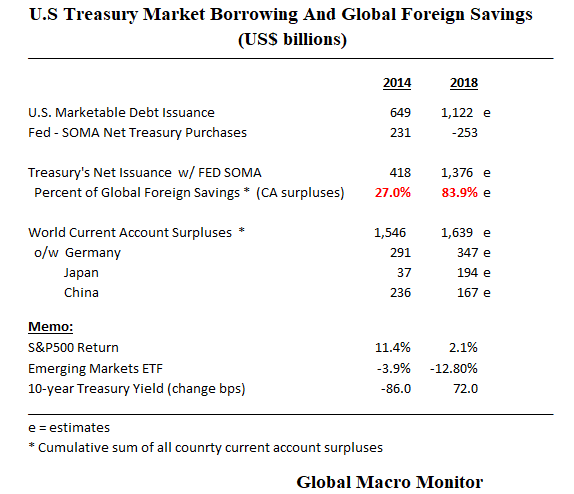
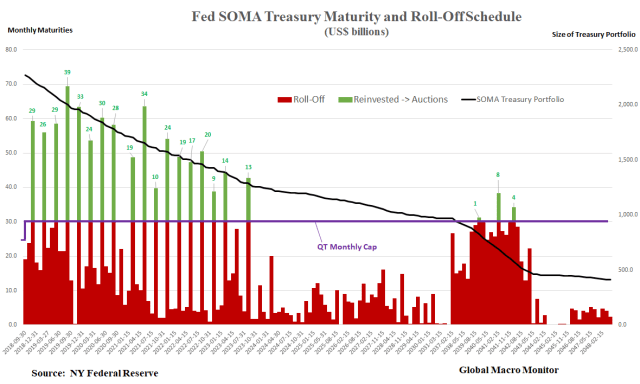
The charts and data show that since 2015,  central banks, have, on average been net sellers of Treasury notes and bonds, to the tune of an annual average of -19 percent of the yearly increase in net new note and bonds issued.  The roll-off of the Fed’s SOMA Treasury portfolio, which is usually financed by a further increase in notes and bonds, does not increase the debt stock, but it is real cash flow killer for the U.S. government.

Unlike the years before 2015, the increase in new note and bond issuance is now a zero-sum game and financed by either the reallocation from other asset markets or an increase in financial leverage.  The structural change in the financing of the Treasury market is taking place at a unpropitious time as deficits are ramping up.

Because 2017 was unique and an aberration of how the Treasury fnanced itself due to the debt ceiling constraint,  the markets are just starting to feel this effect.   Consequently, the more vulnerable emerging markets are taking a beating this year and volatility is increasing across the board.

The New Market Meta-Narrative 

We suspect very few have crunched these numbers or understand them, and this new meta-narrative, supported by the data, is the main reason for the increase in market gyrations and volatile capital flows this year.   We are pretty confident in the data and the construction of our analysis.   Feel free to correct us if you suspect data error and where you think we are wrong in our analysis.  We look forward to hearing from you.

Moreover, the screws will tighten further as the ECB ends their QE in December.  We don’t think, though we reserve the right to be wrong, as we often are,  this is just a short-term bout of volatility, but it is the beginning of a structural change in the markets as reflected in the data.

Interest Rates Will Continue To Rise

It is clear, at least to us, the only possibility for the longer-term U.S. Treasury yields to stay at these low levels is an increase in haven buying, which, ergo other asset markets will have to be sold.   If you expect a normal world going forward, that is no recession or sharp economic slowdown, no major geopolitical shock, or no asset market collapse,  by default, you have to expect higher interest rates.  The sheer logic is in the data.

Of course,  Chairman Powell could cave to political pressure and “just print money to lower the debt” but we seriously doubt it and suspect the markets would not respond positively.

Stay tuned.


Central Bank_2


Central Bank_5


Central Bank_10


Posted in Black Swan Watch, ECB, Fed, Uncategorized | Tagged , , | 34 Comments

The Economic Consequences of Mr. Trump – Project Syndicate

With unemployment at a 50-year low, wages starting to pick up, and the stock market booming, the US economy has defied expectations since the 2016 election. Nobel laureates Angus Deaton and Edmund Phelps, along with Barry Eichengreen, Rana Foroohar, and Glenn Hubbard, ask why, and whether what looks like a robust recovery is masking another crisis in the making. ** This film was created in collaboration with the Center on Capitalism and Society at Columbia University.

Learn more at https://capitalism.columbia.edu and https://capitalism.columbia.edu/econo…

** Keep up to date with PS films by subscribing to our YouTube channel: https://www.youtube.com/project-syndi…

Posted in Economics, Uncategorized | Tagged , | Leave a comment

And little children will lead them

Wolves will live with lambs. Leopards will lie down with goats. Calves, young lions, and year-old lambs will be together, and little children will lead them. – The Book of Isaiah

The country should take the lead from these children.  Sure could use a little more of this these days.


Posted in Uncategorized | Leave a comment

America Thirst: China’s Flows Worrisome – Art Cashin

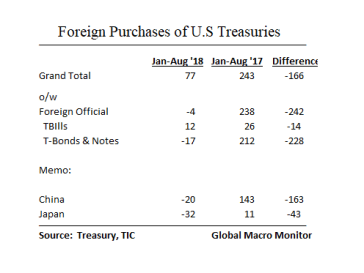
Just before the close, Art Cashin, one of the best out there, cited the weak Treasury auctions and, ergo, worries China is pulling back on its Treasury purchases as a major factor behind the ugly stock sell-off.

Soma_3

Click here for Art Cashin’s comments

No Fed

Recall, also no FED participation in the auctions this month, and primary dealers took down a disproportionately large share of new issues this week.  The auctions ranged in size, from 12 to 42 percent larger relative to October 2017 in each maturity.

Free Ride Over

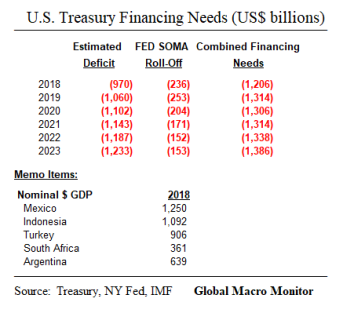
That is the Treasury financing needs due to larger budget deficits and quantitative tightening are growing rapidly.   The almost two decade long free ride and free money from central banks, including China and Japan,  is over.

Of course,  international reserves could begin to build rapidly forcing central banks into more Treasury securities but that scenario runs contrary to President Trump’s policy.  The administration is moving in the opposite the direction seeking to reduce bilateral trade deficits and hammering countries with weak currencies, defined, we suspect, based on purchasing power parity (PPP).  Foreign exchange intervention to maintain a stronger currency will lead to more foreign central bank selling of Treasury securities.

Nationalism can be a real bitch when you’re dependent on foreign financing.  Hope the administration gets woke before it’s too late.  We may have already screwed the pooch.


Soma

Hope you have been reading the Global Macro Monitor over the past month, folks. We gave you the heads up here:

The Gathering Storm In The Treasury Market 2.0
Free Ride Is Over: China & Japan Bailing On Treasuries

Central banks and foreigners have accumulated almost 75 percent of the  stock of marketable notes and bonds.  That liquidity is/has  dried up,  folks.   America First soon to be America Thirst?

The budget mess is also starting to get loopy.  That is higher interest rates = higher interest payments = higher deficits = higher borrowing requirements = higher interest rates…  Wash, rinse, repeat.    Yes, Mr. Vice President, deficits do matter when they have to be financed by normal means.

The free ride is over, Edgar, and winter is coming.  –  GMM, Oct 17th


TIC_12

We should be out in the next few days with some barn burning and eye-opening data all tied to what we think is the meta narrative driving global market weakness.

The U.S. Treasury bond market is the center of universe, of which all asset markets are priced and circle.   Traders and investors must understand its dynamics, and not just in pricing but the kinetics of how it is funded.

Haven flows and/or another round of QE are the only hope of holding U.S. long-term yields down.  Not exactly a positive scenario, comrades.

Stay tuned.

Posted in Bonds, Budget Deficit, Capital Flows, Uncategorized | Tagged , , , | Leave a comment

Foreigners Fleeing Treasuries

You heard it here first, folks.   More analysis to come.  Only massive haven flows can save the bond market, and that ain’t good, is it?

Posted in Uncategorized | Leave a comment

Mr. October And Me

Ahh, the Fall Classic!

We’re not talking about October stock market corrections but the World Series!   The Boston Red Sox and Los Angeles Dodgers square off tonight to begin the 114th October Classic.

Reggie_3

The last time the two teams met was in 1916 when the Dodgers were test driving a new nickname, the “Robins.”   The Red Sox beat Brooklyn four games to one.  Casey Stengel starred for the Robins, and Babe Ruth pitched thirteen shutout innings after giving up a run in the first inning to win the fourteen-inning game two.  The winning players share (World Series bonus) was $3,910 ($87,500 in 2018 dollars) versus the last year’s Astros’ player share of  $438,901.

Mr. October

No baseball player is more synonymous with the World Series than Mr. October himself, Reggie Jackson.

Reggie_2

Jackson earned the nickname “Mr. October” with his performance in Game 6 of the 1977 World Series against the Los Angeles Dodgers. Down 3-2 in the fourth inning, the Yankees outfielder hit a two-run home run and did the exact same thing in the fifth inning. Then in the eighth, he hit another home run to put the Yankees up 8-3. His performance secured the win and the series for New York.
Athlon Sports

Reggie and Me

I have truly lived a Walter Mitty life.

The first twenty-five years of my life was baseball, 24/7, an obsession that almost compares to today’s techno-addicted youth.

My baseball career ended due to an injury, but also mainly the lack of emotional maturity and the ability to pull out of an ugly hitting slump.  Nothing worse for your confidence than cruising along during the season hitting .350, then to fall into a 2-for-50 tailspin.  Then comes the vicious circle thinking you will never get another hit.  Ironically, baseball players can fail 70 percent of the time, and still hit .300, making  it to the Hall of Fame.

It’s very similar to what happens to your psyche and P&L, trying to trade crude oil and natural gas against the ‘bots.  You gotta shake off the bad ones and move on.   I could’ve been somebody, damn it!

I did have a headstart in baseball as a young teen working with the Los Angeles Dodgers, first as a batboy, then batting practice pitcher, and adjunct bullpen catcher.  Later, I would spend some time with the Atlanta Braves and Oakland A’s.

I caught Tommy John (TJ) — the real one, who had the surgery named for him – for almost the entire season he was out before his remarkable comeback.  He could barely extend his hand after the surgery but refused to give up.  I would try to hide in the outfield before games but would soon hear Red Adams, the Dodgers pitching coach, calling me to come to the bullpen.

TJ was very wild when he first started on the comeback trail, bouncing curveballs in the dirt, which too often ended up smacking me in the family jewels.  It was a painful year, and it’s  amazing that I could still have children. Tommy John is one of the greatest human beings ever.

Reggie

One winter or spring during the off-season, can’t recall,  I get a call from my boss to come to Dodger Stadium for a few days as Reggie Jackson was going to film a television commercial.  He said the production company might need a pitcher or catcher and I should be around to help Reggie around the clubhouse and stadium.

I wasn’t in the union so being in the commercial was out.

Over the next three days,  Reggie and I became very close.  He treated me like I was his little brother.  Reggie had this larger than life image, with a reputation for a larger than life ego.

…it all flows from me. I’m the straw that stirs the drink – Reggie Jackson,  Sports Illustrated, May 1977

He took a lot of heat for that quote, and still denies it,  and I certainly didn’t see the Reggie ego the media often portrayed.   He was super kind, friendly, down to earth, always made time for you, and was just a great guy to hang out with.  He made you feel comfortable and not conscious you were in the presence of one of baseball’s greatest stars.  It was very much like a good day hanging with your big brother.

Self-centered egomaniacs don’t treat the little people like that.

One thing that really stood out over our three days together was how Reggie spoke.  He sounded like an university professor, very intelligent,    Later I found out he has an IQ of 160, the same as Steven Hawking!   That is genius zip code.

Pumas  

What really sealed the deal was when Reggie finished filming and was about to leave.  He handed me a piece of paper with an address and phone number:

22 Yankee Hill
Oakland, Ca
(415) xxx-xxxx

He said when I was in the Bay Area; I would never stay in a hotel but with him.   I believe that house burnt down in the 1991 Oakland Hills fire.

He then asked for my shoe size and address.  We shook hands and parted ways.

About a week later five boxes of Puma tennis shoes came in the mail.  Thank you,  Reggie!

Baltimore Orioles

The next season,  the A’s traded Reggie to the Baltimore Orioles as a rental.  He was playing out his option and Charles Finley, the A’s owner, would never pay Reggie’s new market rate.

Reggie

My little brother idolized Reggie, so when the O’s were in town, I took him to a game.  After the game,  I went down to the dugout to say hi as Reggie trotted in from the outfield.  He invited me into the clubhouse.  I asked Reg if my little brother could accompany me.  He said absolutely.

I had told Reggie about my brother, and when we get into the clubhouse, he points to his locker and says,  “Geoff, anything, take anything you want. My uniform, glove, anything.”   Big egos and the self-absorbed don’t treat little people like this.

I love Reggie Jackson.

Pete Rose

Pete Rose was the same way, by the way.  Always thinking and caring about the little guy.

The commish of baseball,  Bart Giamatti, my favorite actor’s father,  died just eight days after banishing Charlie Hustle from baseball.   Just sayin’.

Let’s play ball.   Dodgers in six.

Posted in Uncategorized | 5 Comments

How to prepare for the next global recession | The Economist

Posted in Economics, Video | Tagged , | Leave a comment

Harbinger? Dropping Like A BlackRock

Blackrock

                   Source:   Holger Zschaepitz @Schuldensuehner

Wow.   Completely missed the 34 percent flop in Blackrock, the world’s most massive shadow bank, from its $594.52 January high.   Now trading through the key $400 level, with the next significant support to the downside at $380.   Thanks to Holger for bringing it to our attention.

It looks like it’s all about institutional outflows and diminishing marginal inflows caused by, what Larry and Rob call de-risking, and mainly by the hedge funds.

Sure not seeing the de-risking it in the 10-year Treasury yield, which is another story, and why this year’s two equity corrections/sell-offs are different. , in spite of a persistent massive short position by specs in the 10-year note futures

Blackrock_1


Blackrock_2

Source:   October 15 earnings release

Key comments from the conference call

Question-and-Answer Session

Operator

[Operator Instructions] Our first question comes from Dan Fannon with Jefferies.

Dan Fannon

Thanks. Good morning.

Laurence D. Fink

Hi, Dan.

Dan Fannon

I guess, Larry, could you elaborate on your broader comments about de-risking? It seems based on your commentary that we — it should likely continue here in the short-term and we’re seeing it through your index products. So I guess are there other kind of asset classes we — that you’re seeing that in? And then also, is there a capture rate where you’re seeing flows going into other categories that are obviously less risky?

Laurence D. Fink

I will let Rob talk about it and then I will add to it after him.

Robert S. Kapito

So I think, Larry, mentioned increased trade tensions, emerging markets volatility, and certainly the fear of continued interest rate rises across the globe. So what happens, especially during that type of volatility period is clients de-risk. So depending upon the next couple weeks and some of the political issues as well and the volatility that’s out there, clients may continue to de-risk. Certainly, we’ve seen the hedge funds de-risk from a period of time where I think across the board most of them are already down 2% 4%, so getting below that is difficult for many hedge funds, so they’ve just risked — de-risked. And we also, depending upon the guidelines of the clients and what we think about the markets, we encourage either de-risking or risking depending upon what their objectives are. The goal for us is even in that de-risking, to capture those assets because whatever they’re selling and going into, we have that product. So whether clients move from equity to fixed, we can accomplish that. Whether they’re going from value to growth, long duration to short duration, out of emerging markets into emerged markets, our goal is to offer a holistic solution so that they can de-risk and then be ready to put the risk on with us as well. And that also moves from product to product, whether they do it in iShares, and typically they’ll do that in the non-core iShares that have the most liquidity. Clients in the core iShares do that less because they’re more buy-and-hold. So, we see that more in the active products, and I think that really describes a lot of the flows this quarter.

Laurence D. Fink

Let me just add a little more. I think the market movements post third quarter was, as Rob said, more hedge funds de-risking. We did not see any accelerated outflows in the first few weeks. I think, Dan, when you think about some of these big large strategic partnerships we announced, none of that was asset flows this quarter. All of this is going to be huge asset flows probably in 2019. And this is why we are spending so much time trying to develop these deeper relationships. We are not going to be able to predict or strive for any one quarter, but I do — we’re very excited about the  opportunities of building these deeper relationships that over time are going to really push us towards a much higher growth rate. That being said, if the markets remain to be uncertain, if political risk remains large, you will continue to see clients pause. We’ve seen this in the past. Generally, in the fourth quarter, we see clients adding risk that is typically what happens especially November, December. We — and so, I’m not here to tell you, I know how this will all play out, but we are continuing to see large interest from our clients in our technology businesses, we’re continuing to see large interest from our clients in our alternative space and let me also talk about the breadth of our active business for a second. We had positive active flows in fixed, in multi-asset, and in alts. The only area where we had outflows that were significant was in the low-fee index products, and that I think, Rob Kapito has talked about this for years, that’s where we see how people navigate money. They go in and out of index funds in large-scale as an indicator of their market beliefs. So — and I would also say unlike most organizations in the industry we had positive flows in U.S wealth in our retail side. So I don’t know the outcome of this quarter or political uncertainty, but all I could say is we’re — we have very strong conversations going on right now with really important clients and we will see how that plays out.

Posted in Earnings, Equities, Uncategorized | Tagged , , | 24 Comments

Strength And Beauty In Our Diversity

Posted in Uncategorized | Leave a comment