-
In economics, things take longer to happen than you think they will, and then they happen faster than you thought they could.
-
Join 1,206 other subscribers
Contribute To GMM
Categories
- 3D Printing
- Agriculture
- AI
- Algos
- Apple
- Automation
- Banking
- BFTP
- Bitcoin
- Black Swan Watch
- Bonds
- Brazil
- Brexit
- BRICs
- Budget Deficit
- Capital Flows
- Cartoon of the Day
- Cashless Society
- Chart of the Day
- Charts
- China
- Clean Tech
- Climate Change
- Coach C
- Commodities
- Coronavirus
- COVID
- Credit
- Crude Oil
- Currency
- Cyprus
- Daily Risk Monitor
- Day In History
- Debt
- Demographics
- Disinflaton
- Dollar
- Earnings
- ECB
- Economics
- Economist
- Egypt
- Electric Vehicles
- Emerging Markets
- Employment
- Energy
- Environment
- Equities
- Equity
- Euro
- Eurozone Sovereign Spreads
- Exchange Rates
- Fed
- Finance and the Good Society
- FinTech
- Fiscal Cliff Monitor
- Fiscal Policy
- Food Prices
- France
- Futurist
- Game Theory
- General Interest
- Geopolitical
- Geopolitics
- German Bund
- Germany
- Global Macro Watch
- Global Reset
- Global Risk Monitor
- Global Stock Performance
- Global Trend Indicators
- Gold
- Greece
- Healthcare
- Heat Map
- Hedge Funds
- Housing
- Human Interest
- Immigration
- Impeachment
- India
- Inequality
- Inflation/Deflation
- Infographics
- Innovation
- Institutional Investors
- Interest Rate Monitor
- Interest Rates
- Interviews
- Italian Yields
- Italy
- Japan
- Jobs
- Lectures
- Macro Notes from Conference Calls
- Manufacturing
- Masters
- Mexico
- Monetary Policy
- Movies
- Muni Bonds
- Muni Market
- Natural Gas
- News
- Nonlinear Thinking
- North Korea
- Overbought Markets
- Picture of the Day
- PIIGS
- PMIs
- Policy
- Politics
- Population
- Populism
- Poverty
- President Trump
- Qunat Strategies
- Quote of the Day
- Quotes
- Rare Earth Elements
- Readership
- Reads
- Real Estate
- Relative Strength Index
- Robert Shiller
- RSIs
- S&P500
- Sector ETF Peformance
- Semiconductor prices
- Semiconductors
- Social Media
- Socialism
- Song for the Week
- Sovereign Debt
- Sovereign Risk
- Spain
- Sports
- State and Local Government
- Tail Risk
- Technical Analysis
- Technology
- The Big Reset
- The Weekend Read
- This Day In Financial History
- Trade War
- Trades
- Tweet of the Day
- Ugly Chart Contest
- Uncategorized
- US Releases
- Video
- Volatility
- Wages
- Week Ahead
- Week in Review
- Weekend Reads
- Weekly Eurozone Watch
- Whales
-
Recent Posts
Meta
Week In Review – July 27
Summary
- U.S. 10-year yield wider on the week and pushed toward 3 percent. GDP data good but below whispers
- Turkey 10-year rates out 72 bps as concerns over lack of liquidity, indie monetary policy, and Trump threats
- Some decent tightening in U.S. corporate credit spreads
- Italy sovereign spread out 12 bps
- Japan 10-year JGB yield doubles on spec BoJ policy in for some changes
- China RMB 2 percent weaker
- EM currencies continue July bounce
- Decent week for global stocks, led by Argentina’ continued recovery
- Nasdaq hammered on Facebook swan dive and FANG sell-off
- Russell down 2 percent on the week
- Lumber continues in a bear market
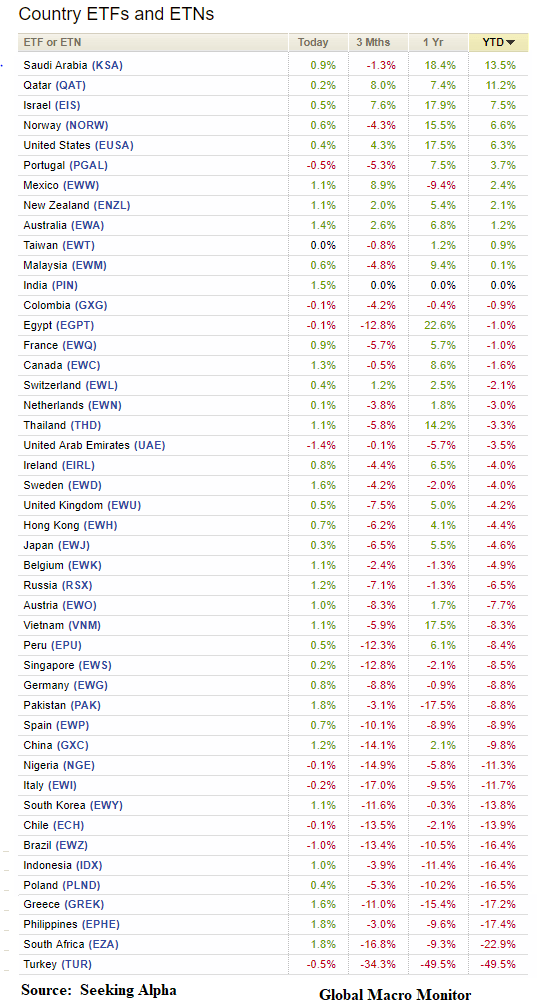
- Saudi and Qatar only country ETFs with double-digit returns
Commentary: None. Prepare for dog days of August, no liquidity, and typically an ugly month for equity returns.
Inflation Cometh (to the Beige Book)

Big JGB Yield Move

US GDP Release

Foreigners Sell Record Italian Bonds

August Performance For S&P500


Posted in Uncategorized, Week in Review
Tagged bonds, Commodities, Currencies, Global equity markets, Performance, Stocks, Week in Review
Leave a comment
Pakistan election: Challenges over economy and legitimacy
FT South Asia correspondent Kiran Stacey looks at the challenges facing the victor of Pakistan’s election, Imran Khan, over his legitimacy following vote-rigging claims and an economic crisis that could lead to an IMF bailout.
► Subscribe to FT.com here: http://bit.ly/2GakujT
Posted in Emerging Markets, Uncategorized
Tagged Election, IMF, Imran Khan, Pakistan
Leave a comment
Global Risk Monitor – July 27


Posted in Daily Risk Monitor, Uncategorized
Tagged bonds, Commodities, Currencies, Global Stock Markets, Peformance, Stocks
Leave a comment
The Future Of Facebook And The Social Challenge Of Technology
Wow!
Haven’t seen a swan dive like that in a major large-cap stock since the GFC. Facebook’s crash took the stock down as much as 25 percent to a low price of $164.30 just a little before 6 pm eastern.
Facebook Swan Dives After Earnings Release

The stock took out its 50, 100, and 200-day moving average ($181.52) in one fell swoop. The 20 percent plus plunge seems overdone, and a bounce is likely but what do we know.
FB Widely Owned By Hedge Funds
Zero Hedge reports that Facebook is the top stock that most frequently appears on the largest ten holdings of hedge funds. That could complicate things in trading at tomorrow’s open with margin calls, but it’s probably too late for those who don’t have to sell. Better to wait and get out on a bounce or even buy some for a trade on a margin puke with a stop at $164, tonight’s AH low.
Revenue Growth
The company announced that Q2 2018 y/y revenue growth was up 42 percent. Stunning


What The Market Didn’t Like This
We think Facebook is running up against the law of large of numbers and management is finally beginning to recognize that fact. Companies this size usually begin to trade like utilities as it is difficult to continue to maintain the rapid revenue growth with such a high base. The FAANGs have not yet succumbed to that conventional wisdom just yet.
The market definitely didn’t like the guidance on revenues and margins,
Revenue deceleration:
Chief Financial Officer David Wehner said shareholders can expect “revenue growth rates to decline by high single-digit percentages from prior quarters” for the third and fourth quarter.
“We plan to grow and promote certain engaging experiences like Stories that currently have lower levels of monetization, and we are also giving people who use our services more choices around data privacy which may have an impact on our revenue growth,” said Wehner. He also said currency fluctuations would hurt the stock in the second half of the year, after helping it for the last several quarters.
Weaker margins:
Wehner also said the company expects margin compression, with operating margins trending towards “mid-30s on a percentage basis,” compared to second quarter operating margins of 44 percent.
That tightening is the result of broadening markets, investments in news products — like the recent introduction of the company’s long-form video format, IGTV — and capital expenditures related to safety and security that total “billions of dollars,” Wehner said.
“We think that’s the right thing to do for the business in terms of ensuring the community, safety and durability and the franchise,” he said. “But they don’t have obviously immediate translation in to revenue dollars.”
Effects of privacy changes:
Facebook has made several privacy policy changes in recent months in the wake of the company’s Cambridge Analytica privacy scandal and recently enacted General Data Protection Regulation (GDPR), a set of rules that give users more control over their online data.
The company’s earnings report revealed some of the earliest effects of the GDPR rules, which took effect in May, with the company reporting fewer daily active users in Europe. But the report only encompasses the first month of those changes.
“GDPR hasn’t had a revenue impact but we also fully recognize it wasn’t fully rolled out,” Chief Operating Office Sheryl Sandberg said on the earnings call. “As we look further out, we recognize there’s still risk and we’re going to watch closely.” – CNBC
We Don’t Like The Social Media Economy And Its Long-Term Business Model
An economy dominated by social media giants, which generate their revenues from advertising based on content that attracts the most eyeballs, doesn’t really produce anything, and effectively sells its users privacy, is not going to make a nation rich and its population prosperous. Moreover, in our opinion, social media reduces overall economic productivity.
Furthermore, it won’t be long, we believe, before the social media giants are under siege with lawsuits based on their contribution to the rise in mental illness among the nation’s youth.
We admit not a great investment or trading strategy. As Chuck infamously once said, “As long as the music is playing, you’ve got to get up and dance.”
Facebook has acknowledged that social media use can be bad for users’ mental health, a sign the company is feeling pressure from a growing chorus of critics raising alarms about the platform’s effect on society.
Researchers for the social network admitted in a blogpost Friday that studies have found that spending time on Facebook “passively consuming information” can leave people “feeling worse”, but also argued that part of the solution is to engage and interact more with people on the platform.
The company’s public recognition of some of its platform’s detrimental effects came days after a former Facebook executive made headlines with a speech slamming the corporation, saying: “The short-term, dopamine-driven feedback loops that we have created are destroying how society works. No civil discourse, no cooperation, misinformation, mistruth.” – The Guardian
Dopamine is the new nicotine, folks.
Moonshots
The moonshots of Google and Facebook are the great economic hope; however, for now, the companies remain almost entirely dependent on ad revenues
Our April Post
In April. we posted a kind of tongue in cheek, half serious piece on why Google was a short.
That brings us to the Google (we are old school and can’t bring ourselves to call it Alphabet) short.
Imagine when a politician has his/her epiphany that all those porn searches they have done over the years on Google are stored somewhere and could be hacked and released to the public? That will ignite a prairie fire of potential legislation, which will spread faster than you can say SNAP. – GMM, Apr 24th
Mothers Don’t Let Your Traders Grow Up To Be Investors
There wasn’t much money in that trade, maybe $10, at most, and your face was ripped off if you stayed with the short
The Rise Of Sextortion
Nevertheless, we don’t think it is 100 percent coincidental that Facebook’s stock plunges 25 percent the same day Zero Hedge posts a piece on “Sextortion.”
Here’s a clever new twist on an old email scam that could serve to make the con far more believable. The message purports to have been sent from a hacker who’s compromised your computer and used your webcam to record a video of you while you were watching porn.
The missive threatens to release the video to all your contacts unless you pay a Bitcoin ransom. The new twist? The email now references a real password previously tied to the recipient’s email address. – Zero Hedge
Another Nigerian Phishing Scam?
Interestingly we have noticed a growing number of emails in our spam box over the past few months, such as the following,
…you recently viewed the child porn on your system, and the site on which you viewed the porn captured your details. So information about your location (IP Address, Mac address), other sensitive information (browser cookies, social media links, browser history) and your social contacts (facebook friends, email contacts) were collected and sent to my server.
All of these details will be automatically forwarded to the concerned police departments including Internet Child Exploitation (ICE) Unit, and FBI exactly 24 hours from now on (I have the special tracking pixel in this email which has been activated right after opening of this email). Believe me, all of the information will be enough to put you behind the bars for the years to come.
However, if you send exactly 0.2 BTC (Bitcoins) to the below address in the next 24 hours, then my servers will automatically delete all of your information and you can continue to live your life.
We didn’t send the bitcoin.
Scary
Some, even entirely innocent victims, who the closest thing they have watched to porn is the Brady Bunch, will be extorted and end up paying the bitcoin. Reputation phobia is much easier to exploit than most realize.
It is only going to take one hacker releasing something like the above – real or fake – that will generate a torrent of legislation, which will likely crush the business model of many social media stocks. A risk that Zuck addressed in the earnings call, i,e,, protecting the privacy of its users, and a problem the market completely ignores, in our opinion.
Deep Fakes
Technology is going rogue, folks.
In January this year, a new app was released that gives users the ability to swap out faces in a video with a different face obtained from another photo or video – similar to Snapchat’s “face swap” feature. It’s an everyday version of the kind of high-tech computer-generated imagery (CGI) we see in the movies.
In December 2017, Motherboard broke the story of a Reddit user known as “deep fakes”, who used AI to swap the faces of actors in pornographic videos with the faces of well-known celebrities. Another Reddit user then created the desktop application called FakeApp.
It allows anyone – even those without technical skills – to create their own fake videos using Google’s TensorFlow open source machine learning framework. – The Conversation
Not to mention what the Russian ‘bots did to, and how they affected, the 2016 presidential election.
Midterm “Deep Fake” Oppo Research
It’s coming.
We expect “deep fakes” (probably not just porn) to proliferate as we approach the 2018 midterm election. Most likely peaking a few days or week before election day leaving little time for a candidate’s rebuttal
Thomas Jefferson must be rolling over in his grave,
“An educated citizenry is a vital requisite for our survival as a free people.” – Thomas Jefferson (paraphrased?)
Get ready for a wild frickin’ ride, folks. The complete weaponization of social media.
Reality is blending with the virtual, the real with the fake, and fewer and fewer can, and are finding it increasingly difficult to distinguish the difference.
Alphabet Revenue Growth Up 26 Percent
Alphabet announced earnings last night with a whopping 25.6 percent quarterly y/y revenue growth (23 percent on a constant currency basis). See earnings release here.

It is stunning to us that an almost $900 billion market cap company can grow this fast. The quarterly increase in revenues relative to the 2017 quarterly was larger than the entire 2018 GDP of Montenegro.
AI
The CEO, Sundar Pichai, opened his remarks and spent a lot of time on Artificial Intelligence (AI), which is at the center off all things these days,
The common thread you’ll hear on today’s call is the benefit of machine learning and AI, and how it’s improving our products and generating great results for our users and partners.
..,Today, I’ll start with how AI is enabling us to advance the mission of making information accessible and useful to everyone in new ways. Then, I’ll share updates on our computing, video and advertising platforms which are helping our partners succeed and grow. And finally, I’ll talk about our growing cloud business.
Let’s begin with AI helping our mission. We revamped the Google News app in May to create reviews. It uses machine learning to highlight top stories organized for users, explore topics more deeply with articles from a range of clustered news sources. We believe in the need to deliver high-quality information and news to users, and to support the news industry as we do so.
The Google Assistant is another the great product based on machine learning. By the end of this year, it will be available in more than 30 languages and 80 countries. We have worked with partners to expand the number of smart devices that are now compatible with the Google Assistant like doorbells, dryers, refrigerators and more, and connect with more than 5,000 devices in the home.
At Google I/O, we also highlighted how AI is improving Google Maps, including enhancing the experience with Assistant and AR features. Through our improvements in machine learning, we have seen a 25x increase in our ability to build maps algorithmically, and we have added 110 million algorithmically drawn buildings to Maps, since the beginning of this year. And with over 1 billion users, we’re continuing to see tremendous growth in maps with especially strong growth in countries like Indonesia, India and Nigeria, each of which are growing over 50% year-on-year.
There are many more great AI powered features we rolled out this quarter including the new version of Gmail with Smart Compose, a new features that helps users craft emails faster. And Google Photos now suggests actions to help you brighten, share, rotate or archive a picture. – Sundar Pichai, Earning Conference Call
Conference Call
Here is the word cloud from the overall conference call and just the Q&A section.
Overall

Q&A

Stock
The stock gapped up at opened, which looks like the high for the day and is now down 2 percent off that high.
Yesterday’s price action looked like a breakout of a classic cup-and handle. Today’s action doesn’t look of feel like a gap and go, and may spend the next few weeks filling that gap.
The close is what matters, however.

Week In Review – July 20
Summary
- Fireworks began at the end of the week with Trump announcing he was not happy with the Fed and currency moves
- Bonds sold on Friday
- EM FX mixed
- The dollar index closed weaker after Trump tweets. Note the dollar fell more that 10 percent during Trump’s first year, and now is moving higher. It is still down over 5 percent since his administration took office
- Stocks relatively quiet, bookended by Turkey, up over 4 percent, and Russia down over 6 percent
- S&P closed at the exact level of last Friday’s close. The only 5th time it has happened in the past 70 years. Weekly S&P500 having trouble closing above 2802
- Financials performed well as the S. yield curved steepened five bps
- Grains up around 4 percent as lumber now in a new bear market after making multi-year highs in May, down over 25 percent
- Only Oil exporter country ETFs with double digit gains this year
Commentary: We noted S&P might have used up its juice after rallying over 3 percent in the first two weeks of the month. Risks are rising as S&P moves into August, one of the most treacherous months. The month of big drawdowns and no liquidity with everyone on holiday. Cautious.


Posted in Uncategorized
Leave a comment