People like Pop, coach of the San Antonio Spurs, make America great. Must view, folks!

People like Pop, coach of the San Antonio Spurs, make America great. Must view, folks!

The hits just keep on coming.
There is a new sheriff in town, the old order is crumbling, and we are afraid the world is going to become much more unstable in the next few years. Assets markets are incapable of discounting or pricing it in.
President Trump Throws Montenegro Under The Bus
In an interview with Fox’s Tucker Carlson last night, President Trump seemed to question the raison d’être of NATO and foreign alliances in general.
Tucker: So membership in NATO obligates the members to defend any member that is attacked. So let’s say Montenegro, who joined last year, is attacked, why should my son go to Montenegro to defend it from attack?
President Trump: I understand what you are saying. I have asked the same question. You know Montenegro is a tiny country with very strong people… They may get aggressive, and congratulations you are in World War III…But that is the way it was set up, don’t forget I just got here.
There are errors and misrepresentations in the above, such as NATO’s Article 5, which has only been invoked once in the aftermath of 9/11, and does not apply when the NATO member is the aggressor.
NATO Expansion Was A Mistake
Before going further let us state for the record, we believe the expansion of NATO without including Russia was a big mistake, unnecessarily provocative, and ruined the West chances of bringing Russia “in.”
With the fall of the Soviet Union and the sudden shift in the military balance in Europe in the early 1990’s, NATO faced an existential crisis. Rather than winding down, the conventional wisdom was that NATO must go “out of area or out of business.” Bureaucracies don’t die easily.
The Russian backlash to NATO’s expansion was devastating. In 1991, 80 percent of the Russian public had a favorable opinion of the United States. After the expansion of the alliance and bombing of Serbia in 1999 without UN Security Council authorization, Russians had a negative view of America. In 2000, Vladimir Putin was elected president of the Russian Federation.
George Kennen
Listen to George Kennen in 1998, the architect of America’s successful containment of the Soviet Union and one of America’s great statesmen of the 20th century, who was “present at the creation” of NATO, and authored the anonymous 1947 Foreign Affairs article, signed ”X,” defining America’s cold-war policy for 40 years,
”I think it is the beginning of a new cold war,” said Mr. Kennan from his Princeton home. ”I think the Russians will gradually react quite adversely and it will affect their policies. I think it is a tragic mistake. There was no reason for this whatsoever. No one was threatening anybody else. This expansion would make the Founding Fathers of this country turn over in their graves. We have signed up to protect a whole series of countries, even though we have neither the resources nor the intention to do so in any serious way. [NATO expansion] was simply a light-hearted action by a Senate that has no real interest in foreign affairs.” – NY Times, 1998
So, to some extent, we agree on many of the philosophical tenets that we think what President Trump believes. The problem lies in implementation and execution.
Just as, we believe, trade disagreements should be settled in a rules-based multilateral framework, such at the WTO.
We also agree with another American president about being suspicious and trying to avoid “foreign entanglements.” The web of foreign entanglements among European nations led to World War I, a war that nobody wanted.
The nation which indulges toward another an habitual hatred or an habitual fondness is in some degree a slave. It is a slave to its animosity or to its affection, either of which is sufficient to lead it astray from its duty and its interest. Antipathy in one nation against another disposes each more readily to offer insult and injury, to lay hold of slight causes of umbrage, and to be haughty and intractable when accidental or trifling occasions of dispute occur. – George Washington
Xi’s One China Policy
What worries us about the Tucker Carlson interview is a potentially destabilizing effect on geopolitics, especially with China.
How do you think Xi Jinping, Trump’s new BFF, who is becoming increasingly aggressive about his “one China” policy, interpreted the interview?
Maybe something like:
“Why should my son go to Montenegro Taiwan to defend it from attack?”
Wars begin with misperception and miscalculation.
Saddam Hussein misread ambiguous messages from the U.S. ambassador believing he could get away with invading Kuwait. In 1950, North Korea may have misinterpreted the Truman administration policy statement, that South Korea was outside the American defense perimeter in the Pacific.
We believe the world is becoming more unstable by the day especially with messages such as the one sent by the president last night.
We don’t like foreign entanglements, though we believe the U.S. should be the first among equals in the community of nations. We also doubt the American public, at the end, of the day, is willing to send “their sons to defend Taiwan” but those are cards we have been dealt by past leaders. To send mixed signals now only destabilizes and invites aggression.
We also sense that President Xi believes that even more than he did yesterday.
Taiwan may be about to get hot, hot, hot in the next year after last night’s Commander in Chief’s ambiguous message on defense treaties.
To stave off an eventual crisis, both capitals must work to ensure that Taiwan does not stand alone, that Taiwan’s people continue to believe in the feasibility of a free and (de facto) independent future, and that the United States and Taiwan’s armed forces can deter and, if necessary, defeat Chinese aggression. – The American Interest
Sidetracked By Geopolitics
We apologize to our readers for being sidetracked with geopolitics and will get back to economics and the markets tomorrow. It is imperative investors and traders understand the magnitude and seriousness of, what we believe, is taking place in the world.
The post-war order is crumbling before our very eyes (or, maybe, we are just seeing pink elephants in the clouds).
Political and geopolitical risk is rising rapidly. The warning lights are flashing.
UPDATE (July 22) – Looks like Fox took down original video and replaced with the following.
It has been over three years since President Trump first launched his successful campaign for the highest office in the land. The then unconventional candidate, and now president: has broken almost every rule in the political playbook; is a walking civic faux pas; has brought a new 24/7 reality show inside the beltway, and turned Washington into the “Greatest Show On Earth.” The ratings are going through the roof!
We are not big fans of the president’s policies, or the person, but we have to admire the man as one of the world’s greatest trolls. He can set his political opposition’s heads on fire at will, and you know he loves it.
As a very close friend, and a Trump supporter, told me on Sunday, “he has set the world on fire!” He doesn’t have children, by the way, so he worries less than I do.
Trump Is Finished, Trump Is Finished. No, He’s President
Countless times President Trump has committed the “unpardonable sin” that would end his candidacy, weaken or end his presidency, and send him to the political dustbin. So they told us.
Yesterday in Helsinki feels different, however.
Standing with Vladimir Putin at his side, the president effectively sided with the old KGB spy. Stating “the United States has been foolish,” the president questioned the veracity of his own administration and the conclusion of the U.S. intelligence community the Russian government hacked the 2016 presidential election to help Trump win. Nothing new he hasn’t said before, but standing next to the Russian president? Jaw-dropping.
The president is now on the defensive with his tweet this morning about how great his meeting with NATO and “even better meeting” with Putin went, and is “sadly” not being reported – “the Fake News is going Crazy!”
Not so. The criticism and condemnation of yesterday’s Helsinki presser is universal and widespread,
Even Abby Huntsman, the Fox News Channel Anchor/Co-Host of Fox & Friends Weekend, and daughter of the president’s current ambassador to Russia, Jon Huntsman, tweeted yesterday,
By the way, we supported Jon Huntsman when he ran for president in 2012, a campaign that never got any traction. He left office as the governor of Utah with an 80 percent approval rating, has a first-rate intellect and impeccable character, and positioned in the sweet spot of the political spectrum, in our opinion. Watch that guy.
Water Cooler Talk To Predict Elections
Finally, I am a big proponent of political “water cooler talk,” such as political cartoons, satire, and tuning into jokes overheard on the train ride home, etc., to get a better feel for the political landscape and mood of the voters. Even as artificial intelligence and big data become more ubiquitous, predicting the outcome of elections is becoming increasingly more difficult and more uncertain. Those damn ‘bots and millennials with cell phones!
We suspect the Helsinki debacle may have been President Trump’s “Hanoi Jane (Fonda) Moment,” the abomination of desolation, and is going to turn many, including the military, and especially officers, against him. Times may be a-changin’ for the president. We have said it before and have been wrong.
Let me finish with a personal story from an earlier life and then I will post some of the latest political cartoons making the rounds.
By the way the ‘toons are observations, data points for us, and not endorsements. They do reflect what we see as a changing mood, They are now coming fast and furious. We suspect there are several web scraping algos to measure the mood of the political cartoon world and make predictions.
Lech Wałęsa Goes Ice Fishing
Right after the Berlin Wall fell, the new Republic of Poland, headed by President Lech Wałęsa, hired me as an economic advisor to help the government restructure its external debt. Recall, Wałęsa, a cult hero of Ronald Reagan and the American conservatives, co-founded and headed Solidarity (Solidarność), the Soviet bloc’s first independent trade union. He won the Nobel Peace Prize in 1983.
We loved wearing our Solidarność t-shirts in college. It was code and a symbol for conservative students to recognize that they were safe with each other just as the fish symbol was for early Christians during their persecution during the 1st century Roman Empire. Frickin’ tribalism is killing and ripping us apart but it was not as bad as it is today when I was in college.
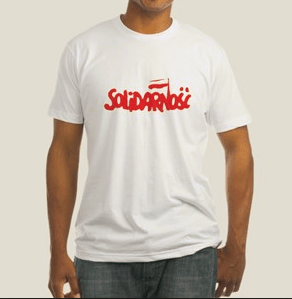
Many credit Solidarity, coupled with the election of a Polish pope in 1978, Karol Józef Wojtyła, who took the name John Paul II, as a significant catalyst in the fall of the Soviet Union.
Front Seat To History
I had a front seat to witness Poland’s conversion from communism to democracy and a market economy, and had the honor to help contribute in the country’s transformation. Poland is now an emerging market economic superstar. It is sad to watch the country join, along with many others, the slow drift away from liberal democracy to authoritarianism. The Poles are good people.
Nevertheless, I worked for a relatively high-level, high profile public official, the U.S. equivalent to, say, the Deputy Secretary of Treasury and spent many hours in the Ministry of Finance. Late in President Wałęsa’s term, I began to hear jokes about the president circulating among the bureaucrats throughout the Ministry.
After hearing the following joke from a high ranking public official, I knew Wałęsa had lost the respect of the Polish people, and there was no way in hell he would be re-elected. My emerging market buddies thought I was crazy.
President Wałęsa lost the 1995 presidential election by 1 percent to former Communist Aleksander Kwasniewski.
The President Goes Ice Fishing
Lech Wałęsa decided to go ice fishing last Sunday afternoon. He cut a hole in the ice and dropped his line. After 10 minutes he had no bites. The president hears a voice from above, “there is no fish here!” He had a little too much vodka the night before and so, at first, he thinks he is just hearing voices.
Lech pulls his line and moves 10 meters north, cuts another hole in the ice, and drops his line. After 15 minutes, no bites. Another voice from heaven rings out, “I told you, there is no fish here!”.
The frustrated president lashes out, “Who is that. Is that you, God?”. No answer.
Wałęsa decides to give it one more try.
He moves another 10 meters, cuts a circle in the ice, and drops his line. After 30 minutes, a thunderous voice from heaven shouts, “Mr. President, I told you there is no fish here!”.
Now very frustrated as the fish aren’t biting and God isn’t answering, President Wałęsa shouts at the top of his lungs, “Who is that? Is that you, God? I am Lech Wałęsa, the president of the Republic of Poland, I demand to know who is speaking to me. Damn it!”
After about a 30-second pause, the voice from heaven responds.
“I am the manager of this ice skating rink!”
So there you have it, folks, not a political statement just a data point, an observation, deduction, and prediction. The political water cooler talk, which led me to conclude Wałęsa would not re-elected, could not have been part of an algorithm, AI, or machine learning program.
Algos don’t drink beer and vodka with Polish bureaucrats. They do, however, spy on their Facebook pages. How likely would it be for a government official to make public such a joke about their boss on a Facebook page? Not very.
Sometimes it really does pay to have boots on the ground. There is still hope for us human analysts.
Massive Lavender Wave Coming In November
We believe there will be a massive “lavender wave,” in the November midterms. Lavender is the color combination of pink and blue.
In a recent poll, the president’s approval rating among men is 54 percent positive and 45 percent negative. Among women, it’s 32 percent positive and 65 percent negative. There are many more women registered voters than men.
In elections, women are also more likely to vote in higher numbers and have done so for decades. Women have casted between four and seven million more votes than men in recent elections.
Moreover, the revulsion toward the president among women has not only made them more likely to vote but has turned them into activists. Women are running for office this year in record numbers.
Recall it was the African-American women who put Doug Jones over the top in Alabama’s special U.S. Senate election against Roy Moore last year. Exit polls showed that 98 percent of black women supported Jones.
Do the math, folks. Listen to the water cooler talk, read the cartoons.
The Dems will control the House, and probably Senate come next January. PredictIt gives the Dems a 68 percent probability of taking back the House but only a 30 percent chance of taking the Senate. We will take that bet, however, a 3,600 percent compounded annual return if Chuck becomes the next Majority Leader.
Here Comes The Walk Back
President Trump is now out trying to clean up yesterday’s mess by parsing the language from the Putin presser,
“In a key sentence in my remarks I said the word ‘would’ instead of ‘wouldn’t,'” Trump said. He explained he reviewed a transcript and video of his remarks.
“The sentence should have been: ‘I don’t see any reason why it wouldn’t be Russia,'” he said. “Sort of a double negative.”
“I think that probably clarifies things pretty good on itself,” Trump said. — CNN
Wow! Very Clintonesque.
“It depends on what the meaning of the word ‘is’ is. If the–if he–if ‘is’ means is and never has been, that is not–that is one thing. If it means there is none, that was a completely true statement – President Clinton, August 1998
Too late, however. President Trump’s “Hanoi Jane” moment is, and has been, in the books for some time.
As Ron Insana tweeted yesterday, markets are incapable of incrementally pricing an increasing probability of big tectonic shifts. That is why markets crash when the shit begins to hit the fan.
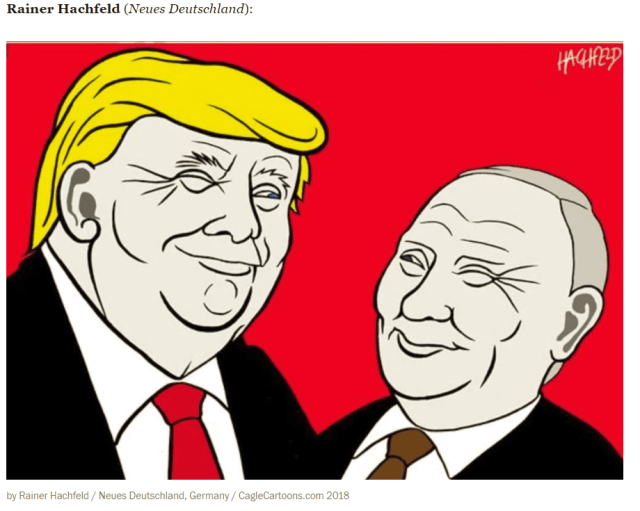
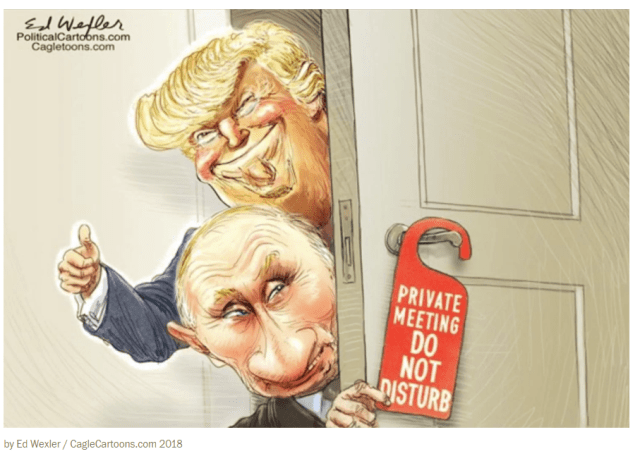
Trump and Putin’s Helsinki summit relationship, as skewered by cartoons
Please view the cartoons and tweets not as a partisan but as a sociologist or social psychologist, trying to better gauge the political climate in the United States.
We look forward to the hate mail and threats.





Insana nails it.
It is also called denial or the inability to distinguish between cyclical issues versus structural shifts, for example. Such as using monetary policy to deal with demographic issues. Stabilization policies or structural reform? Call in the IMF or World Bank? Or the Pope?
Markets In The Land Of Pharaoh
It does feel the markets are in Egypt, however. The land of de Nile.
The post-war international order is more at risk of unraveling – and we are not saying its demise is imminent – than is currently priced.
– Global Macro Monitor, July 11, 2018
July 16, 2018
Fellow shareholders,We had a strong but not stellar Q2, ending with 130 million memberships. Membership growth was 5.2m, the same as Q2 last year, but lower than our 6.2m forecast. – Netflix Investor Relations
Down 14 percent in A.H.

Whether the problem is rising inequality, economic stagnation, or technological disruption, nostalgia offers relief from socioeconomic angst. But far from being innocuous, infatuation with a mythicized past is shaping our politics in dangerous ways, not least by creating fertile ground for jingoistic leaders who are happy to exploit nostalgia for their own ends. – EDOARDO CAMPANELLA
(QOTD = Quote of the Day)
Summary
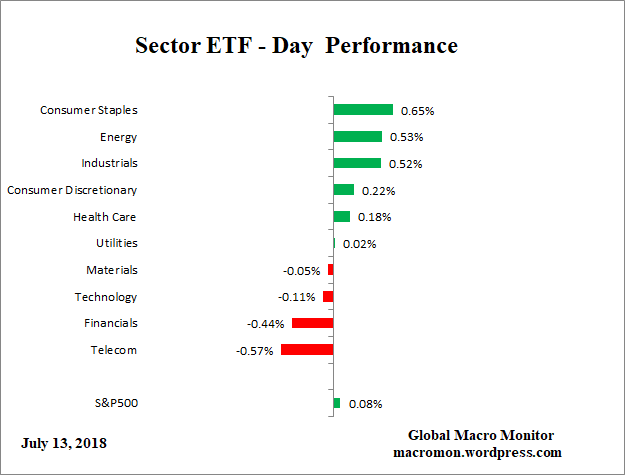
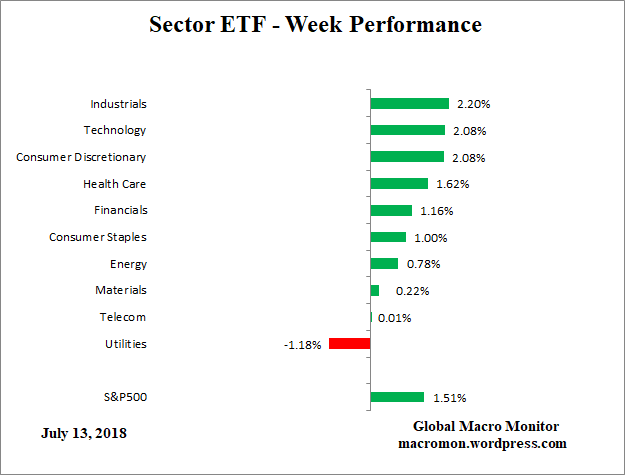
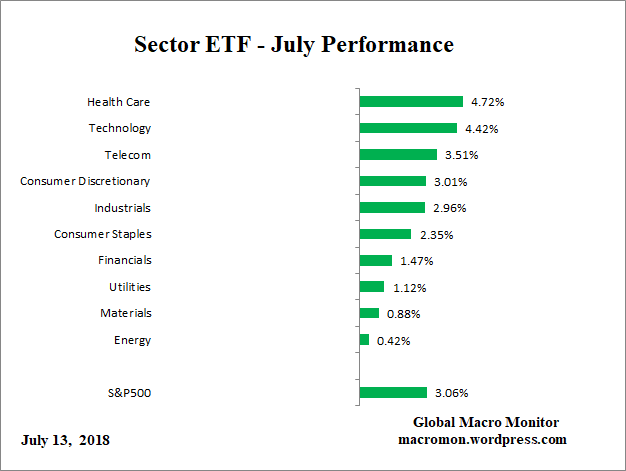
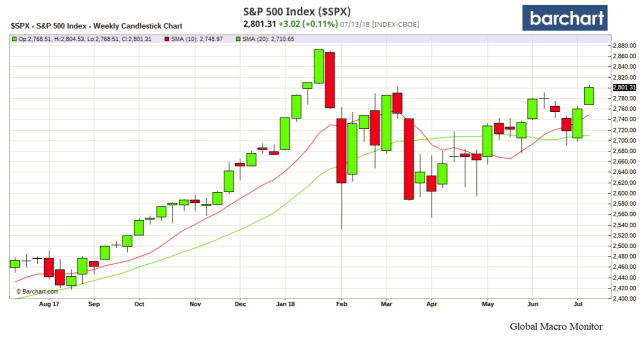
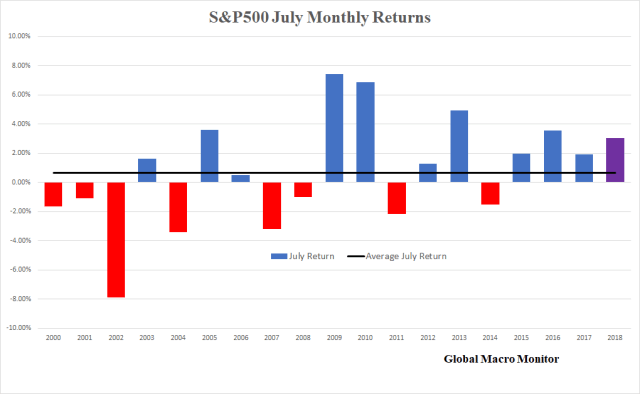
Commentary: The S&P closed the week at its highest level since January correction. There have not been three consecutive green weekly candlesticks since January highs, however. It feels the S&P is ready to break above the critical 2802 level as earnings season kicks into high gear. Already up over 3 percent in July, so history suggests not much juice left in the battery.
Inflation probably running hotter than expected. Watch to see if Chairman Powell throws some shade on the market.
The market also thinks the “trade war” is nothing more than virtual reality. Tell that to the farmers.
Wow!
Everybody got it wrong from the machines to the bookies. There is hope for us mere humans.
The ex-ante MIT Algo had France losing to Brazil in semi-finals. The humans (bookies) had Brazil taking home the World Cup.

Today’s victory erases the bad memory of the Zinedine Zidane’s infamous headbutt – coup de boule – and red card which cost France the 2006 World Cup to Italy.
Hats Off To Croatia
The algos didn’t give them a chance.
Croatia’s GDP is about the same size as the economy of Tulsa, Oklahoma and has a population the size of the Bay Area in Northern California.
An amazing feat to make the finals.
Hope the French victory gives eMac a nice “kick” in the polls.