The Future Of Facebook And The Social Challenge Of Technology

Wow!

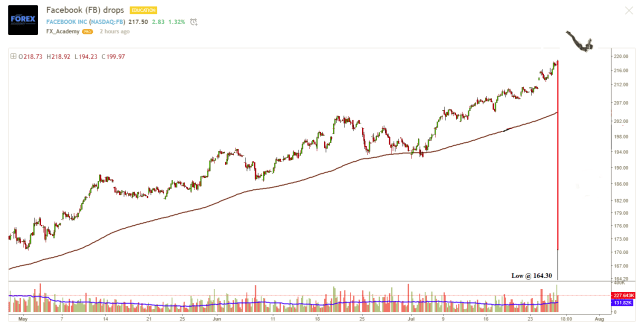
Haven’t seen a swan dive like that in a major large-cap stock since the GFC.    Facebook’s crash took the stock down as much as 25 percent to a low price of $164.30 just a little before 6 pm eastern.

Facebook Swan Dives After Earnings Release
Jul25_FB_1

The stock took out its 50, 100, and 200-day moving average ($181.52) in one fell swoop.  The 20 percent plus plunge seems overdone, and a bounce is likely but what do we know.

FB Widely Owned By Hedge Funds

Zero Hedge reports that Facebook is the top stock that most frequently appears on the largest ten holdings of hedge funds.  That could complicate things in trading at tomorrow’s open with margin calls, but it’s probably too late for those who don’t have to sell.  Better to wait and get out on a bounce or even buy some for a trade on a margin puke with a stop at $164, tonight’s AH low.

Revenue Growth

The company announced that Q2 2018 y/y revenue growth was up 42 percent.  Stunning

Jul25_FB_2

Jul25_FB_3

What The Market Didn’t Like This

We think Facebook is running up against the law of large of numbers and management is finally beginning to recognize that fact.   Companies this size usually begin to trade like utilities as it is difficult to continue to maintain the rapid revenue growth with such a high base.  The FAANGs have not yet succumbed to that conventional wisdom just yet.

The market definitely didn’t like the guidance on revenues and margins,

Revenue deceleration:

Chief Financial Officer David Wehner said shareholders can expect “revenue growth rates to decline by high single-digit percentages from prior quarters” for the third and fourth quarter.

“We plan to grow and promote certain engaging experiences like Stories that currently have lower levels of monetization, and we are also giving people who use our services more choices around data privacy which may have an impact on our revenue growth,” said Wehner. He also said currency fluctuations would hurt the stock in the second half of the year, after helping it for the last several quarters.

Weaker margins:

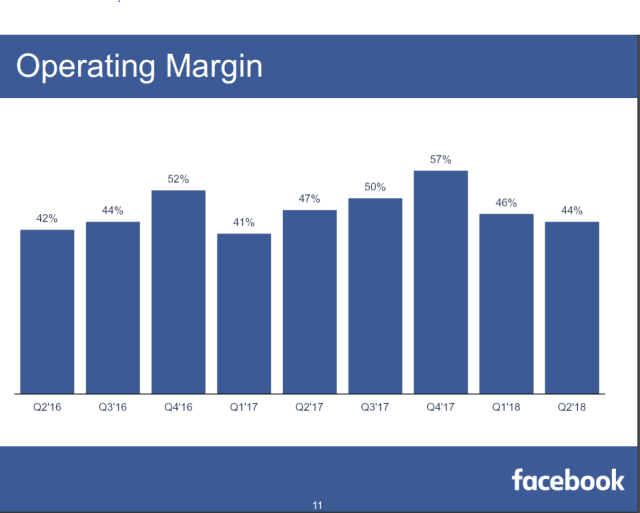
Wehner also said the company expects margin compression, with operating margins trending towards “mid-30s on a percentage basis,” compared to second quarter operating margins of 44 percent.

That tightening is the result of broadening markets, investments in news products — like the recent introduction of the company’s long-form video format, IGTV — and capital expenditures related to safety and security that total “billions of dollars,” Wehner said.

“We think that’s the right thing to do for the business in terms of ensuring the community, safety and durability and the franchise,” he said. “But they don’t have obviously immediate translation in to revenue dollars.”

Effects of privacy changes:

Facebook has made several privacy policy changes in recent months in the wake of the company’s Cambridge Analytica privacy scandal and recently enacted General Data Protection Regulation (GDPR), a set of rules that give users more control over their online data.

The company’s earnings report revealed some of the earliest effects of the GDPR rules, which took effect in May, with the company reporting fewer daily active users in Europe. But the report only encompasses the first month of those changes.

“GDPR hasn’t had a revenue impact but we also fully recognize it wasn’t fully rolled out,” Chief Operating Office Sheryl Sandberg said on the earnings call. “As we look further out, we recognize there’s still risk and we’re going to watch closely.”   – CNBC

We Don’t Like The Social Media Economy And Its Long-Term Business Model

An economy dominated by social media giants, which generate their revenues from advertising based on content that attracts the most eyeballs, doesn’t really produce anything,  and effectively sells its users privacy, is not going to make a nation rich and its population prosperous.  Moreover,  in our opinion,  social media reduces overall economic productivity.

Furthermore, it won’t be long, we believe,  before the social media giants are under siege with lawsuits based on their contribution to the rise in mental illness among the nation’s youth.

We admit not a great investment or trading strategy.  As Chuck infamously once said,  “As long as the music is playing, you’ve got to get up and dance.”

Facebook has acknowledged that social media use can be bad for users’ mental health, a sign the company is feeling pressure from a growing chorus of critics raising alarms about the platform’s effect on society.

Researchers for the social network admitted in a blogpost Friday that studies have found that spending time on Facebook “passively consuming information” can leave people “feeling worse”, but also argued that part of the solution is to engage and interact more with people on the platform.

The company’s public recognition of some of its platform’s detrimental effects came days after a former Facebook executive made headlines with a speech slamming the corporation, saying: “The short-term, dopamine-driven feedback loops that we have created are destroying how society works. No civil discourse, no cooperation, misinformation, mistruth.”  – The Guardian 

Dopamine is the new nicotine, folks.

Moonshots

The moonshots of Google and Facebook  are the great economic hope;  however,  for now, the companies remain almost entirely dependent on ad revenues

Our April Post 

In April. we posted a kind of tongue in cheek, half serious piece on why Google was a short.

That brings us to the Google (we are old school and can’t bring ourselves to call it Alphabet) short.

Imagine when a politician has his/her epiphany that all those porn searches they have done over the years on Google are stored somewhere and could be hacked and released to the public?  That will ignite a prairie fire of potential legislation, which will spread faster than you can say SNAP.  – GMM, Apr 24th

Mothers Don’t Let Your Traders Grow Up To Be Investors

There wasn’t much money in that trade, maybe $10, at most, and your face was ripped off if you stayed with the short

The Rise Of Sextortion

Nevertheless,  we don’t think it is 100 percent coincidental that Facebook’s stock plunges 25 percent the same day Zero Hedge posts a piece on “Sextortion.”

Here’s a clever new twist on an old email scam that could serve to make the con far more believable. The message purports to have been sent from a hacker who’s compromised your computer and used your webcam to record a video of you while you were watching porn.

The missive threatens to release the video to all your contacts unless you pay a Bitcoin ransom. The new twist? The email now references a real password previously tied to the recipient’s email address.  – Zero Hedge

Another Nigerian Phishing Scam?

Interestingly we have noticed a growing number of emails in our spam box over the past few months, such as the following,

…you recently viewed the child porn on your system, and the site on which you viewed the porn captured your details. So information about your location (IP Address, Mac address), other sensitive information (browser cookies, social media links, browser history) and your social contacts (facebook friends, email contacts) were collected and sent to my server.

All of these details will be automatically forwarded to the concerned police departments including Internet Child Exploitation (ICE) Unit, and FBI exactly 24 hours from now on (I have the special tracking pixel in this email which has been activated right after opening of this email). Believe me, all of the information will be enough to put you behind the bars for the years to come.

However, if you send exactly 0.2 BTC (Bitcoins) to the below address in the next 24 hours, then my servers will automatically delete all of your information and you can continue to live your life. 

We didn’t send the bitcoin.

Scary  

Some, even entirely innocent victims, who the closest thing they have watched to porn is the Brady Bunch, will be extorted and end up paying the bitcoin.  Reputation phobia is much easier to exploit than most realize.

It is only going to take one hacker releasing something like the above – real or fake – that will generate a torrent of legislation, which will likely crush the business model of many social media stocks.  A risk that Zuck addressed in the earnings call, i,e,, protecting the privacy of its users, and a problem the market completely ignores, in our opinion.

Deep Fakes

Technology is going rogue, folks.

In January this year, a new app was released that gives users the ability to swap out faces in a video with a different face obtained from another photo or video – similar to Snapchat’s “face swap” feature. It’s an everyday version of the kind of high-tech computer-generated imagery (CGI) we see in the movies. 

In December 2017, Motherboard broke the story of a Reddit user known as “deep fakes”, who used AI to swap the faces of actors in pornographic videos with the faces of well-known celebrities. Another Reddit user then created the desktop application called FakeApp.

It allows anyone – even those without technical skills – to create their own fake videos using Google’s TensorFlow open source machine learning framework. – The Conversation

Not to mention what the Russian ‘bots did to, and how they affected, the 2016 presidential election.

Midterm “Deep Fake” Oppo Research

It’s coming.

We expect “deep fakes” (probably not just porn) to proliferate as we approach the 2018 midterm election.  Most likely peaking a few days or week before election day leaving little time for a candidate’s rebuttal

Thomas Jefferson must be rolling over in his grave,

 “An educated citizenry is a vital requisite for our survival as a free people.” – Thomas Jefferson (paraphrased?)

Get ready for a wild frickin’ ride, folks.   The complete weaponization of social media.

Reality is blending with the virtual, the real with the fake, and fewer and fewer can, and are finding it increasingly difficult to distinguish the difference.
Trouble in River City!

Posted in Equities, Uncategorized | Tagged , , | Leave a comment

Alphabet Revenue Growth Up 26 Percent

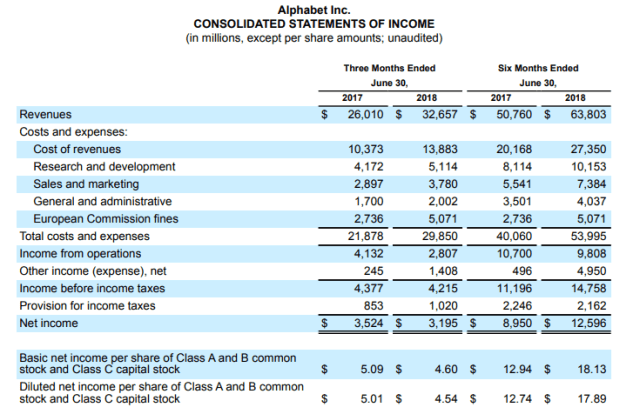
Alphabet announced earnings last night with a whopping 25.6 percent quarterly y/y revenue growth (23 percent on a constant currency basis).   See earnings release here.


Alphabet

It is stunning to us that an almost $900 billion market cap company can grow this fast.    The quarterly increase in revenues relative to the 2017 quarterly was larger than the entire 2018 GDP of  Montenegro.

AI

The CEO,  Sundar Pichai, opened his remarks and spent a lot of time on Artificial Intelligence (AI), which is at the center off all things these days,

The common thread you’ll hear on today’s call is the benefit of machine learning and AI, and how it’s improving our products and generating great results for our users and partners.

..,Today, I’ll start with how AI is enabling us to advance the mission of making information accessible and useful to everyone in new ways. Then, I’ll share updates on our computing, video and advertising platforms which are helping our partners succeed and grow. And finally, I’ll talk about our growing cloud business.

Let’s begin with AI helping our mission. We revamped the Google News app in May to create reviews. It uses machine learning to highlight top stories organized for users, explore topics more deeply with articles from a range of clustered news sources. We believe in the need to deliver high-quality information and news to users, and to support the news industry as we do so.

The Google Assistant is another the great product based on machine learning. By the end of this year, it will be available in more than 30 languages and 80 countries. We have worked with partners to expand the number of smart devices that are now compatible with the Google Assistant like doorbells, dryers, refrigerators and more, and connect with more than 5,000 devices in the home.

At Google I/O, we also highlighted how AI is improving Google Maps, including enhancing the experience with Assistant and AR features. Through our improvements in machine learning, we have seen a 25x increase in our ability to build maps algorithmically, and we have added 110 million algorithmically drawn buildings to Maps, since the beginning of this year. And with over 1 billion users, we’re continuing to see tremendous growth in maps with especially strong growth in countries like Indonesia, India and Nigeria, each of which are growing over 50% year-on-year.

There are many more great AI powered features we rolled out this quarter including the new version of Gmail with Smart Compose, a new features that helps users craft emails faster. And Google Photos now suggests actions to help you brighten, share, rotate or archive a picture.  – Sundar Pichai, Earning Conference Call

Conference Call

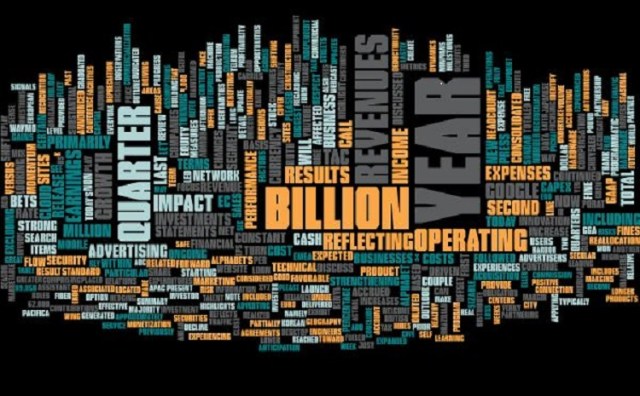
Here is the word cloud from the overall conference call and just the Q&A section.

Overall 

Google_ConCall_Word Cloud

Q&A

Google_ConCall_Word Cloud_QA

Stock

The stock gapped up at opened, which looks like the high for the day and is now down 2 percent off that high.

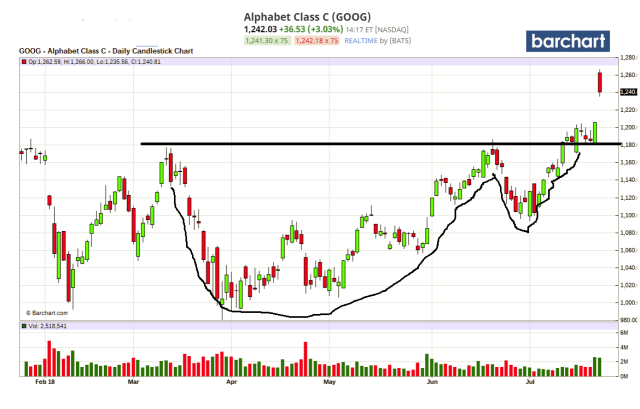
Yesterday’s price action looked like a breakout of a classic cup-and handle.   Today’s action doesn’t look of feel like a gap and go, and may spend the next few weeks filling that gap.

The close is what matters, however.

Jul24_Goog

Posted in Earnings, Uncategorized | Tagged , | Leave a comment

Week In Review – July 20

Summary

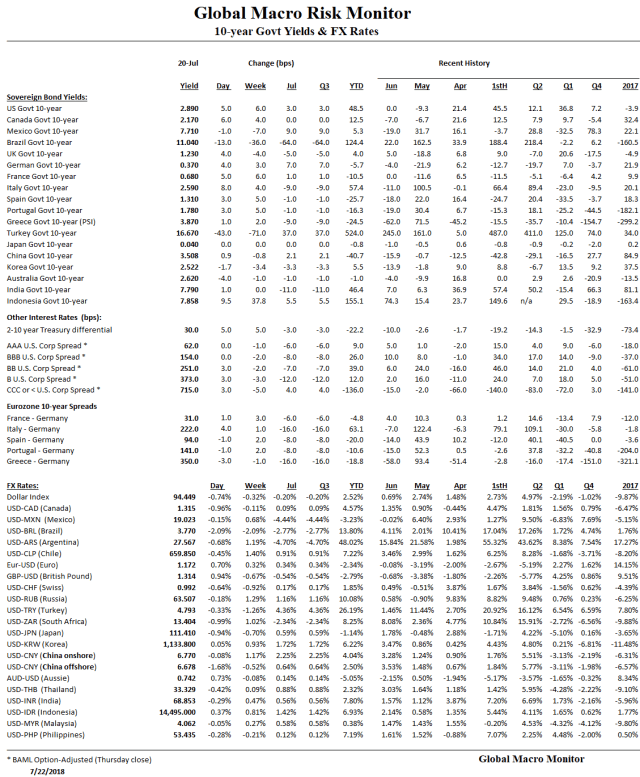
  • Fireworks began at the end of the week with Trump announcing he was not happy with the Fed and currency moves
  • Bonds sold on Friday
  • EM FX mixed
  • The dollar index closed weaker after Trump tweets.  Note the dollar fell more that 10 percent during Trump’s first year, and now is moving higher.  It is still down over 5 percent since his administration took office
  • Stocks relatively quiet, bookended by Turkey, up over 4 percent, and Russia down over 6 percent
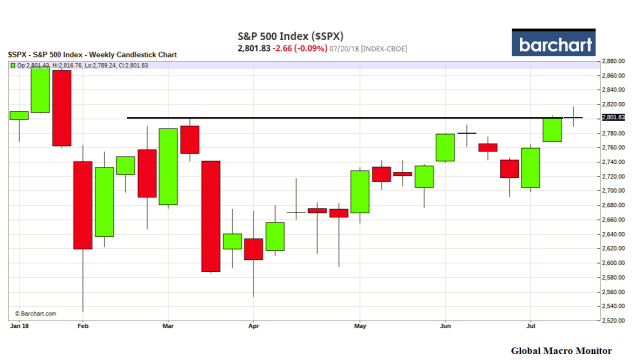
  • S&P closed at the exact level of last Friday’s close. The only 5th  time it has happened in the past 70 years.  Weekly S&P500 having trouble closing above 2802
  • Financials performed well as the S. yield curved steepened five bps
  • Grains up around 4 percent as lumber now in a new bear market after making multi-year highs in May, down over 25 percent
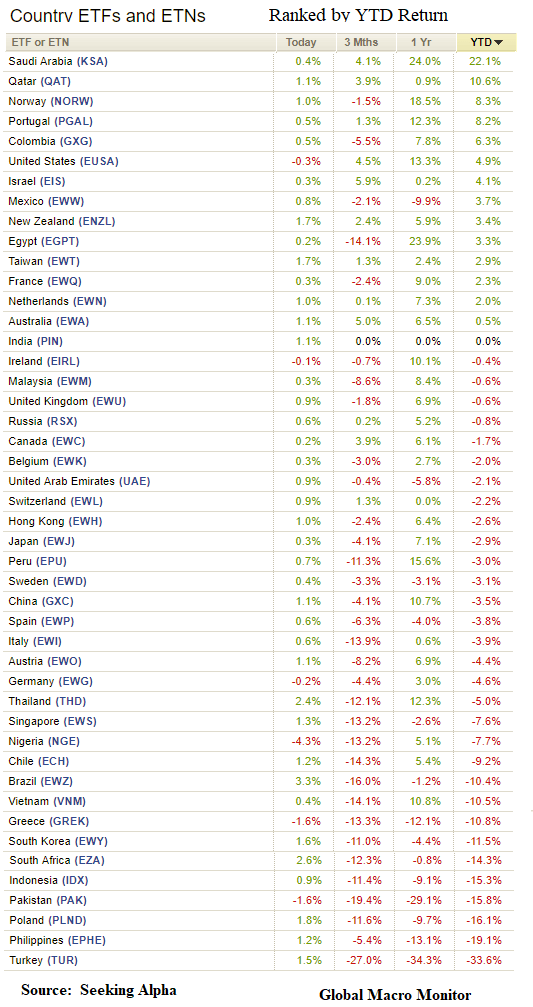
  • Only Oil exporter country ETFs with double digit gains this year

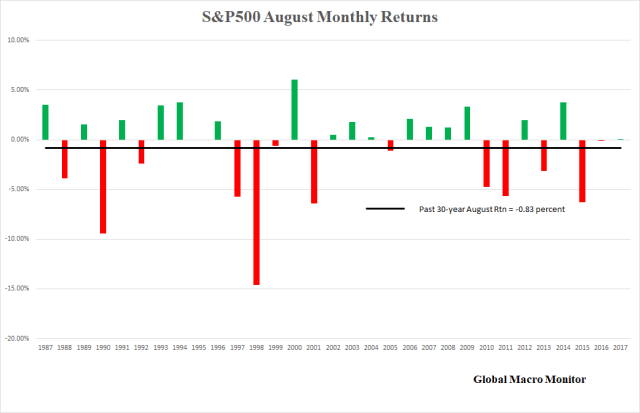
Commentary:  We noted S&P might have used up its juice after rallying over 3 percent in the first two weeks of the month.   Risks are rising as S&P moves into August, one of the most treacherous months.  The month of big drawdowns and no liquidity with everyone on holiday.   Cautious.

Week_Chart2

Week_Chart3

Week_Chart1


Week_2018_ETFs


Week_Table


Posted in Uncategorized | Leave a comment

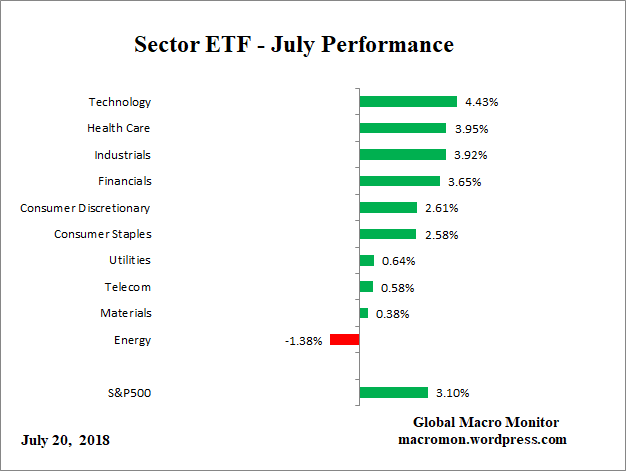
Sector ETF Performance – July 20

ETF_D

ETF_W

ETF_M

ETF_YTD


Posted in Sector ETF Peformance, Uncategorized | Tagged , | Leave a comment

Global Risk Monitor – July 20

RiskMon_1

RiskMon_2

Posted in Daily Risk Monitor, Uncategorized | Tagged , , , , , | Leave a comment

Miami Dolphins Have A New Defensive End

The commish, Roger Goodell, will love this guy, err fish, because he doesn’t spear with his helmet to tackle.

If he kneels during the Anthem, however, he could face suspension, and Trump will be all over his tail and will use him as real bait to feed to his base!

You gotta admit that is one helluva pass rush.

We confess our sexist bias as it’s 50/50 that hard hitting dolphin just may be female.

https://twitter.com/eveforster/status/1020616441727463424?s=21

Posted in Sports, Uncategorized | Tagged | Leave a comment

God, I Love Mike Trout!

You got that?  Pulled the little guy out of the stands to hang with him!

Posted in Sports, Uncategorized | Tagged | Leave a comment

Why Gold Is Such A Dog

Summary

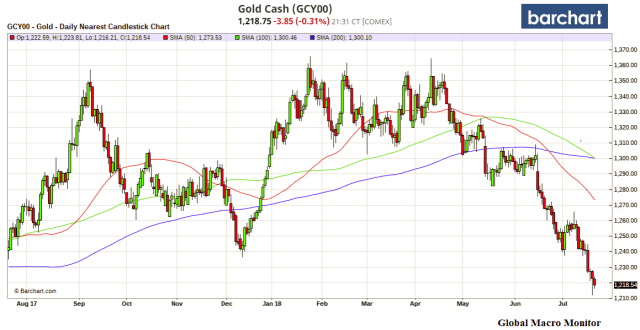
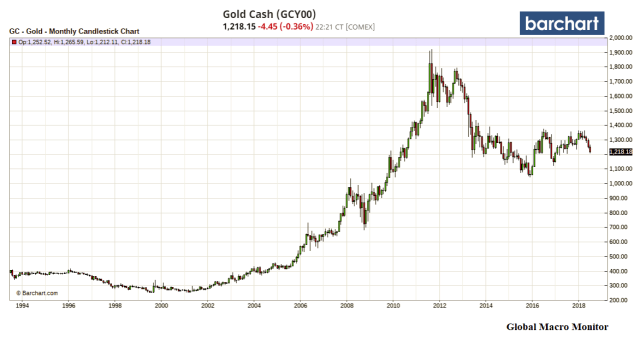
  • Gold prices have been in a bear market since the August 2011 peak at $1920
  • Prices are making new 52-week lows
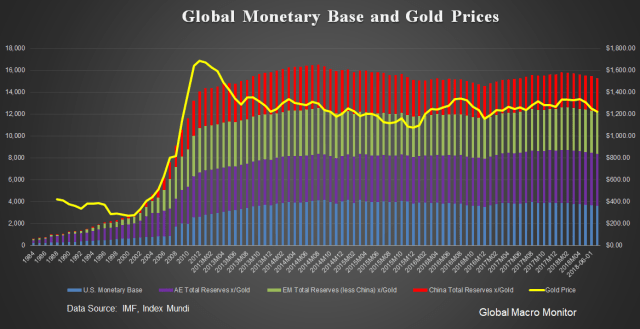
  • Gold has primarily been a monetary asset throughout history and moves closely with the global monetary base (GMB), the sum of the U.S. monetary base and total international reserves
  • Gold has lost some of its luster as a store of value as goods and services inflation failed to materialize after the printing presses flooded the global economy with trillions of reserve currencies during Great Financial Crisis
  • Surprisingly,  demand remained steady or even increased as the major central banks emitted trillions in new currency
  • The broken credit mechanism resulted in an overall monetary contraction and  shortage of dollars
  • The gold bugs had their day as gold moved 650 percent from August 1999 to August 2011 while the GMB moved 455 percent during the same period, the result, mainly of a massive build in international reserves
  • The global monetary base will continue to contract over the next several months as the Fed shrinks its balance sheets and emerging markets continue to lose international reserves
  • Gold prices will thus linger and drift down toward and below $1,000 unless a major global shock results in a flight to quality
  • Just as the simultaneous unfolding of umbrellas do not cause but, instead, reflect a reaction to similar external forces – rain;  so to do comovements in the dollar and gold. In other words, moves in the dollar do not cause moves in gold but reflect a reaction to similar external stimuli
  • The next round of QE, which will probably be the result of a G7 sovereign debt crisis, should cause the massive spike in gold prices that the bugs were looking for in round one
  • We could be wrong


Jul19_Gold

Gold is making 52-week lows.

The yellow metal has been in a vicious bear market, down almost 40 percent since its September 2011 high of $1,920.   We find it almost impossible to make money in the commodity, much like everything else in trading these days,  at least for us.

Close your eyes and  BTFD and let it ride!  That trade is only working now in just a few stocks.

Only Buying French Dips

After taking some big hits and several small ones, we have disciplined ourselves to buy only French Dips these daze.  We are not comfortable trying to pick up pennies in front of a steamroller.

Everything is expensive and it is even more difficult to time the bursting of price bubbles driven by restricted supply rather than leveraged demand, such as was the case n 2008 credit and housing bubble.

Furthermore,  with the algos looking to pick you off 23/5 it is even becoming impossible to scalp to make money in a range trading market.

Cash flow is getting tight and we can’t decide if our next career is a truck driver or python programmer.   Have any thoughts?

Enough of the ranting.

Jul19_Gold1

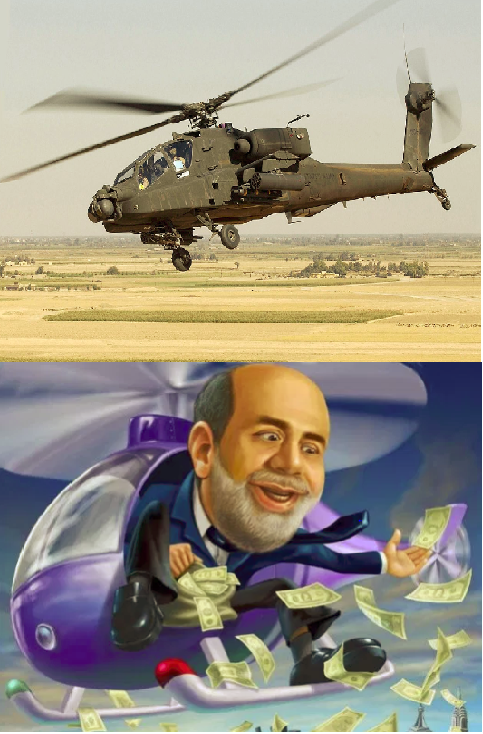
Helicopter Ben

On October 24, 2005, President George W. Bush announced he was nominating Ben Bernanke, his chief economic adviser at the CEA,  to replace Alan Greenspan as the next Fed chairman.  The gold price was trading at around $470.

I noticed Boeing stock was up over 2 percent, and Boeing made the AH-64 Apache helicopter.  I instantly thought how efficient the markets were that helicopter stocks were rocking the same day “Helicopter Ben” is nominated as the Fed chairman. Genius!

Jan19_Helicopter Ben


I instantly shot off an email to my now famous friend, Barry Ritholtz, pointing this out and he made it his QOTD – quote of the day.  True story.

Thank Goodness For Gentle Ben 

In all seriousness,  we complain here a lot about irresponsible monetary policy and the serial bubble blowers at the Fed, but we are grateful Bernanke was the Fed Head during the Great Financial Crisis (GFS).   Even if he did play a major role in contributing and missing the massive housing and credit bubble.

I am sure most of you would agree it’s much better living with the consequences of a too loose monetary policy than living under a freeway and eating bark for dinner.

Anyone in the know and close to the situation in 2008/09 understands how close we came, and several times, and within minutes,  to a complete financial and economic collapse.

Marshall Law

I am not talking about 50 percent clipped off the Dow but a complete collapse of the global payments system,  marshall law, the hijacking of food trucks, food riots, and wars.

We came very, very close to the apocalypse, folks.

Ignorance was bliss back in the Q4 2008 but those in the know spent many nights without sleep hyperventilating.

Unfortunately, it doesn’t seem we have learned our lesson and the final chapter has yet to be written.  It seems as if asset bubbles are the only tool to keep the global economy afloat these days.  No wonder the Fed wants to keep trillions of excess reserves in the system by paying banks not to lend them out.

What Drives Gold Prices

So what are the factors that drive gold prices over the medium and long-term?

There is really no metric to determine the equilibrium price of gold. such as a price-earnings ratio.    Gold has little industrial use and has mainly been a monetary asset throughout the ages.

We wrote back in 2010, just before the 55 percent blow-off over the next 12 months,

Because the equilibrium price of gold is an unknown,  the yellow metal keeps running.  There is no real metric to determine its fundamental value — a real rate of interest and price-earnings or price to book ratio, for example.   This is also the case with most commodities.   And, in a world of zero interest rates, the opportunity cost of holding gold is extremely low. 

…Nobody knows the “right” price and that is why the commodity, in our opinion,  will surprise to the upside.

..Some say Gold is nothing more than a fear trade.”   We agree:  we are afraid when we are too long, not long enough, or not long at all! – GMM, Sept 25, 2010

Fundamentals

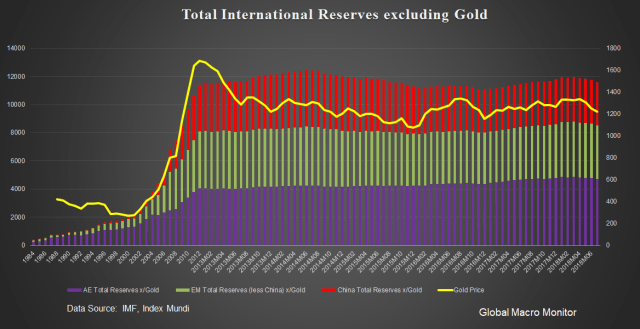
After many years of watching and trading gold, we have concluded that, because it is a monetary asset (the Russians are selling dollars to add to their gold reserves), gold moves closely with what we call the global monetary base (GMB).  That is the sum of the U.S. monetary base and total global international reserves excluding gold.

Jul19_Gold_1


We can’t recall where or how we came up with calculation of the global monetary base  and will get back to you as soon as we do.  Ed Yardeni does a great job tracking the global monetary aggregates, however.

When we have more time we may revise the data and add a portion of the ECB monetary base to the global monetary base as the euro now makes up a growing portion of international reserves.  The dollar is still around 65 percent of total reserves.

Peak Global Monetary Base

The global monetary base peaked in August 2014 about two years after the the gold price peaked.   We think because the rapid increase in base money didn’t result in the goods inflation as many believed, including us, by the way,  gold has lost much of its luster as a monetary asset and paved the way for rise of cryptocurrencies.

We understood, maybe not as well as we should have, that the credit mechanism was broken and the increase in traditional base money would not translate into a rapid increase in the monetary aggregates causing demand pull inflation.  We failed to believe, however, the markets would be willing to hold dollars after such massive monetary emissions.

We extrapolated our experiences from the emerging markets such as Venezuela and Argentina, and failed to believe the demand for the reserve currencies would actually increase and dollar shortages would break out due to the contraction of credit.

Gold Disappoints 

After waiting for their moment for so long,  the gold bugs didn’t get what they were looking for, at least not yet. Inflation didn’t emege and gold didn’t perform, and now just wanders and lingers, seemingly waiting for the next monetary burst.

We do believe the next round of quantitative easing may be a different story, however, as it will probably occur simultaneously with a sovereign funding crisis in a G7 country.  Central banks will be called upon to fund the inability of a sovereign borrower to rollover its debt.  Much like what happened during European debt crisis in 2011 but on a larger scale, such as a big debtor like Italy getting into trouble.  The currency then becomes “hot potato” money as demand dries up and the potential for hyperinflation increases.

Increase In Total International Reserves 

It is interesting gold began to move when total international reserves started to expand in the emerging markets in the late 1990’s.  The EM governments learned after the 1995 Mexican Peso Crisis, the 1997 Asian Financial, and 1998 Russian debt default that allowing hot money to cause currency appreciation — though holding down inflation and creating “wealth effect” driven growth — was a recipe for a balance of payments and current account crisis.

Jul19_Gold_2

The change in foreign exchange regimes across the emerging markets to more of a “dirty float” mechanism  where central banks intervene in the FX markets to keep their currencies competitive led to a massive build in international reserves.  It makes sense that gold would rise just from the increased demand from the “allocation effect.”  Some countries try and keep a certain percentage of their international reserves in gold.

Asset Bubbles And The New Economy

We have noted several times that everything changed in the 1990’s as assets markets began to grow increasingly overvalued, and actually drive and lead the economy rather than follow it.  The big inflows and recycling of the massive build in international reserves back  into U.S. financial markets was a major factor contributing to that change.

Gold Price And The Change In Global Monetary Base

Jul19_Gold_3
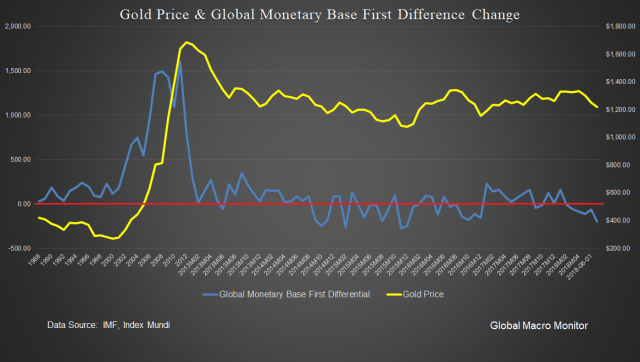
Finally,  we have charted the monthly gold price to the first difference change in the global monetary base.  As the chart illustrates, the two track relatively well.  They both peaked around the same time and have been doing nothing ever since.

China RMB

The global monetary base has been contracting over the past few months as emerging markets have been losing reserves due to currency weakness and the Fed has been reducing the monetary base through its balance sheet reduction.   No surprise gold has been weaker.

China holds a little over 25 percent of the world’s international reserves.

As President Trump said today China’s currency “has been dropping like a rock.”  The RMB is only down about 2 1/2 percent in July, hardly a rock, such as the Turkish “kaya”, which is down 5 percent in the same period.

It’s difficult to determine whether China is weaponizing the RMB in the trade war with the U.S. or capital flight is causing the weakness and the PBOC is losing reserves trying to cushion the fall.  If so, it could explain the recent weakness in gold.

Conclusion

Keep the global monetary base, both the U.S. base and total international reserves on your radar, especially the first difference change in the GMB.  You will be amazed how closely they track each other over the medium to long-term.

It will also give you more confidence in your view as noise and volatility increase.   Gold is a treacherous market to trade.

The relationship will be noisy  as is everything else.  Gold can suddenly spike. It is still considered a safe haven in times of turmoil.

We expect the GMB to continue to shrink over the next several months and wouldn’t be surprised to see gold dip below $1,000 per ounce.

Stay tuned.

Posted in Euro, Fed, Gold, Uncategorized | Tagged , , | 2 Comments

Charts That Count: Another China Crisis? – FT

China’s currency has devalued sharply against the dollar in recent weeks. The last time China surprised the markets with a devaluation, in the summer of 2015, it prompted a global sell-off of risk assets. John Authers discusses why China’s currency is moving again, and asks why this devaluation has so far had much less impact on stock markets than the last one.

► Subscribe to FT.com here: http://bit.ly/2GakujT

Posted in Black Swan Watch, China, Uncategorized | Tagged , , , | Leave a comment

Is Trump Starting To Lean On The Fed Or Setting It Up?

President Trump said in an interview with CNBC’s Joe Kernan this morning he “does not agree”, is not “thrilled” or “happy” with the FOMC’s interest rate hikes.  The full interview and transcripts will be available tomorrow.

Jul19_Trump Interview

Click here for excerpt of interview

You Heard It Here First

Presidents never, or rarely comment on monetary policy or currency market moves. for that matter,  x/ the hackneyed meme “a strong dollar is the best interest of the United States.”

President Trump hit them all in this interview today, from the Fed to the Euro and Chinese RMB (“dropping like a rock”).  It doesn’t surprise us.

Recall our March 21st post, The Biggest Risk At The Fed.

But this doesn’t concern us as much as the Fed’s independence.

“Just let it rip”

That is we are worried more about the freedom from White House pressure and interference in conducting monetary policy than getting a few bps wrong on the Fed Funds rate.   This is especially true and relevant given the strongman tendencies and  lack of respect for institutional norms of the current president.

Here is Larry Kudlow, the president’s new chief economic adviser:

“Just let it rip, for heaven’s sake,” Kudlow said of economic growth in the U.S., during a more than hour-long interview Wednesday on CNBC. “The market’s going to take care of itself. The whole story’s going to take care of itself. The Fed’s going to do what it has to do, but I hope they don’t overdo it.”  – CNN
– Global Macro Monitor,  March 21, 2018

We were assured by Fed insiders shortly after that post in March Chairman Jerome Powell was tough and we should not underestimate his independence.   He has thus far proven to be an extraordinarily competent Fed leader.

Moreover, the president seems to have appointed very competent and independent Board governors to fill the many vacancies on the FRB.

Nothing Here, Move On

Other than committing another faux pas by publicly criticizing the Fed — and it really wasn’t that critical — the president’s comments,  taken in isolation,  were relatively benign and does not pose a threat to central bank independence, in our opinion.

But the totality and cumulative mistakes of  amateur hour at the White House, from foreign to domestic economic policy, are slowly chipping away at the world’s confidence in the management of America, Inc..

What we fear most is the loss of confidence in the world reserve currency status of he U.S. dollar, which is slowly eroding.   There doesn’t currently seem to be a viable replacement, however.  We do live in a nonlinear world,  where technological advancements can rapidly change and turn sectors upside down overnight, so that could change in a heartbeat,

Just look at the rise of crypto and mobile payments in the past decade?

Who is to say that a replacement for the dollar won’t come along in the next few years?  That would be a huge game changer and could render the U.S.economy to the dustbin of highly indebted countries, with large deficits, and irresponsible monetary policies.  And you know who they are.

Is Trump Setting Up The Fed As The Fall Guy?

CNBC’s Steve Liesman raises an interesting question: is Trump setting up the Fed to take the fall for his trade policies gone bad?   Farmers are really starting to feel the pain.

As Dale grain and beef cattle farmer Dennis Whitsitt watches his crops grow in the fields, he also watches grain prices tumble as tariffs between the U.S. and several other countries take effect.

The Trump administration began talking about imposing tariffs on Chinese imports in January, starting what has come to be called a trade war. Trump’s threats led China to threaten retaliatory tariffs on U.S. goods, including soybeans and pork. Both countries enacted the threatened tariffs on July 6. The administration also imposed tariffs on goods from the European Union, Canada and Mexico, leading those countries to impose retaliatory tariffs as well. Those tariffs also included farm goods as foreign leaders looked to hurt areas that voted for Trump. In Whitsitt’s opinion, the tariffs have hit their mark, as far as farmers go.

It doesn’t seem like a good strategy,” Whitsitt said of the trade war.
— The Herald,  Jasper, IN

What Worries Us Most About The Interview

This is what tweaked us most about the president remarks,

Now I am just saying the same things what I would have said as a private citizen. So somebody would say oh maybe you shouldn’t say that as a president. I couldn’t care less what they say. Because my views haven’t changed.   – President Trump

“I couldn’t care less” — Are you frickin’ kidding me?

As we posted  last night, the president’s not even ambiguous (double negative) comments on coming to the defense of a NATO country, coupled with the U.S. public, which some could read, acquiescence to the Russian annexation of Crimea only increases the risks that China moves on Taiwan.

The U.S. would then have to decide if it willing to “send its boys” to defend Taiwan and enter World War III.

Serious business, folks.

By the way,  this just in,

CHINA WAR GAMES NEAR TAIWAN

As Washington pundits and government officials debate President Trump’s meeting with Russian President Vladimir Putin in Helsinki, China is busy sending a strategic message to the United States with large-scale war games near Taiwan.

China on Wednesday kicked off live-fire drills in the East China Sea north of Taiwan in an area simulating the size of the island state — a not-so-subtle message to the country Beijing regards as a breakaway province.

The military maneuvers at sea also will be held not too far to the west of the Japanese island of Okinawa, home to U.S. military forces.

The six-day war games were announced Monday in a sea closure zone that warned all vessels to stay clear of the area, where Chinese ships are firing missiles and other weaponry.

The sea closure zone covers an area off the coast of Zhoushan, south of Shanghai, to Wenzhou about 200 miles to the south. The Communist Party-affiliated newspaper Global Times noted the exercise zone’s “similar size to the island of Taiwan.”

The exercises are designed to warn Taiwan, Chinese military expert Song Zhongping, told the newspaper. “The drill’s main objective is to send a serious warning to Taiwan separatists,” Mr. Song said.

According to another Chinese military expert quoted by Global Times, the East China Sea is viewed by the Chinese military as the main battle zone if war breaks out.

The expert, who was not named, said this week’s drills are larger than in the past and require more troops and weapons. The maneuvers will test the Chinese military’s combat capabilities, tactics and training methods and its new weapons and hardware.

“The [People’s Liberation Army] air force and navy have been frequently conducting island encirclement exercises,” Mr. Song said. “The drill this time will add up and form a military deterrence of high pressure against the Taiwan separatists.”

According to Mr. Song, the war games will involve joint military operations in a bid to simulate real combat. —  Washington Times, July 18th

Stay tuned!

Posted in Fed, Uncategorized | Tagged , | 11 Comments