Rivets Starting to Pop in Greece

The FT reports,

Greece should get its next €8bn in international aid, but its economic outlook is deteriorating so rapidly that a second bail-out plan agreed just three months ago is no longer adequate to keep Athens afloat, international lenders have determined.

The report by the so-called “troika” of lenders to Greece – the European Commission, International Monetary Fund, and European Central Bank – put the blame for Greece’s deteriorating fiscal outlook on both the broader recession and failures by Greek government to implement reforms.

But in the first acknowledgement that mounting unrest within Greece was having an impact on official deliberations, the report – seen by the FT – said the occasionally violent demonstrations in Athens were contributing to economic problems.

“There is no doubt that Greece is undergoing a recession that is deeper and longer than expected,” the report said. “The deterioration in the labour market, with employment falling much faster than expected, uncertainties of political and financial nature, and social unrest and industrial action have weighed on supply and on domestic demand.”

Now watch the Greek protestors turn on each other.   Makes you wonder if an EU plan to be announced Sunday  Wednesday is really going to solve the core issues of the crisis in the eurozone:  1) too much debt that can’t be paid back;   2) debt/credit constrained growth;  3)  growing unemployment;  4) over levered banks suffering liquidity problems with too much exposure to deteriorating sovereign borrower also experiencing liquidity problems; and  5)  overly optimistic expectations in a “one shot kills all”  policy announcement.

However,  the S&P500 trades like a Kentucky Derby thoroughbred locked in the starting gate – 1190 to 1230-35 – and ready to bolt once the bell rings.

(click here if video is not observable)

Posted in Black Swan Watch, Budget Deficit, Euro, PIIGS | Tagged , | Leave a comment

Quote of the Day: Sarkozy’s Warning

If there isn’t a solution by Sunday, everything is going to collapse
–
French president Nicolas Sarkozy

Posted in Black Swan Watch, Euro, PIIGS, Sovereign Debt, Sovereign Risk | Tagged , | Leave a comment

China’s U.S. Debt Holdings

                     (click here if chart is not observable)

Posted in Charts, China, Sovereign Debt | Tagged , , | Leave a comment

S&P500 Key Levels

It’s kind of useless, in our opinion, to be looking at the technicals as the market approaches the big life or death event.   The EU debt plan is either going to be taken positively, in which case the S&P500  will break through the 1230-1234  resistance level;  or it will be negative and the market will breakdown, most likely to new lows.   No muddle through scenario, in our opinion.   The Eurocrats either make it or break it.

Until then,  however, here are some key support levels for the S&P500, our global proxy for risk:  1195.74 (.236 fib retracement),  yesterday’s low at 1191.48,  the 50-day moving average at 1175.41, and the .382 fib retracement at 1172.62.

This is a tough market as it reacts to Euro tape bombs and can grind up your capital like an IN-N-OUT hamburger.   Betting on bureaucrats to do the right thing can also be hazardous to your financial health.    Good luck.

(click here if chart is not observable)

Posted in Equities | Tagged , | Leave a comment

Occupy Harvard, Columbia, & Berkeley

Here’s a piece we posted last November which has relevance to those who are camped out in lower Manhattan and their Occupy Wall Street offshoots around the country and world.  We’ve changed the source of the video as the old has been blocked and added a longer one for those interested in the topic.

We must admit our fear and squeamishness when we see large emotional groups scapegoating a small minority for all that is wrong with the world.  It’s just a small step to attribute the evils of the “1 percent” to ethnicity, religion, or whatever.    No doubt it’s going to worse before it gets better, so let’s pray it doesn’t come to this.   We don’t think it will, but let us be vigilant.

The Corruption of Academia

Posted on November 21, 2010 by macromon

I saw Inside Job yesterday, which is a must view for anyone in the financial industry.  Clearly it has a lefty perspective and is very tough on the Street, but some scenes are illuminating and priceless.  The corruption of the economics academy is exposed in interviews with Fredrick Mishkin, former Federal Reserve governor, who resigned during the crisis,  and Glen Hubbard,  former head of the Council of Economic Advisors under Bush 43.   Larry Summers worth an estimated $15-30 MM?????  Laura Tyson paid $350K a year to sit on the Board of Morgan Stanley?

Hey, we’re all for making money, but just calling out a “no spin zone” when we see one. Here is  a clip from the film:

(click here if video is not observable)

Posted in Black Swan Watch, Geopolitical, Housing, Politics | Tagged , , , | Leave a comment

World’s Highest Paid Political Leaders

Here’s some interesting data coming to us from Investopedia.com.  Now you can understand the frustration of Frau Merkel as she bails out countries’ with leaders making a higher salary than hers!

Top 10 Political Leader’s Salary by Country (2010):
1. Lee Hsien Loong (Singapore): $2,183,516
2. Donald Tsang (Hong Kong): $513,245
3. Raila Odinga (Kenya): $427,886
4. Barack Obama (United States): $400,000
5. Nicolas Sarkozy (France): $302,435
6. Stephen Harper (Canada): $296,400
7. Mary McAleese (Ireland): $287,900
8. Julia Gillard (Australia): $286,752
9. Angela Merkel (Germany): $283,608
10. Yoshihiko Noda (Japan): $273,676


Posted in Economics, General Interest, Politics | Tagged , , , | Leave a comment

President of Wal-Mart China Resigns After Pork Scandal

(click here if video is not observable)
Posted in Uncategorized | Tagged , | Leave a comment

U.S. Public Debt: Going Greek

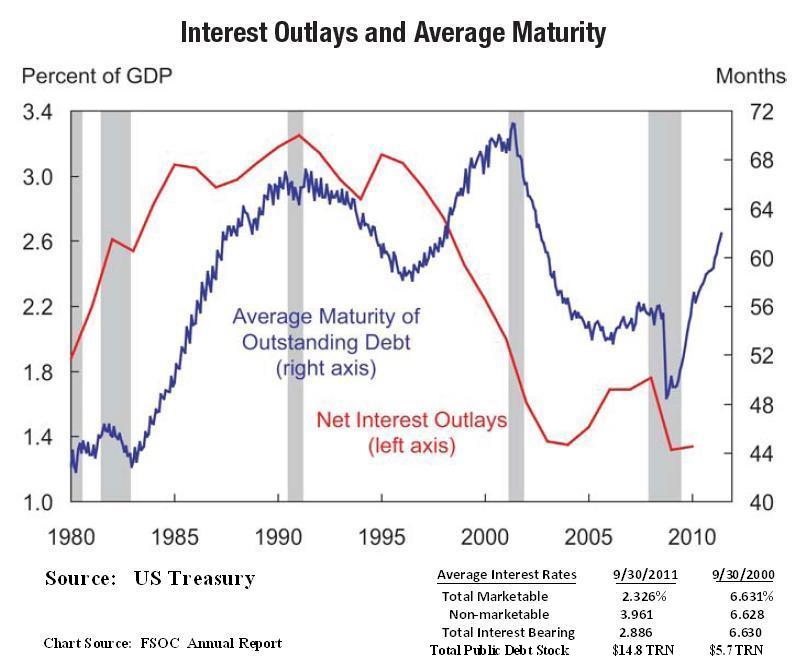
Here is one chart that may be used in our grandchildren’s economic and political history classes.   The current debt service burden on the national debt (as % of GDP) is as low as it has been in last thirty years.  As one Latin American finance minister used to say, “debt and deficits without tears.”

The chart may surprise many given the huge run up in the U.S. federal debt over the past 10 years.  The data show that the total public debt stock has increased from $5.7 trillion on September 30, 2000 to $14.8 trillion on September 30, 2011.

The net interest cost to service the debt, however, has fallen as a percent of GDP due to the sharp drop in the average interest rate paid on the debt, which fell from 6.63% in 2000 to 2.886% on September 30, 2011.  Growth also contributed to the drop and as a rule of thumb if the average interest rate is below the nominal growth rate, the ratio falls.

The danger of massive borrowing at record low interest rates is that it makes the borrower extremely vulnerable to an increase in rates.     This was the case of the housing bubble.   This is the case of Greece.   Furthermore, debt and leverage is rewarded in a declining interest rate environment and punished as rates increase.   A repeat of the 30-year secular decline in interest rates is not likely.

Rising interest rates can also reduce market confidence in a heavily indebted borrower’s ability to service its debt, which in turn reduces market access and increases the rollover risk of maturing debt.   Pay it down, default, bailout, or, in the case of a country with an autonomous central bank, hyperinflationary monetization of maturing debt becomes the only options.    

What puts the “acute” in an acute sovereign debt crisis is the inability to roll over maturing debt.    No doubt Secretary Geithner understands this and, as the chart illustrates, is trying to extend the average maturity of the public debt.

Borrowing at low interest rates also raises several questions.   What will happen to the U.S. budget deficit if the economy picks up and interest rates return to normal?  Will the increase in cyclical tax revenues be offset and by increased interest payments on the national debt?   What are the political implications as debt service crowds out expenditures in the rest of the budget?   Did the Fed enable the borrowing binge by its zero interest rate policy?

Borrowing at low interest rates is the like the analogy of the two frogs in a pot of boiling water.  One is dropped into a pot of boiling of water, feels the pain, and immediately jumps out. The other is put into pot of cold water and as the heat is turned up enjoys itself in the Jacuzzi while boiling to death.   High interest rates are penal, low rates are not, until they begin to increase.

Greece borrowed most of its bond denominated public debt at an average interest rate of around 5.0 percent.  That was some Jacuzzi.

P.S.   If you think the U.S. is vulnerable to an interest rate shock, take a look at Japan.   Yikes!

(click here if chart is not observable)

Posted in Black Swan Watch, Bonds, Economics, Sovereign Debt, Sovereign Risk | Tagged , , , | 6 Comments

In China, Black Market iPhone Costs $1700

(click here if video is not observable)

Posted in Apple, China, Video | Tagged , , , | Leave a comment

NY Times: Greek government’s $38,000 bills for office curtains

Today’s NY Times piece on the failure of Greece to cut its bureaucracy is a must read for anyone trying to understand one of the major forces driving global markets.   It also gives context to why Germany and other core eurozone countries are so conflicted over bailing out Greece and the banks who financed such a bloated bureaucracy.    The Times writes,

ATHENS — Stories of eye-popping waste and abuse of power among Greece’s bureaucrats are legion, including officials who hire their wives, and managers who submit $38,000 bills for office curtains.

The work force in Greece’s Parliament is so bloated, according to a local press investigation, that some employees do not even bother to come to work because there are not enough places for all of them to sit.

But as Europe looks for any sign of hope that Greece is on the road to reform, there are growing concerns about its ability — and willingness — to trim its payroll, a crucial element in bringing expenses under control enough to win continued international financing.

It’s going to be interesting.


Posted in Black Swan Watch, Euro, PIIGS, Sovereign Debt, Sovereign Risk | Tagged , , , | Leave a comment