Quote of the Day: Amen!

“Just consider what levels of debt we are passing on to future generations.  This isn’t responsible, politically, morally or ethically.” – Juergen Stark, ECB

Posted in Fiscal Policy, Quote of the Day, Sovereign Debt | Tagged , , | Leave a comment

Korea ETF: Our Fave “Dubya” Bottom

After posting the W bottoms on the S&P500 and the Brazil ETF here is our favorite, the Korea ETF (EWY).   We learned during the 1997 Asian Financial Crisis never to short Korea and never underestimate the resolve of the Korean people.   This bottom forms the classic W pattern as defined by John Bollinger.    Stockcharts.com writes,

W-Bottoms were part of Arthur Merrill’s work that identified 16 patterns with a basic W shape. Bollinger uses these various W patterns with Bollinger Bands to identify W-Bottoms. A “W-Bottom” forms in a downtrend and involves two reaction lows. In particular, Bollinger looks for W-Bottoms where the second low is lower than the first, but holds above the lower band. There are four steps to confirm a W-Bottom with Bollinger Bands. First, a reaction low forms. This low is usually, but not always, below the lower band. Second, there is a bounce towards the middle band. Third, there is a new price low in the security this low holds above the lower band. The ability to hold above the lower band on the test shows less weakness on the last decline. Fourth, the pattern is confirmed with a strong move off the second low and a resistance break.

(click here if chart is not observable)

Posted in Charts, Equities, Global Stock Performance | Tagged , , | Leave a comment

Four Unconventional Insurance Policies

We thought these “weird insurance policies” brought to us by Investopedia.com very interesting.   Gives new meaning to the phrase, “this market has (Mariah’s) legs!’

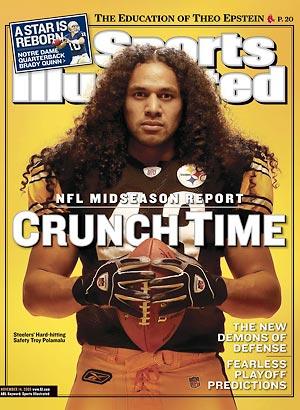
Troy Polamalu’s Hair
Troy Aumua Polamalu was drafted by the Pittsburgh Steelers in the first round of the 2003 NFL Draft. A strong safety, Polamalu is known for his hard-hitting style on the field, which helped him earn the 2010 NFL Defensive Player of the Year Award. In addition to his athletic prowess, Polamalu is readily recognized on the field by his luxuriant hair which cascades down his back.

After Procter & Gamble signed on Polamalu in 2010 to endorse its Head & Shoulders shampoo, the company took out a one million dollar insurance policy with Lloyd’s to protect against hair loss. The policy, which will pay out if Polamalu sustains losses to more than 60% of his hair in an accident, specifies that the football player cannot engage in fire breathing or climb Mount Everest.

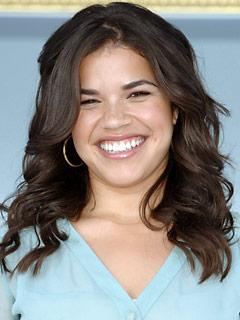
America Ferrera’s Smile
Ugly Bettystar, America Ferrera’s smile was insured in 2007 for $10 million at Lloyd’s. Aquafresh, makers of Aquafresh White Trays, an at-home teeth whitening product, paid to insure the actress’s smile as Ferrera began working with the company to promote the United States charity, Smiles for Success. The organization provides free dental care to women who are making a transition from public assistance to the workforce.

Mariah Carey’s Legs
American R&B/pop singer-songwriter, Mariah Carey is best known for her five-octave range and melismatic singing style. She is one of the biggest-selling artists in musical history, having sold more than 200 million albums, singles and videos worldwide. Carey is also known for her great legs. In 2006, women’s razor brand, Gillette Venus named Carey the first “Celebrity Legs of a Goddess” as part of a nationwide promotion. Following this designation, Gillette reportedly insured Carey’s legs for $1 billion.

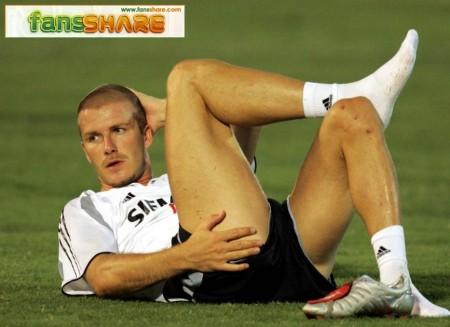
David Beckham’s Legs
In 2006, soccer great David Beckham’s legs were insured for £100 million (equal to about $195 million at the time). The policy was considered to be the largest personal insurance policy for a sports figure in history, and due to its size, was reportedly was taken out by several companies. The policy protected not only Beckham’s legs, feet and toes, but also his good looks. Beckham, after all, earned his keep not just by being an iconic soccer hero, but also through various commercial deals. The policy would reportedly pay in the event Beckham was unable to play soccer or in the event of disfigurement.

(click here if pictures are not observable)

Posted in General Interest | Tagged , , , , | 1 Comment

Moneyball

Maybe Billy Beane can do for the U.S. economy what he did for the Oakland A’s and Major League Baseball.   This movie looks good.  Michael Lewis, who wrote the book on which the movie is based,  is now one Big Swinging Richard! Out on September 23rd.  Can’t wait to see it.

(click here if video is not observable)

Posted in General Interest, Video | Tagged , , | Leave a comment

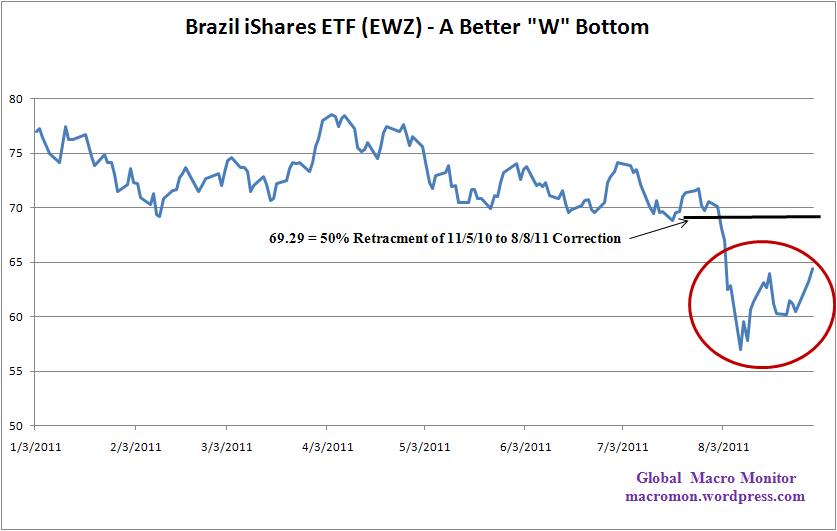
Brazil ETF: A Better “Dubya” Bottom

Yesterday we raised the question has the S&P500 put in a short-term W bottom?  The Brazilian bottom looks a little better to us.   We took some of the ETF and looking for a quick trip into the $69-70 resistance area with a tight stop! If we’re wrong, we’ll Blame It on Rio.   Boa Sorte!

(click here if chart is not observable)

Posted in BRICs, Equities | Tagged , , | 1 Comment

Can You Say “Dubya” Bottom?

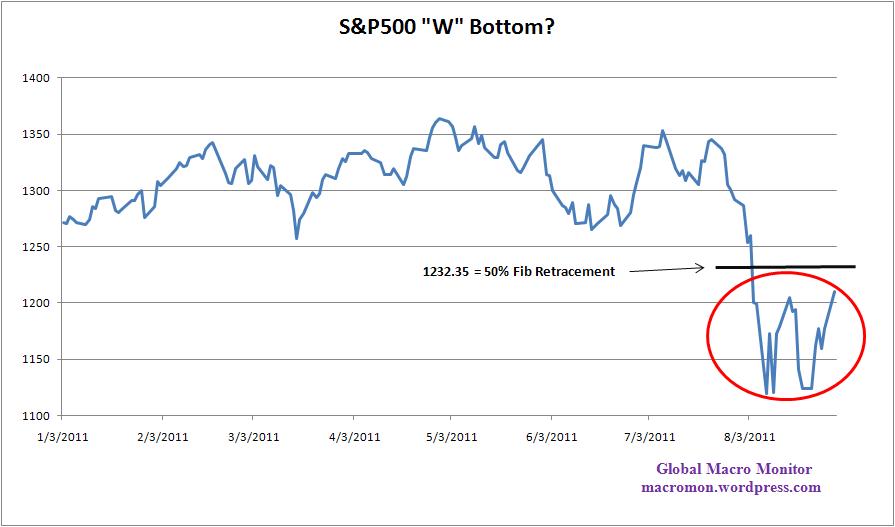
That sure looks like a W bottom on the S&P500,  no?  Not the classic trajectory and confirmation, not to mention the compressed time frame, but you’ve got to respect the price action.  The macro swans are still out, so the question is are they priced?   We don’t know and not willing to make a huge bet either way.  The next negative headline and tape bomb will be the true test.

The 50% retracement of the recent closing high to closing crash low is 1232.35.  After that is the 61.8% retracement at 1258.86.  We’re focusing more on taking some positions in emerging equities,  particularly Korea and Brazil.   Stay tuned.

(click here if chart is not observable)

Posted in Equities, Global Stock Performance | Tagged , , | Leave a comment

Get Them to the Greek (Writedowns) – IASB

Wow! Just came across this piece from the FT about the concerns of the International Accounting Standards Board  (IASB) of how European financial institutions have not reserved enough against potential credit losses on their Greece sovereign bond holdings.  Are these guys reading the Global Macro Monitor?   Recall our piece posted on Friday,

…all of the bailouts have been a de facto attempt to recapitalize European banks, who would have taken massive hits in the event of defaults in the periphery and thus collapsing the European financial system. The problem is, as far as we can see, the European banks continue to report decent earnings failing to take sufficient reserves against their sovereign exposure, which would be painful, but necessary,  and result in reporting losses. European banks are relatively thinly capitalized to begin with…Where is the European Banking Authority?  Every euro the banks receive in backdoor bailout money as the periphery bonds mature and get paid by the European taxpayer should go into loan loss reserves. It appears some banks have just begun to take the hits and to allocate specific reserves against their sovereign exposure to the periphery. 

This is what today’s FT piece had to say,

In a private letter sent to the European Securities and Markets Authority, the European Union’s market regulator, the International Accounting Standards Board criticised the inconsistent way in which banks and insurers have been writing down the value of their Greek sovereign debt. “This is a matter of great concern to us,” Hans Hoogervorst, IASB chairman, said in the letter, which was seen by the Financial Times.

People familiar with the IASB’s letter said the intervention was unprecedented and reflected its belief that some European companies had not been making enough provisions for Greek sovereign debt losses.

Makes you go  hmmmmmm!    Others are reaching the same (and correct, in our opinion) conclusion after assessing the situation.   Judge Robert Bork used the following analogy to explain what appeared to be collusion between several parties,

If you pull up to an intersection and five people sitting at the bus stop all simultaneously raise their umbrellas, it doesn’t necessarily follow they have colluded to do so.  It could be they were all reacting to the same external force – rain!

This is important stuff.   Breaking the destabilizing feedback loop between sovereign debt and the European banking system is a necessary condition for a sustainable market rally and global recovery.  The problem is that most of Europe is still in denial though the IMF’s Christine Lagarde, the former French FinMin, gets it.   Be sure to read the full FT piece and review our Friday’s post.

Posted in Black Swan Watch, Bonds, PIIGS | Tagged , , , , | 1 Comment

Seven Days in Utopia

Any golfers out there?  Looks like Robert Duvall’s new movie, Seven Days in Utopia, may be the next Legend of Bagger Vance.   Should be out this weekend.  Can’t wait to see it.

(click here if video is not observable)

Posted in General Interest, Video | Tagged , , | Leave a comment

Quote of the Day: Facebook and Narcissism

Technology Review has a great little piece, Where Is the Facebook for Old People?

Here’s the money quote:

Where is the online social networking equivalent of the Jitterbug phone? Easy to use, foolproof, and designed, more than anything, to keep you connected to loved ones. Perhaps that’s the problem with social networks in the first place: they reward display and narcissism, exactly the traits most closely associated with youth. Apparently genuine connection will have to wait for a more advanced technology.

Display and narcissism.   Great market!

Posted in Demographics, General Interest, Quote of the Day, Technology | Tagged , | Leave a comment

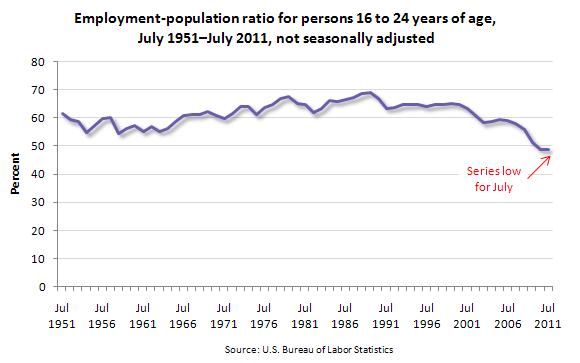
Chart of the Day: Youth Employment Ratio Lowest on Record

The BLS reports,

In July, the employment-population ratio for youth—the proportion of the 16- to 24-year-old civilian noninstitutional population that was employed—was 48.8 percent, a record low for the series.

Long flash mobs and water cannons.

(click here if chart is not observable)

Posted in Black Swan Watch, Chart of the Day, Charts, Demographics, Employment | Tagged , | Leave a comment