Short and sweet tonight. Even turkeys can fly in hurricane “I-Lean The Wrong Way.” Reports that hedge funds, with almost no tolerance for short-term pain, have opened the biggest net short positions since early 2008 has driven a relatively low volume short covering rally. We even heard predictions of a 400 point drop in the Nasdaq if Mr. Ben didn’t announce QE3. We guess they were positioned for it and had a front row seat at Friday’s performance of the Nutcracker.
None of the issues that took the market down, mainly, worries over global growth and troubles in Europe have been resolved and it our sense Greece is about to come back on the radar in a big way. Notice in the charts below the U.S. indices that went down the most bounced the most. That’s not true in Europe, however, which had, at best, a tepid bounce.
If the S&P500 closes above its recent short-term high of 1208.47 we will reassess our position. Until then we remain on vacation. It was impressive to see Apple close the week strong after the sad news of Steve Jobs resignation as CEO. Great company, great stock, God bless, Steve Jobs. Good luck this week.
The Greeks are starting to play hardball on their private sector debt swap warning the deal could crater if the 90 percent participation is not met. We think there are other reasons why it is trouble.
According to various news reports Greece has sent a document to the finance ministers of the 57 countries where financial institutions hold Greek bonds. Bloomberg cites the Greek finance minister,
“If these thresholds are not met, Greece shall not proceed with any portion of the transaction described in this letter if it determines” there isn’t enough private sector involvement “to permit the official sector to support the new multi-year adjustment program.
Initially, we applauded the Greece deal as it was the first bailout that included the private sector, which has essentially been free riding on the back on the European taxpayer.
In fact, all of the bailouts have been a de facto attempt to recapitalize European banks, who would have taken massive hits in the event of defaults in the periphery and thus collapsing the European financial system. The problem is, as far as we can see, the European banks continue to report decent earnings failing to take sufficient reserves against their sovereign exposure, which would be painful, but necessary, and result in reporting losses. European banks are relatively thinly capitalized to begin with. Also see here.
Where is the European Banking Authority? Every euro the banks receive in backdoor bailout money as the periphery bonds mature and get paid by the European taxpayer should go into loan loss reserves. It appears some banks have just begun to take the hits and to allocate specific reserves against their sovereign exposure to the periphery. Moral hazard everywhere!
After further analysis of the Greece debt swap we found the deal structurally flawed. Though the swap does reschedule maturities, Greece’s interest payment burden increases under the swap as the coupons on the new exchange bonds exceed the average interest rate the sovereign currently pays on existing bonds. In addition, the interest payments on the borrowing to purchase the zero-coupon bond collateral exceeds any small savings from the discounting of original principal.
The massive rally in 30-year bonds since the deal was announced has also complicated matters as the cost of a zero-coupon has increased almost 25 percent and now approaches 40 cents on the euro, which is almost the price at which Greek debt currently trades. Why, we ask, should Greece do this deal?
There is also much chatter about a Eurobond where all the debt of the eurozone is federalized. How about that for moral hazard? Why would a bondholder tender to the debt swap if a Eurobond is on the horizon, which may pay the periphery debt in full? Unless, of course, one believes Europe is about to cut Greece loose or bondholders receive intense pressure from their home governments.
The European policymakers, along with their American counterparts, have lost credibility and the confidence of the markets. The intractable political problems and institutional constraints inherent in the eurozone prevents a solution to the debt crisis.
It’s time the IMF, with the help of Asia, step up and play a bigger role in providing a comprehensive solution to the European sovereign debt crisis. We’re pulling for you, Ms. Lagarde, and the global economy is depending on you.
Yesterday was a sad day for Global Macro Monitor with the announcement that Steve Jobs is stepping down as CEO of Apple. We are one of his biggest fans. The guy has created nothing less than a technological nation-state (see below). A true superpower in today’s world of sovereign downgrades.
The question for the stock is does his retirement remove the uncertainty premium that has repressed its price or does it add more uncertainty surrounding the company’s innovative capacity? We don’t know and will let the market decide. Today’s action does appear they are voting for the former. Can they close it in the green today?
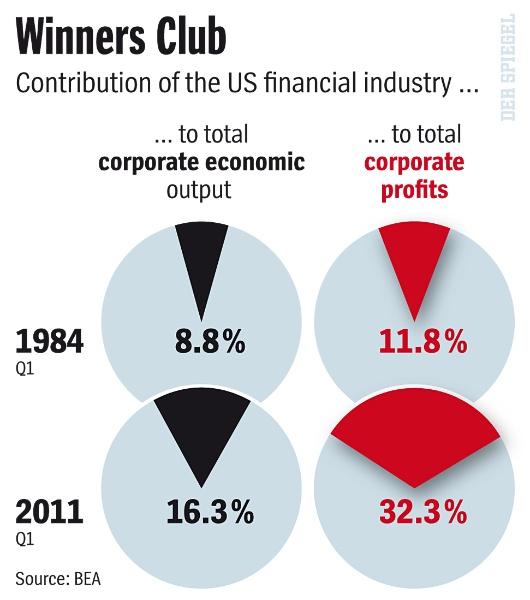
The enemy looks friendly and unpretentious. With his scuffed shoes and thinning gray hair, John Taylor resembles an elderly sociology professor. Books line the dark, floor-to-ceiling wooden shelves in his office in Manhattan, alongside a bust of Theodore Roosevelt and an antique telescope.
Taylor is the chairman and CEO of FX Concepts, a hedge fund that specializes in currency speculation. It’s the largest hedge fund of its kind worldwide, which is why Taylor is held partly responsible for the crash of the euro. Critics accuse Taylor and others like him of having exacerbated the government crisis in Greece and accelerated the collapse in Ireland.
The vitriol for hedge fund types is ubiquitous, but there is also a some truth in the article, especially on regulatory issues. Swedish Finance Minister Anders Borg refers to people like Taylor as “like a pack of wolves.” New York Governor Andrew Cuomo even gets into the mix as once likening short-sellers to “looters after a hurricane.”
Here are some more money quotes from the piece, which is well worth your time:
– The truth is that the financial markets are controlling the politicians.
– The markets take advantage of every weakness and every rumor to speculate against one country after the next.
– Stock markets are currently in turmoil. Even the most experienced equity traders cannot remember a time when prices fluctuated as widely from day to day — and often even within a single day — as they have in recent weeks.
– But without the destructive power of the banks, hedge funds and other investment companies, the world would not be where it is today — at the edge of an abyss.
– Many things that happen on Wall Street and in London’s financial district are “socially useless,” says Lord Adair Turner, chairman of Britain’s Financial Services Authority (FSA).
– Flassbeck believes that the crises in the globalized economy have “a common root, namely the inability of economists to correctly interpret the world.”
– Of all people, it was an academic specializing in literary studies who managed to most accurately analyze the insanity of the financial markets and the impotence of economists.
– When Deutsche Börse decided to move from Frankfurt to the nearby town of Eschborn, the town saw a rapid increase in the demand for air-conditioned basement space, where so-called high-frequency traders, as well as banks, set up their state-of-the-art supercomputers.
– The traders at Deutsche Bank are apparently more clued into who holds Greece’s government bonds than the Greeks themselves.
– Speculation has always existed in economic history, but never to such an extent as today.
– German Chancellor Angela Merkel knows that there is more at stake than the stability of the economy and overcoming a temporary weakness. “This type of crisis cannot be allowed to repeat itself in the foreseeable future,” Merkel said, “otherwise it will be extremely difficult to guarantee political stability, and not only in Germany.”
– Following the near-collapse of the markets, then-German President Horst Köhler characterized the financial markets as a “monster.”
– Jochen Sanio, head of Germany’s banking regulatory agency, believes it is highly likely that the next crisis will emanate from this largely unregulated realm of hedge funds and other financial players.
– When asked whether it is possible to make future crises unlikely, Hilmar Kopper, the former CEO of Deutsche Bank and current chairman of the supervisory board of HSH Nordbank, replies with a simple “no.” According to Kopper, more huge financial bubbles could happen in the future.
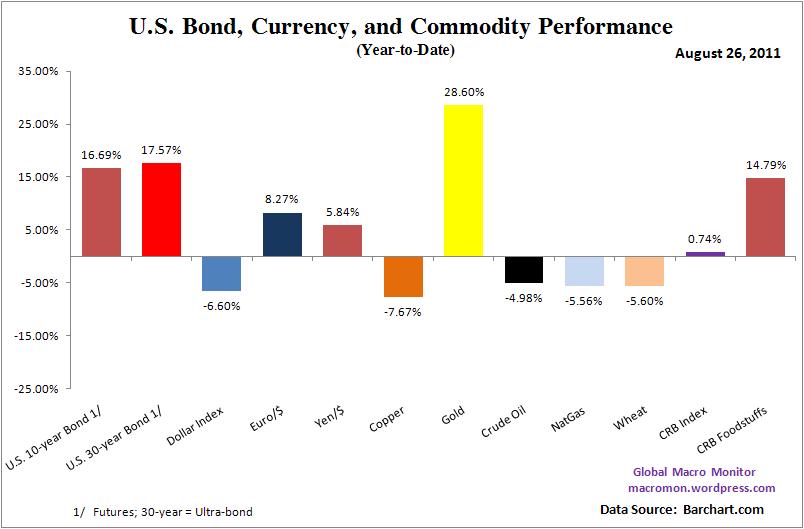
WTF was that? S&P500 up 3.43 percent and the GLD down 3.80 percent and that’s not counting the spike to over 1,900 cash gold in after hours trading. How are the fundamentalists going to reconcile and stick that in the Jackson Hole?
We say Mrs. I-Lean The Wrong Way got hammered today as many were caught off-side and the short seeking algos sent the levered set reaching for the you know what. Please pass it this way! Ouch.
“When you come to a fork in the road, take it.” – Yogi Berra
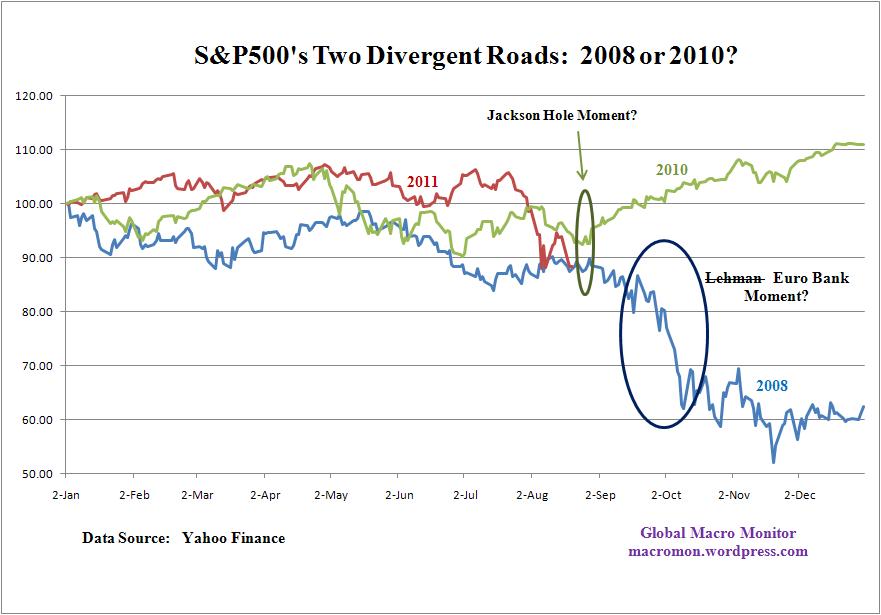
Lot’s of chatter out there about the 2008 and 2010 analog for the S&P500 so we constructed a tracking chart for you. Note the index is right at the return of the 2008 analog and faces similar events, which caused a nonstop year-end rally in 2010 and swan dive in 2008.
As all eyes are on Bernanke looking for clues of a new round a quonto we’ll be more focused on Trichet. The future of Europe and the global banking system is highly dependent on his policies over the next few months. Stay tuned.


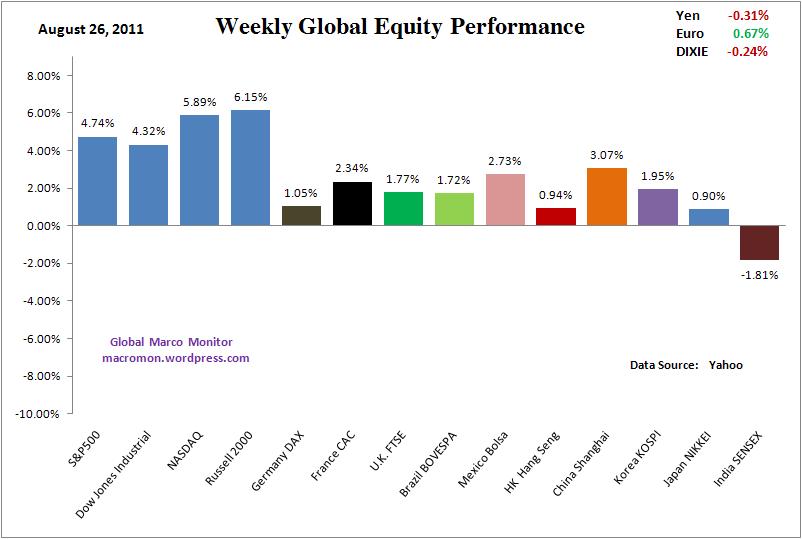
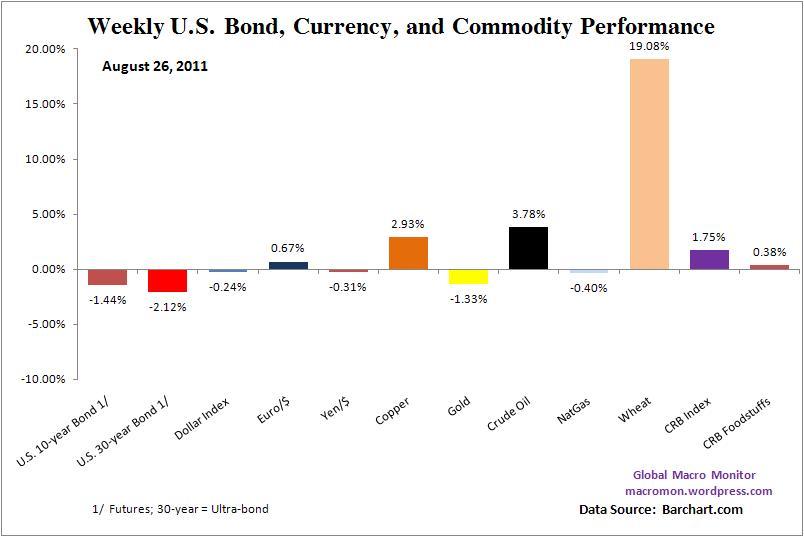

 (click here if charts are not observable)