So You Think The Stock Market Is Volatile?

#CKStrong

It’s all relative, folks.

Thus far in the new year, there have been 25 trading days, of which six days have had moves on an absolute basis of over 1.5 percent (both positive and negative). During 2021 the average number of six daily moves over 1.5 percent during the previous 25 days was two, so, yes, volatility has certainly picked up.

Realized 25-day annualized volatility at the close of today’s trading was 19 compared to an average of 12 in 2021 and 27 in 2020. The VIX closed at 22.86 today, which seems a bit low to us.

The extraordinary volatility of 2020 was driven by the COVID stock market crash in February/March, the most volatile 25 -day period in post-war stock market history. The VIX failed bigly to anticipate future volatility and was at 14 when the bear market started on February 19th.

Too many yield-seeking vol sellers during quiet times have weakened the VIX as an anticipatory signal, in our opinion.  The VIX, expected volatility based on option prices over the next 30-day period, peaked at 85 in early April 2020, along with our measure of realized volatility.

In early April 2020, the 25-day realized volatility increased to over 90, absolutely stunning, and illustrated in the following chart.

The stock market anticipated the largest quarterly economic collapse in the county’s history, coming in Q2 2020, where real GDP fell 37.5 percent at a compounded annual rate. Interestingly, the S&P bottomed on March 23rd just before the start of Q2 as it heard the footsteps of the most massive global fiscal and monetary stimulus in history.

The 2020 economic and stock market collapse was most likely an aberration, not to be repeated. We seriously doubt global policymakers will flip the lights off on the economy ever again. Never say never?

Current Market

We expect volatility to remain elevated as the Fed starts to turn the monetary screws in March, but they are a long way from neutral. If the past is prologue, they will move at a snail’s pace. 

At some point during the tightening cycle, something will break, most likely the equity market first, if the Fed doesn’t get spooked by increased market volatility and lets inflation run, which will be political death for the political party in power.   Think 1980, Jimmy Carter, and Paul Volcker. 

Jay Powell is no Paul Volcker and will have to earn his inflation-fighting bona fides.

Investors should certainly have some dry powder, lots, in our opinion, to put to work on the break.  The S&P500 is up 112 percent over the past five years, and since 1960,  second only to the move in the mid to late-1990s.

Valuations are extraordinarily elevated, and the market is overdue for a big dipper.  Nobody knows the timing of a major correction, which will likely be determined by how sensitive the market is to the coming monetary tightening cycle and how far and hard the policymakers have to squeeze to bring inflation under control.

Equities Are The Place To Be In The Long-Term   

There is no doubt, however, equities are where wealth is built over the long-term, reflected in the following chart.  

That is one scary chart and really should be scaled by taking the log of the S&P levels. 

Getting Out Too Early

I sold out at 3200, leaving 1300 S&P points on the table, which would have resulted in my firing if I were not in the fortunate position of being independent.  I also have trader status with the IRS, which cannot be revoked, so taxes are not an issue in my decision-making. My positions are marked-to-market at the end of the year, taxed on the mark, even if I haven’t sold or covered the position. 

However, most investors and portolio managers are not in my position and have to remain almost fully invested due to career risk and fear of missing out (FOMO).  I have always equated FOMO investing to fearing missing the four days of partying on the Titanic after it left the dock. No thanks, not my cup of tea, though I do get the trade. I really do, even in crypto. 

Putting the big fail of getting out too early in the past, I am currently positioned in my happy place and sleep well at night (even though I am a chronic insomniac). I hope you all are too, that is in your happy investing place.  

Scalping is the word for me. Stay tuned.    
Posted in Uncategorized | Leave a comment

S&P500 Key Levels & Realized Volatility

#CKStrong

Wow, wild swings. We wrote on January 6th,

Will the current sell-off morph into a Wiley E. Coyote moment and drive stocks over a cliff allowing them to fall to fair value, which, for most, is much lower?  We seriously doubt it until the Fed begins to remove lots of the stimulus and tighten monetary conditions. – GMM

Almost every big move this young year seems that traders were way offside.

We expect volatility to remain high before a new trend is established, which will come when the Fed starts tightening the screws, if, and a big if the Board has the spine, which we have our doubts.

The big moves last Friday and Monday (see chart below) may have been the shy tone that several Fed officials expressed earlier this week about the willingness to go to war on inflation.

Nevertheless, the wage/price spiral is accelerating. Take a look at Amazon after their earnings release today. Management announced that Prime membership fees would increase by $20, almost 20 percent, which we expect is to help offset their rising labor costs.

Amazon has well over 200 million Prime members, and it’s estimated that 60-70 percent of American adults are members. Inflation coupled with accommodative monetary policy is good for stocks in the short term, and Amazon’s stock is up over 15 percent in after-hours trading.

The longer the Fed waits or is too slow, however, inflation digs its roots deeper into the economy, and the more pain will be inflicted from the coming tightening cycle.

Posted in Uncategorized | Leave a comment

QOTD: America’s Monetary Orgy

#CKStrong

QOTD = Quote of the Day

…the Fed continues to ladle out the punch, even though the party is turning into an orgy. – Martin Wolf, “The Fed Is Too Late To Remove The Punchbowl,” FT

Posted in Uncategorized | Leave a comment

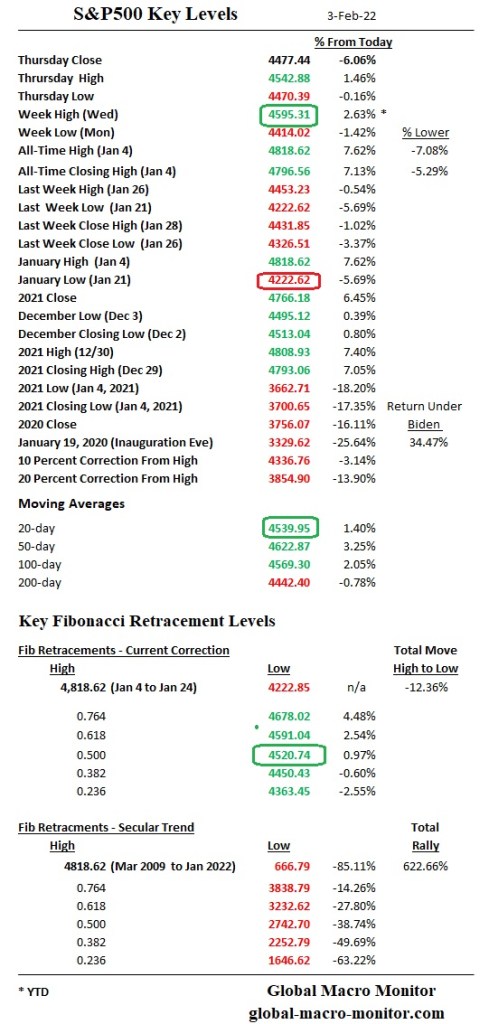
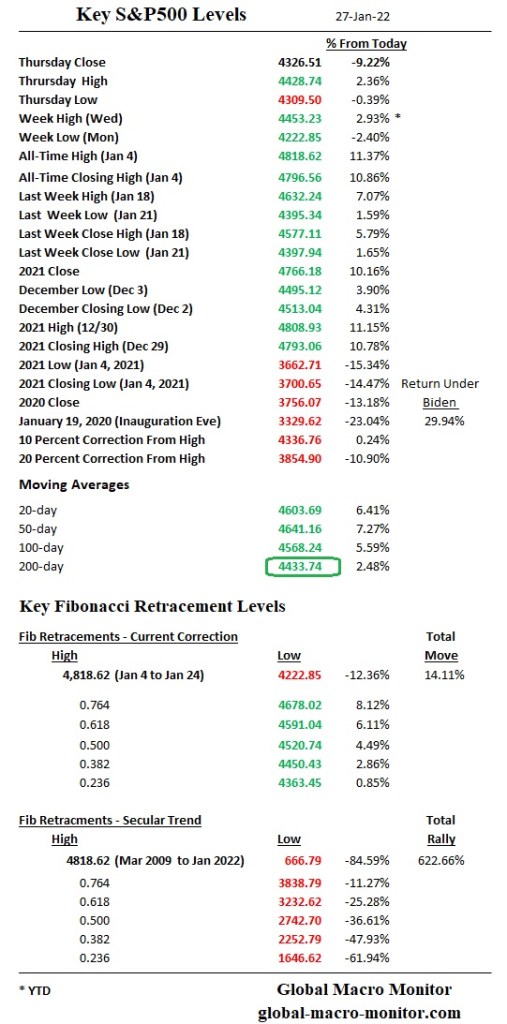
S&P500 Key Levels – January 27

#CKStrong

The market made a valiant effort to recapture the S&P’s 200-day today but failed and couldn’t hold its early gains.

Posted in Uncategorized | Leave a comment

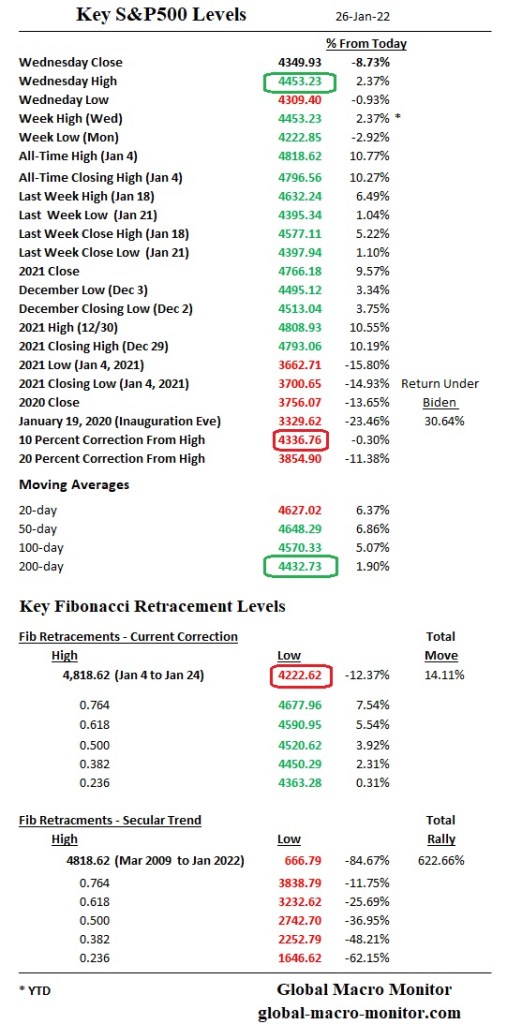
S&P500 Key Levels – Jan 26

#CKStrong

Recapturing the 200-day at 4432.62 (+1.9%) relatively soon a must for Bulls to hold the line here.

Posted in Uncategorized | Leave a comment

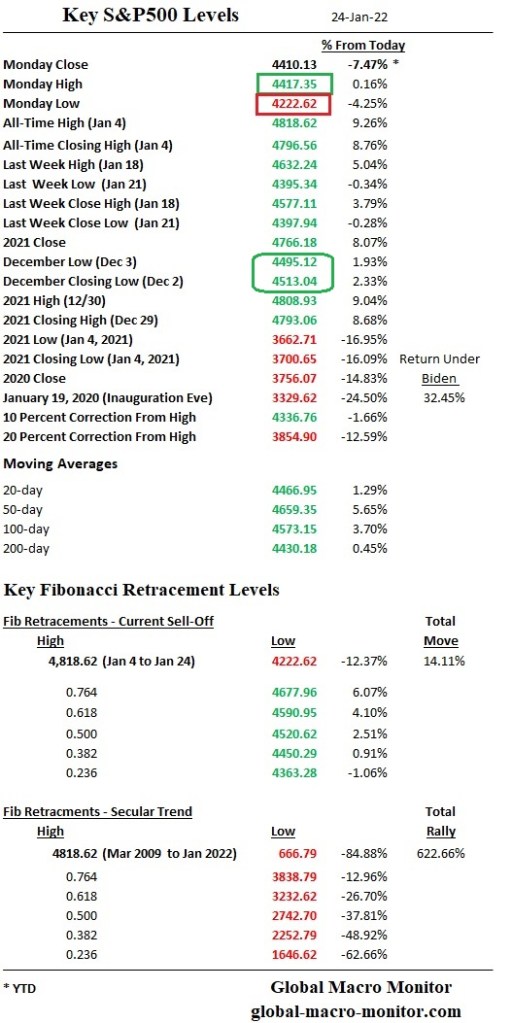
S&P500 Key Levels

#CKStrong

S&P has some work to do. Today’s low a must hold. Today’s high at 4417.35 most likely taken out in the morning, a January close above the December low at 4495 usually a necessary condition for a positive year. Stay tuned.

Posted in Uncategorized | Leave a comment

Summers And Krugman Debate Inflation

#CKStrong

This is good. Well worth your time and will determine your financial health.

Posted in Uncategorized | Leave a comment

Friday’s Retail Sales Were Supply-Chain Positive

#CKStrong

There was a lot of hang wringing over Friday’s retail sales coming in softer than expected.

U.S. retail sales stumbled at the end of 2021, factory output weakened and consumer sentiment deteriorated at the start of the new year, illustrating a loss of traction for the economy that many analysts view as temporary.

Friday’s data deluge showed how lingering shipping challenges, supply and labor constraints, the fastest inflation in decades and the omicron variant are weighing on activity. – Bloomberg

Slowing Sales A Necessary Conditions To Fix Inflation And The Supply Chain

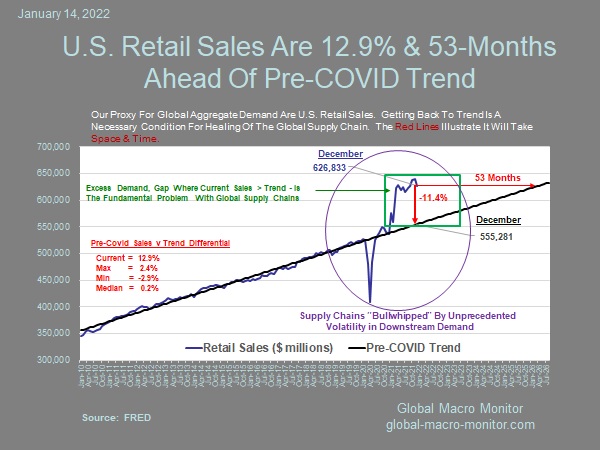
Au contraire, we use the differential of U.S. retail sales versus its pre-COVID trend as a good proxy of what is driving much of the problem in the global supply chains — that is, excess demand. Americans are buying too much stuff generating a massive traffic jam in supply logistics.

Take a look at the chart (last chart) below and see how out of whack retail sales are and how far above they are above its pre-COVID trend, which is, no doubt, inflationary and unsustainable.

We use the differential of current level of retail sales to its pre-COVID trend as a proxy of excess demand in global the economy. No doubt, there are real supply chain issues where factories close, say, due to sick workers from COVID, for example, but these are de minimis when compared to the massive gap between demand and supply, which is gummy up U.S. ports.

Bullwhip Effect

The volatility and unstable point-of-sale demand create havoc on the visibility of producers and upstream suppliers, who must forecast future demand. . Research indicates such high volatility in point-of-sale demand of, say, just five percent will be interpreted by supply chain participants as a change in demand of up to forty percent.

In such an environment, it is not uncommon for suppliers to panic, double and triple order, hoard, or attempt to secure some inputs in the underground market. In other words, hyperinflationary expectations and panic, to some extent, have taken over and swamped the supply chain.

Yes, folks, that is the type of behavior exhibited in hyperinflationary economies. I have lived it first hand.

To Produce Or Not To Produce

Moreover, producers have to decide if the demand they do see is real and sustainable and then determine whether to expand capacity accordingly to meet that excess demand.

Our priors are that producers’ perceptions are that much of the demand has been generated by the stymie money pumped into the economy over the past 19 months and is more or less temporary and the dominant expectation is that sales will eventually revert back to trend. Producers have been burned so many times in the past by misreading the spike in sales that were not sustainable and learned an expens lesson, getting stuffed with excess inventory and capacity.

Friday’s numbers confirmed, at least to us, that the initial stimulus is starting to wear off as the Fed prepares to reverse and begins to remove accommodation. Here’s to hoping they get the timing right.

No Pain-Free Way To Reduce Inflation

There is no pain-free way of ridding an economy of inflation. It’s difficult to measure how much the Fed needs to slam on the brakes, especially as the economy moves back to its natural trajectory without trillions of income support, all while it teeters over a fiscal cliff.

The Fiscal Cliff

Whatever, the case, the next year will be very interesting to watch how the economy and markets react to the Fed’s attempt to unwind its monetary experiment, which is unique and has never been attempted in a modern-day economy.

Finally, I think the pandemic will mark the point when economists stopped referring to supply curves, replacing the term with “supply chains,”which most macro analysts have very limited knowledge . About time.

Stay frosty, folks.

Posted in Uncategorized | Leave a comment

The Best MLK Weekend Of All-Time

#CKStrong

We are reposting a repost of a post for the holiday and in honor of Dr. King, one of our greatest Americans, a true patriot, and a modern day saint.

Originally Posted on 

During my Lehman days as a bond strategist, the firm’s research group would do a January roadshow in many of America’s major cities to present our ideas to institutional investors.   One particular year, we were in Atlanta at the end of the week and scheduled for another “greatest show on earth” in Chicago the next Tuesday.

A Weekend In The Peachtree Hyatt

Rather than flying home to New York, I decided to stay over in Atlanta and migrate north on Monday evening.   It was MLK weekend and I wanted to attend services at the Ebenezer Baptist Church, where Martin Luther King, Jr. was baptized as a child and gave his first sermon. If my memory is correct, I believe his father also pastored the church.   His mother was shot and killed while she played the organ in that church in 1974.

Dr. King’s tomb is located just outside the side door of the church in the middle of a reflecting pool.

dr. king

Three Memories Of Ebenezer

I recall three of my main takeaways from that Sunday morning.

First,  I was maybe one of ten whites out of 600-700 people sitting in the pews.  Sadly, as Dr. King said almost 60 years ago.

I think it is one of the tragedies of our nation, one of the shameful tragedies, at 11 o’clock on Sunday morning is one of the most segregated hours, if not the most segregated hour in Christian America.  – MLK, Jr  Meet the Press, April 17, 1960

Nevertheless, I felt incredibly welcome and never — not for one nanosecond —  was conscious about such a silly thing as the difference of the color of my skin.  During the greeting time, the Ebenezers made me feel so welcome and a part of their family.

Second, not to contradict Dr. King, but I believe the service started at 9:30 AM and went to almost 1:00 PM!  Maybe it was a special MLK weekend service.  The pastors in the mostly white churches I have attended have trouble keeping the attention of the congregation for more than 20 minutes.

Third, the sermon was entirely different from those I had experienced in middle-class white churches.  Less doctrine, though similar theology, and more real life.  The struggles of raising children in poverty.  Grandparents raising their grandchildren. Troubles with children with drug addiction. The struggles of being black in white America, all of the life struggles which are just as ubiquitous in the white and all communities of color.  No pretense of being sinless and perfect, no holier than thou vibe, no judgment, no condemnation, no guilt, no shaming.  All love, compassion, kindness, and forgiveness.  Just like the real Jesus.

Also, the sharing of the same joys and blessings.  New babies, college graduates, marriages, medical recoveries, and others.

Daddy King” was referred to several times.

It truly echoed the genius and saintliness of Dr. King.

I walked away convinced the Church for the African-American community was much more — that is a considerable part of their life — than what I had experienced in white evangelical America.

Yes, maybe some of us attend more than just Sunday services, but many, such as yours truly, often do so with the dubious motive of seeking the blessings of personal peace and personal prosperity.  The community of the Church, as it for the African-Americans, though not always, is secondary.

The next day, Martin Luther King Jr Day, I spent across the street at the King Center.

More Empathy, Less “Being A Dick

What great memories from that unforgettable MLK weekend.

I grew up lower-middle class in the white suburbs of Los Angeles, attending an all-white high school.  Fortunately, I had a father, who was politically left of the salad fork (out of a rebellion,  I became a conservative in college),  and also spent my first 25 years playing sports, fighting in the baseball trenches with, pulling for, breaking bread, and downing brewskies with my teammates of color; or as I grew to learn colorless.

I am very thankful for those experiences.  It helped me integrate into and see the real greatness of America.

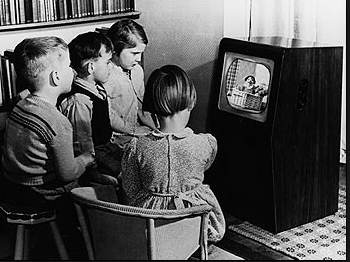
I feel sad for my many brothers and sisters who have not had the same privilege and are stuck still watching black and white television:  unable or unwilling to embrace and enjoy the tremendous diversity of this great country.

Ditto for the similar ignoramuses from other races and ethnic groups.

tv

I can’t imagine eating steak and potatoes every day and every night.

Ignorance And Racism Know No Boundaries

Let me finish by qualifying all of the above.

Racism is such a prominent feature of so many human societies that some evolutionary psychologists have concluded it is “natural” or “innate.”  We don’t know about that but are certain it is not just a “white thing”, a “black thing, or a “brown thing,” etc.

I have shared the story of my brother who was murdered by an undocumented worker, who stated, after stabbing him, “all anglos need to be exterminated.”   This sociopathic asshole killed my brother not because he was brown, or undocumented, but because he was one sick and crazy mother f$@ker.

Now, more than ever it is time to commit to expanding our menu.  Let’s make it a point to understand and enjoy the perspectives and various cultures of all the different races and ethnic groups.

Allegorically, and literally, let’s eat more balaedas, falafel, babaghanoush, borscht, moussaka, and bouilli, among others.  The steak and potatoes will taste sooo much better.

Sorry to end on a note that violates the spirit of Dr. King but I can’t help myself.

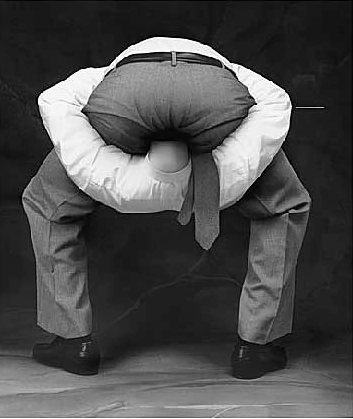
Any white man (probably less so for a white woman) who thinks he knows what it is like to be an African-American growing up and living in America, has his head…well…you know where.

head

Bring on the hate mail.

Posted in Politics, Uncategorized | Tagged , , | Leave a comment

The Nonfarm Payrolls Report In Four Charts – Part 1

#CKStrong

We have crunched a lot of data from Friday’s nonfarm payrolls report (NFP) and have made some fascinating observations to share with our readers. 

This is the first post in a series in which we go deep into the data to bring you our insights on the condition of  the U.S. labor market. The later posts will get more granular into the employment subsectors (see last table below)

#1 – Total Private Nonfarm Payrolls

We prefer the private sector data, which excludes 22 million government jobs, of which 64 percent are local government payrolls; state governments make up 23 percent. The federal government (x/ military) is 13 percent of total government payrolls. 

Government workers are, in general, shielded from market forces, and the Bureau of Labor Statistics (BLS) does not publish government wage data, at least not in the NFP report. 

The above chart illustrates that private sector payrolls remain 7.4 million or 5.5 percent below their pre-COVID trend. Recall that from February 2020 to April 2020, the private sector lost 21 million jobs when the lights were turned off in most of the world’s economies as the COVID pandemic ravaged the globe.

Government payrolls lost 1 million jobs and didn’t bottom until December 2020, most of which were local government jobs.

Most Unrecovered NFPs Are In Three Sectors

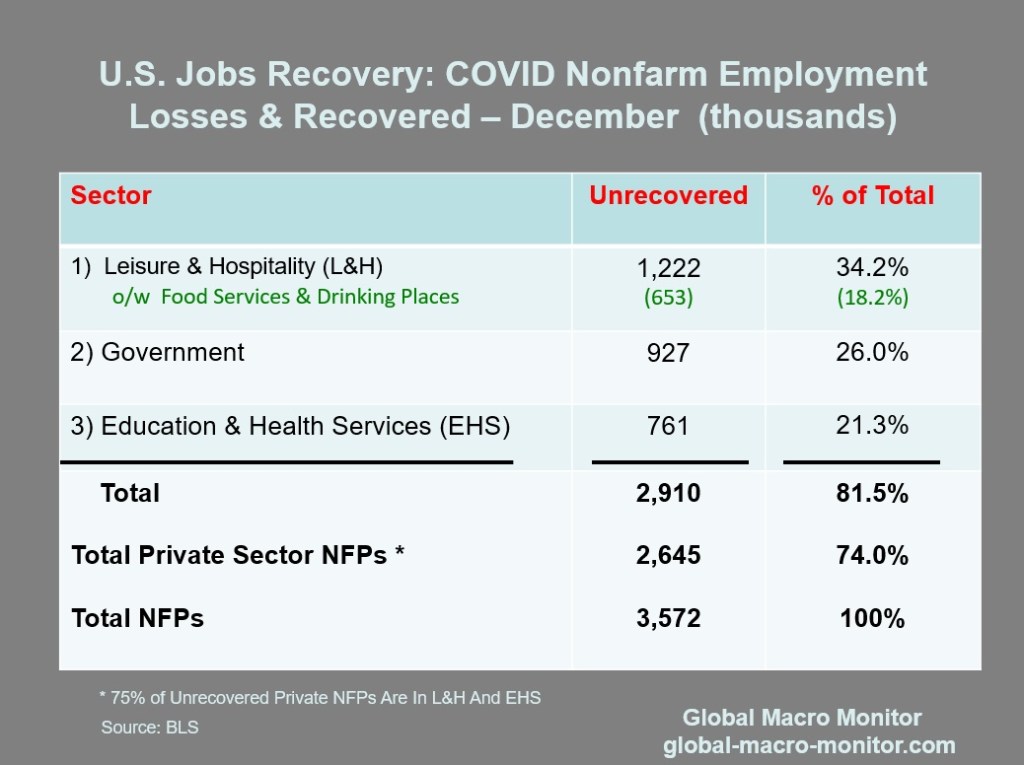
The above data show that 81.5 percent of all unrecovered NFPs are in three sectors: Leisure & Hospitality (L&H); Government (of which, 73 percent are local govenment jobs), and  Education & Health Services (EHS). 

The L&H and EHS sectors alone make up 75 percent of all private sector unrecovered NFPs. 

Readers should make the distinction between the number of NFPs below trend and jobs lost during the initial labor market crash during 2020, which is the context of the data above. 

#2 – Nominal Average Hourly Earnings (AHE)

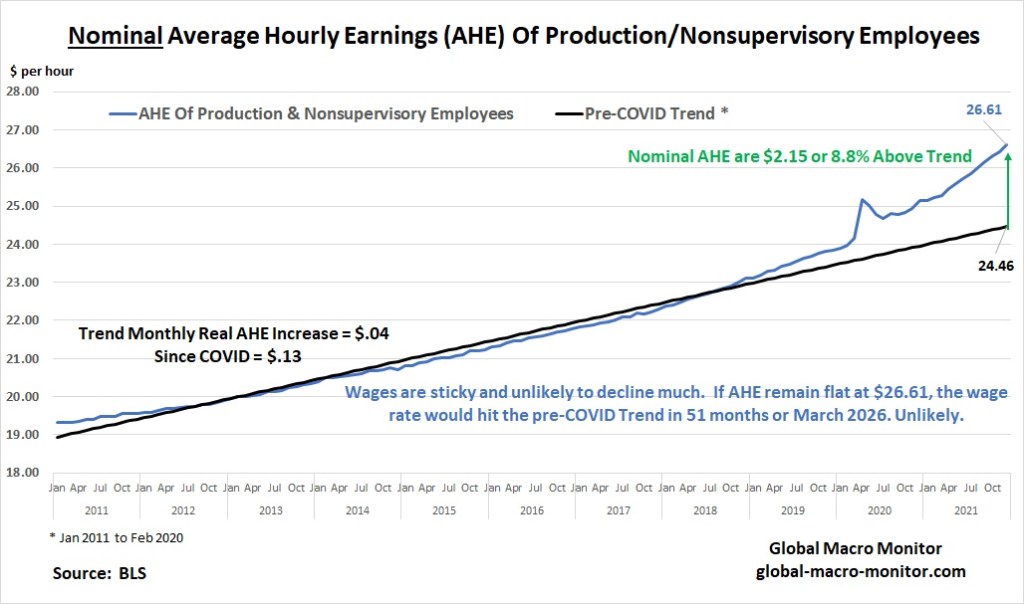
The chart below surely illustrates, at least to us, wage inflation, which make price increases sustainable, is undoubtedly not transitory.  It appears wage growth is actually accelerating. 

The December AHE is now $2.15 or 8.8 percent above its pre-COVID trend. 

We asked in a post last August,

What is the Fed thinking?

… It’s clear the labor supply curve has shifted left.

Isn’t that evident with 32.2 percent of the unrecovered jobs in the leisure and hospitality sector, yet no workers can be found? Moreover, 62.2 percent of unrecovered jobs are in three sectors: leisure and hospitality, government, and education and healthcare. None for no lack for demand.  – GMM, Aug 21

We warned that the Fed was repeating the same mistake of the mid-1970s, trying to monetize a supply shock with massive and ongoing stimulus.   

We were also early in our inflation call in or Feburary 9th post, Ready For 4 Percent CPI By Mid-Year?

We also posted that it wouldn’t surprise us to see inflation print at 5 percent in 2021, and we were beaten down like red headed stepchild. I can say that because of my reddish hair.. 

#3 Money Illusion

Money illusion is an economic theory positing that people have a tendency to view their wealth and income in nominal dollar terms rather than in real terms. In other words, it is assumed that people do not take into account the level of inflation in an economy, wrongly believing that a dollar is worth the same as it was the prior year.  – Investopedia

We hear a lot of money illusion these days, with the noise and praise that wages are rising rapidly. 

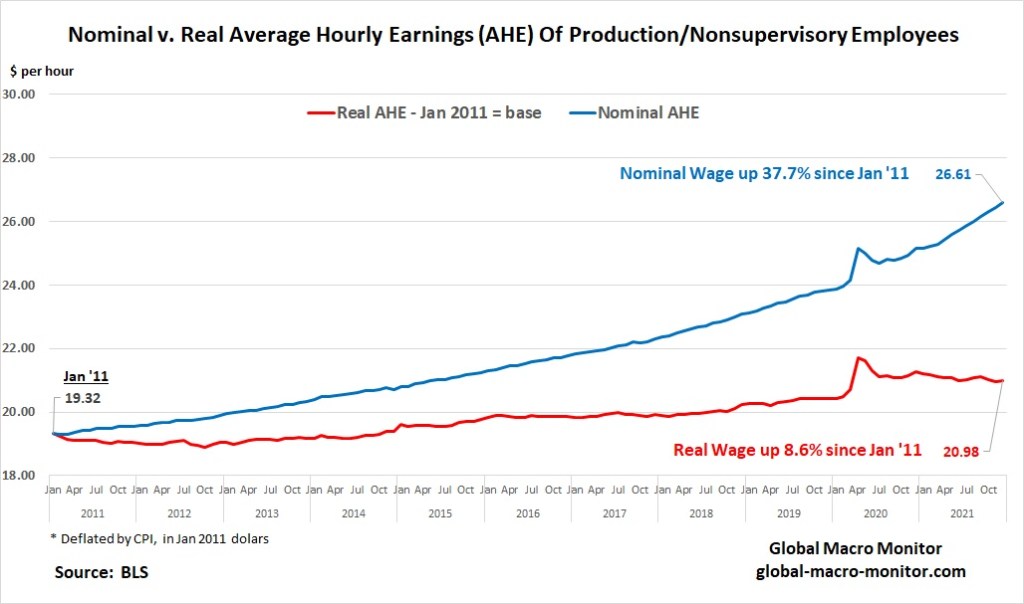
In some sectors, we are happy that wages are rising more than in others.  However, rising wages without a corresponding increase in productivity is the gas that fuels inflation.  This is evident in the following chart, which juxtaposes nominal against real AHE.   

Notice that nominal AHE have been up 37.7 percent since January 2011 versus the 8.8 percent increase in real AHE. 

We have deflated nominal AHE by the CPI index rebased to January 2011.  

#4 Real Average Hourly Earnings

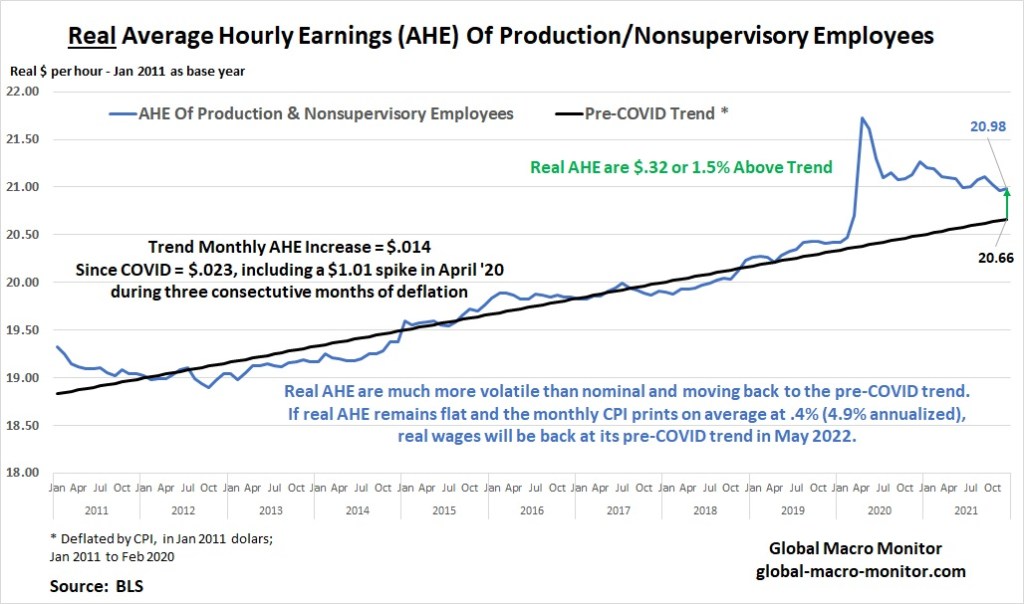
Our real AHE chart is very enlightening.  

First, it illustrates how volatile real wages are compared to nominal. 

Second, the real AHE is only $.32 or 1.5% above its pre-COVID trend.

Finally, if the CPI monthly prints come in at an average of 0.4 percent (4.9 percent annualized) and real AHE stays flat for production and nonsupervisory, the real macro wage will be back to trend by this May.  Both components, nominal and CPI, won’t follow this trajectory, but we use the scenario for illustrious purposes to show how absurd money illusion is. 

If the CPI print on Wednesday comes in hotter than the 0.6 percent increase in December’s AHE, the real macro wage will decline.

Upshot

Most, or 82 percent of the unrecovered NFPs are in three sectors:  L&H,  Government, and EHS. 

Inflation hurts workers. 

Money illusion is rampant.

Wages increases without a corresponding increase in productivity or the inability of producers to pass on rising input costs, which pressures profit margins, is inflationary. 

The following table is an appetizer of our next post, which we hope will be published tomorrow depending on doctors’ orders. 

Notice a pattern, anyone?

Stay frosty, folks.

Posted in Uncategorized | Leave a comment