It was early August 2001 when I asked my wife if we should fly into Washington, D.C. a few days early before my best friend’s wedding. He was planning to marry his sweetheart on September 16, 2001, at St. John’s Episcopal Church, where new presidents attend a prayer service the morning of their inauguration. My 6- and 3-year-old daughters and I were in the wedding party.
I wanted some extra time for the girls to see the great sights of the Capitol City, where I had attended graduate school and begun my career several years earlier.
I secured some VIP passes from our congressman for tours of the White House and the U.S. Capitol. The passes came in the mail around mid-August, with the date for the Capitol tour scheduled for 8:30 am, September 11, 2001.
Just another day. It was before history changed.
We also planned a trip to New York after the wedding, as my girls wanted to visit their birthplace. The oldest specifically requested a trip to the top of the World Trade Center’s Windows on the World.
Their last night in New York before moving to California was spent at the Marriott World Trade Center, South Tower.
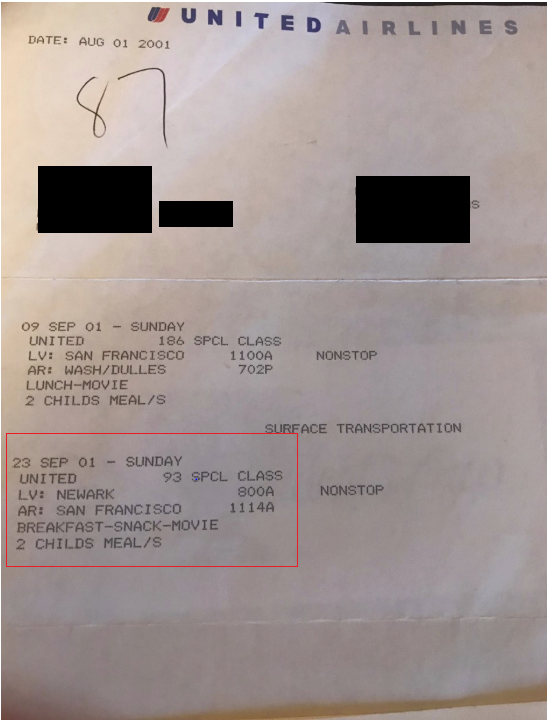
We booked our flights.
The return flight from New York was familiar. I had flown it at least a hundred times — United Flight #93, Newark to San Francisco.
Just another routine United flight. It was before history changed.
Washington, D.C.
We arrived at Dulles Airport on Sunday night, September 9th, and it felt good to be back in Washington.
As we were disembarking, my 3-year-old noticed the overhead air blowers were still on and blowing hard. She shouted, “Dad, they’re wasting energy!”
The plane burst out laughing. California was in the middle of an energy crisis, experiencing brownouts daily throughout that summer.
September 10, 2001
The following morning we had some downtime, and because the White House was only a few blocks from our Georgetown hotel, I took the girls down to see the president’s house. We arrived at the front gate, and I noticed the Secret Service on top of the White House with high-powered binoculars, scanning the sky.
I hadn’t seen this since the day after the U.S. bombed Libya in 1986, in retaliation for Gaddafi’s bombing of a Berlin disco that killed several American soldiers. I had an interview the next day at the Council of Economic Advisers (CEA), located in the Old Executive Office Building, and I recalled how tight security was — specifically, the sharpshooters on top of the White House.
For context, I hadn’t been in Washington in five years before our September 2001 visit, and, no doubt, security had ramped up considerably since. Put away those conspiracy theories.
Video Tape
I began filming the White House the day before history changed — specifically the Secret Service, their high-powered eyes trained on the sky above the White House.
I mentioned to my family there must be “some sort of terrorist alert.” My very bright, analytical 3-year-old immediately chimed in: “Dad, they’re trying to hurt the president.”
After thinking a minute longer, she asked, “Dad, do they [the Secret Service] know we’re good guys?” It was somewhat hilarious, at the time. We have it all on tape.
Lafayette Park
It was hot and humid in Washington on September 10, 2001, the day before history changed. I took the family across the street, sat them on a bench in Lafayette Park, and went to fetch them some water from a street vendor.
Before leaving on the water run, I noticed a Middle Eastern–looking man sitting on the bench next to my daughters. He was very agitated fiddling with his cell phone and rapidly thumbing through a stack of ATM receipts — I recall some were from Bank of America.
What struck me most was his fidgety, nervous demeanor.
He was casually dressed in nice khaki slacks, an olive-green button-down shirt, and sandal-like, full-toed shoes. He smelled of cheap European cologne. I will never forget his face.
While I was out getting water, for some reason, I had a bad feeling. I began to think the man on the bench fit the profile of a terrorist. I seriously considered walking back across Pennsylvania Avenue to report the suspicious character to the uniformed Secret Service officers at the White House’s north gate. I’m sure they would have laughed and dismissed me as some kook.
When I got back to the park, the man was gone. I asked my wife, “What happened to the guy sitting on the bench? He reminded me of a terrorist.” True story.
Racial profiling? No, his agitated state is what made me suspicous.
I had a strong feeling based on his actions and my own experience being so close to the first 1993 bombing of the World Trade Center, when I worked on Wall Street.
September 11, 2001
About 8:00 am, my wife woke us in a panic. We had overslept and needed to hurry to get to the Capitol building.
I knew we wouldn’t make it on time and, reluctantly, put the kibosh on our trip up to the Hill. My wife and our oldest went down to the lobby to grab some breakfast. My youngest, still suffering from jet lag, was sound asleep.
I was reading the Washington Post when they returned to the room in horror and told me to turn on the television — a plane had crashed into the World Trade Center.
For the next few hours, I watched in shock and was on the phone constantly with my friend, the bridegroom, who had a view of the WTC from his Greenwich Village apartment.
When American Flight #77 hit the Pentagon about an hour later, it was only a matter of minutes before F-14s were buzzing over our Georgetown hotel.
I went outside and saw people hustling up the sidewalk and noticed the military had come out onto the street — a Humvee stationed at every corner in Georgetown. This doesn’t happen in America.
Get Out of Washington
I began to fear for the safety of my family and decided it was time to get out of Washington. I told my wife, “If these people have chemical or nuclear weapons, we’re smack in the middle of their target.”
As I was heading out the door to rent a car, my oldest shouted, “Dad, get a purple car!” Yeah, right, I thought.
I arrived at Hertz in Georgetown, and the clerk said I was lucky — there was one car left. They pulled it up to the office. A purple Volvo.
Charlottesville
On our way to Charlottesville, I was overcome with the incredible grief all of America was suffering, especially thinking about my friends in the WTC. I felt sick.
It felt like the end of American exceptionalism. These things just don’t happen in America.
Seeing American flags draped over the freeway overpasses on our drive to southern Virginia, I thought, as many others did that day, that this was my generation’s Pearl Harbor.
September 12
The next day at Jefferson’s Monticello, a busload of senior Japanese tourists pulled up to our third president’s home. They were soon smitten with my 3-year-old — one heck of a cute baby, with a friendly, unique personality.
The Japanese tourists asked to take pictures with her. I warmly agreed and thought how surreal it was — the day after our own Pearl Harbor. Surely some of these people were alive, and on the other side, on December 7, 1941.
It was the first few days of a grave new crisis; the nation was grieving and in complete shock, just as the Pearl Harbor generation had been on that dark December day 60 years earlier. And there was my child, chumming it up with these beautiful Japanese seniors — a pearl in their eyes — who were once considered the enemy of the “greatest generation” just a little over a half-century before.
It gave me a glimmer of hope that the country would make it through the dark days.
The Japanese are now one of our closest allies, which could never have happened without forgiveness. No peace without justice, no justice without forgiveness.
Whenever I have the chance, and it feels appropriate, I ask my Japanese friends if they forgive the U.S. for bombing Hiroshima and Nagasaki. I’ve never received an unequivocal answer. Not once.
It seems the official position is to sweep it under the rug:
In 2007, during Shinzo Abe’s first term as prime minister, Defense Minister Fumio Kyuma referred to the bombing of Hiroshima and Nagasaki as “something that couldn’t be helped.” — LA Times, April 2016
The FBI
The day after the attacks, I began to think again about the man I’d encountered in Lafayette Park.
I contacted the FBI to report the incident.
At first, they seemed to mock me — asking how he was dressed, probably expecting I’d reply, “in Arab garb,” like a thobe, ghutra, and egal.
I spoke with the FBI several times after that. They always remained aloof and never shared any information.
Enter Bob Woodward
I then contacted the Washington Post’s Bob Woodward, who put me in touch with his research assistant. We had about a half-hour conversation, in which he told me Al-Qaeda liked to scout their targets just before hitting them.
Was the White House a target?
Several reports specifically identified Capitol Hill and the White House as targets on Sept. 11. One said a bin Laden associate — erroneously — “gave thanks for the explosion in the Congress building.”
A key figure in the bin Laden financing organization known as Wafa initially claimed “the White House has been destroyed,” before having to correct himself. — Washington Post, January 28, 2002
I can’t remember if it was the FBI or Woodward’s assistant who confirmed that the 9/11 terrorists had emptied their bank accounts just before the attack and transferred the cash back to the UAE:
From September 5 through September 10, 2001, the hijackers consolidated their unused funds and sent them to Hawsawi in the UAE. — National Commission on Terrorist Attacks
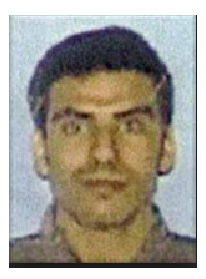
The ATM receipts were convincing enough, but my suspicions about the man in the park were confirmed when the FBI released photos of the 9/11 hijackers.
I will never forget that face.
I had sat my daughters down on a park bench across the street from the White House, the day before September 11, 2001, next to one of the hijackers. His name was Khalid al-Mihdhar, a senior Al-Qaeda operative who helped crash American Airlines Flight #77 into the Pentagon.
How twisted was it that on September 10, 2001, the Secret Service was on top of the White House combing the sky for potential terrorists, while one of the Al-Qaeda hijackers sat right under their nose, less than 1,000 feet away?
The Wedding
My friends bravely decided not to cancel their wedding the following Sunday, and we shared in their joy under extremely stressful conditions.
The church was located just across the street from Lafayette Park, a stone’s throw from the White House, where president-elects traditionally attend their pre-inaugural church service.
Midway through the wedding, with the country and all of us still on edge, an army of sirens began to blare. It seemed to last an hour. Almost everyone in the church thought another attack might be underway.
I thought the presbyter was going to stop the wedding. We got through it.
Back Home
When the government lifted the ban on air travel, we caught one of the first flights out of Dulles back to the West Coast. That was one nervous flight.
One of our flight attendants panicked when a passenger refused to sit down. I have no doubt our plane was crawling with air marshals.
We Made It
We got through it. The nation got through it.
The world is much different now.
September 11th came too close to my family, but we escaped the ultimate tragedy.
Not so for many of our friends, fellow Americans, and good citizens from other countries who lost their lives that day.
I miss my friends who lost their lives that day.
Please God, bless their families and all those who lost loved ones, and the brave Americans who have made the ultimate sacrifice protecting us, and the many who still work to keep us safe.
Everyone Has a Story
Everyone remembers exactly where they were and what they were doing on the day that changed history.
I had wanted to write this story down for 17 years but just couldn’t do it. Now my children will have it to pass on to their children.
Everyone has a 9/11 story. Write it down. It’s cathartic.

 We anticipate monitor and comment on market-moving global economic and geopolitical issues. No dark side brooding, no wanting the world to end, no political rants. Traders, investors, policymakers, or market observers can’t afford to ignore us. In one word, perspicacity.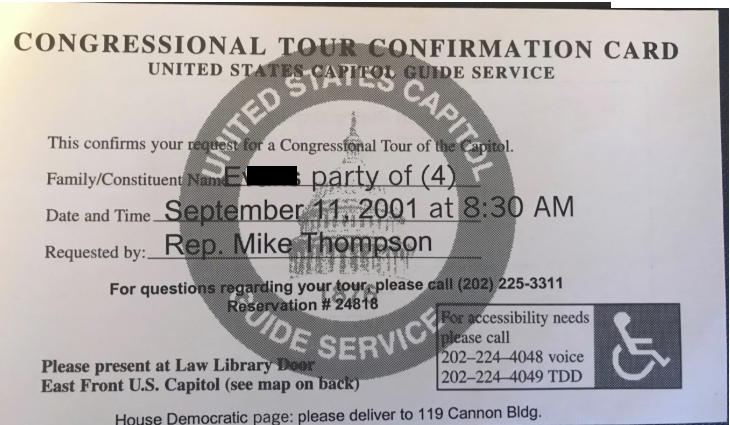



 Global Macro Monitor