
We have updated the GDP growth rates for the 2019 and the 2020 forecasts and ranked the world’s fastest growing economies in the ginormous table below. The data are from the April 2019 IMF’s World Economic Outlook.
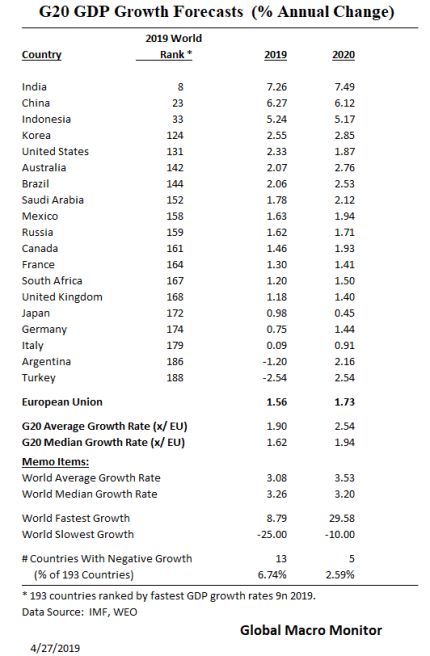

We have updated the GDP growth rates for the 2019 and the 2020 forecasts and ranked the world’s fastest growing economies in the ginormous table below. The data are from the April 2019 IMF’s World Economic Outlook.
Caveat emptor. The complacency in markets is absolutely stunning as the U.S. slowly drifts into, what could be, the biggest Constitutional Crisis in the nation’s history.
Trump lost the top legal analyst at Fox News today. This is a major development.
Judge Napolitano told friends in 2017 that President Donald Trump had told him he was considering him for a United States Supreme Court appointment should there be a second vacancy.
Fox News legal analyst Judge Andrew Napolitano is not going easy on President Trump.
In a scathing op-ed and accompanying video published Thursday, Napolitano said that special counsel Robert Mueller’s report on Russian attempts to influence the 2016 presidential election and Trump’s efforts to cover it up showed a clear pattern of criminal behavior. – Yahoo News

Click here for the full interview.
Our Maundy Thursday Post
We concluded within 15 minutes after the release of the Mueller Report last Thursday, after reading the first 20 pages, the House Democrats would have no choice but to move on impeachment. See our Maundy Thursday post here. We received major pushback.
The markets are totally clueless to the potential of a huge spike in major political risk in the U.S. during the coming summer.
Clinton and Nixon Impeachment
Clinton’s impeachment coincided with the second biggest bull market in the 20th century and a super hot economy. Nixon’s impeachment was battered by the headwinds of spiking oil prices due to OPEC I, which was in retaliation by Arab nations for the U.S. rearming Israel during the Yom Kippur War.
Many suspect the Arab nations sensed Nixon was too politically weak to help Israel, which was a major miscalculation, and almost led to a dangerous confrontation between the U.S. and the Soviet Union.
We just found this tidbit of history from Politico of how during the Watergate scandal the Nixon administration was melting down and the President retreated to self-medication,
The Nixon administration began disintegrating—the president unable to play his role as the leader of the nation and the free world—at 7:55 p.m. on October 11, 1973.
The newly appointed secretary of state, Henry Kissinger, picked up his telephone. His trusted aide at the National Security Council, Brent Scowcroft, was on the line from the White House. The Arab-Israeli war of 1973 was in its fifth day, escalating toward a global crisis and a potential nuclear conflict.
SCOWCROFT: The switchboard just got a call from 10 Downing Street to inquire whether the president would be available for a call within 30 minutes from the prime minister. The subject would be the Middle East.
KISSINGER: Can we tell them no? When I talked to the president he was loaded.
President Richard Nixon—ravaged by more than four years of war in Vietnam, 15 months of Watergate investigations and countless nights of intense insomnia—was incapacitated. – Politico
Wow! POTUS was hammered as the world spiraled toward nuclear conflict and incapable of taking “the call.”
This further confirms our suspicions that domestic political scandals, such as Watergate, distorts and weakens the global perception — and maybe not just perception — of U.S. leadership in the world. And contributed, at least, partially, to the 1973 Yom Kippur War and subsequent economic crisis caused by the related OPEC embargo. – GMM, May 2017
Crude oil is up 43 percent year-to-date, the stock market is hovering around new highs but topping in our opinion, and the economy is slowing but who knows what will happen. Let’s hope we don’t have a repeat of the above as China and Russia sense weakness and chaos in the U.S. but we don’t see how they cannot.
Thus the probability of a major geopolitical event or crisis is increasing as the White House will be obsessed with their coming battle with Congress over the next several months. Taiwan, Iran, Venezuela, North Korea, Ukraine, or other? Take your pick.
Hollywood Can’t Make This Stuff Up
The activity of President Trump & Co. as reported by the Mueller Report is in a different zip code in terms of seriousness compared to both Clinton – lying about a blow job — and Nixon — obstructing the investigation of a break-in into the Democratic National HQ at the Watergate hotel.
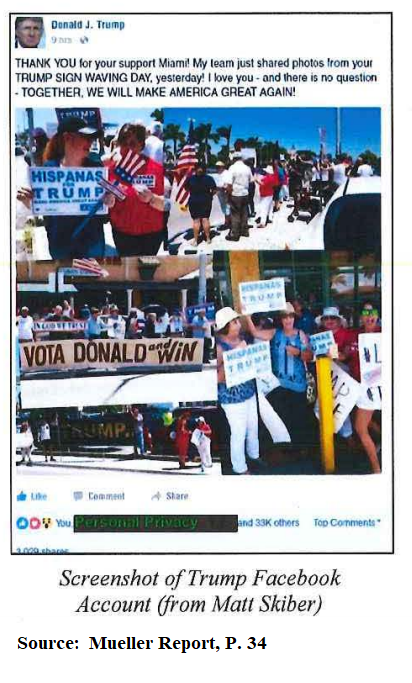
The Mueller Report documents the Trump Campaign soliciting, meeting, accepting and benefiting from help from the Russian government, who hacked the 2016 presidential election. Then trying to obstruct the investigation of those events.
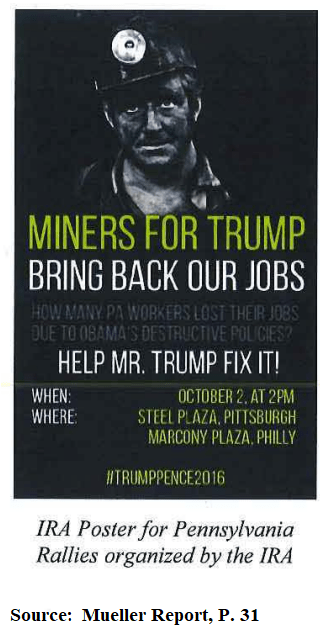
Check out how dark (in a spiritual sense) this campaign poster is, which the Russian IRA put together for a campaign rally which they sponsored during 2016 in Pennsylvania. The poster is directly out of the Mueller Report.
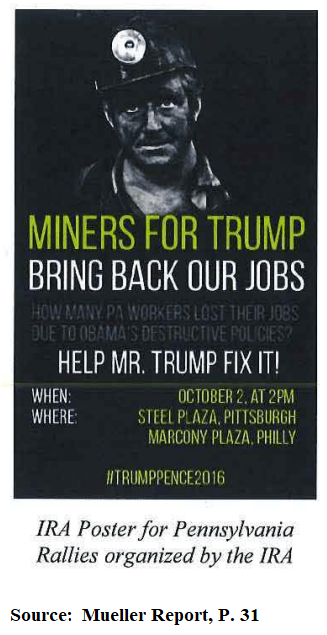
Don’t know about you but it really gives us the heebie-jeebies.
The man whose father [died of black lung disease in 1987] was featured in a pro-Trump Russian “Miners for Trump” propaganda ad speaks to CNN’s Anderson Cooper after it appeared in special counsel Robert Mueller’s report. — See video of interview here
Less Than 30 Percent Of Voters Have Read Mueller Report
The latest Morning Consult/Politico poll states that only 28 percent of voters have actually read the Muller Report. Anyone who just skims it is in for the shock of their lives. It reads like a Tom Clancy spy thriller but, unfortunately, it is scary true. Hollywood can’t make this stuff up
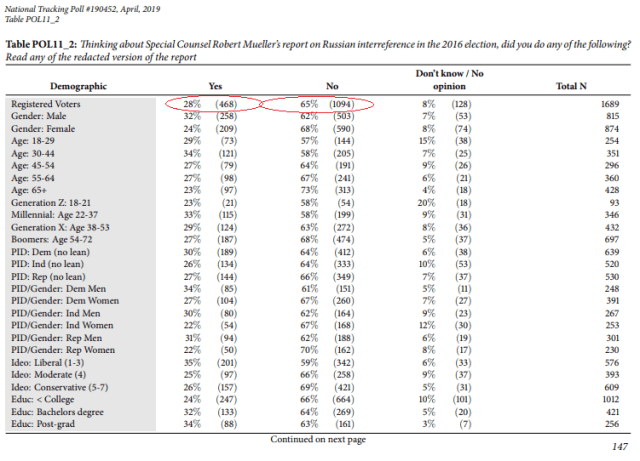
Once the report disseminates through the electorate, we suspect the dam could break. It is now the number one best seller on Amazon.
White House Keeps Digging Deeper
Moreover, Trump is providing the House with more ammunition for impeachment by ignoring Congressional subpoenas, which was the basis for one of Nixon’s articles of impeachment. Back then, the House Judiciary Committee passed three of the five proposed articles of impeachment.
Article III alleged in part that Nixon:
failed without lawful cause or excuse to produce papers and things as directed by duly authorized subpoenas issued by the Committee on the Judiciary of the House of Representatives on April 11, 1974, May 15, 1974, May 30, 1974, and June 24, 1974, and willfully disobeyed such subpoenas. — Wikipedia
Coming Summer of Discontent
We are expecting a Summer of Discontent. That is increased political instability, which will eventually weigh on the markets. We are the only out there with this call and it is not even close to the market’s radar.
Stay tuned.
Gotta find a good company or some crafties to bet on. A good draft frosty without the batteries will satisfy a yuuge overlooked market.
The FT’s Leila Abboud and Al Gilmour put alcohol-free and low-alcohol beers to the test, tasting them against full-strength brews from some of the biggest producers in the industry.
Read more at https://on.ft.com/2VdsyLi
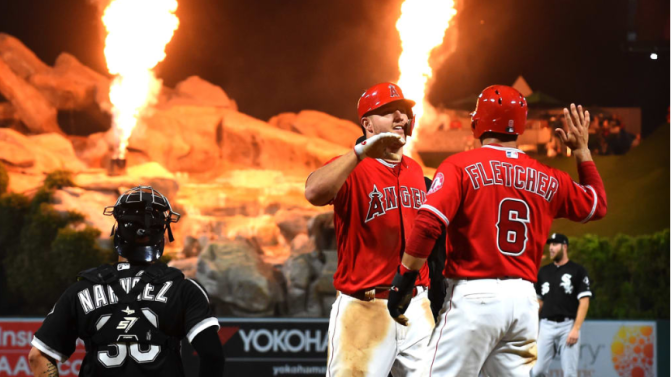
The first time we ever saw Mike Trout play baseball it was like watching the real-life version of The Natural, and thought someday people will say,
There goes [Mike Trout] the best there ever was in this game – Roy Hobbes, The Natural
Moreover, the dude is such a nice and decent guy.
“What’s nice about it is Mike is such a good person,” Jim Quinn, the former mayor of Millville [Trout’s hometown], told NBC Sports. “You get some of these superstar athletes that have attitudes and aren’t really genuine, but Mike is a genuinely nice guy.” – GOODSPORTS
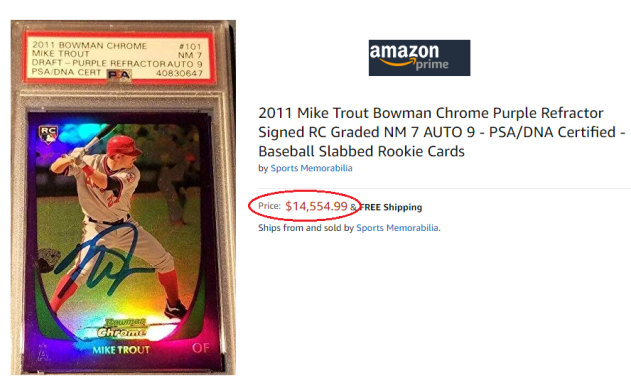
We began to hoard all things, Mike Trout.
We’re buyers of Mike Trout’s rookie card. – GMM, September 1, 2012
QE?
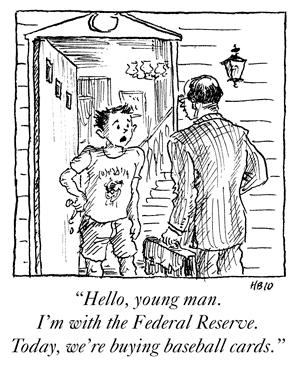
We also knew QE was at our back and thought someday the Fed may begin to add baseball cards to its SOMA portfolio, especially if the POTUS collected them and would lean on the FOMC to ease monetary policy in order to inflate their prices (note, FDR was an avid stamp collector).
We are pretty sure President Trump is not a big baseball fan as he has yet to throw out a ceremonial first pitch on opening day,
Every president since William Howard Taft, the commander in chief famously known for his particularly rotund figure, has thrown a first pitch at an MLB game…Donald Trump, for whatever reason, has yet to engage in the ceremonial practice of throwing the first pitch on Opening Day. – Complex.com
Fundamentals
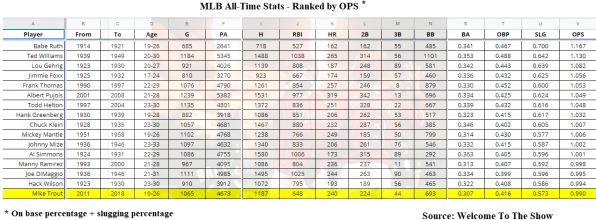
Given, no Fed buying and QE backstop we will have to depend on fundamentals — Trout’s productivity — to add value to our trade. And the fundies are still sizzling,
Baseball has been around for about 150 years and Trout — only 27 years old — is already in discussion for one of the best to ever play the game…Since his first full year in 2012, Trout has averaged 34 homers, 26 steals and 98 walks and has hit .310/.420/.579. No player in the game’s history has racked up more WAR through their age-26 season. Basically, any metric you want to use puts Trout at the top of the game – MLB.com
I played against some of the all-time greats. Mike Trout is better than all of them. – Dale Murphy
What We Are Buying
Mike Trout Farm Hats. See here.
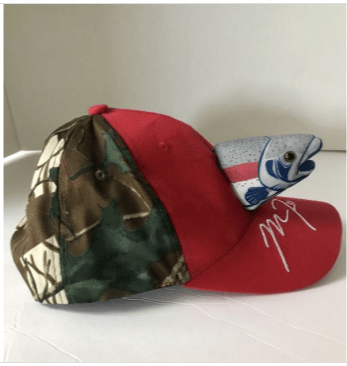
We have no doubt the appreciation of the Trout Farm hat, as a collectible, will beat inflation over the years and estimate our great grandchildren will cashing these for thousands of dollars.
Looking for a big price jump when Trout is elected to the Hall of Fame circa 2037!
Upshot
Relax. Tune out the ugly politics. Enjoy the new stock market highs. Watch some baseball. Watch the Warriors win their third straight NBA championship.
Then continue to sell this strength while there’s a bid. We think the S&P makes a nominal new high at 3025-ish before the Big Dipper sell-off or bear market.
That we are aware of…
Apple
Steve Jobs and Steve Wozniak had withdrawn from Reed College and UC Berkeley respectively by 1975. Wozniak designed a video terminal that he could use to log on to the minicomputers at Call Computer. Alex Kamradt commissioned the design and sold a small number of them through his firm. Aside from their interest in up-to-date technology, the impetus for Jobs and Wozniak, also referred to collectively as “the two Steves”, seems to have had another source. In his essay From Satori to Silicon Valley (published 1986), cultural historian Theodore Roszak made the point that the Apple Computer emerged from within the West Coast counterculture and the need to produce print-outs, letter labels, and databases. Roszak offers a bit of background on the development of the two Steves’ prototype models. – Wikipedia
Google
The Google first company was officially launched in 1998 by Larry Page and Sergey Brin to market Google Search, which has become the most used web-based search engine. Page and Brin, students at Stanford University in California, developed a search algorithm at first known as “BackRub” in 1996. The search engine soon proved successful and the expanding company moved several times, finally settling at Mountain View in 2003. This marked a phase of rapid growth, with the company making its initial public offering in 2004 and quickly becoming one of the world’s largest media companies. The company launched Google News in 2002, Gmail in 2004, Google Maps in 2005, Google Chrome in 2008, and the social network known as Google+ in 2011, in addition to many other products. In 2015, Google became the main subsidiary of the holding company Alphabet Inc. – Wikipedia
Amazon
In 1994, Jeff Bezos incorporated Amazon. In May 1997, the organization went public. The company began selling music and videos in 1998, at which time it began operations internationally by acquiring online sellers of books in United Kingdom and Germany. The following year, the organization also sold video games, consumer electronics, home-improvement items, software, games, and toys in addition to other items. – Wikipedia

Hat Tip: @tooskinnymariah
Harley-Davidson
Harley-Davidson is the iconic American motorcycle manufacturer. Founded out of a small shed in 1903 by William S. Harley and brothers Arthur and Walter Davidson in Milwaukee, Wisconsin. The Motor Company produces traditional cruiser motorcycles utilizing air-cooled V-Twin engines. – MotoUSA
Disney
Disney was originally founded on October 16, 1923 by brothers Walt and Roy O. Disney as the Disney Brothers Cartoon Studio; it also operated under the names The Walt Disney Studio and Walt Disney Productions before officially changing its name to The Walt Disney Company in 1986. The company established itself as a leader in the American animation industry before diversifying into live-action film production, television, and theme parks. – Wikipedia
Mattel
Harold “Matt” Matson and Elliot Handler founded Mattel in 1945. The company sold picture frames, and later dollhouse furniture. Matson sold his share to Handler due to poor health, and Handler’s wife Ruth took Matson’s role. In 1947, the company had its first hit toy, a ukulele called “Uke-A-Doodle”.
The company incorporated the next year in California. Mattel became the first year-round sponsor of the Mickey Mouse Club TV series in 1955. The Barbie doll debuted in 1959, becoming the company’s best-selling toy in history. In 1960, Mattel introduced Chatty Cathy, a talking doll revolutionizing the toy industry, which led to pull-string talking dolls and toys flooding the market throughout the 1960s and 1970s. – Wikipedia
Wow! We are still digesting the full redacted version of the Mueller Report.
We only had to get through the first few pages within an hour of its release on Thursday for us to conclude the House Democrats will have no choice but to move on Impeachment. See our post, Impeachment Market – The Only Market That Matters Now here.
If we could make any investment right now, it would be the media that takes the report and runs with it. Books, movies, conspiracy theories, and others will use the Mueller Report as the original source for the next 50 years, and beyond. The Mueller Report reads like a Tom Clancy novel and makes the Bridge of Spies look like a Flintstones cartoon.
We find it interesting that most cannot abstract themselves from the heat of the political moment to recognize the historical importance and consequences of this document. It is the classic case of the boiling frog fable.
We have pulled just a few money quotes from the first few pages, which we believe will resonate throughout history. Don’t use it as an excuse not to read the entire report.
Keep an open mind and stay flexible. Read the full report for yourself and do not depend on the spin from either side.
Hollywood can’t make this stuff up.

See the full redacted version of the Mueller Report here.
The Russian government interfered in the 2016 presidential election in sweeping and systematic fashion. Evidence of Russian government operations began to surface in mid-2016. – Mueller Report, P. 1
BFTP: Blast From The Past
We posted the following last May when earnings and the market were all lathered up and on a sugar high induced by the corporate tax cut and weaker dollar in 2017. Our lack of confidence in earnings growth has been confirmed by the following chart.

We are expecting the S&P to make a nominal new high at around 3025 before the big dipper correction or a bear market. We posted a plethora of our concerns, including valuations, peak margins, too much public and corporate debt, demographics, tectonic shifts in geopolitics, and domestic politics. Add to that a bout of political instability coming this summer, the Summer of Discontent, as the Democrats move to impeach Trump after the revelations of the Mueller Report. Stay tuned.
Not very.
We will leave the calculation for the entire stock market to the stock analysts.
Here’s why:
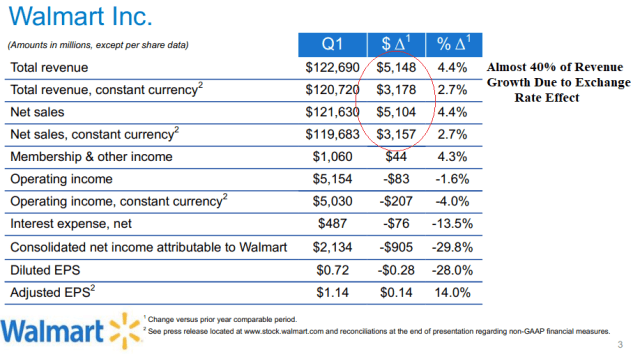
Just glancing over WalMart’s latest earnings release from the week, we see two one-off macro factors that helped WalMart’s earnings in Q1, and likely are the same for most companies:
Note that almost 40 percent of WalMart’s y/y revenue growth in Q1 was due to the exchange effect, and over 1300 bps of tax cut relief. That is one-offs.
Though the dollar was weaker in Q1, it has rebounded sharply in Q2. Thus a deleterious exchange rate effect is coming to Q2 earnings. Not to mention higher gas prices and interest rates, which will negatively impact the non-energy and non—financial sectors.

The latest Comres poll revealed that Remain would now win by 58 per cent to 42 per cent of the vote. – CityAM
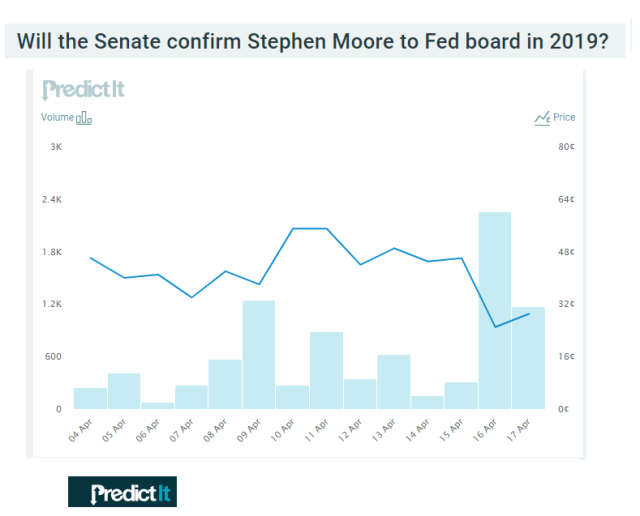
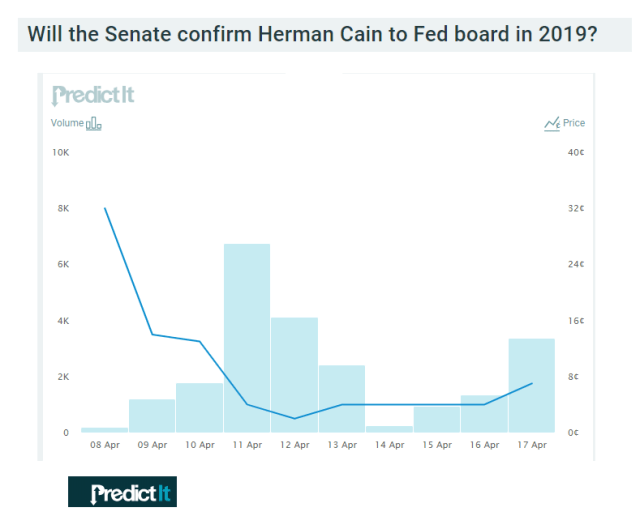
Prediction markets not pricing the confirmation of Stephen Moore and Herman Cain to the Federal Reserve Board. Stay tuned.
Taking a break from Holy Week to sift through the Mueller Report.
It is going to be very difficult, in our opinion, for the House Judiciary Committee (HJC) not to proceed with impeachment hearings. If they begin, the Democrats will have the votes in the House to impeach (simple majority), which is a necessary condition but not sufficient for the removal of President Trump from office. Conviction in the Senate will take 67 votes, thus we estimate it will take 20-22 Republicans votes.
We’re not making a political statement or being partisan but just trying to give our readers a heads up on the results of our brief analysis and how we see it playing out. The odds of impeachment have gone from around 6:1 to 4:1 in the past two weeks.
We expect the market price at PredictIt to move up another 30-50 percent in the next few weeks, or 3:1 odds for impeachment. Don’t think your gonna make that in Amazon in two weeks, though the shares might get an impeachment bump.
Speaker Pelosi is on record saying the votes aren’t there in the Senate and impeaching the President is futile and could come with a high political cost. The release of the Mueller Report now ratchets up pressure on House Democrats to “perform their constitutional duties.” Tough political spot.
The stock market, and markets in general, probably won’t start paying attention until HJC Chairman Jerry Nadler makes the announcement to proceed with hearings, which could be after Rober Mueller testifies.
Place your bets and pray for the country.



