
Help keep the lights on at the Global Macro Monitor. Contribute any amount based on your perception of our value added by clicking the PayPal donate widget at the right side of the screen. Thank you!


Help keep the lights on at the Global Macro Monitor. Contribute any amount based on your perception of our value added by clicking the PayPal donate widget at the right side of the screen. Thank you!
Help keep the lights on at the Global Macro Monitor. Contribute any amount based on your perception of our value added by clicking the PayPal donate widget at the right side of the screen. Thank you!


Over the past 40 years, the fishing village of Shenzhen has been reborn as a futuristic metropolis bursting with factories. Bloomberg Businessweek’s Ashlee Vance travels to the heart of China’s tech revolution to witness this new reality firsthand, as part of a three-episode exploration of the city. In part one of Hello World Shenzhen, Vance gets a worker’s view of life in a startup and then explores one of the city’s famous electronics markets to learn how people survive (and in some cases make fortunes) in such a frenetic, competitive environment.
Comments welcome.
Interesting discussion by Think Tank contributor MacroMan, who retells a story about Yale Professor Robert Shiller:
We asked him once to visit us in our offices and the meeting took place the day after then Fed Chairman Alan Greenspan’s famous Irrational Exuberance speech in December 1996:
“But how do we know when irrational exuberance has unduly escalated asset values, which then become subject to unexpected and prolonged contractions as they have in Japan over the past decade?”
The professor said he was in town to meet with Greenspan who was concerned about the run-up in stock prices. During the meeting Greenspan solicited his thoughts on why stocks were rising. The professor answered maybe it was just “irrational exuberance” among investors. Hmmmm…
–The Ambiguity of Stock Value, December 27, 2010
In other words, Greenspan cribbed Shiller’s phrase for his speech!
Perhaps this explains why Shiller named his book “Irrational Exuberance” — he was taking back the phrase from Greenspan as his own.
Fascinating stuff . . .
Professor Robert Shiller, of Yale University, is probably best known for his book, Irrational Exuberance, which called the top of the dot.com bubble and the second edition called the top in the housing market. During our days on Wall Street, we were big fans of Shiller’s book, Market Volatility.
We asked him once to visit us in our offices and the meeting took place the day after then-Fed Chairman Alan Greenspan’s famous Irrational Exuberance speech in December 1996,
But how do we know when irrational exuberance has unduly escalated asset values, which then become subject to unexpected and prolonged contractions as they have in Japan over the past decade?
The professor said he was in town to meet with Greenspan who was concerned about the run-up in stock prices. During the meeting, Greenspan solicited his thoughts on why stocks were rising. The professor answered maybe it was just “irrational exuberance” among investors. Hmmmm….
We think Shiller’s best work was Market Volatility and specifically the following,
The Ambiguity of Stock Value
Stock prices are likely to be among the prices that are relatively vulnerable to purely social movements because there is no accepted theory by which to understand the worth of stocks….investors have no model or at best a very incomplete model of behavior of prices, dividend, or earnings, of speculative assets.
Shiller nails it here. Stock values are ambiguous as there are no models to determine their “true” price. Even at the macroeconomic level, this is true and Greenspan addressed it in his Irrational Exuberance speech,
There is, regrettably, no simple model of the American economy that can effectively explain the levels of output, employment, and inflation. In principle, there may be some unbelievably complex set of equations that does that. But we have not been able to find them, and do not believe anyone else has either.
Consequently, we are led, of necessity, to employ ad hoc partial models and intensive informative analysis to aid in evaluating economic developments and implementing policy. There is no alternative to this, though we continuously seek to enhance our knowledge to match the ever growing complexity of the world economy.
So too it is with our job in forecasting asset values, which can only be done with “ad hoc partial models” in the ether of ambiguity. Because prices are determined by simply buying and selling, we paraphrase Shiller in constructing our ad hoc model,
Stock prices are likely to be among the prices that are relatively determined by capital flows because there is no accepted theory by which to understand the worth of stocks.
In our experience getting ahead of the capital flows have been more profitable than buying what we believe to be a “cheap” stock or selling an “expensive” stock.
And that leads us to the next issue of perspective based on reference points, time frames, and historical bias.
Take a look at the three objects. Two charts of the exact same market, the S&P500 over different time horizons; and one picture.
Do you see an S&P500 that is overvalued? Undervalued? Oversold? About to roll over or break to new highs? Do you see a young lady or an old hag? It most likely depends on your confirmation bias. Larry Summers, who will leave the White House at the New Year, coauthored a paper in the late 1980s stating market volatility is caused by investors and traders with different time horizons.
But, like Keynes’ beauty contest analogy, the true question to ask for 2011 is not what we see, but what we believe the market – i.e., the dominant marginal buyers – will see. Do they see the young lady or the old hag?
Or maybe beauty is relative, or even ambiguous, and we have to determine which markets will be deemed the least old or the most pretty. And that just may be the best lesson here, which we think certainly is the case for the world’s major currencies. Dollar strength doesn’t necessarily equate to the young lady!




Bonus
Golf-Home Owners Find Themselves in a Hole – WSJ
Help keep the lights on at the Global Macro Monitor.
Contribute any amount based on your perception of our value added by clicking the PayPal donate widget at the right side of the screen. Thank you!

I’m focused on the picture in the People’s Daily tweet. Are those what I think they are?
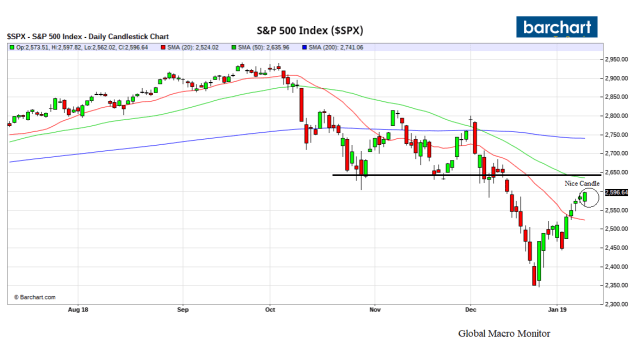
Nice price action today generating an outside day, which the textbooks tell us is a confirmation and continuation of the recent move. No fight here.
Nevertheless, moving into the zone of heavy resistance as the S&P crosses 2600 and the 50-day and .50 Fibo at 2640ish become just a chip shot away. Grab your gap wedge, folks.

Waiting for Godot Mr. Doji so we can sell this market.
One Note Of Caution For The Bears
We are a bit concerned and nervous waiting for our short set-up as everyone and their mother are talking about the heavy resistance at 2600-2650, and also looking for a retest of the Dec 26th low. There will have to be some real selling up there, which we think is probable given earnings should be sufficiently negative to break some supply loose. Stay tuned.

Help keep the lights on at the Global Macro Monitor. Contribute any amount based on your perception of our value added by clicking on the PayPal donate widget at the right side of the screen. Thank you!

Deciding means jumping in all the way, doing whatever it takes, and going after your dreams with the tenacity of a dateless cheerleader a week before prom night. – Jen Sincero, You Are a Badass: How to Stop Doubting Your Greatness and Start Living an Awesome Life
QOTD: Quote of the Day
By one estimate, China mints a new billionaire every two days, far exceeding the rate of countries like the United States. But how did China remain a nominally Communist state while becoming a hotbed for billionaires-in-the-making? Bloomberg QuickTake explains how capitalist compromises and moves begun decades ago have made China the not-quite-Communist country it is today.
Video by Henry Baker, Graphics by Christian Capestany, Sylvia Yang – Bloomberg

 Global Macro Monitor