


-
In economics, things take longer to happen than you think they will, and then they happen faster than you thought they could.
-
Join 1,086 other subscribers
Contribute To GMM

Categories
- 3D Printing
- Agriculture
- AI
- Algos
- Apple
- Automation
- Banking
- BFTP
- Bitcoin
- Black Swan Watch
- Bonds
- Brazil
- Brexit
- BRICs
- Budget Deficit
- Capital Flows
- Cartoon of the Day
- Cashless Society
- Chart of the Day
- Charts
- China
- Clean Tech
- Climate Change
- Coach C
- Commodities
- Coronavirus
- COVID
- Credit
- Crude Oil
- Currency
- Cyprus
- Daily Risk Monitor
- Day In History
- Debt
- Demographics
- Disinflaton
- Dollar
- Earnings
- ECB
- Economics
- Economist
- Egypt
- Electric Vehicles
- Emerging Markets
- Employment
- Energy
- Environment
- Equities
- Equity
- Euro
- Eurozone Sovereign Spreads
- Exchange Rates
- Fed
- Finance and the Good Society
- FinTech
- Fiscal Cliff Monitor
- Fiscal Policy
- Food Prices
- France
- Futurist
- Game Theory
- General Interest
- Geopolitical
- Geopolitics
- German Bund
- Germany
- Global Macro Watch
- Global Reset
- Global Risk Monitor
- Global Stock Performance
- Global Trend Indicators
- Gold
- Greece
- Healthcare
- Heat Map
- Hedge Funds
- Housing
- Human Interest
- Immigration
- Impeachment
- India
- Inequality
- Inflation/Deflation
- Infographics
- Innovation
- Institutional Investors
- Interest Rate Monitor
- Interest Rates
- Interviews
- Italian Yields
- Italy
- Japan
- Jobs
- Lectures
- Macro Notes from Conference Calls
- Manufacturing
- Masters
- Mexico
- Monetary Policy
- Movies
- Muni Bonds
- Muni Market
- Natural Gas
- News
- Nonlinear Thinking
- North Korea
- Overbought Markets
- Picture of the Day
- PIIGS
- PMIs
- Policy
- Politics
- Population
- Populism
- Poverty
- President Trump
- Qunat Strategies
- Quote of the Day
- Quotes
- Rare Earth Elements
- Readership
- Reads
- Real Estate
- Relative Strength Index
- Robert Shiller
- RSIs
- S&P500
- Sector ETF Peformance
- Semiconductor prices
- Semiconductors
- Social Media
- Socialism
- Song for the Week
- Sovereign Debt
- Sovereign Risk
- Spain
- Sports
- State and Local Government
- Tail Risk
- Technical Analysis
- Technology
- The Big Reset
- The Weekend Read
- This Day In Financial History
- Trade War
- Trades
- Tweet of the Day
- Ugly Chart Contest
- Uncategorized
- US Releases
- Video
- Volatility
- Wages
- Week Ahead
- Week in Review
- Weekend Reads
- Weekly Eurozone Watch
- Whales
-
Recent Posts
Meta
Harbinger? Dropping Like A BlackRock
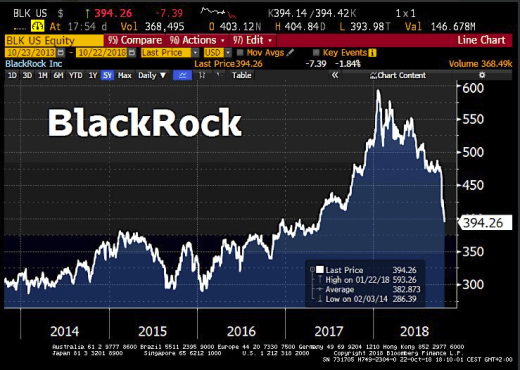
Source: Holger Zschaepitz @Schuldensuehner
Wow. Completely missed the 34 percent flop in Blackrock, the world’s most massive shadow bank, from its $594.52 January high. Now trading through the key $400 level, with the next significant support to the downside at $380. Thanks to Holger for bringing it to our attention.
It looks like it’s all about institutional outflows and diminishing marginal inflows caused by, what Larry and Rob call de-risking, and mainly by the hedge funds.
Sure not seeing the de-risking it in the 10-year Treasury yield, which is another story, and why this year’s two equity corrections/sell-offs are different. , in spite of a persistent massive short position by specs in the 10-year note futures
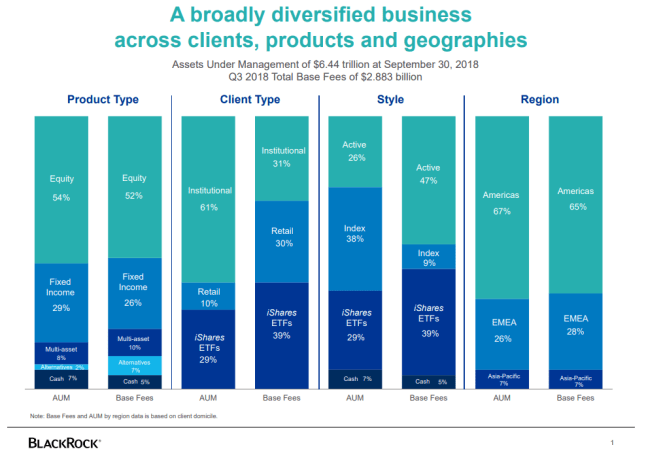
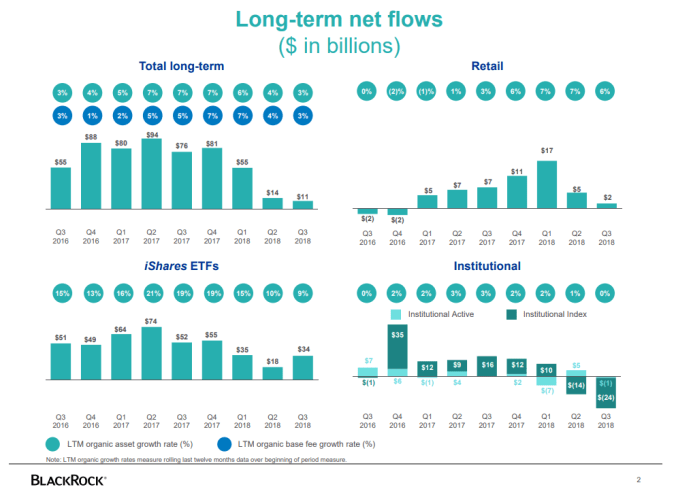
Source: October 15 earnings release
Key comments from the conference call
Question-and-Answer Session
Operator
[Operator Instructions] Our first question comes from Dan Fannon with Jefferies.
Dan Fannon
Thanks. Good morning.
Laurence D. Fink
Hi, Dan.
Dan Fannon
I guess, Larry, could you elaborate on your broader comments about de-risking? It seems based on your commentary that we — it should likely continue here in the short-term and we’re seeing it through your index products. So I guess are there other kind of asset classes we — that you’re seeing that in? And then also, is there a capture rate where you’re seeing flows going into other categories that are obviously less risky?
Laurence D. Fink
I will let Rob talk about it and then I will add to it after him.
Robert S. Kapito
So I think, Larry, mentioned increased trade tensions, emerging markets volatility, and certainly the fear of continued interest rate rises across the globe. So what happens, especially during that type of volatility period is clients de-risk. So depending upon the next couple weeks and some of the political issues as well and the volatility that’s out there, clients may continue to de-risk. Certainly, we’ve seen the hedge funds de-risk from a period of time where I think across the board most of them are already down 2% 4%, so getting below that is difficult for many hedge funds, so they’ve just risked — de-risked. And we also, depending upon the guidelines of the clients and what we think about the markets, we encourage either de-risking or risking depending upon what their objectives are. The goal for us is even in that de-risking, to capture those assets because whatever they’re selling and going into, we have that product. So whether clients move from equity to fixed, we can accomplish that. Whether they’re going from value to growth, long duration to short duration, out of emerging markets into emerged markets, our goal is to offer a holistic solution so that they can de-risk and then be ready to put the risk on with us as well. And that also moves from product to product, whether they do it in iShares, and typically they’ll do that in the non-core iShares that have the most liquidity. Clients in the core iShares do that less because they’re more buy-and-hold. So, we see that more in the active products, and I think that really describes a lot of the flows this quarter.
Laurence D. Fink
Let me just add a little more. I think the market movements post third quarter was, as Rob said, more hedge funds de-risking. We did not see any accelerated outflows in the first few weeks. I think, Dan, when you think about some of these big large strategic partnerships we announced, none of that was asset flows this quarter. All of this is going to be huge asset flows probably in 2019. And this is why we are spending so much time trying to develop these deeper relationships. We are not going to be able to predict or strive for any one quarter, but I do — we’re very excited about the opportunities of building these deeper relationships that over time are going to really push us towards a much higher growth rate. That being said, if the markets remain to be uncertain, if political risk remains large, you will continue to see clients pause. We’ve seen this in the past. Generally, in the fourth quarter, we see clients adding risk that is typically what happens especially November, December. We — and so, I’m not here to tell you, I know how this will all play out, but we are continuing to see large interest from our clients in our technology businesses, we’re continuing to see large interest from our clients in our alternative space and let me also talk about the breadth of our active business for a second. We had positive active flows in fixed, in multi-asset, and in alts. The only area where we had outflows that were significant was in the low-fee index products, and that I think, Rob Kapito has talked about this for years, that’s where we see how people navigate money. They go in and out of index funds in large-scale as an indicator of their market beliefs. So — and I would also say unlike most organizations in the industry we had positive flows in U.S wealth in our retail side. So I don’t know the outcome of this quarter or political uncertainty, but all I could say is we’re — we have very strong conversations going on right now with really important clients and we will see how that plays out.
The Taiwan Strait Getting Hot, Hot, Hot…
We posted the following in July after President Trump threw Montenegro under the bus.
Taiwan may be about to get hot, hot, hot in the next year after last night’s Commander in Chief’s ambiguous message on defense treaties. – GMM
U.S. To Send Warships Through The Strait, Again
Yesterday, Zero Hedge posted a great piece, In Latest Provocation To Beijing, US Plans New Warship Passage Through Taiwan Strait, bringing to our attention the following Reuters article,
The United States is considering a new operation to send warships through the Taiwan Strait, U.S. officials tell Reuters, a mission aimed at ensuring free passage through the strategic waterway but which risks heightening tensions with China.
The United States is considering a new operation to send warships through the Taiwan Strait, U.S. officials tell Reuters, a mission aimed at ensuring free passage through the strategic waterway but which risks heightening tensions with China. – Reuters
John Bolton’s Fingerprints
The show of force by the U.S. in the Taiwan Strait appears to be a hardening line against and challenge to President Xi’s One China Policy and has National Security Adviser, John Bolton’s fingerprints all over it.
Bolton has close professional and personal ties in Taipei . According to an investigative report by the Washington Post ( April 9, 2001 ), Bolton was on the payroll of the Taiwan government before joining the Bush administration. Bolton received $30,000 for “research papers on UN membership issues involving Taiwan ” at the same time he was promoting diplomatic recognition of Taiwan before various congressional committees.
In 1999 Bolton, speaking as an AEI scholar, said that “…diplomatic recognition of Taiwan would be just the kind of demonstration of U.S. leadership that the region needs and that many of its people hope for. The notion that China would actually respond with force is a fantasy.” Bolton joined a prominent group of neoconservatives and traditional conservatives who signed a statement jointly sponsored by the Project for the New American Century and the Heritage Foundation that lambasted the Clinton administration for its failure to offer unequivocal support of Taiwan . – Counterpunch
Sum Of All Fears
The Sum of All Fears, at least ours.
A neocon chickenhawk driving U.S. foreign policy, provoking an emerging China, in an area they consider one of the highest in the country’s national interest.
Moreover, this is happening at a unique and critical period in world history,
The defining question about global order for this generation is whether China and the United States can escape Thucydides’s Trap. The Greek historian’s metaphor reminds us of the attendant dangers when a rising power rivals a ruling power—as Athens challenged Sparta in ancient Greece, or as Germany did Britain a century ago. Most such contests have ended badly, often for both nations, a team of mine at the Harvard Belfer Center for Science and International Affairs has concluded after analyzing the historical record. In 12 of 16 cases over the past 500 years, the result was war. When the parties avoided war, it required huge, painful adjustments in attitudes and actions on the part not just of the challenger but also the challenged. – Graham Allison, The Atlantic, Sept 2015
We also don’t think the timing of the leak to Reuters was a coincidence,
Protesters chant anti-China slogans on Taipei march in first large-scale rally pro-independence rally in decades.
Thousands of people have rallied in Taiwan’s capital to call for a referendum on independence, in the first major protest calling for a popular vote since the self-ruling island became a democracy more than 20 years ago.
The march on Saturday through Taipei took place as China has stepped up its claims to Taiwan, which Beijing considers as part of its own territory.
– Al Jazeera, October 20th
Are you freaking kidding?

We suspected the doctrine of Strategic Ambiguity with Taiwan died when President Trump hedged about coming to the defense of a NATO country if it were attacked,
Tucker: So membership in NATO obligates the members to defend any member that is attacked. So let’s say Montenegro, who joined last year, is attacked, why should my son go to Montenegro to defend it from attack?
President Trump: I understand what you are saying. I have asked the same question. You know Montenegro is a tiny country with very strong people… They may get aggressive, and congratulations you are in World War III…But that is the way it was set up, don’t forget I just got here. – GMM, July 2018
But to be replaced by a doctrine of direct provocation with China, based on a bet President Xi is a Paper Tiger on Taiwan? A crazy, dangerous gambit, in our opinion, and one that could easily be dismissed if not for the future of the world depended on it.
Extending President Trump’s logic above, we asked back in July,
“Why should my son go to
MontenegroTaiwan to defend it from attack?”
NFW will the American public send their sons and daughters to fight World War III over Taiwan. President Xi knows it, and President Trump effectively stated it in his interview with Tucker Carlson back in July, at least, that is what he seemed to imply. The probability for a fatal miscalculation is now higher than ever.
Here’s to hoping, and praying, John Bolton has recalibrated his China will “respond with force is fantasy” view. And, especially, that Defense Secretary, James Mattis, remains in the administration. Mr. Bolton is a known bully, possibly the force behind the resignation of U.N. Ambassador, Nikki Haley.
It was reported he even threatened a Brazilian official in the diplomatic scrum leading up to the Iraq War, “We know where your kids live.” How we long for that National Security Adviser who dresses like a “beer salesman.”
Let us rephrase and state it again, Taiwan is getting hot, hot, hot, and we doubt President’s Trump and his new BFFS, President Xi, can patch this one up over a few diet cokes.
On Your Radar
Watch this space.
The world and market is asleep in deep, deep hibernation at the wheel on this one, folks.
We leave you with this fantasy,
We are confident that Saddam Hussein has hidden weapons of mass destruction and production facilities in Iraq. – John Bolton, 2002
Update:
Run, don’t walk, to today’s South Morning China Post’s piece, TAIWAN’S COSYING UP TO TRUMP COULD SPARK A CHINA-US WAR,
This is not the first time Taiwan has become a central issue in US-China relations. In the 1960 US presidential debate, John Kennedy and Richard Nixon traded barbs over whether America should launch a nuclear war against China to protect the tiny islands of Matsu and Quemoy, or Kinmen, in the event of a communist invasion.
Trump might now see Taiwan as an increasingly valuable point of leverage over China, but Beijing will make no compromise on this politically most sensitive issue as it considers Taiwan a “core interest”.
As the US and China drift dangerously towards direct conflict, Taiwan should be cautious. The narrow Taiwan Strait could be the flashpoint that sparks war between the world’s most powerful nations. – SCMP
Update:
Posted in Black Swan Watch, China, Uncategorized
Tagged China, One China Policy, Taiwan Strait
24 Comments
Week In Review – October 19
Summary
- Spain sovereign spread starting to widen as small to medium Spanish banks hammered over mortgage tax
- Brazilian assets continue to perform as the election of Jair Bolsonaro is a done deal, slated for next weekend
- Mexican peso weaker. Reports AMLO to scrap NAFTA 2.0 negotiating team could be causing uncertainty
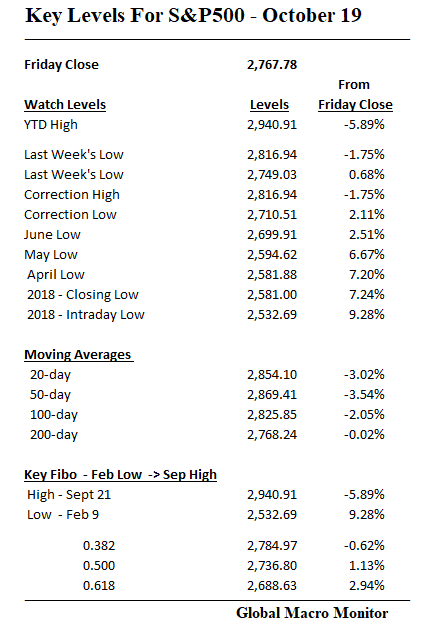
- S&P500 closed right at its 200-day moving average and couldn’t hold a bid last week
- Crude down 3 percent
Commentary: Sloppy trading until the U.S. midterm. Earnings galore this week. Could see some buying, but earnings growth to reset next year as effect of tax cut will end. The October algo — selling ‘bots and traders come in, probe market for bid, if no sellers, cover, repeat — still the program.
S&P: 2736 and 2710 support, and 2816 resistance
Heavy turnout: our political earthquake may be playing out

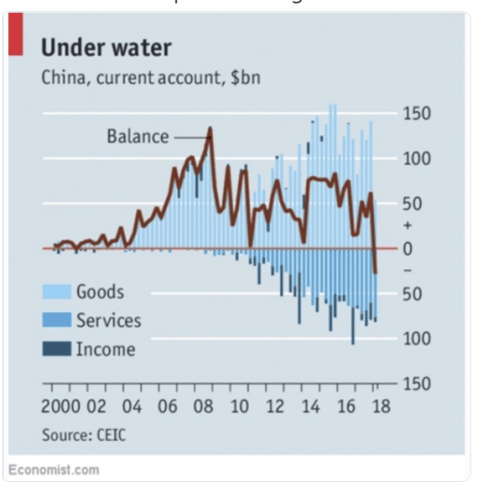
China In Current Account Deficit – Less Foreign Savings For Global Market
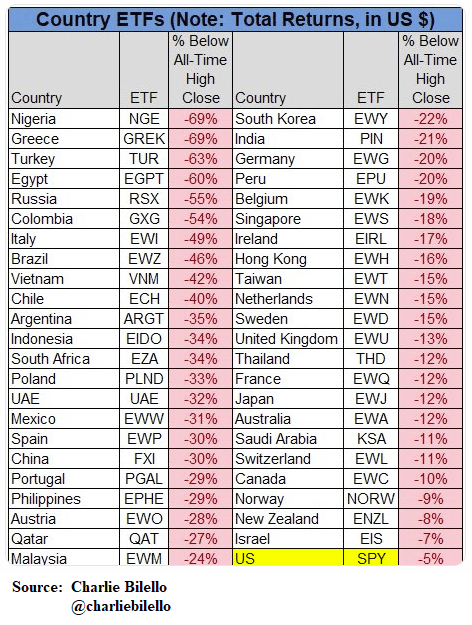
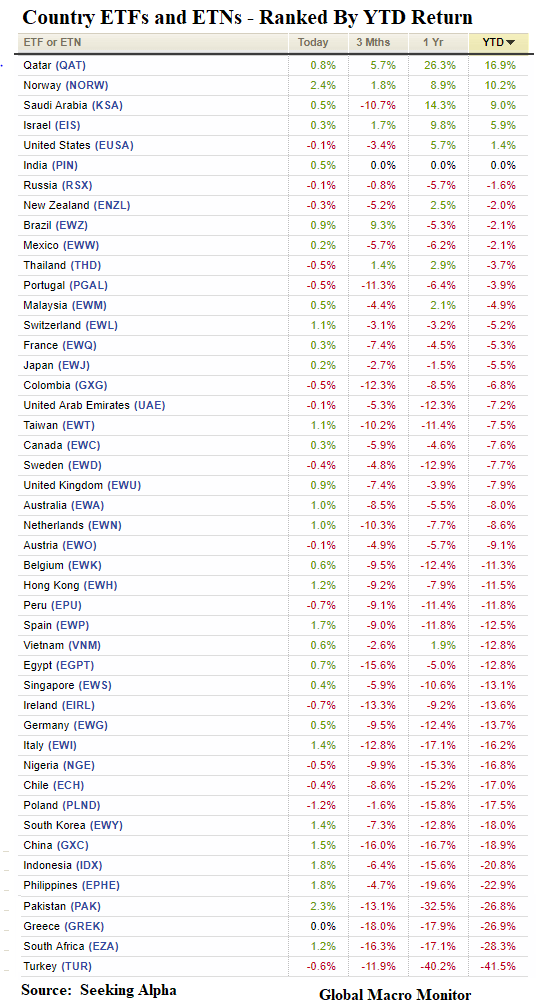
Annus horribilis for country ETFs
Baseball Royalty Prepares For Fall Classic. Can You Name Them?


Posted in Uncategorized, Week in Review
Tagged bonds, Commodities, Currencies, Global equity markets, Performance, Stocks, Week in Review
Leave a comment
The Coming Political Earthquake(s)
Nation [ethnic groups] will rise against nation [ethnic groups], and kingdom against kingdom. There will be great earthquakes, famines and pestilences in various places, and fearful events and great signs from heaven. – Jesus of Nazareth
OK, folks, we will lay it on the anvil.
We are not afraid of being wrong, which is often the case, as we have internalized the key to longevity is to cut your losses quickly. That is the essence of being a trader. Nobody knows the future but you need to act as if you do in order to have the confidence to pull the trigger.
Furthermore, we don’t suffer the recency bias from being wrong in the November 2016 election and therefore not afraid and don’t have to hedge our analysis. If we are wrong, we move on. Punto!
If women and the young turn out in November, we won’t be, however.
Our conclusions are not influenced by our partisanship (though always impossible to exclude all bias) and not wishful thinking but positive analysis based on the data, recent trends, and probabilities, sprinkled with some political intuition.
BREXIT ain’ gonna happen. The political extremes on both ends have “woke” the sleepy and complacent middle, women, and the young.
We believe you will see the results in the upcoming “November to Remember” midterms.
I fear all we have done is to awaken a sleeping giant and fill him with a terrible resolve. — Japanese Admiral Isoroku Yamamoto (quote never confirmed)
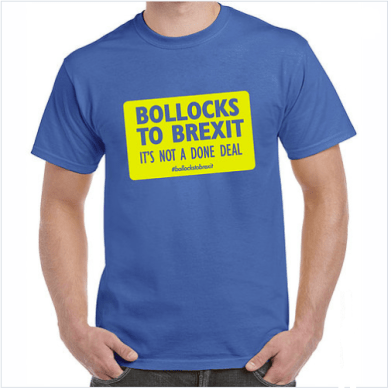
A second vote on BREXIT is an uphill battle, but if the Trump administration gets “bitch slapped” in the November midterms the momentum and pressure for a new BREXIT vote will build, in our opinion.
Theresa May’s government has ruled out a second referendum on membership, saying it would be an undemocratic denial of the result of the June 2016 Brexit referendum, which voted 52-48 in favour of leaving. The main opposition Labour party also officially remains opposed, although Keir Starmer, shadow Brexit secretary, last month said the party had not ruled out supporting a new vote. – FT
Young Voters The Key In The U.S. November Midterms
It’s all up to young voters turning out in November. If they would have voted in the first BREXIT referendum, we wouldn’t be having half of this conversation.
It has been estimated that only 36 per cent of people in the 18 – 24 year old category voted in the EU referendum. 64 per cent of young people did not bother to take themselves down to the polling station and place their vote – Independent
Gen Z
It does look like the youth are finally getting fired up, at least, in the States.
So far, the data point to a surge in political engagement, intention to vote and outreach between friends to encourage voting. Gen Zers may be voting for the first time, but they are certainly not new to politics. – The Conversation
Millennials
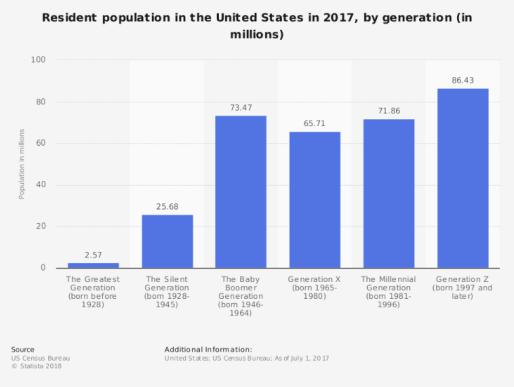
The jury is still out on whether their older brothers and sisters, the millennials, will get off their arse and get to the polls.
In the 60+ age demographic, almost 90 per cent of eligible voters cast their ballots, but, at the other end of the scale, only 25 per cent of millennials took the time to vote. – Global News
Bad freaking citizenship, millennials. Do they enjoy being slaves to their senior political taskmasters and enjoy laying down in the Clash of Generations? Just askin’.
Indeed, if there is one sentiment that unites the crises in Europe and America it is a powerful sense of “baby boomers behaving badly” — a powerful sense that the generation that came of age in the last 50 years, my generation, will be remembered most for the incredible bounty and freedom it received from its parents and the incredible debt burden and constraints it left on its kids. – Thomas Friedman, NY Times
Moreover, millennials have no right to complain the leadership of the Democratic Party is dominated by septuagenarians, octogenarians, and soon to be, nonagenarians. Shut up and vote!
The Lavender Wave
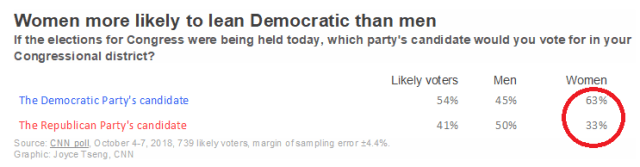
We are expecting a Lavender Wave (pink plus blue) in the November midterm. The die is cast with the women’s vote, now let’s see if the young show up.
The political arithmetic seems pretty simple to us. Women and the young will Trump old white men, that is if they show up.
- Women vote in higher numbers than men and have done so in every election since 1964. In 2016, 9.9 million more women than men voted. Women have voted at higher rates than men since 1980. In 2016, 63.3% of eligible female adults went to the polls, compared to 59.3% of eligible male adults. Even in midterm elections, when voter turnout is lower among men and women, women vote in higher numbers and at higher rates than men.
- More women than men register to vote. Some 83.8 million women were registered to vote in 2016, compared to 73.8 million men. – Footnotes
The Young And The Left

Simple math. Where are we wrong?
After the November to Remember, EXIT the BREXIT will take center stage.
The political tectonics are about to shift, folks, and you heard it here first.
No Sugar Coating It
Our recommendation to the one percenters and the comfortably
numbretired baby boomers, who have bequeathed to and saddled the younger generations with massive pension and public sector debt liabilities?You better Wake The F&*k Up! – Global Macro Monitor, Feb. 20, 2018
By the way, not priced.
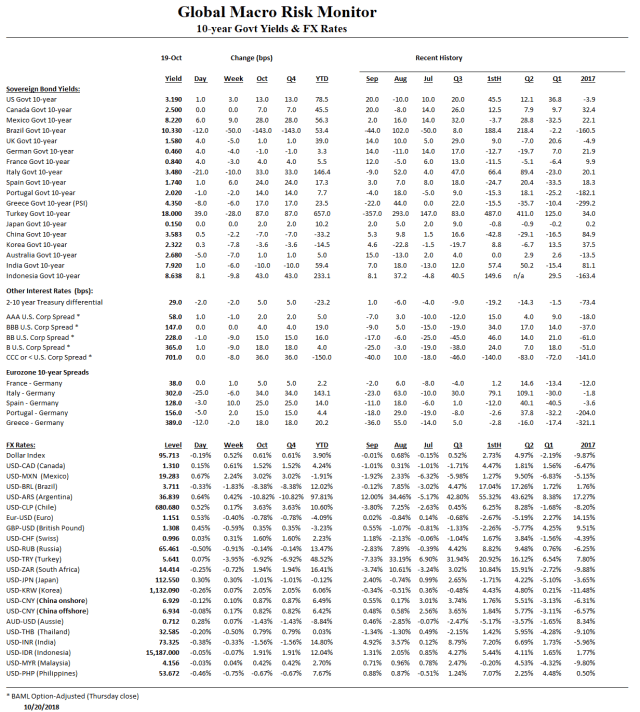
Global Risk Monitor – October 19

Posted in Daily Risk Monitor, Uncategorized
Tagged bonds, Commodities, Currencies, Global equity markets, Performance, Stocks
Leave a comment
On This Day In History: The Fed Put Is Born
Or, at least, went into labor.

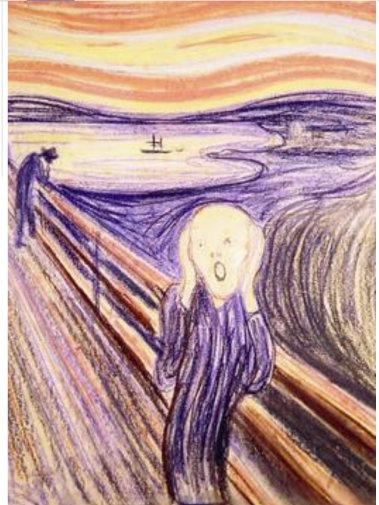
Wow, three decades and one year today, I was a young economist at the World Bank. My friend and I, now the chief economist at the FDIC, were graduate students and walked by the White House on our way to lunch. The stock market was down somewhere between 5-10 percent in the morning. I looked through the gates on Pennsylvania Avenue and thought to myself, “I wonder if President Reagan is up to the challenge.”
My Boss In The Oval
The president was 76 years old, and rumors were floating around he was already losing it. Little did I know, I would be working for the man who was briefing the POTUS in the Oval about the crash on that morning just a few years later at a major money center bank.
He was the Deputy Secretary of the Treasury, who was acting Secretary on Black Monday as James Baker was in Europe beating up on the Germans over exchange rate policy.
Over lunch in 1989 or 1990, my boss shared with me the play-by-play in the Oval on October 19, 1987. He said President Reagan was sharp, impressive, calm, and proactive, jumping up from his desk, “What do we need to do to calm the markets?” How America misses that kind of leadership even if you agreed with the president’s policies and politics, or not.
Money & Banking Class
I was also a young adjunct professor at George Mason University teaching money and banking courses. I had been warning my students that a major crash, as in 25 percent, was highly probable.
I think my classes were on Tuesday and Thursday. I walked in the next day after Black Monday and they were impressed. Interest rates were spiking for almost a year, and coupled with the increased volatility, which began in August after a two-year stock run, almost straight up, were clear warning signals.
The stock market was in a speed wobble and free fall even before it crashed. Ditto for 1929.
I also can’t remember any of my students’ names but one was a big blonde dude, very bright, and another a young woman who said she worked at the C.I.A.. I can’t remember the exact details of the path of how I walked to class that day, or any of my students name, but I am 100 percent certain it took place, Senator.
One In A Zillion?
WTF? Wasn’t the volatility spike on October 19, 1987 like a one in 11 billion probability, or something like that?
I later worked with options traders who were short calls on the OEX that day and lost money, so they said. The vega (volatility derivative) swamped the delta causing the price of the call option to increase in price even as the price of the underlying fell over 20 percent. That is frickin’ hard to believe.
The Morning After
The next morning, Terrible Tuesday, the market was still in free fall. Volume had already exceeded the prior day. No bid. The market makers were abandoning ship, some were thought to be insolvent.
Many Wall Street firms put pressure on the NYSE to close the market but President Reagan, under pressure from the Fed, would not allow them claiming executive privilege.
…the president of the United States would very much prefer if the New York Stock Exchange could see its way clear to remain open.” – Howard Baker, Chief of Staff
All of a sudden, I believe after lunch, a phantom buyer came into Chicago and bought the Major Market Index (MMI), which stabilized prices and the market hasn’t looked back since. Market psychology is a real bitch sometimes.
Thank you, Alan Greenspan. Can’t say for sure it was him and them but it is widely believed to be the birth of the Fed put, and later the Plunge Protection Team (PPT).
Recall, the Dow didn’t recover its September 1929 high until 1954.
Now The Addiction
The problem now is we are addicted to and expect the Fed crack or Xanax with every little market hiccup. The economy, and, now, especially, monetary policy are determined, in large part, by asset prices.
It’s stunning to see the POTUS and pundits, such as Jim Cramer, whining the Fed is “too crazy tight” when the real effective funds rate is still negative.

Crazy stupid.


One of GMM‘s most excellent followers, who we very much like and respect, responded with this:
We still like and respect the reader, by the way.