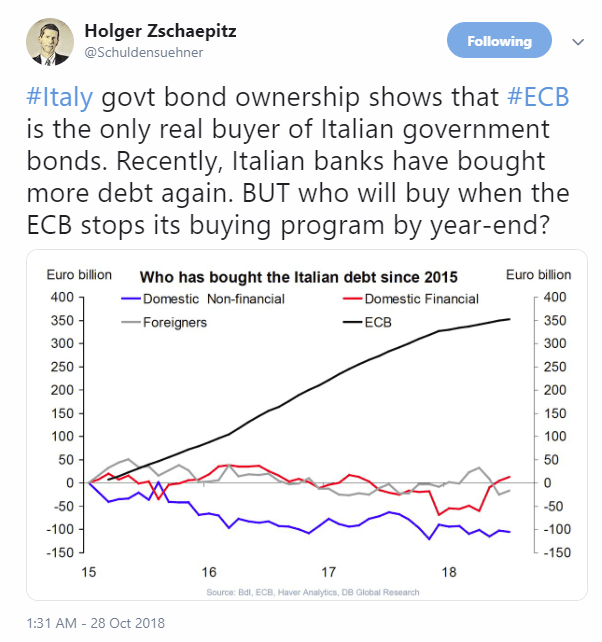
Italians are all talking about the bond spread – FT

Lo spread’ – the yield gap between Italian and German 10-year bonds – is the hot topic of conversation in Rome after the populist coalition government promised a spending splurge

► Subscribe to FT.com here: http://bit.ly/2GakujT

Posted in Eurozone Sovereign Spreads, Italy, Uncategorized | Tagged , | Leave a comment

Traders Get Caught…..

What is else in new?

Slice through the 200-day like a hot knife through butter yesterday only to close above it today.  Still would not touch equities here for my than a flip,  and looking to get shorty at higher prices.

Bear_Trap


Posted in Equities, Uncategorized | Tagged | Leave a comment

Price Action In The S&P & Its 200-day MA

That was easy.

Only second close below the 200-day (2765ish) for the S&P since January 2016.   The 200-day has been steel support for the S&P500, and a trampoline for reversal rallies over the past few years.   Not today.

Is this a bear trap?  Don’t think so, has more downside, in our opinion.  Stops at 2770.

Key earnings out of JP MO tomorrow.

Bonds behaving badly as expected.

Posted in Equities, Uncategorized | Tagged , , | Leave a comment

Browbeating the Fed 2.0

As the market melt and President Trump ramps up his rhetoric on Fed rate hikes, we thought you’d be interested in our July post.

By the way,  the geopolitics in the Taiwan strait are growing much hotter since we wrote.  We took a lot of pushback from this post (see last few paragraphs).   Here is the latest

Taipei (AFP) – Taiwan’s President Tsai Ing-wen on Wednesday accused China of “seriously challenging” peace and stability, describing the island she leads as being on the frontline of tensions in the Pacific.

Her comments come as Beijing pursues a multi-pronged attack on any claims to sovereignty by self-ruled democratic Taiwan, which it sees as part of its territory to be reunified, by force if necessary.  – AFP, October 10th

Is Trump Starting To Lean On The Fed Or Setting It Up?

President Trump said in an interview with CNBC’s Joe Kernan this morning he “does not agree”, is not “thrilled” or “happy” with the FOMC’s interest rate hikes.  The full interview and transcripts will be available tomorrow.

Jul19_Trump Interview

Click here for excerpt of interview

You Heard It Here First

Presidents never, or rarely comment on monetary policy or currency market moves. for that matter,  x/ the hackneyed meme “a strong dollar is the best interest of the United States.”

President Trump hit them all in this interview today, from the Fed to the Euro and Chinese RMB (“dropping like a rock”).  It doesn’t surprise us.

Recall our March 21st post, The Biggest Risk At The Fed.

But this doesn’t concern us as much as the Fed’s independence.

“Just let it rip”

That is we are worried more about the freedom from White House pressure and interference in conducting monetary policy than getting a few bps wrong on the Fed Funds rate.   This is especially true and relevant given the strongman tendencies and  lack of respect for institutional norms of the current president.

Here is Larry Kudlow, the president’s new chief economic adviser:

“Just let it rip, for heaven’s sake,” Kudlow said of economic growth in the U.S., during a more than hour-long interview Wednesday on CNBC. “The market’s going to take care of itself. The whole story’s going to take care of itself. The Fed’s going to do what it has to do, but I hope they don’t overdo it.”  – CNN
– Global Macro Monitor,  March 21, 2018

We were assured by Fed insiders shortly after that post in March Chairman Jerome Powell was tough and we should not underestimate his independence.   He has thus far proven to be an extraordinarily competent Fed leader.

Moreover, the president seems to have appointed very competent and independent Board governors to fill the many vacancies on the FRB.

Nothing Here, Move On

Other than committing another faux pas by publicly criticizing the Fed — and it really wasn’t that critical — the president’s comments,  taken in isolation,  were relatively benign and does not pose a threat to central bank independence, in our opinion.

But the totality and cumulative mistakes of  amateur hour at the White House, from foreign to domestic economic policy, are slowly chipping away at the world’s confidence in the management of America, Inc..

What we fear most is the loss of confidence in the world reserve currency status of he U.S. dollar, which is slowly eroding.   There doesn’t currently seem to be a viable replacement, however.  We do live in a nonlinear world,  where technological advancements can rapidly change and turn sectors upside down overnight, so that could change in a heartbeat,

Just look at the rise of crypto and mobile payments in the past decade?

Who is to say that a replacement for the dollar won’t come along in the next few years?  That would be a huge game changer and could render the U.S.economy to the dustbin of highly indebted countries, with large deficits, and irresponsible monetary policies.  And you know who they are.

Is Trump Setting Up The Fed As The Fall Guy?

CNBC’s Steve Liesman raises an interesting question: is Trump setting up the Fed to take the fall for his trade policies gone bad?   Farmers are really starting to feel the pain.

As Dale grain and beef cattle farmer Dennis Whitsitt watches his crops grow in the fields, he also watches grain prices tumble as tariffs between the U.S. and several other countries take effect.

The Trump administration began talking about imposing tariffs on Chinese imports in January, starting what has come to be called a trade war. Trump’s threats led China to threaten retaliatory tariffs on U.S. goods, including soybeans and pork. Both countries enacted the threatened tariffs on July 6. The administration also imposed tariffs on goods from the European Union, Canada and Mexico, leading those countries to impose retaliatory tariffs as well. Those tariffs also included farm goods as foreign leaders looked to hurt areas that voted for Trump. In Whitsitt’s opinion, the tariffs have hit their mark, as far as farmers go.

“It doesn’t seem like a good strategy,” Whitsitt said of the trade war.
— The Herald,  Jasper, IN

What Worries Us Most About The Interview

This is what tweaked us most about the president remarks,

Now I am just saying the same things what I would have said as a private citizen. So somebody would say oh maybe you shouldn’t say that as a president. I couldn’t care less what they say. Because my views haven’t changed.   – President Trump

“I couldn’t care less” — Are you frickin’ kidding me?

As we posted  last night, the president’s not even ambiguous (double negative) comments on coming to the defense of a NATO country, coupled with the U.S. public, which some could read, acquiescence to the Russian annexation of Crimea only increases the risks that China moves on Taiwan.

The U.S. would then have to decide if it willing to “send its boys” to defend Taiwan and enter World War III.

Serious business, folks.

By the way,  this just in,

CHINA WAR GAMES NEAR TAIWAN

As Washington pundits and government officials debate President Trump’s meeting with Russian President Vladimir Putin in Helsinki, China is busy sending a strategic message to the United States with large-scale war games near Taiwan.

China on Wednesday kicked off live-fire drills in the East China Sea north of Taiwan in an area simulating the size of the island state — a not-so-subtle message to the country Beijing regards as a breakaway province.

The military maneuvers at sea also will be held not too far to the west of the Japanese island of Okinawa, home to U.S. military forces.

The six-day war games were announced Monday in a sea closure zone that warned all vessels to stay clear of the area, where Chinese ships are firing missiles and other weaponry.

The sea closure zone covers an area off the coast of Zhoushan, south of Shanghai, to Wenzhou about 200 miles to the south. The Communist Party-affiliated newspaper Global Times noted the exercise zone’s “similar size to the island of Taiwan.”

The exercises are designed to warn Taiwan, Chinese military expert Song Zhongping, told the newspaper. “The drill’s main objective is to send a serious warning to Taiwan separatists,” Mr. Song said.

According to another Chinese military expert quoted by Global Times, the East China Sea is viewed by the Chinese military as the main battle zone if war breaks out.

The expert, who was not named, said this week’s drills are larger than in the past and require more troops and weapons. The maneuvers will test the Chinese military’s combat capabilities, tactics and training methods and its new weapons and hardware.

“The [People’s Liberation Army] air force and navy have been frequently conducting island encirclement exercises,” Mr. Song said. “The drill this time will add up and form a military deterrence of high pressure against the Taiwan separatists.”

According to Mr. Song, the war games will involve joint military operations in a bid to simulate real combat. —  Washington Times, July 18th

Stay tuned!


Posted in Fed, Uncategorized | Tagged , , , | Leave a comment

S&P500 Flirting With Key Support

The S&P500 moved through its 200-day moving average this morning and has bounced almost 20 points back above the low for a day back through the 200-day .   Since early 2016, the 200-day has acted as steel support for stocks, and a trampoline to launch strong reversal rallies.

We count only one close below the 200-day since early 2016, in early April.

Charlie B. recently noted the S&P500 ETF has closed 571 straight days above its 200-day moving average, an all-time record.

S&P_3


S&P_1

S&P_2

The level to watch today is 2765.91.   


Posted in Equities, Uncategorized | Tagged , | 2 Comments

Tail Event Day: -3.29% S&P500 and +1.7 bps 10-year Yield

Something is rotten in the U.S. bond market, which is irritating the stock market, to say, the very least.

Today’s 3.29 percent flop in the S&P500, coupled with a 1.7 bps rise in the 10-year yield, is very rare, and has only happened this century in the midst of a major stock market crash.

The S&P500 has declined 3 percent or more in just 1.42 percent (68) of the 4,781 trading days since October 1999, and the 10-yield has risen more than 1.5 bps during those 3 percent + drops in just 0.17 percent of the (8) trading days since October 1999.

No flight to “quality” as stocks have tanked, even with the record short in 10-year futures at an all-time high.  Bonds should have rocked on today’s 800 point decline in Dow Jones  Come on,  man!

Our Treasury market analysis seems to be playing out.   We suggest you read it.


Risk_Parity


Posted in Equity, Interest Rates, Uncategorized | Tagged , , , | Leave a comment

QOTD: Slouching Toward A Banana Republic

Could it be the markets are instead revolting against President Trump’s fiscal profligacy, and beginning to price in a potential debt crisis/major interest rate spike?   Just askin’.

“I think the Fed is making a mistake. They are so tight. I think the Fed has gone crazy.”  – President Trump

By the way,  here is your crisis manager if this thing really starts to go sideways.


Mnuchin_Aug15


Seat Belts_Mar24

Posted in Equities, Fed, Interest Rates, Monetary Policy, Uncategorized | Tagged , | 3 Comments

Biblical Breakout In 10-year Yields

Breaking out of an almost 40-year downward channel.  Don’t think higher rates are about to enter the “promised land” with public debt over 100 percent of GDP

The number forty can also represent a generation of man. Because of their sins after leaving Egypt, God swore that the generation of Israelites who left Egyptian bondage would not enter their inheritance in Canaan (Deuteronomy 1). The children of Israel were punished by wandering the wilderness for 40 years before a new generation was allowed to possess the promised land. Jesus, just days before his crucifixion, prophesied the total destruction of Jerusalem (Matthew 24:1 – 2, Mark 13:1 – 2). Forty years after his crucifixion in 30 A.D., the mighty Roman Empire destroyed the city and burned its beloved temple to the ground.  – BibleStudy.org

https://twitter.com/occupywisdom/status/1049731025448960000?s=21

Posted in Uncategorized | Leave a comment

Lavender Wave Still Cometh

Massive Lavender Wave Coming In November

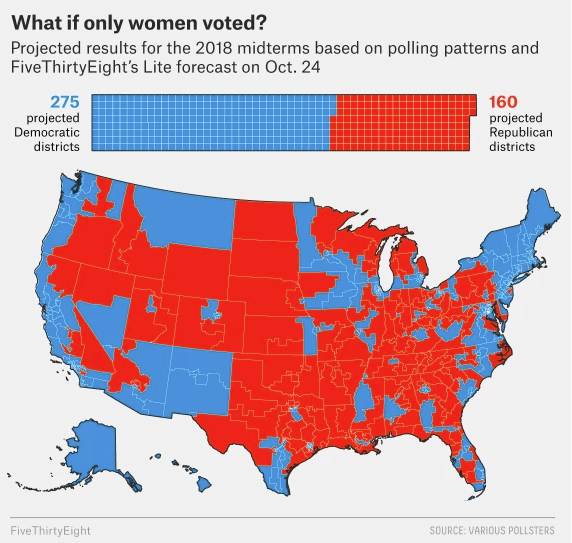
We believe there will be a massive “lavender wave,” in the November midterms.  Lavender is the color combination of pink and blue.

…In elections, women are also more likely to vote in higher numbers and have done so for decades.  Women have cast between four and seven million more votes than men in recent elections.

…Do the math, folks.  Listen to the water cooler talk, read the cartoons.
GMM, Aug 5th

CNN is out with the most recent generic ballot poll, which will cause a sigh of relief in the Democratic Party.

Washington (CNN) – Four weeks out from Election Day, Democrats remain well ahead of Republicans in a generic ballot matchup, with 54% of likely voters saying they support the Democrat in their district and 41% backing a Republican, according to a CNN poll conducted by SSRS.

This is the widest margin of support for Democrats in a midterm cycle since 2006, when at this point, the party held a whopping 21-point lead over Republicans among likely voters. That’s also when Democrats seized control of the House from Republicans, making Nancy Pelosi speaker until 2011. – CNN


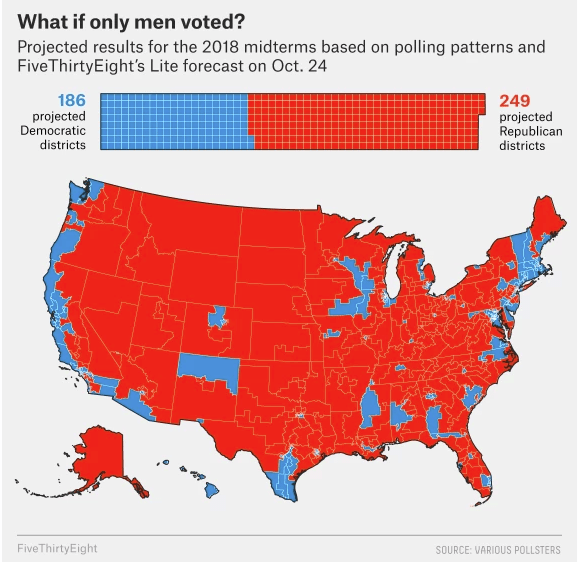
Blue Wave_2


That is one big gender deficit for Republicans to make up in the next month.

The political arithmetic seems pretty simple:   more women vote;  women are more likely to vote, and women favor Democrats in the generic ballot by a yuuuuuge margin.

Dems Likely To Pick-up 27-47 House Seats

Our prediction is based, not on our personal politics, but on inference from the polling data, history, and simple factor models.   Recall, we predicted Trump would win the electoral college and Clinton, the popular vote, on the eve of the 2016 election.

Presidential Favorability Ratings And House Seats Gained/Loss

The midterm is almost always a referendum on the sitting president.  Moreover, voters are more likely to come out in November to say “f-you” than “thank you”, Mr. President.

The following plots Gallup’s presidential approval ratings a little over 600 days into a first-term presidency with the net seats gained by the party in the White House.


Blue Wave

Note the positive relationship with approval ratings and House seat gains.   The 2002 midterm is the only modern midterm election of a first-term president, which resulted in a net gain of House seats.

The model, with a decent .64 R-squared.  predicts the Republicans are set to lose 47 House seats in November.  Yes, we get it, small data set.

Crude Oil Price-Midterm Model 

In our September 25th post, Rising Oil Prices And Midterm Elections, we laid out a simple prediction model based on crude oil prices and change in House seats during the midterm elections.

Gas prices are highly correlated with crude oil, and rising gas prices are politically toxic.


Blue Wave_5


Voters are feeling the pinch at the pump with gas prices up almost 20 percent year-on-year.


Blue Wave_6

The simple oil price model now predicts the Republicans are set to lose 27 House seats.

Blue Wave_3


Blue Wave_4

Upshot

We suspect the difference between a Lavender Tsunami and a narrow Democratic victory taking back the House will depend on if millennial women show up to vote in November.  Place your bets on how the recent SCOTUS hearings will motivate them either way.

Of course, the midterm elections will be determined by more than just the popularity of the president at the time or the 21-month increase in crude and gas prices.   It’s better than wishful thinking, however,  or putting a wet finger to the air,  and sure beats depending on a warm feeling in our tummy.    Stay tuned.

Posted in Crude Oil, Politics, Uncategorized | Tagged , , , , , | 3 Comments

QE’s Fading Legacy Moving Long Yields Higher

Summary

  • The legacy of the Fed’s QE is fading in the bond auctions
  • For the first time in several years, SOMA did not and will not participate in any of the September or October Treasury auctions
  • The Treasury has to refinance SOMA maturities with the issuance of new market debt or run down its checking account balance at the Fed
  • Though quantitative tightening does not increase the public debt, it puts supply pressure on the market
  • This post is an excerpt of our Sep 23rd post, The Gathering Storm In The Treasury Market 2.0

We suspect our Sep 23rd beast of a post,  The Gathering Storm In The Treasury Market 2.0,  was TLDR – Too Long, Didn’t Read.  One famous blogger said of it, “This post is so big, you can see it from space.”   We feel it was an important read for any market watcher as the 10-year T-Note yield is the most important price in the world.

In that post we which laid out why several factors which have kept U.S. long-term interest rates low and repressed term premium suppressed are fading,

Impatience and ADD equals missed opportunities,  as we wrote in the summary bullet points,

  • The yield curve is flat for technical reasons, and we believe term premia will increase
  • We expect a measured move in the 10-year Treasury yield to 4.25 to 4.40 percent, much sooner than the Street anticipates  – GMM, Sept 23rd

That was just before the 10-year yield broke out.

We are going to slice and dice the that post for an easier read for those of us use to 140 280 characters.

We named four significant factors that were changing and set to move long-term interest rates higher and increase the term premium.   This post extracts and focuses on the fading legacy of QE in the bond auctions

Posted on September 23rd

We now examine four changing structural factors that have created a favorable technical environment for the U.S. bond markets, which have kept long-term interest rates abnormally low and pancaked the yield curve:

  1. The ballooning of the budget deficit during economic expansion;
  2. QE and its diminishing legacy of reinvesting maturing notes and bonds;
  3. Borrowing from the social security trust funds,
  4. Globalization

The Diminishing Legacy Of QE

Treasury_Fed_Bal_Sheet

We constructed the following chart to illustrate the schedule of maturing Treasury securities by month, held in the Fed’s September 12th SOMA portfolio.

Treasury_SOMA_Maurities and Rolloff

In the current month of September, for example, $19 billion of Treasury securities mature, but the total falls below the $24 billion monthly quantitative tightening cap (purple line) leaving zero SOMA cash available to reinvest and participate in the Treasury auctions.  The $19 billion will not be reinvested and is reflected in the red bar.  The Treasury will be forced to plug the gap with new market borrowings or rundown its cash balance at the Fed.

The same dynamics hold for the roll-off of the SOMA MBS portfolio, where the cash balances at the Fed of the government-sponsored enterprises (GSEs) are reduced when mortgages run-off and not reinvested.

September To Remember

September will be the first month in several years where the SOMA will not participate in any of the notes, bond, FRN, or TIPs auctions.  Recall our early assertion, SOMA’s cash reinvestment of its maturing Treasuries back into the auction does not increase in the public debt.

The same holds for October, when the QT cap steps up to $30 billion per month, as $24 billion of Treasuries mature.

In November, $59 billion of SOMA Treasuries mature, of which $30 billion (the QT cap) will not be rolled over (red bar) and drained from the financial system, with the remaining $29 billion (green bar) in cash used as noncompetitive bids in the variety of notes, bonds, FRN, and TIP auctions.

Some argue SOMA’s impact on the auction and markets is de minis.  We disagree.

Asymmetric Effects Of QT

We need to think more about this but our first impression is the economic effect of quantitative easing, and quantitative tightening is not symmetric.  Because of the difference on the liability side, QT appears that it will be more direct, more onerous than expected, and will be quicker in its economic impact than QE.

Treasury_Redemptions

Moreover, QE enabled the government to issue the debt it now has to pay back to the Fed or forced to roll by more issuance of marketable debt.

QE has blurred the lines between fiscal and monetary policy.   Quantitative easing (QE) has  just been “turbocharged fiscal policy in drag with a lag.” Great hip-hop line, no?

Portfolio Switching

Research at the Fed from last year expected a symmetric decline in demand for risky assets under quantitative tightening relative to QE.   The action in emerging markets this year appear to confirm, at least, in part, their analysis.

Carpenter et al. (2015) examined data from the Financial Accounts of the United States and found that the household sector—which in this dataset includes sophisticated investors such as hedge funds—was the predominate seller of Treasury securities to the Federal Reserve during its large-scale asset purchase programs, and that the household sector rebalanced its portfolio toward corporate bonds, commercial paper, and municipal debt and loans.  If we lean on their results and apply them in reverse—that is, reverse the actions that were found to occur during that earlier period so as to hypothetically mimic a period of Fed securities redemptions—then we would expect the household sector, as defined in this context, to rebalance its portfolio away from the riskier assets and back towards Treasury securities.  – Federal Reserve Board

Reduction In SOMA Treasury Portfolio 

The black line in chart above illustrates the decrease in the SOMA Treasury portfolio over time as securities roll-off.

Some argue that the stock of excess reserves are declining too fast, down 18 percent since QT began causing the Fed Funds rate to consistently trade at the top of the 25 bps target range.  Consequently, the Fed will be forced to end its balance sheet reduction sooner than the markets think.

A plausible scenario.   However, why not just stop paying or further reduce the interest rate on excess reserves (IOER), which will force reserves back into the Fed Funds market putting downward pressure on the rate?

If we had to guess,  QT ends in June 2022 when the SOMA Treasury portfolio hits $1.5 trillion and the MBS portfolio around $1 trillion.  We suspect, however, the glass will begin shattering long before then, forcing the Fed to reverse course.

…before the financial crisis hit, growth in the Federal Reserve’s securities holdings was in line with growth in nominal GDP.  In particular, between 1990 and 2007, the Federal Reserve’s securities holdings totaled a fairly steady share—about 5 percent—of nominal GDP.  – Federal Reserve Board

A $2.5 trillion SOMA portfolio in June 2022 would be approximately 10.5 percent of GDP,  more than double its holdings before the GFC.

History Of SOMA Participation In Treasury Auction

Our next chart illustrates the SOMA participation in every Treasury auction since September 2009, which was financed by the sum of its maturing securities during each particular month.

The green bars represent the SOMA percentage takedown of the total amount of securities issued during the auctions, and the black line is the corresponding 10-year Treasury yield on the date of each auction.


Treasury_SOMA_All Auctions

Operation Twist

The Fed engaged in “Operation Twist” between September 2011 and December 2012 (two red bars) to bring down long-term rates.  It sold shorter-term securities in its portfolio to purchase long-term Treasuries.  It appears just the anticipation of the program reduced yields as traders began front-running the Fed.

Interest rates began to spike as soon as the SOMA ran out of maturing securities and stopped participating in the auctions.   That is what concerns us now.

The SOMA’s participation in auctions going forward will be sporadic, at best, which could put upward pressure on rates and further crowding out borrowers as the Treasury is forced to issue more marketable securities.

The following is the Treasury press release of the results from the August 30-year bond auction.  Notice the SOMA took down almost 12 percent of the total outstanding bonds issued.


Treasury_August_30_auction


SOMA Participation Does Not Increase Public Debt Stock

It is important to realize the net stock of Treasury debt does not increase with SOMA participation in the auctions as the cash is derived from maturing securities.  Nevertheless, is does allow size of the auctions to increase.

Declining SOMA Auction Participation 

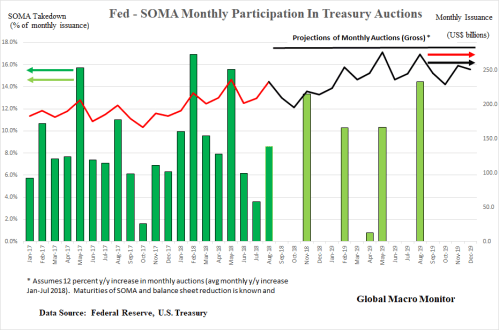
Our next chart shows the recent past and future SOMA participation in the Treasury auctions through 2019.  The key takeaway here is that the SOMA will be active in the auctions in only five of the next 16 months,

Treasury_SOMA_2017_2019

We believe the bond market has not fully focused on the diminishing participation of the SOMA in the auctions going forward.   It now has the data and should be on traders’ radar, causing upward pressure on long-term interest rates.   We could be wrong in our analysis of how powerful the impact SOMA’s auction participation is on markets, however.

Posted in Debt, Fed, Fiscal Policy, Interest Rates, Uncategorized | Tagged , , | 3 Comments