Let The Political Shitshow Begin

It’s about to get interesting, folks.

We have been warning of the rising political risk.

Cohen had struck a deal with U.S. attorneys in Manhattan’s southern district after months of court proceedings related to a raft of materials seized in raids on his office and hotel room in April.

Trump’s name was not used in the lower Manhattan courtroom, but Cohen made references to an unidentified “candidate,” at whose direction Cohen said he paid two women for the purpose of influencing the presidential election.  – CNBC

Will Trump now begin to burn down Rome?

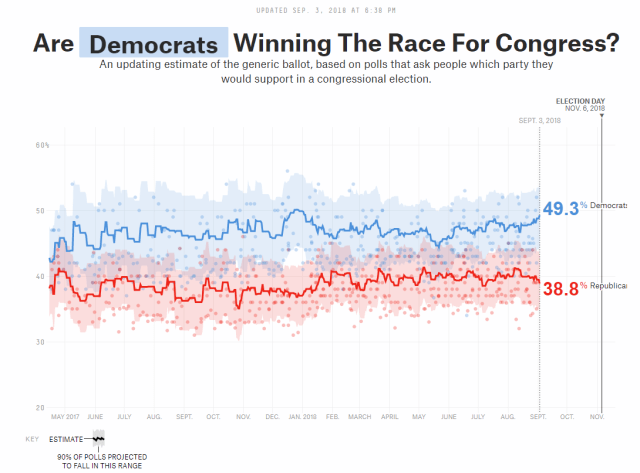
The market has been in hyperbolic discount mode of any political risks going forward, including the Dems retaking the House, all for just 50 S&P points of upside and a new nominal intraday high.  Piss poor risk-reward, in our opinion.

This new chapter that began late today will last for some time, and who knows where it takes the country.   Hoping for the best.  Seat belts.

Stay tuned.


Posted in Politics | Leave a comment

Videographic: European Central Bank

Videographic on the European Central Bank. After years of austerity, Greece emerged on Monday from its third and last bailout. The European Union, ECB and the International Monetary Fund loaned the country a total of 289 billion euros ($330 billion) in three successive programmes in 2010, 2012 and 2015.VIDEOGRAPHIC  – AFP News Agency

Posted in Uncategorized | Leave a comment

Tweet Of The Day: ML & AI


Posted in AI, Tweet of the Day, Uncategorized | Tagged , , | Leave a comment

Other Fowl Plays In The Emerging Markets

Fowl Play? The Twisted Linguistics of Turkey

American turkeys and African guinea fowl, victims of Portuguese vagary, became inextricably mixed. Today the geographically garbled turkey is known as dinde (from poule d’Inde or chicken of India) in France, kalkoen (from Calicut hen) in the Netherlands, and indjushka (Indian bird) in Russia. The Turks, who knew it didn’t come from Turkey, called it hindi (from India). In Levantine Arabic, it’s known as dik habash (Ethiopian bird); in Malaya, ayam belanda (Dutch chicken); and in Cambodia, moan barang (French chicken). The Albanians, who hedged their bets, call it gjel deti (sea rooster).
– National Geographic 

Fascinating to watch the younger market pundits declare the worst is over for the emerging markets.

The worst?  NFW!

Temporarily oversold?  We fully agree.

https://twitter.com/AnthonyBSanders/status/1030611873165725698

U.S. Monetary Policy 

The dollar monetary tightening is the receding tide exposing those emerging market economies who have been swimming naked.   Thus far, Turkey and Argentina have been caught in their birthday suits.

Buffet_Aug17.png


More Tightening Coming 

It’s about to get worse, not better, folks.

The rollover of the Fed’s maturing Treasury portfolio into the monthly 2,3,5,7, 10, 30-year notes and bond,  2-year FRNs, and 5-10-30 TIP auctions begins to drop-off significantly starting in September.  That is very little Fed participation in Treasury auctions going forward.   The Fed SOMA portfolio recently took down 11.85 percent of the 10 and 30-year auctions just last week.

The diminishing participation of SOMA as the funding needs of the U.S. government increase due to the explosion of the budget deficit, ceteris paribus, should put significant upward pressure on long-term interest rates.

Of course, safe haven inflows into the Treasury market in the event of a macro shock could upend our interest rate expectations.  Moreover, the net short position in Treasury futures is at record levels and vulnerable to a short squeeze.

But that has been the case for quite awhile. Short squeezes are technical and by definition short-term in nature, and the crowd is sometimes right.

Bonds_SOMA_Auction_2

Thus, while economists and investors obsess daily over the flattening yield curve, we are are looking for it to begin steepening as it has been artificially flat and distorted by QE, both at home and abroad.

On The QT

Moreover, the Fed’s quantitative tightening cap steps up from $40 billion per month ($24 billion = Treasuries and $16 billion = MBS) to $50 billion ($30 billion = Treasuries and $20 billion = MBS) in October.   That is the Fed will be draining a maximum of $50 billion per month of dollar liquidity starting in Q4.

Granted most will come out of excess bank reserves, but monetary policy is a complex and complicated beast.  Nobody fully understands the consequences of the Fed’s actions and can pinpoint precisely the impact and timing on capital flows.   This applies as much to the monetary authorities as it does to Joe Sixpack and Mrs. Watanabe.

Black Box

In other words monetary policy has always been and always will be a black box.  Now more than ever as we are in the uncharted territory of unwinding quantitative easing. Indicator species become that more important to detect changes in the financial ecosystem. Emerging markets and commodities have traditionally been the first to suffer physical deformities when the global monetary screws begin to tighten and become binding.

Thus far,  the drain of liquidity from the Treasury market is relatively close to the projective cumulative cap — $132 vs $131.6 billion actual (end-July).  The SOMA MBS portfolio reduction is running only about 60 percent of the cumulative QT cap, which began last October, probably due to the erratic nature of the maturities of mortgage securities with prepayment uncertainty.  The MBS portfolio has shrunk by $53.6 billion (end-July) versus the projected maximum of $88 billion.

63.4 percent Cum Probability of a 50 bps Higher FED Funds Rate By December

Then there are the further interest rates hikes to come.  The markets are estimating a 96 percent probability the Fed hikes another 25 bps in September and a 66 percent probability of another 25 bps in December to a Fed Funds target range of 2.25-2.50 percent by year-end.

Turkey Lookalikes

Nice interactive table from Reuters BreakingViews on EM countries with macro vulnerabilities similar to Turkey.

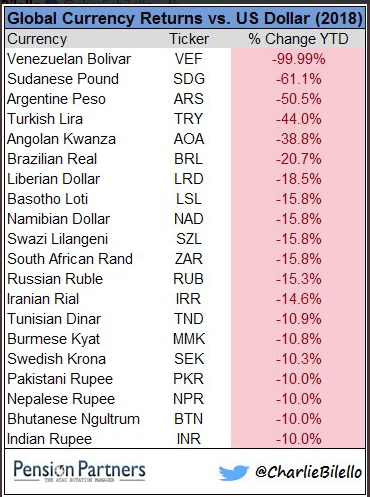
Resembling Turkey is a problem right now. The lira’s alarming slide has made investors wary of any emerging country that shares too many of the same economic and financial vulnerabilities. The most similar, such as South Africa and Argentina, are already hurting. But even those with a less striking resemblance are vulnerable as capital flows out of riskier markets.

Breakingviews has identified some of the economic problems afflicting Turkey and ranked other emerging markets according to how vulnerable they are on the same counts. These difficulties include big budget and current account deficits, inadequate foreign exchange reserves, and too much debt issued in foreign currency. A relatively high proportion of overall debt held by outsiders is another weakness.  – Reuters BreakingViews


It pains us to see Chile ranked so poorly as we worked on the country’s structural adjustment programs in the late 1980’s, and watched it become the superstar emerging market for 25 years.  We suspect this is largely the result of being caught up in the trade wars and collapse of copper prices.  We need to drill down deeper at the country level.

Feels Like 1997

We hope you had a chance to read our post, Feels Like 1997.  It gives a good background on the current turmoil in emerging markets in the context of the 1997 Asian Financial Crisis.  We also explore the danger of weaponizing capital flows.

Is The U.S. The “Ultimate” Emerging Market 

Because the U.S. so dependent on external financing,  we believe the use of capital flows as a weapon and tool of achieving policy goals will certainly backfire and eventually turn on the United States.

In fact, Adam Posen writes FDI into the U.S. has fallen to zero.

Beyond the cost of President Trump’s trade war with longtime US friends and rivals, his policy of economic nationalism has taken a toll in another important sphere: Net inward investment into the United States by multinational corporations—both foreign and American—has fallen almost to zero. As I pointed out in a posting in Foreign Affairs this month, this shift of corporate investment away from the United States will decrease long-term US income growth, reduce the number of well-paid jobs available, and accelerate the shift of global commerce away from the United States.  – Adam Posen,  IIE

Are portfolio flows into the Treasury market next?

Turkey dropped off the U.S. government’s list of major owners of Treasury debt, following in the footsteps of Russia in reducing its portfolio.

Turkey’s holdings of bonds, bills and notes have fallen 42 percent in the first half of this year, dropping to $28.8 billion in June, according to a Treasury Department report released Wednesday. Treasury has a floor of $30 billion to be classified as a major holder.  – Bloomberg

It is difficult to definitively conclude that a country selling off it Treasuries is retaliation or financial weaponization.  Economies with balance of payments difficulties, who are forced to intervene in their FX markets to prevent a currency collapse,  by definition, suffer a reduction in international reserves, which are usually held in Treasury securities.  Ergo their holdings of U.S. Treasuries decline.

Gold

A little sidebar.

The reduction of international reserves in the emerging markets, the largest component of the global monetary base, is the major reason why we believe the gold price has been falling and continues to decline.   See here to understand what many consider the surprisingly poor performance of gold in the current environment.

Jul19_Gold_3

The Limits Of Quantitative Easing As A Bailout Mechanism

Nevertheless, the demand for a currency, even if it is the reserve currency, is not infinite nor is it permanent.   American voters and policy makers need to put the country on a sustainable political and fiscal path, and do it soon.  That is possible but not probable without a crisis.

Fed Bailout? 

Don’t count on the Fed retreating from its tightening policy or bailing out the emerging markets just yet.  Not until the glass really begins to shatter.

Raghuram Rajan, former governor of the Reserve Bank of India, in an interview with CNBC, said the Fed isn’t in a position to hold off on rate hikes.

“In 2013, when we had the last bout of volatility, the Fed stayed off raising interest rate for some time. It is not clear it can do that right now because we have inflation numbers in the U.S. gaining strength,” said Rajan, who in 2005 went to the Fed’s Jackson Hole retreat and warned that the global economy faced the risk of a meltdown from risky behavior in the financial sector. 

“At this point, it seems to me the Fed is set on a path of rate hikes, and emerging markets will have to manage,” he added. – MarketWatch

Feels like 1997.

Stay tuned.

Posted in Black Swan Watch, Emerging Markets, Uncategorized | Tagged , , , , | 13 Comments

You Go, Girl!

https://twitter.com/asjbaloch/status/1030573984042102785?s=21

Posted in Uncategorized | Leave a comment

Week In Review – August 17

Summary

  • Turkey continues to get crushed across the board with 10-year blowing out another 40 bps on the week to over 21 percent
  • EM bond markets hammered
  • U.S. credit continues to behave well
  • Euro periphery spreads widening with Italy out to 282 bps over Bunds
  • EM FX weaker led by South Africa
  • The dollar index closed above crucial 50% weekly Fibo (see chart), recovering half of the 15 percent correction from January 2017 to February 2018
  • Global stocks weaker; the U.S. closed higher, however
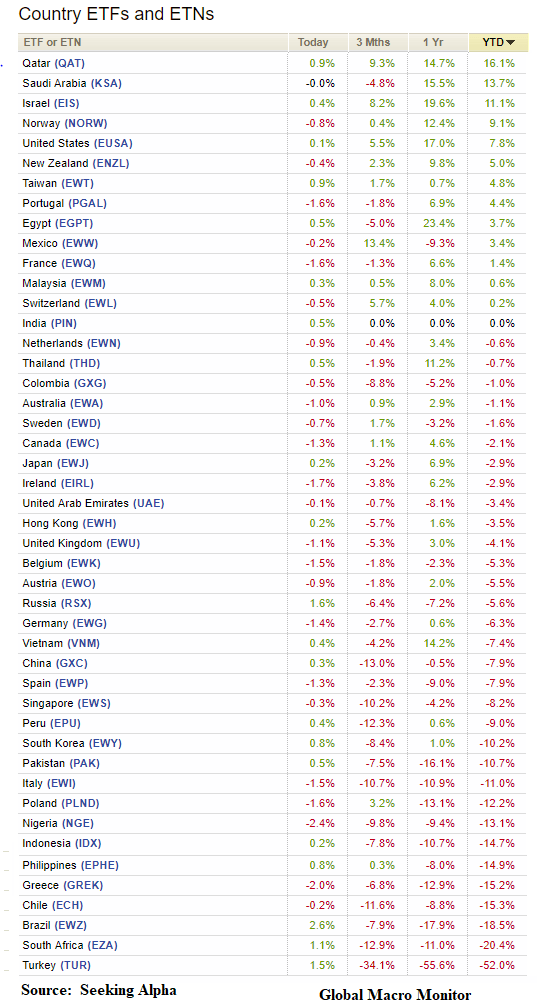
  • Fewer and fewer country ETFs are green on the year
  • Lumber bouncing after vicious bear market
  • Crude weaker
  • No shine for the metals with copper now down 20 percent YTD

Commentary:   Just back to the desk and have been out of touch.  It looks like we may be wrong on our call in Q1 U.S. stocks had entered a bear market — the S&P500 index is now less than 1 percent from an all-time high.  Nevertheless, we still don’t like equities – unless for a trade, and that is becoming exceedingly difficult to make money — here and expect volatility to spike beginning in September through rest of year.  See our post, Feels Like 1997.

Week_Chart_1

Week_2018_ETFs


Week_Table

Posted in Uncategorized, Week in Review | Tagged , , , , , , , , , | Leave a comment

Sector ETF Performance – August 17

ETF_D

ETF_W

ETF_M

ETF_Q

ETF_YTD

Posted in Sector ETF Peformance, Uncategorized | Tagged | Leave a comment

Global Risk Monitor – August 17

RiskMon_1

RiskMon_2

Posted in Daily Risk Monitor, Uncategorized | Tagged , , , , , | Leave a comment

Feels Like 1997

Just back home after a week-long road trip to many major U.S. cities.

The “Cranes Of Dubai” 

As an economist, I am always looking for anecdotal evidence of how the local economy is doing.  What impressed me most was the ubiquity of building cranes, which usually symbolize a top, or closer to, the end of a cycle, than a bottom

At the peak of the building boom in 2006, the apocryphal statistic that Dubai had between 15 and 25 per cent of the world’s tower cranes was widely reported. Some said there could be as many as one tower crane for every 44 residents. But industry experts say that while such “facts” made good headlines, they were unlikely to have ever been true.   – The National

Other Observations:

  1. Surprised at the poverty of seniors in New England.  Most of the cashiers in retail were closer to 80 years old than 40 years old.  My friends tell me one factor is simple demographics. Maine, for example, is the oldest state in the country;
  2. Spending across all cities seemed robust;
  3. You can feel and almost slice the faux wealth across the board;
  4. Prices everywhere are absurd, such as $2.50 for coffee refills and rents in NYC.  Not sustainable;
  5. Gas is 20 percent cheaper on the east coast than in California. Always the case due to different standards and higher taxes;
  6. Visited the country’s new rust belt — i.e., Manhattan retail. It is genuine. Stunning to see 3 out 4 storefronts empty in my old West Village neighborhood,
  7. America is a great country and draws its strength from her diversity, from the beautiful young woman, an Albanian immigrant student, who checked us in at Hertz at Logan, to our Uber driver from Ukraine at SFO.

We will have more on the trip later.

Turkey

Greg Ip published an interesting piece in the WSJ,   On Turkey, Another Step in the Weaponization of Global Finance,

Trade wars may be morphing into something more dangerous: financial wars.  – Greg Ip

It channels our thoughts from the post from the road, Watch Turkey

Do U.S policy makers go the traditional route of trying to stabilize the situation through IMF, etc., or is it politics uber alles?    Does the Trump administration instead step on Turkey’s throat?

We may be witnessing the end of globalization.  – GMM, August 12th

It’s Not The Dollar, Stupid!

We find it hilarious to watch the market pundits pin the recent turbulence in markets on a rising dollar.  Complete nonsense.

The trade-weighted broad dollar index is about back to where it was on 2016 election day.  The dollar is a symptom and recipient of capital flows due to the weak fundamentals driving the turmoil in the emerging markets and also U.S. monetary tightening.

Dollar_Aug15

We concede the recent strength of the dollar is a suitable indicator species that something is amiss in the global economy but does the discovery of a four-headed frog in Minnesota, for example, cause a changing ecosystem or is it just a reflection?

Some countries with poor initial conditions at the beginning of quantitative tightening in the U.S. (and coming to Europe sometime soon) monetary policy, which is unique and has never been attempted in the history of the modern currency system, are ill-prepared  for this unprecedented financial undertaking.

External and internal imbalances, political instability, and too much debt are toxic in a tightening monetary environment.   Argentina and Turkey were the first to blow.

Tighter Money

The Fed has reduced its balance sheet by about $200 billion since October 2017.   Nobody knows for sure the impact on “global liquidity” — an elusive concept similar to the term “contagion” —  or can write a model of differential equations to measure the consequences of such a rapid and large reduction in base money.   Only, at best, calculated guesses.

Bonds_SOMA_Portoflio_Total SOMA

We do know, however, it is starting to bite.  Emerging markets and commodities are the first to feel the impact of tighter global liquidity.

Feels Like Asia 1997

Ron Insana read our mind with his tweet this morning.

The timeline of what we are seeing feels much like how the 1997 Asian Financial Crisis unfolded.

The U.S. economy was also very strong but other financial conditions were different back then.  The Fed had hiked once in April 1997 and stopped in May.  Chairman Greenspan was worried about ‘irrational exuberance” in the U.S. equity market.  He was eventually correct but 3 ½ years too early.

The Asian “Tiger economies,”  Thailand, Malaysia, Indonesia, the Philippines, and eventually, Korea, experienced significant balance of payments crises.  See here for a good history.

Contagion

The crisis spread around the world and sowed the seeds for the Russian debt default and LTCM crisis in 1998.   We were sitting on a trading desk at the time and experienced first hand how financial contagion spreads like a pandemic.

We had warned investors to watch the Hang Seng index as it was in meltdown mode while the bonds of the rest of the emerging markets x/ Asia were making all-time low credit spreads.  We were also worried about Korea, which was relatively unscathed by the first round of turmoil that hit Asia in the summer.

Korea

Korea was exposed with a large stock of short-term debt, mainly interbank and trade lines to Japanese banks.  We were fortunate to work with one the best Japanese bank analysts at the time who would brief us on a daily basis.  The large Tokyo banks had to shrink their balance sheets due to losses in Asia and the falling Nikkei index to maintain adequate capital ratios.  We calculated the easiest way to do so was to allow their interbank lines to roll off in Korea.

The U.S. and European banks saw the Japanese banks getting out, and also headed for the exits as they didn’t  want to be the last holding the bag.   The Korean central bank was in the market almost every day selling dollars and hard currency to fund the redemptions and cushion the blow to the currency.

Korea’s reserves fell to a level that set off a panic that the government could not repay its own borrowings.  We never worried about a sovereign default and predicted Korea would “carve out” enough reserves to fund government debt service by selectively defaulting on other claims on the country.  That is exactly what Korea did:  restructuring the commercial bank debt.

Spread To Latin America And Beyond

As the Korean banks suffered a liquidity crisis, they were forced to sell assets to pay their interbank lines coming due.  They were big sellers of Brazilian bonds, which drove the price down, forcing Brazilian banks to sell their holdings, and raise additional liquidity by, say, selling their Russian debt.

We walked in one morning, and the Hang Seng was down almost 10 percent on the day.  The very day before, the EMBI, an index of dollar-denominated EM sovereign debt,  closed at a record tight spread over U.S. Treasuries.   A mass liquidation began, and if we recall correctly, some Brazilian bonds fell over 20 points that day.

This is a simplistic explanation and, of course, it was more widespread, complicated, and complex, but this is how contagion and panic spreads, folks.   Market psychology then takes over, and it’s game on.  Enter the dragon – a full-blown global financial crisis.

An external stabilizer with deep pockets, such as the IMF, and a credible economic program and plan becomes essential to restore confidence.  Even then, it takes time for the markets to believe the plan and commitment of policy makers are credible.

Are We On The Eve Of Another 1997?

We don’t know, but the current situation merits close attention and concern.

Today feels more like a combination of the 1995 Mexican Peso Crisis, which was triggered by the tightening of U.S. monetary policy,  Asia 1997, and the Russian Debt default, which was a local currency debt crisis, coupled with moral hazard and politics.

What Worries Us Most

The Trump administration has a weak economic bench, in our opinion, which doesn’t have the credibility and confidence of the international financial community as the Committee To Save The World – Alan Greenspan, Robert Rubin, and Larry Summers – did.

Mnuchin_Aug15


Committee To Save The World_Aug15


The Clinton administration had a deep economic team and confidence of the global markets, regardless if you agreed with their policies.  They even dispatched the little known Timothy Geithner to negotiate the stabilization programs in Asia.

Add Stanley Fischer, who was essentially running the show at the IMF at the time,  and Terrence Checki at the New York Fed, and the international financial community had the murderer’s row of economic policy makers during the late 1990’s financial crises.

POTUS

Furthermore,  we are not sure what side the POTUS is on.

Is he a short seller of the countries who are at odds with his administration’s trade and other policies?  Will he step on the throat of those emerging markets if they begin to go up in flames?

With Turkey facing a currency crisis, President Trump last week poured fuel on the fire by doubling tariffs on imports of its steel and aluminum to offset the effects of its weaker currency or force the country to release an American pastor. (Mr. Trump’s motive remains unclear.)

In the hierarchy of things afflicting Turkey, this isn’t that high: The country’s problems are mostly self-inflicted, from its large current-account deficit and steep dollar debts to the politicization of its central bank.

But it is the latest example of how the U.S. and other countries are weaponizing international finance in ways that could destabilize the global economy and fray the intricate web of relationships that sustain it.

While trade wars aren’t good for growth, rarely do they induce a recession, or even a noticeable slowdown. The infamous Smoot-Hawley tariff of 1930 was at most a minor contribution to the Great Depression. By contrast, there’s a long record of international financial disruptions fueling economic stress, from the Depression to the bankruptcy of Lehman Brothers nearly 10 years ago.  – WSJ

One Last Thing

We were market makers during the 1997 Asian Crisis.   Where are the market makers today?   Gone, gone, and gone.

The liquidity for those looking to get out if a full-blown crisis does erupt will be horrendous.   Just look to the recent events in Italy and lack of liquidity in one of the world’s largest bond markets.

The conditions for a perfect storm are in place.   We are not claiming it is inevitable but it is a higher probability than currently being discounted and should be on everyone’s radar.

Stay tuned.

Posted in Credit, Monetary Policy, Uncategorized | Tagged , | 18 Comments

Watch Turkey

Traveling and out of touch.

We are watching how the  international community, especially the U.S, responds to Turkey’s economic crisis.  Do U.S policy makers go the traditional route of trying to stabilize the situation through IMF, etc., or is it politics uber alles?    Does the Trump administration instead step on Turkey’s throat?

We may be witnessing the end of globalization.


Posted in Uncategorized | Leave a comment