
-
In economics, things take longer to happen than you think they will, and then they happen faster than you thought they could.
-
Join 1,198 other subscribers
Contribute To GMM

Categories
- 3D Printing
- Agriculture
- AI
- Algos
- Apple
- Automation
- Banking
- BFTP
- Bitcoin
- Black Swan Watch
- Bonds
- Brazil
- Brexit
- BRICs
- Budget Deficit
- Capital Flows
- Cartoon of the Day
- Cashless Society
- Chart of the Day
- Charts
- China
- Clean Tech
- Climate Change
- Coach C
- Commodities
- Coronavirus
- COVID
- Credit
- Crude Oil
- Currency
- Cyprus
- Daily Risk Monitor
- Day In History
- Debt
- Demographics
- Disinflaton
- Dollar
- Earnings
- ECB
- Economics
- Economist
- Egypt
- Electric Vehicles
- Emerging Markets
- Employment
- Energy
- Environment
- Equities
- Equity
- Euro
- Eurozone Sovereign Spreads
- Exchange Rates
- Fed
- Finance and the Good Society
- FinTech
- Fiscal Cliff Monitor
- Fiscal Policy
- Food Prices
- France
- Futurist
- Game Theory
- General Interest
- Geopolitical
- Geopolitics
- German Bund
- Germany
- Global Macro Watch
- Global Reset
- Global Risk Monitor
- Global Stock Performance
- Global Trend Indicators
- Gold
- Greece
- Healthcare
- Heat Map
- Hedge Funds
- Housing
- Human Interest
- Immigration
- Impeachment
- India
- Inequality
- Inflation/Deflation
- Infographics
- Innovation
- Institutional Investors
- Interest Rate Monitor
- Interest Rates
- Interviews
- Italian Yields
- Italy
- Japan
- Jobs
- Lectures
- Macro Notes from Conference Calls
- Manufacturing
- Masters
- Mexico
- Monetary Policy
- Movies
- Muni Bonds
- Muni Market
- Natural Gas
- News
- Nonlinear Thinking
- North Korea
- Overbought Markets
- Picture of the Day
- PIIGS
- PMIs
- Policy
- Politics
- Population
- Populism
- Poverty
- President Trump
- Qunat Strategies
- Quote of the Day
- Quotes
- Rare Earth Elements
- Readership
- Reads
- Real Estate
- Relative Strength Index
- Robert Shiller
- RSIs
- S&P500
- Sector ETF Peformance
- Semiconductor prices
- Semiconductors
- Social Media
- Socialism
- Song for the Week
- Sovereign Debt
- Sovereign Risk
- Spain
- Sports
- State and Local Government
- Tail Risk
- Technical Analysis
- Technology
- The Big Reset
- The Weekend Read
- This Day In Financial History
- Trade War
- Trades
- Tweet of the Day
- Ugly Chart Contest
- Uncategorized
- US Releases
- Video
- Volatility
- Wages
- Week Ahead
- Week in Review
- Weekend Reads
- Weekly Eurozone Watch
- Whales
-
Recent Posts
Meta
Happy Presidents Day, NOT!
Key Points:
- Survey conducted by political scientists from the University of Houston and Coastal Carolina University, with participation from American Political Science Association (APSA) scholars and published experts in presidential studies.
- Donald Trump is ranked as the lowest-rated U.S. president, falling below Buchanan and Andrew Johnson.
- His presidency is characterized by institutional challenges, including tensions with the judiciary and oversight agencies.
- He is identified as the most polarizing president, intensifying partisan divisions and public distrust in institutions.
- Comparative historical analysis contrasts his governance style with previous controversial administrations, such as Nixon’s.
- His rejection of electoral outcomes is a key factor in scholarly assessments of democratic resilience.
- The long-term implications of his presidency remain a subject of ongoing academic debate, particularly regarding executive power and institutional stability.
The 2024 Presidential Greatness Project Expert Survey, conducted by Brandon Rottinghaus (University of Houston) and Justin S. Vaughn (Coastal Carolina University), provides an empirical assessment of U.S. presidents from George Washington to Joe Biden. The survey was distributed to current and recent members of the Presidents & Executive Politics Section of the American Political Science Association (APSA), as well as scholars who have recently published peer-reviewed research in presidential studies. Of the 525 invited experts, 154 provided usable responses, offering an academically rigorous evaluation of presidential leadership.
The survey ranks Donald Trump as the lowest-rated U.S. president, placing him below James Buchanan and Andrew Johnson, two presidents historically associated with crises that threatened the republic—the Civil War and Reconstruction, respectively. The survey’s findings suggest that Trump’s administration presented significant institutional challenges, contributed to heightened political polarization, and raised concerns about the resilience of U.S. democratic norms.
Institutional Challenges and Democratic Norms
A key finding of the survey is that Trump’s presidency was marked by frequent tensions with democratic institutions. Respondents highlighted his strained relationship with the judiciary, intelligence agencies, and independent oversight bodies, which raised concerns about the separation of powers and the rule of law. The survey results also emphasize the significance of Trump’s post-election actions in 2020, particularly his rejection of electoral outcomes and efforts to challenge election legitimacy. These elements contribute to scholarly debates about the extent to which executive behavior influences democratic stability.
Polarization and Its Consequences
The survey identifies Trump as the most polarizing president in U.S. history. While political polarization is not unique to his tenure, respondents indicated that his presidency exacerbated partisan divisions, particularly in areas such as public trust in institutions, congressional oversight, and executive authority. Political scientists have long analyzed the effects of partisan entrenchment on governance, and the survey’s findings align with broader concerns that polarization may erode institutional effectiveness and democratic consensus.
Comparative Analysis of Presidential Leadership
Presidential greatness rankings are historically shaped by factors such as crisis management, institutional impact, and governance style. Scholars have compared Trump’s administration to those of previous controversial leaders, such as Richard Nixon, whose presidency ended amid the Watergate scandal. However, a key distinction noted in the survey results is that Nixon ultimately resigned in response to institutional pressure, whereas Trump’s refusal to accept electoral defeat and his role in post-election controversies have been central to scholarly assessments of his administration.
Long-Term Implications for Democratic Governance
The survey results raise broader questions about democratic resilience and institutional continuity. Research on democratic erosion often identifies key risk factors, including executive challenges to institutional independence, contested elections, and shifts in political norms. The expert evaluations in this survey suggest that Trump’s presidency aligns with several of these concerns, particularly in relation to election integrity and the evolving scope of executive power. Whether these trends are temporary or indicative of broader institutional shifts remains a subject of ongoing academic inquiry.
Conclusion
The 2024 Presidential Greatness Project Expert Survey, conducted by scholars from the University of Houston and Coastal Carolina University, provides an empirically grounded framework for assessing presidential leadership. Trump’s ranking at the bottom of the presidential greatness scale reflects expert concerns about institutional norms, political polarization, and executive conduct. While assessments of presidential effectiveness evolve over time, this study underscores the extent to which Trump’s presidency has influenced discussions on democratic governance, institutional resilience, and the executive branch’s evolving role.

Posted in Uncategorized
2 Comments
Global Risk Monitor: Week In Review – February 14
U.S. Markets:
The U.S. stock market ended the week with strong gains, nearing record highs despite mixed economic signals. The Nasdaq Composite led with a 2.58% gain, and the S&P 500 followed, closing within 1% of its all-time high. Investor optimism was driven by President Trump’s decision to delay new global tariffs in favor of a “reciprocal tariff” framework to be determined country by country.
The inflation report caused a temporary selloff midweek, but equities rebounded as investors digested Federal Reserve Chair Jerome Powell’s comments that policymakers were still assessing inflation’s trajectory. Growth stocks continued to outperform value stocks, while small-cap stocks lagged.
Global Markets:
- Europe: The STOXX Europe 600 climbed to a record level (+1.78%), supported by positive corporate earnings and speculation about a Ukraine ceasefire deal with Russian concessions. Germany’s DAX (+3.33%) and France’s CAC 40 (+2.58%) led gains.
- Japan: The Nikkei 225 gained 0.89%, supported by yen weakness and Trump’s decision not to impose new tariffs on Japan.
- China: The CSI 300 rose 1.19%, while Hong Kong’s Hang Seng Index surged 7.04%, driven by investor interest in tech stocks and AI firms. However, China’s property market remains a major drag, with a double-digit decline in home sales and falling prices.
Economics
U.S. Inflation Data:
January’s Consumer Price Index (CPI) exceeded expectations, rising 0.5% month-over-month and 3.0% year-over-year (previously 2.9%). The core CPI (excluding food and energy) climbed 0.4% MoM, doubling December’s pace. The main driver was shelter costs, which rose 0.4% and contributed to nearly 30% of the inflation increase.
The Producer Price Index (PPI) also came in hot at 0.4% MoM, slightly above consensus. However, healthcare and airfare prices showed signs of cooling, suggesting potential disinflationary forces.
Monetary Policy & Federal Reserve:
In response to inflation concerns, Powell reaffirmed that the Fed is not yet ready to cut rates, shifting expectations for the first rate cut from September to December. Chicago Fed President Austan Goolsbee called the inflation report “sobering,” warning that multiple months of high CPI could delay monetary easing further.
International Economic Trends:
- Europe: Trade tensions with the U.S. over the reciprocal tariff policy could weigh on euro area growth, though it is unlikely to shift the trade surplus.
- UK: The British economy grew 0.1% in Q4 2024, surprising analysts. Bank of England officials are debating cautious rate cuts as inflation pressures persist.
- China: A higher-than-expected 0.5% CPI rise suggests inflation is reappearing, but factory deflation remains entrenched (-2.3% PPI YoY).
- Emerging Markets: Hungary’s inflation surprised to the upside (+1.5% MoM), lowering chances of imminent rate cuts. India faces higher U.S. tariffs, increasing global trade uncertainty.
Week Ahead
- U.S. Markets: Investors will closely watch upcoming data releases, including:
- Empire State Manufacturing Index (Tuesday)
- Housing Starts & Building Permits (Wednesday)
- Philadelphia Fed Index & Jobless Claims (Thursday)
- Existing Home Sales & University of Michigan Consumer Sentiment (Friday)
- Global Markets & Central Banks:
- China PMIs (Monday) will provide insights into early-year industrial activity.
- Bank of Canada policy rate decision (Wednesday) is expected to deliver a 25 bps rate cut.
- European Central Bank (Thursday) is likely to lower its deposit rate by 25 bps as inflation stabilizes around 2.4% YoY.
- Market Sentiment:
- The S&P 500 may test new highs if bond yields remain stable, but inflation concerns could increase volatility.
- Traders will focus on Nvidia’s earnings (Feb 26) and the upcoming PCE inflation report (Feb 28), the Fed’s preferred inflation gauge.
Conclusion:
Despite hotter-than-expected U.S. inflation data, equity markets showed resilience as investors weighed trade policy uncertainty, monetary policy outlook, and corporate earnings strength. The delay in new tariffs provided short-term relief to markets, but trade fragmentation remains a long-term risk. Next week’s housing and labor data will be key to assessing U.S. economic momentum heading into Q2 2025.


Posted in Uncategorized
Leave a comment
The Dark History of Valentine’s Day
Betcha didn’t know this.
Posted in Uncategorized
Leave a comment
Krugman On Shifting Political/Economic Landscape
Interesting interview. Worth your time.
Posted in Uncategorized
Leave a comment
What’s Inflating, What’s Not…
Wait…Were’t we promised the cost of auto insurance would be cut in half? CPI came in hot this morning.

Posted in Uncategorized
Leave a comment
NFL Super Bowl Commercials 2025
This year’s Super Bowl commercials were about as interesting as the game, IMHO.
Posted in Uncategorized
Leave a comment
Waiting On…………..GEICO!
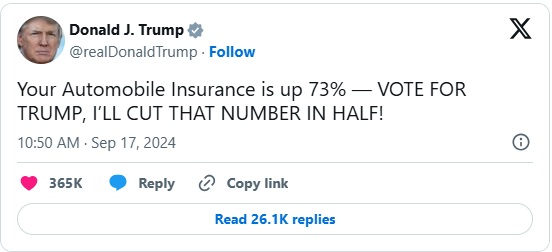
The real price of motor vehicle insurance is up 63 percent since 2010 with the nominal price up 138 percent. We wait.

Posted in Uncategorized
2 Comments
 Global Macro Monitor