Open Convention? Think Lincoln’s 1860 Cage Fight

The Dam Is Breaking

Probably only a matter of days if not hours before Biden stands down.  Those worried about a messy convention should study the 1860 Republican Convention – in Chicago, by the way – and how Honest Abe wrestled the nomination from Sen. William Seward of New York.

Originally posted March 15, 2024

Lincoln & His Fake Convention Tickets

The monumental impact of the results of the upcoming election on the country and the world has often been compared to that of the election of 1860, which brought President Lincoln to the White House.  And if you agree “politics ain’t beanbag,”  imagine today the uproar if a candidate snagged their party’s nomination the way President Lincon did from William Seward, who later became his Secretary of State, part of the Team of Rivals.

Lincoln’s Nomination

Finally, the third day [of the convention] arrived. One thousand Seward men marched behind a smartly uniformed brass band. They wound their way noisily through Chicago’s streets, playing the song “Oh, Isn’t He a Darling?” and finally arrived triumphantly in front of the Wigwam. To their horror, they found that they could not get in: the Lincoln men, admitted with their counterfeit tickets, had taken their seats. – Great American History

The 1860 Republican National Convention, held in Chicago, is notable for Abraham Lincoln’s unexpected nomination as the Republican candidate for President, a feat achieved through shrewd political maneuvers, most notably the strategic use of counterfeit tickets by his delegation. Here’s a revised account emphasizing this aspect:

  • Chicago’s selection as the convention location set the stage for a significant political showdown, with Senator William Seward of New York as the expected nominee.
  • Lincoln, a lesser-known figure at the time, capitalized on his political acumen and local support to challenge the frontrunner.
  • Central to Lincoln’s strategy was the ingenious production and distribution of counterfeit tickets by his team.
  • These counterfeit tickets were used to flood the convention hall with Lincoln supporters, effectively marginalizing Seward’s delegates.
  • Seward’s camp, led by Thurlow Weed, was initially confident but failed to anticipate Lincoln’s tactical planning and grassroots support.
  • The convention dynamics were heavily influenced by Lincoln’s ability to control the audience composition, thanks to the counterfeit tickets.
  • Despite Seward leading after the first ballot, Lincoln’s growing momentum was palpable, aided by his supporters’ overwhelming presence.
  • The shift in delegate support on subsequent ballots, particularly from Pennsylvania, was a turning point, facilitated by the charged atmosphere favoring Lincoln.
  • Lincoln’s nomination was secured after three ballots, marked by the strategic use of counterfeit tickets which played a crucial role in his victory.

This pivotal moment underscored Lincoln’s resourcefulness and political insight, setting him on the path to the presidency.

We leave you with the words of Chairman Mao,

Posted in Uncategorized | Leave a comment

Global PMI: Input costs rise to a 16-month high

Take heed, folks; input costs, as measured in the latest release of the Global Manufacturing PMI, are rising at the fastest clip in 16 months. Manufacturing input costs were a leading indicator of the last wave of inflation.  

Measured overall, worldwide manufacturing input costs rose at the steepest rate for 16 months in June. These rising costs pushed up factory gate selling prices, which rose at the sharpest pace since March 2023. Rates of increase in both price measures remained stronger (on average) in developed nations compared to emerging markets. – JPMO Global Manufacturing PMI

Summary

The latest Global Manufacturing PMI report, produced by J.P. Morgan and S&P Global, indicates a continuation of the upturn in global manufacturing, although input cost inflation has accelerated to a 16-month high. Key highlights:

  1. PMI Overview: The Global Manufacturing PMI came in at 50.9 in June, slightly down from May’s 51.0 but staying above the neutral 50.0 mark for the fifth consecutive month, indicating ongoing improvement in operating conditions.

  2. Sub-indices Performance: Four of the five sub-indices showed expansion:
    • Output: The growth rate held near May’s two-and-a-half-year high.
    • New Orders: Increased for the fifth month, albeit at a slower rate.
    • Employment: Rose for the third time in four months.
    • Suppliers’ Delivery Times: Lengthened.

  3. Regional Insights:
    • Asia: Showed robust performance with significant growth in countries like India, Vietnam, and Thailand.
    • Euro Area: Continued weakness with output falling for the fifteenth consecutive month, particularly in Germany, France, and Italy.
    • US, UK, and Brazil: Sustained growth into June.

  4. New Export Orders: Fell for the first time in three months, indicating a deterioration in international trade flows.

  5. Business Optimism: Dipped to an eight-month low due to subdued market conditions.

  6. Inflationary Pressures:
    • Input Costs: Rose at the steepest rate in 16 months.
    • Output Prices: Increased at the fastest pace since March 2023, with stronger rates of increase observed in developed nations compared to emerging markets.

  7. Supply Chain Conditions: Remained relatively stable, with only marginal lengthening in vendor lead times despite global shipping disruptions.

The report reflects a mixed global manufacturing landscape with pockets of growth amidst inflationary pressures and supply chain challenges.

Posted in Uncategorized | Tagged , , , , | 1 Comment

No Country For Old Men

Wendell:    That’s very linear, Sheriff.
Ed Tom Bell:    Well, age will flatten a man. – No Country For Old Men

When I was younger, I could remember anything, whether it had happened or not; but my faculties are decaying now and soon I shall be so I cannot remember any but the things that never happened. It is sad to go to pieces like this but we all have to do it. ― Mark Twain

Winning isn’t everything, it’s the only thing. If you can shrug off a loss, you can never be a winner! – Vince Lombardi

The chorus grows louder. 

Money Quotes From All of the Above:

Mr. Biden has been an admirable president…the greatest public service Mr. Biden can now perform is to announce that he will not continue to run for re-election. – NY Times

…the unfortunate truth is that Biden should withdraw from the race, for the good of the nation he has served so admirably for half a century. – Atlanta CJ 

…the Bidens to insist on defying biology, to think that a decent performance at one rally or speech can offset the indelible images of Thursday night, is folly. – David Remnick, New Yorker

President Joe Biden needs to end his campaign. – Mark Leibovich, The Atlantic

Joe Biden, a good man and a good president, has no business running for re-election. – Thomas Friedman,  NY Times

Joe Biden can emulate LBJ without courting chaos. Biden can finish the noble work that was denied to Lyndon B. Johnson — healing the country and lifting his party to victory, through an admirable act of self-awareness and courage. – David Von Drehle, WashPost

Posted in Uncategorized | Tagged , , , , | Leave a comment

Global Risk Monitor: Week In Review – June 28

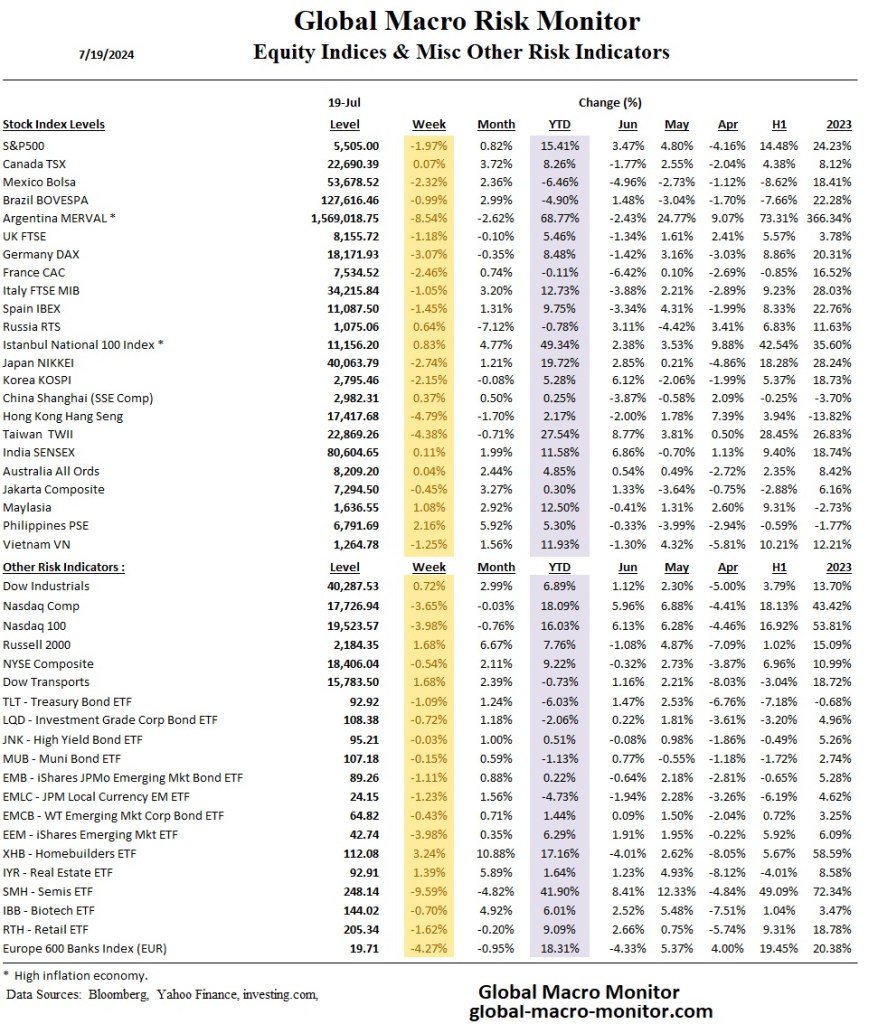
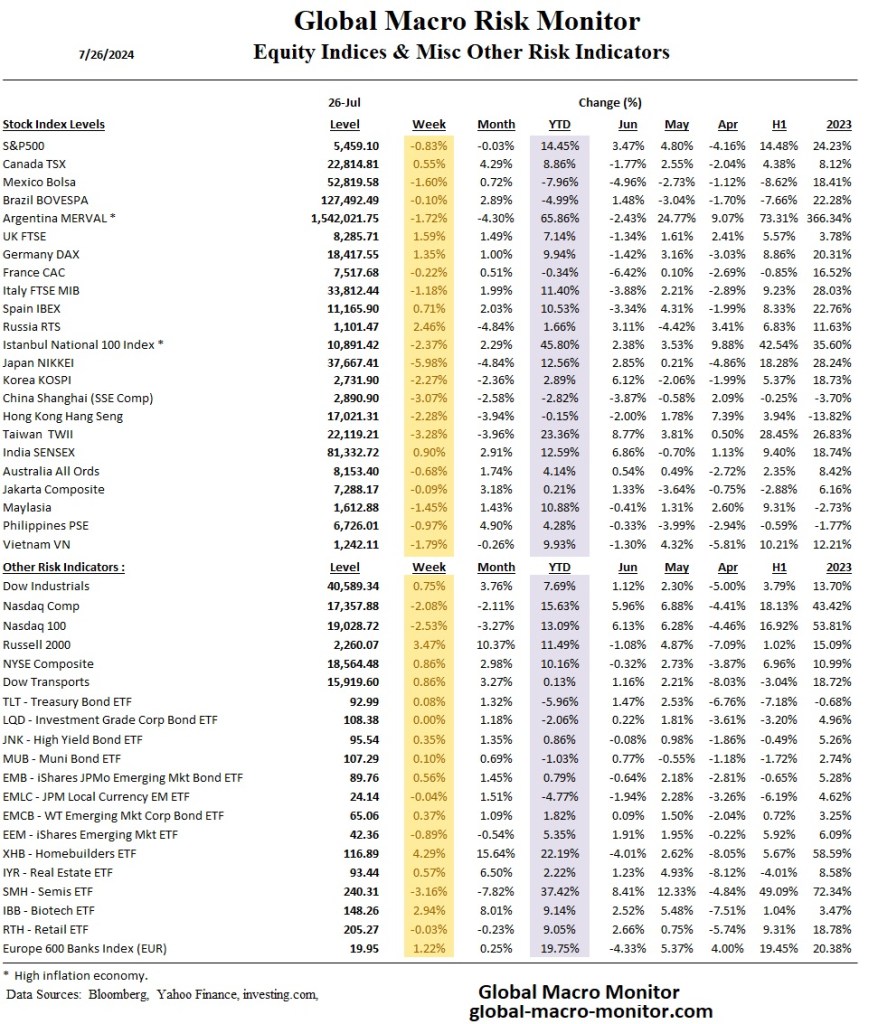
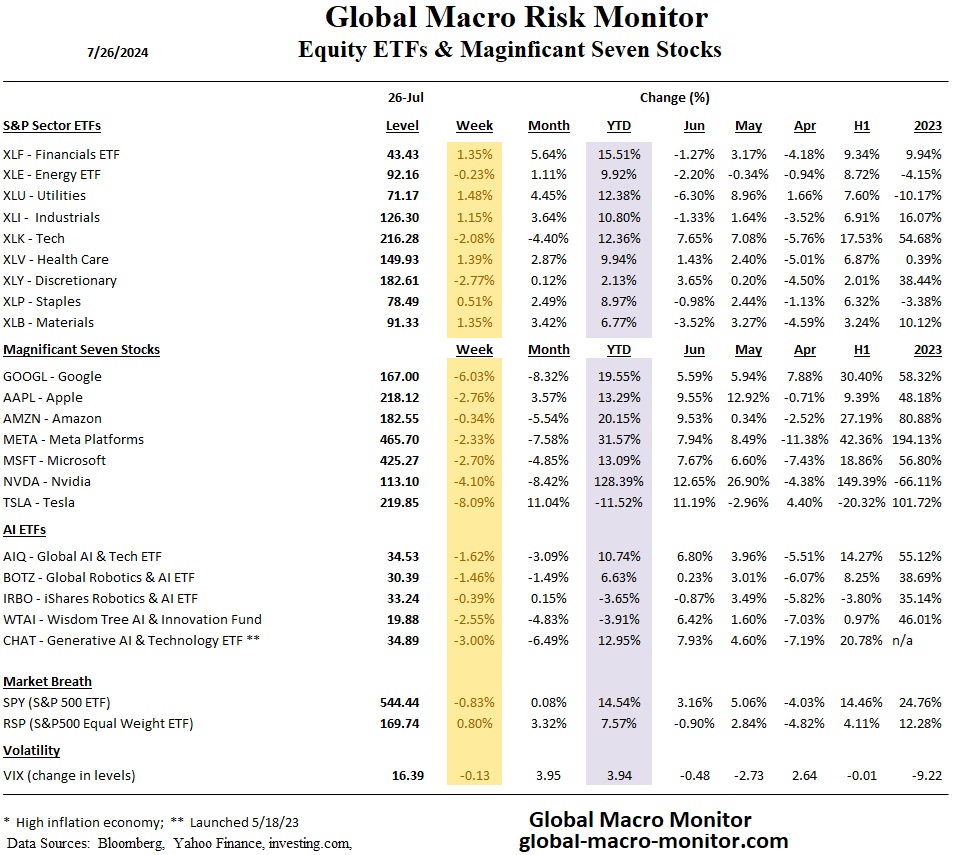
Global equity markets exhibited mixed performances this week. European indices showed slight declines, while several Asian markets experienced gains. The S&P500 and Nasdaq were relatively flat, with the Russell 2000 putting in a rare outperformance. Emerging markets showed diverse results, with two-percent moves in Vietnam and India.

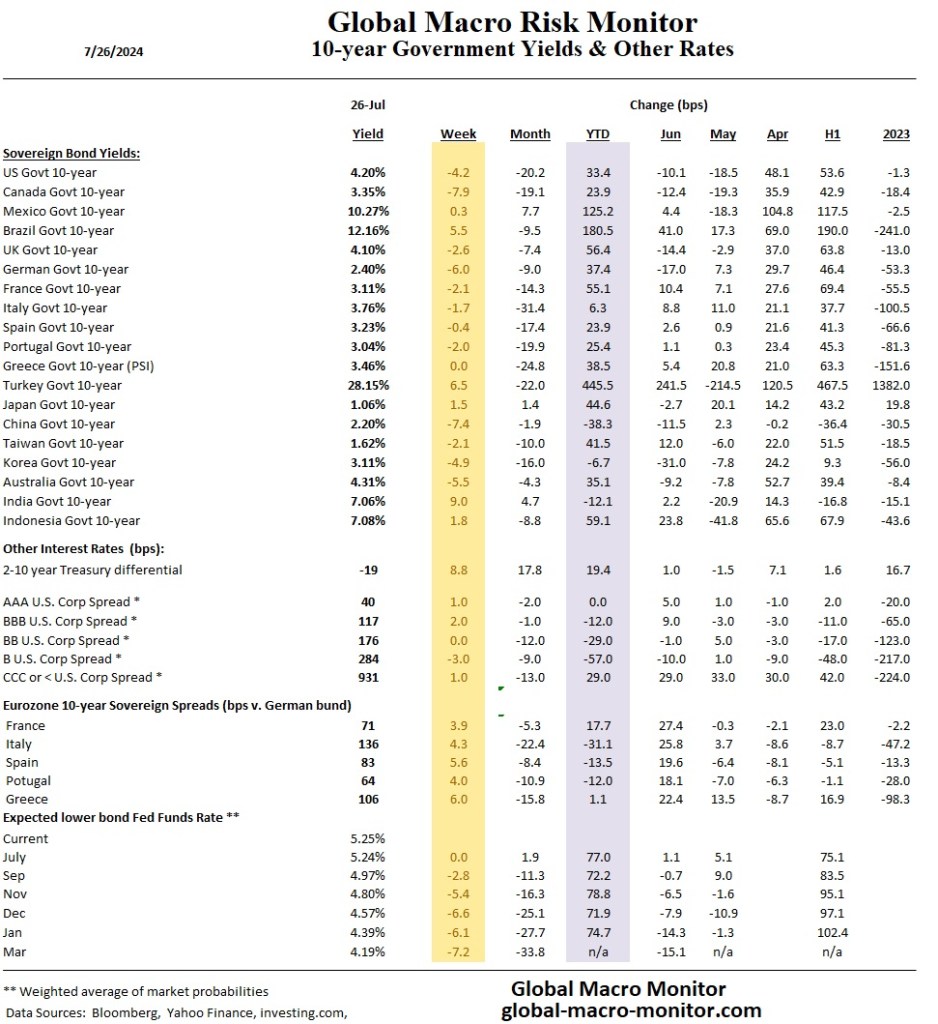
Fixed-income markets showed varied movements this week, with yields mostly higher. The U.S. 10-year yield rose 14.5 bps matching Italy’s 14.2 increase.  Mexico’s 10-year yield was 13.6 bps lower on the week

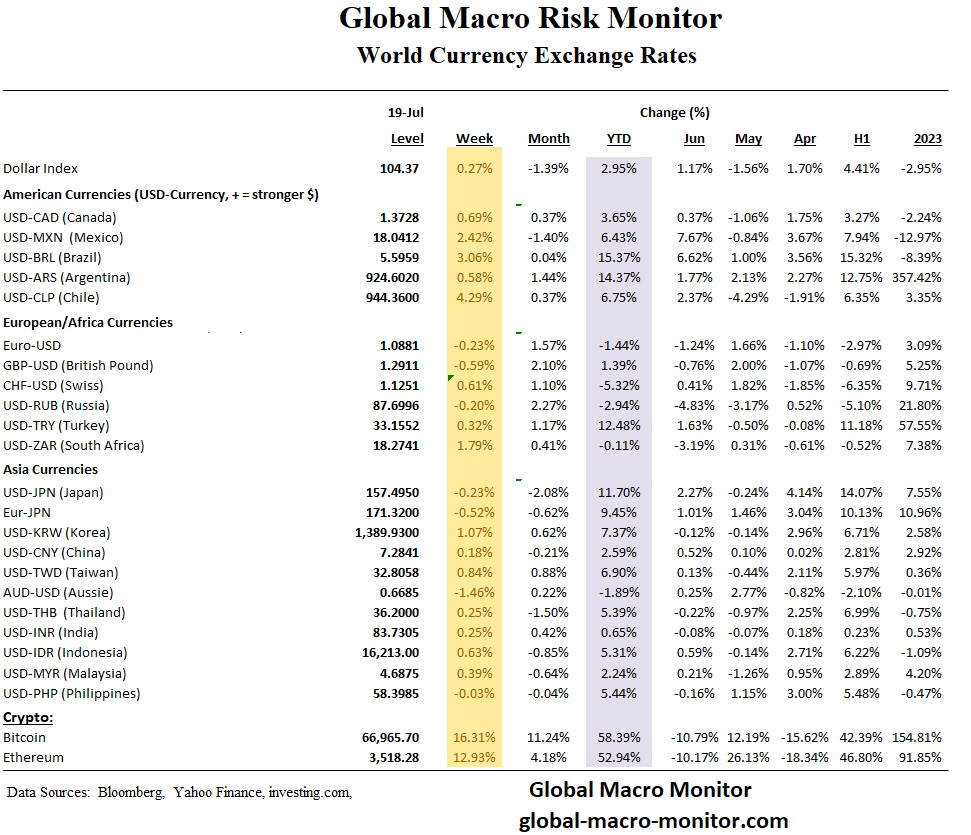
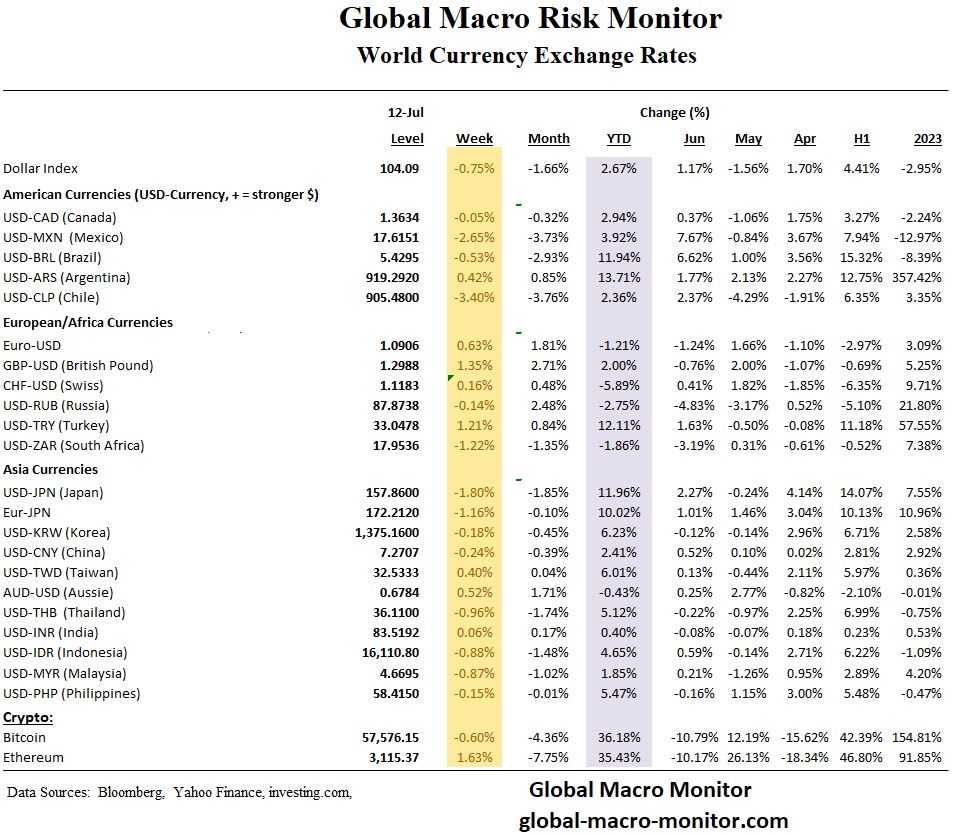
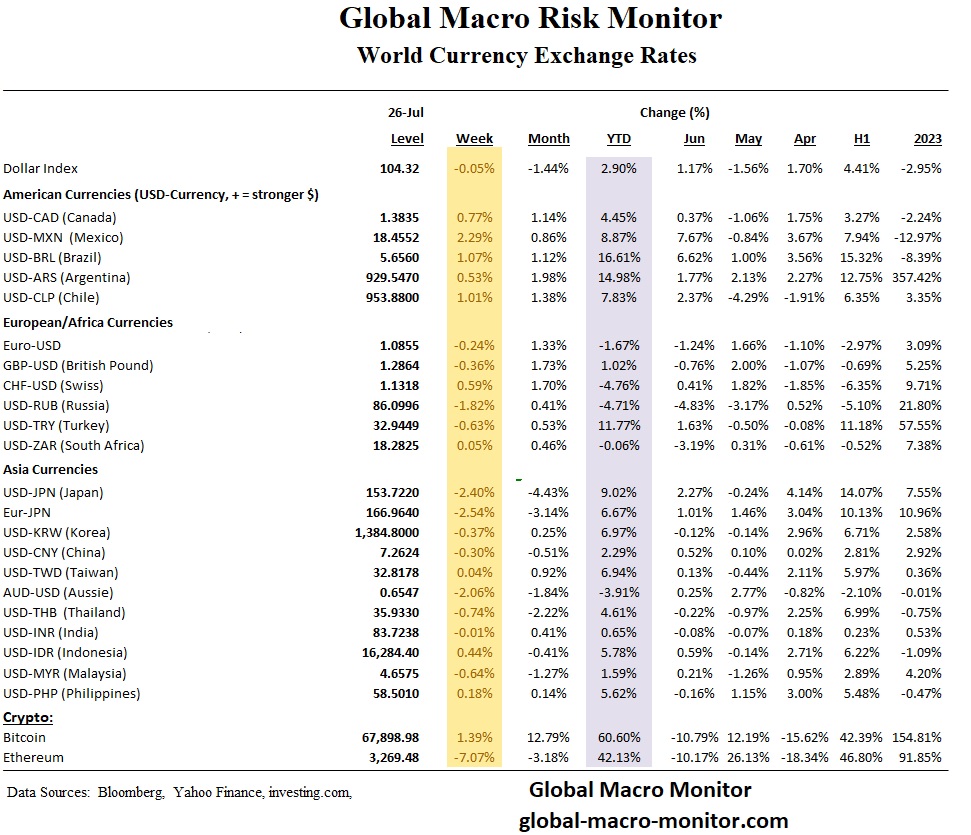
The global currency markets experienced diverse movements, with the U.S. Dollar Index remaining relatively stable. The Brazilian Real and Mexican Peso lost 2.96% and 1.08%, respectively, against the dollar. Cryptocurrencies fell on the week.

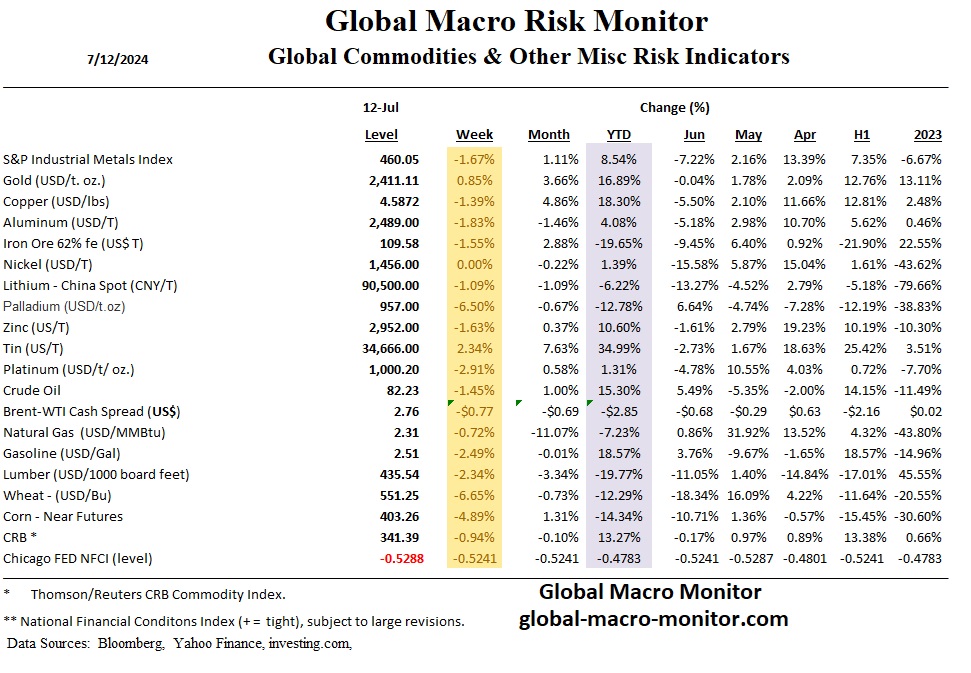
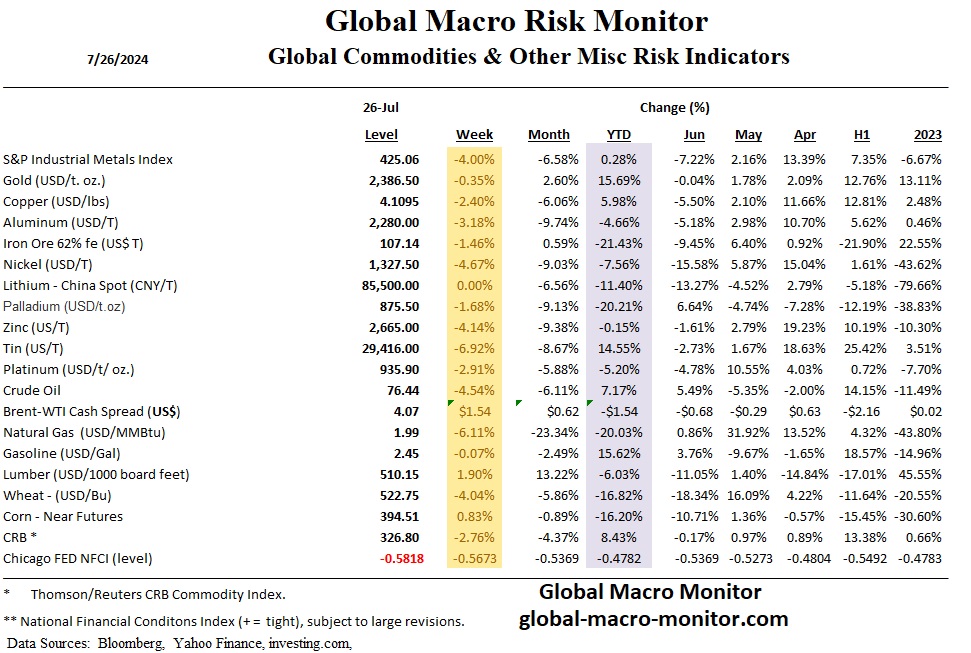
Commodity markets also put in a mixed performance for the week. Notable gains were observed in palladium and zinc. Conversely, the S&P Industrial Metals Index and copper prices declined, while gold was flat. Agricultural commodities saw significant price drops.

Posted in Uncategorized | Leave a comment

Say it ain’t so, Joe… Enter Gavin

Posted in Uncategorized | Leave a comment

History’s Biggest “Butterfly Effect” Occurred On This Day

Originally Posted on by macromon

The butterfly effect is the concept that small causes can have large effects. Initially, it was used with weather prediction but later the term became a metaphor used in and out of science.

In chaos theory, the butterfly effect is the sensitive dependence on initial conditions in which a small change in one state of a deterministic nonlinear system can result in large differences in a later state. The name, coined by Edward Lorenz for the effect which had been known long before, is derived from the metaphorical example of the details of a tornado (exact time of formation, exact path taken) being influenced by minor perturbations such as the flapping of the wings of a distant butterfly several weeks earlier. Lorenz discovered the effect when he observed that runs of his weather model with initial condition data that was rounded in a seemingly inconsequential manner would fail to reproduce the results of runs with the unrounded initial condition data. A very small change in initial conditions had created a significantly different outcome.  — Wikipedia

On this day in history, June 28, 1914, the driver for Archduke Franz Ferdinand,  nephew of Emperor Franz Josef and heir to the Austro-Hungarian Empire,  made a wrong turn onto Franz Josefstrasse in Sarajevo.

Just hours earlier, Franz Ferdinand narrowly escaped assassination as a bomb bounced off  his car as he and his wife,  Sophie,  traveled from the local train station to the city’s civic city.   Rather than making the wrong turn onto Franz Josef  Street, the car was supposed to travel on the river expressway allowing for a higher speed ensuring the Archduke’s safety.

Yet, somehow, the driver made a fatal mistake and tuned onto Franz Josef Street.

The 19-year-old anarchist and Serbian nationalist, Gavrilo Princip, who was part of a small group who had traveled to Sarajevo to kill the Archduke,  and a cohort of the earlier bomb thrower, was on his way home thinking the plot had failed.   He stopped for a sandwich on Franz Josef Street.

Seeing the driver of the Archduke’s car trying to back up onto the river expressway, Princi seized the opportunity and fired into the car, shooting Franz Ferdinand and Sophie at point-blank range,  killing both.

That small wrong turn,  a minor perturbation to the initial conditions, or deviation from the original plan,  set off the chain events that led to World War I.

Archduke_Jan27

Stumbling Into The Great War
Fearing Russian support of Serbia, Franz Josef would not retaliate by invading Serbia unless he was assured he had the backing of Germany.   It is uncertain as to whether the Kaiser gave Franz Josef Germany’s unequivocal support.   Russia, fearing Germany would intervene, mobilized its troops forcing Germany’s hand.

The great European powers thus stumbled into a war they didn’t want through complicated entanglements and alliances, and miscalculation.  Russia backing Serbia;  France aligned with Russia,  Germany backing the Austro-Hungarian Empire;  and Britian, who really didn’t have a dog in the fight except her economic interests, aligned with France and Russia.

Later the U.S. would enter the war due to Germany’s unrestricted submarine warfare threatening American merchant ships and the Kaiser floating the idea of an alliance with Mexico in the famous Zimmerman Telegram, which was intercepted by the British.

Of course, some will argue that Great War in Europe was inevitable

The great Prussian statesman Otto von Bismarck, the man most responsible for the unification of Germany in 1871, was quoted as saying at the end of his life that “One day the great European War will come out of some damned foolish thing in the Balkans.” It went as he predicted.  – History.com

Nevertheless,  maybe the course of history would have been different if not for that wrong turn on June 28, 1914, which created the humongous butterfly effect, which we still experience the consequences this very day.

The botched Treaty of Versailles  sowed the seeds the for World II.  The War contributed to the Russian revolution and Cold War.  The redrawing of borders in the Middle East after the War created the conditions for the instability and breakdown to tribalism the region experiences today.

A map marked with crude chinagraph-pencil in the second decade of the 20th Century shows the ambition – and folly – of the 100-year old British-French plan that helped create the modern-day Middle East.

Straight lines make uncomplicated borders. Most probably that was the reason why most of the lines that Mark Sykes, representing the British government, and Francois Georges-Picot, from the French government, agreed upon in 1916 were straight ones.  — BBC News

If Franz Ferdinand had not been murdered on this day in history,  that conflict between the Serbs and the Austro-Hungarian Empire may have been contained to just the Balkans.   Maybe.

The butterfly effect.  Think how many small events, decisions, mistakes, one small turn, or “minor perturbations” in plans have had enormous consequences in your own personal life.

Posted in Economics, Geopolitical, Uncategorized | Tagged , , | 1 Comment

Presidential Economic Scorecard

As we prepare for tonight’s debate, let’s take a closer look at the economic scorecard. President Biden has overseen a stronger economy compared to former President Trump, but his tenure has also been marked by significantly higher inflation. Biden inherited a budget deficit of approximately 15% of GDP and increased stimulus spending, which was supported by the Federal Reserve’s monetary policies. This combination has contributed to the current inflation, for which Biden is accountable.

In contrast, Trump’s presidency was significantly impacted by the COVID-19 pandemic and the resulting economic shutdowns, leading to the largest quarterly GDP drop on record. Additionally, for the first time in history, core CPI inflation saw three consecutive months of negative readings.

While the data is skewed by the pandemic, the sitting president, for good or for bad owns the economic conditions during their tenure. Think Jimmy Carter, who was faced with the OPEC II oil crisis and the Iran hostage situation, both largely outside his administration’s control yet it cost him his reelection.

Posted in Uncategorized | Leave a comment

King Dollar Drives Yen to 38-year Low

The Japanese yen’s dramatic decline underscores the powerful influence of the Federal Reserve on global markets. Japanese authorities find their intervention efforts ineffective as the yen touched a 38-year low against the dollar. The persistent strength of the US dollar, driven by the Fed’s “higher for longer” interest rate policy, highlights the relevance of the Interest Rate Parity (IRP) model in current FX market dynamics. This model, which ties exchange rate movements to interest rate differentials, is particularly pertinent as high US borrowing costs draw money into the dollar, strengthening it further.

Despite Tokyo’s interventions, the yen’s decline illustrates Japan’s limited control over its currency amid US monetary dominance. Investors and analysts point to the need for the Fed to ease its policies to alleviate the yen’s slide. The current scenario exemplifies how global financial markets are deeply interconnected, with US policy decisions exerting widespread influence.  More than $7 trillion in foreign currency trades occur daily, dwarfing the $140 billion average daily trade in global goods and services.  

The yen’s depreciation also illustrates the challenges central banks face in stabilizing their currencies against a backdrop of divergent monetary policies and robust economic conditions in the US.

Key Points

  • The Japanese yen has reached a 38-year low against the dollar, showcasing the impact of US monetary policy.
  • Japanese authorities’ intervention efforts to stabilize the yen are proving ineffective.
  • The Federal Reserve’s ‘higher for longer’ interest rate policy keeps US rates high, drawing money into the dollar and strengthening it.
  • Global investors recognize the Fed’s dominant role, with high US borrowing costs impacting global currencies.
  • A key gauge of the dollar hit a year-to-date high, further pressuring other world currencies.
  • Despite Tokyo’s record intervention, the yen continued to weaken, indicating limited success of these measures.
  • Analysts believe effective intervention will only occur if the Fed eases its policies.
  • Asset managers have increased their bets against the yen, reflecting bearish sentiment.
  • Contrary to earlier expectations, the robust US economy and persistent inflation have kept the Fed from cutting rates.
  • Upcoming US inflation data may influence future Fed decisions and subsequently affect the yen.

Exchange Rate Determination Models

Exchange rates are a crucial component that facilitates the over $30 trillion in annual trade of global goods and services.  On any given day, FX traders utilize various models of exchange rate determination, either explicitly or act as if they do, in their trading strategies.  The following are a concise overview exchange rate modes:

  1. Purchasing Power Parity (PPP):
    • Prices of identical goods should be the same across countries (Absolute PPP).
    • Exchange rates adjust based on inflation differences (Relative PPP).
  2. Interest Rate Parity (IRP):
    • Covered IRP: Forward rates reflect interest rate differentials.
    • Uncovered IRP: Expected currency depreciation offsets interest rate differences.
  3. Monetary Models:
    • Flexible-Price Model: Prices adjust quickly, linking money supply to exchange rates.
    • Sticky-Price Model: Short-term price rigidity influences exchange rates.
  4. Portfolio Balance Approach:
    • Exchange rates are influenced by supply and demand for financial assets.
  5. Balance of Payments Approach:
    • Focuses on current and capital account balances affecting currency value.
  6. Asset Market Approach:
    • Investor expectations and financial asset demand impact exchange rates.

Current FX Market Trends:

  • Interest Rate Parity Focus:
    • Interest rate differentials heavily influence today’s FX markets, particularly the Fed’s policies.
    • The Federal Reserve’s “higher for longer” policy keeps US interest rates high, boosting the dollar and pressuring other currencies like the yen.
  • Speculative and News-Driven Movements:
    • Exchange rates are volatile due to speculation and economic news, with traders betting heavily against the yen.
  • Global Economic Sentiment:
    • Broader economic conditions and risk appetite influence FX market behavior, with the yen’s weakness reflecting the US’s dominant financial position.
  • Technical Analysis *

These models are a sample of several that provide a comprehensive framework for understanding the complex factors that influence exchange rates in the global economy. Each model highlights different aspects of the economic environment, including price levels, interest rates, financial markets, and international trade flows.

* Although not a traditional economic model, traders widely use technical analysis to predict short-term exchange rate movements. This approach relies on historical price data, chart patterns, and statistical indicators to forecast future price movements.

The above was based on and motivated by a recent  Bloomberg article

Posted in Uncategorized | Tagged , , , , | Leave a comment

How America Spends vs. How American Spent

Over the past fifty years, American household spending has significantly changed due to technological advancements, globalization, and evolving socio-economic factors. Housing costs have dramatically increased, consuming 27% of household budgets today compared to 19% in 1984, fueled by the chronic housing shortage and escalating construction costs. Conversely, food expenditures have decreased from 20% to 14% of household budgets, thanks to efficiency gains in agriculture that have halved food costs since 1972. Healthcare spending has surged, driven by industry consolidation and increased demand for medical services, despite technological advances that have generally curbed costs in other sectors. Healthcare spending per capita in the U.S. is nearly double that of other wealthy nations.

Clothing expenses have plummeted due to globalization and the outsourcing of production, which has reduced prices but drastically lowered the proportion of garments made in the U.S. In 1972, most, if not all, clothing was made in the United States. Today, the share is around 3 percent

Meanwhile, spending on entertainment and dining out has remained stable, reflecting enduring consumer value in these categories. The shift towards mobile communications from landlines illustrates the impact of technology on consumer habits. Healthcare is expected to claim an increasing share of consumer budgets, particularly as the population ages, signaling continuous growth in healthcare demand. These shifts offer a clear view into the evolving priorities and economic pressures shaping American life.

  • Housing Expenditure Rise: Housing expenses have increased from 19% of a household’s budget in 1984 to 27% today.
  • Decrease in Food Spending: The proportion of income spent on food has declined from 20% in 1972 to 14% due to increased agricultural efficiency. Farms are more than twice as productive as they were in the 1970s.
  • Healthcare Costs Surge: Healthcare spending has grown significantly, fueled by industry consolidation and increased demand for medical services.
  • Globalization Impact on Clothing: The share of clothing made in the U.S. dropped from nearly 100% in 1972 to 3% today, with consumers buying more but spending less due to overseas manufacturing.
  • Stable Entertainment and Dining Costs: Spending on restaurants and entertainment has remained relatively constant, indicating sustained consumer interest.
  • Technological Transformation: Shifts from landlines to cellphones and data plans have kept communication spending stable despite technological changes.
  • Education Spending Increase: More Americans are pursuing higher education, leading to increased spending in this sector.
  • Efficiency in Vehicle Expenses: Households own more cars yet spend a smaller portion of their budget on them, thanks to manufacturing efficiencies.
  • Rising Miscellaneous Expenses: A notable increase in spending on prepared foods and snacks reflects a shift towards convenience.
  • Future Healthcare Spending: Experts anticipate healthcare will continue to consume a larger portion of household budgets, particularly as the population ages.

The above analysis summarizes a recent article in the Washington Post. The data are from the Bureau of Labor Statistics’ Consumer Expenditure Survey

Posted in Uncategorized | Tagged , , , , | 1 Comment

Do These Trendy Baby Names Ring A Bell?

Great piece in the Washington Post today about trendy baby names. 

Wattenberg has a theory…she calls her “grand theory” of baby names… In the olden days, Americans shared a monoculture dominated by three broadcast TV networks, no internet and no annual SSA name rankings. Hence the frequent reliance on family tradition when a bouncing baby arrived.

Nowadays, she said, people not only have access to unlimited cable channels and the internet, but those innovations have helped usher in a “username creation” mentality — meaning that if someone else has the same name, it’s viewed as taken. So parents tend to tweak their baby’s name just a bit — keeping the “-son,” for example, while swapping the “Ja-” for “Car-.”

Wattenberg finds “an incredible irony” in this. People think they’re choosing something totally unique, but they do it in a way that winds up moving with the zeitgeist. As a result, names have a , with nearly half of all baby names now following identifiable suffix trends — a phenomenon Wattenberg calls “lockstep individualism.”  – Washington Post

Baby names often encapsulate the trends and cultural shifts of their times, with different spellings and endings marking distinct generational identities. A detailed analysis of American baby names from 1945 to 2023 highlights these shifts, showcasing how names evolve from traditional to unique and trendy variations.

Key Points:

  • Generational Markers: Names ending in ‘-ly’, ‘-ley’, and ‘-leigh’ indicate generational trends, with ‘ly’ popular among Gen X and ‘leigh’ rising in the 2010s.
  • Peak Popularity: ‘Ly’ endings peaked in 1970, ‘ley’ in 1987, and ‘leigh’ in 2019.
  • Cultural Shifts: Traditional family names have been largely replaced by more unique names that still conform to unspoken social norms.
  • The Role of Sounds: As naming traditions faded, the sounds and aesthetics of names took precedence, influencing name choices.
  • Data Analysis: The Social Security Administration’s data reveals broad trends in name endings, despite challenges in categorization.
  • Changing Trends: The popularity of names like ‘Jason’ in the 1970s has given way to a variety of names sharing similar suffixes like ‘son’ (Mason, Jackson, Carson).
  • Lockstep Individualism: Despite striving for uniqueness, many modern names conform to popular endings, demonstrating a blend of individuality and conformity.
  • Influence of Media: The rise of internet and media has shifted naming conventions, moving away from family traditions to more unique and personalized choices.
  • Impact of Trends: The data reveals that modern names increasingly share common endings, reflecting broader societal trends.
  • Personal Story: The article also narrates a personal journey of choosing a name for a newborn, reflecting the delicate balance between uniqueness and fitting in.

This analysis not only shows how names can reflect broader cultural trends but also illustrates the personal and societal factors that influence these choices over decades.


Posted in Uncategorized | Tagged , , , , , | Leave a comment