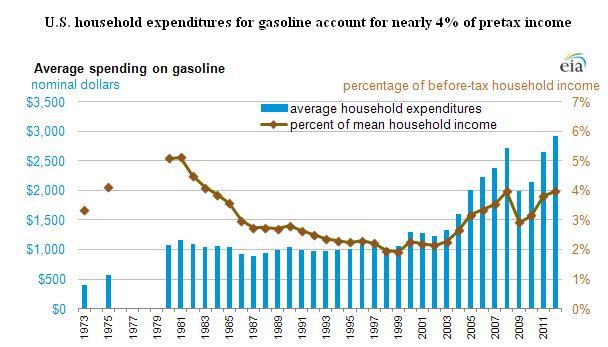
Gas expenditures as % income at 30-year high

Paid over $4.00 a gallon this weekend.  This high this early in the year brings the gas price back on the macro radar screen.

The EIA notes,

Gasoline expenditures in 2012 for the average U.S. household reached $2,912, or just under 4% of income before taxes, according to EIA estimates.  This was the highest estimated percentage of household income spent on gasoline in nearly three decades, with the exception of 2008, when the average household spent a similar amount.

Lower end consumer getting clocked.  Keep it on your radar.

Feb19_Gas

(click here if chart is not observable)

Posted in Crude Oil, Energy | Tagged , , | 3 Comments

Stanley Fischer to Replace Bernanke?

February 18_WashPost

The Washington Post thinks it is a possibility.

Dylan Matthews’ excellent piece — run don’t walk to read — speculates on the  former:  1) MIT/University of Chicago professor;  2)  Ben Bernanke Ph.D. adviser;  2)  World Bank chief economist;  3)  IMF chief economist;   4) Vice Chairman of Citigroup; and 4) outgoing Bank of Israel governor,

His former advisee Bernanke will end his term as Fed chair in January 2014. Could the teacher follow the student? Could Fischer move from Jerusalem to Washington? It’s not as crazy as it may sound; the market for top central bankers is increasingly global, most vividly illustrated by the November selection of Bank of Canada governor Mark Carney to lead the Bank of England. In this post-crisis era, the job of a central banker requires someone who is simultaneously a brilliant economist, regulator, diplomat and politician. Among Fed watchers, there is quiet, off-the-record talk that that person might be Fischer.

If only!   God, we hope so.   And the markets would love it.

Intense speculation will begin this summer over Chairman Bernanke’s replacement as his second term ends comes to an end.   Matthews notes that President Obama “would probably want to name his replacement by fall.”

The article is an excellent background piece on Stanley Fischer,  the man who steered the global economy through the Mexican Peso Crisis,  Asian Financial Crisis,  Russian Debt Default,  and the collapse of LTCM all within the short period of 1995-98 period.  Run don’t walk.   Click here.

Feb18_Stan Fisher

(click here if picture is not observable)

Posted in Economics, Monetary Policy | Tagged , , , | 1 Comment

Daily Interest Rate Monitor – February 18

Interest Rate Monitor

(click here if table is not observable)

Posted in Interest Rates | Tagged , , , | Leave a comment

Seven common words coined by American Presidents

Source:  Dictionary.com

Moment

George Washington

Early America was a hotbed of political discussion–and neologisms. In 1781, George Washington wrote about the early formation of the United States, “The present temper of the states is friendly to the establishment of a lasting union; the moment should be improved; if suffered to pass away it may never return.” This is the first recorded use of moment in the sense of a brief or opportune time to accomplish a goal. George Washington didn’t only seize his days, he seized every moment.

Out-of-the-way

George Washington

Though at the time “American” English sounded very similar to “British” English, the young Americans were inventing new words to accommodate the novel situations in the colonies. On October 10, 1756, George Washington wrote to Governor Robert Dinwiddie, criticizing the placement of military forts: “one of them, if no more, erected in my opinion in a very out-of-the-way place.” This sense of “secluded” was novel, perhaps more applicable in the vast American frontier where anything could seem out-of-the-way.

Belittle

Thomas Jefferson

Through the early 1600s the word little was used as a verb in English, though its adjectival sense has always been more prominent. Thomas Jefferson, third President of the United States, coined the verb formation belittle in his seminal book Notes on the State of Virginia. He wrote, “So far the Count de Buffon has carried this new theory of the tendency of nature to belittle her productions on this side of the Atlantic.” In Jefferson’s sense to belittle is to make something seem less valuable or important. Which lesser-known President coined our next well-known word?

Caption

James Madison

The word caption is both young and old. It came into widespread use in the twentieth century with the vast proliferation of printed images that often needed explaining. However, James Madison (fourth President of the United States) wrote to Thomas Jefferson in 1789 and told him, “You will see in the caption of the address that we have pruned the ordinary stile of the degrading appendages of Excellency.” Madison’s use of the word takes a tip from the legal sense popular since the late 1600s indicating a certificate or “note of caption.”

Michigander

Abraham Lincoln

This term for a native of the state or territory of Michigan was coined in 1848 by none other than Abraham Lincoln when he was still a congressman. In July of that year Lincoln spoke against Presidential candidate Lewis Cass, long-time governor of the Michigan Territory. “I mean the military tale you Democrats are now engaged in,” Lincoln said, “dovetailing onto the great Michigander.” The great emancipator’s neologism combines Michigan with gander (a male goose) characterizing Lewis Cass as goose-like.

Normalcy

W.G. Harding

This term for the quality of being normal or maintaining the status quo is synonymous with “normality” in English. Until the turn of the 20th century, normalcy made brief cameos in technical and mathematical dialogue, but in 1920 the word got a serious boost in popularity when soon-to-be-president W.G. Harding used it in a campaign speech. “America’s present need is not heroics but healing; not nostrums (remedies) but normalcy; not revolution but restoration.” Normalcy was at the forefront of Harding’s platform for returning the United States to its pre-WWI equilibrium.

Lunatic fringe

Theodore Roosevelt

This word refers to more than the fringe on your jacket; a lunatic fringe is a small group of fanatical followers of a political or social movement. Theodore Roosevelt coined the term in 1913 in reference to a break-out group of anarchists: “There is apt to be a lunatic fringe among the votaries of any forward movement.” In this sense Roosevelt recognizes the formation of a “lunatic fringe” as a side effect of forward political motion. We hope you’ve enjoyed our presidential patter. May all Michiganders seize the moment, return to normalcy, and never belittle the lunatic fringe.

Posted in General Interest, Politics | Tagged , | 1 Comment

Beggar Thy Neighbor’s Stock Market

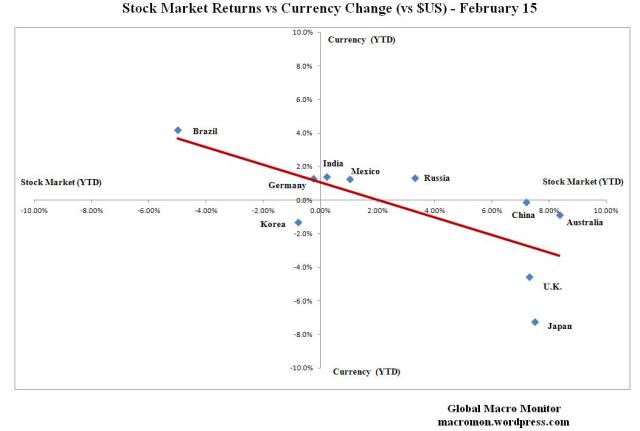
Interesting chart which we suspected and all knew that, thus far, the 2013 macro equity trade x/ U.S. has been to be long those markets where the home currency is weakening against the dollar.  The red regression line illustrates this relationship though it is far from a perfect fit.

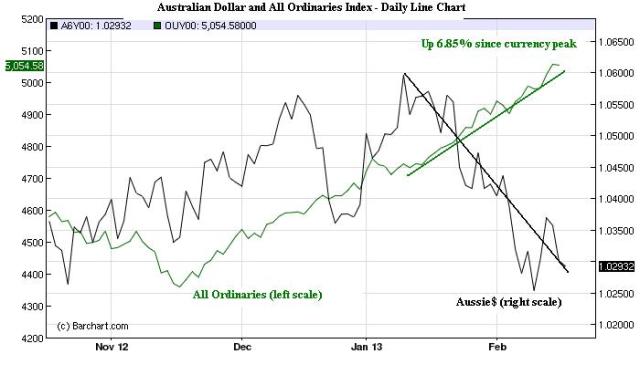
Interesting to note Australia’s stock market, one of the best performers in 2013, began its  latest leg as the currency peaked against the dollar on January 10th.

Brazilian equities have been the real dog this year as it appears the government will allow the currency to appreciate to dampen inflation.

Feb17_Stock Market_CurrencyFeb17_Aussie_AORD

(click here if charts are not observable)

Posted in Equities, Monetary Policy | Tagged , , , , , | 2 Comments

Overbought and Oversold Markets – February 15

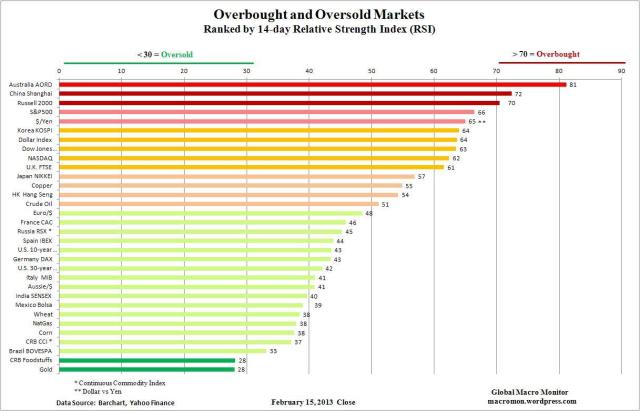
The Relative Strength Index (RSI) is a momentum oscillator that measures the speed and change of price moves. The RSI moves between zero and 100 and is considered overbought with a reading above 70 and oversold when below 30.  Note the RSI can sustain an overbought (oversold) reading in a strong up (down) trend.

Click chart to enlarge.

WIR_Overbought(click here if chart is not observable)

Posted in Overbought Markets | Tagged , , , | 3 Comments

Global Trend Indicators

WIR_Global TrendWIR_Equity_MA(click here if tables are not observable)

Posted in Global Trend Indicators | Tagged , , , , , , , , | 2 Comments

Week in Review

WIR_Key LevelsWIR_Equity_WeekWIR_Bond_WeekWIR_Equity_YTDWIR_Bond_YTD(click here if charts are not observable)

Posted in Week in Review | Tagged , , , , , , , | Leave a comment

Weekend Lecture: Is Innovation Over?

Tyler Cowen, of George Mason University, and Bhaskar Chakravorti, of Tufts University, debate the proposition: Innovation is over. The discussion was moderated by Vijay Vaitheeswaran, Shanghai bureau chief for The Economist, at The Economist’s World in 2012 Festival on December 1st and 3rd 2011.

WithTheEconomist

(click here if video is not observable)

Posted in Technology | Tagged , , , , | 1 Comment

U.S. Equity Sector ETF Weekly Performance – February 15

Sector ETF_WeekSector ETF_YTDSector ETF_Technicals

(click here if charts are not observable)

Posted in Sector ETF Peformance | Tagged , , , , , | 2 Comments