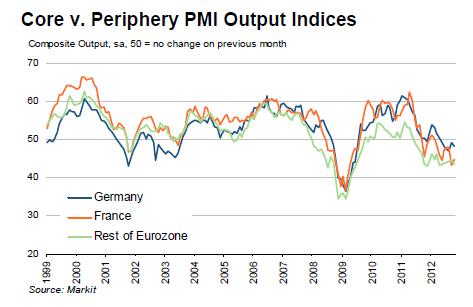
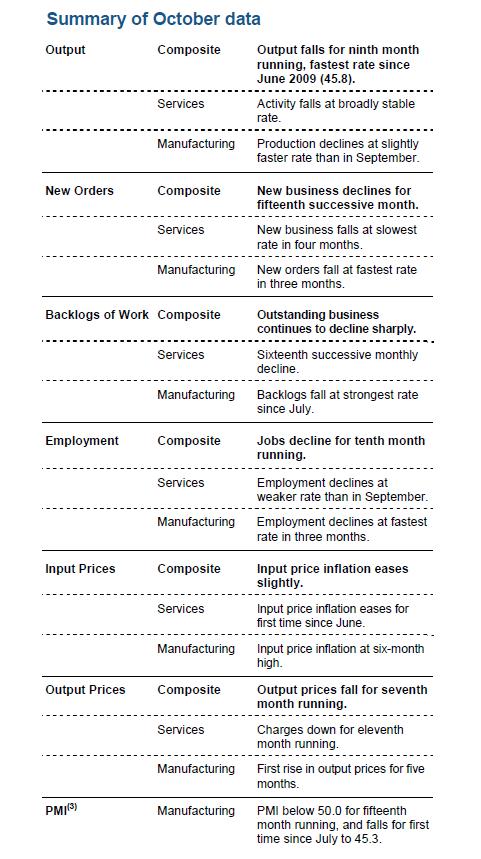
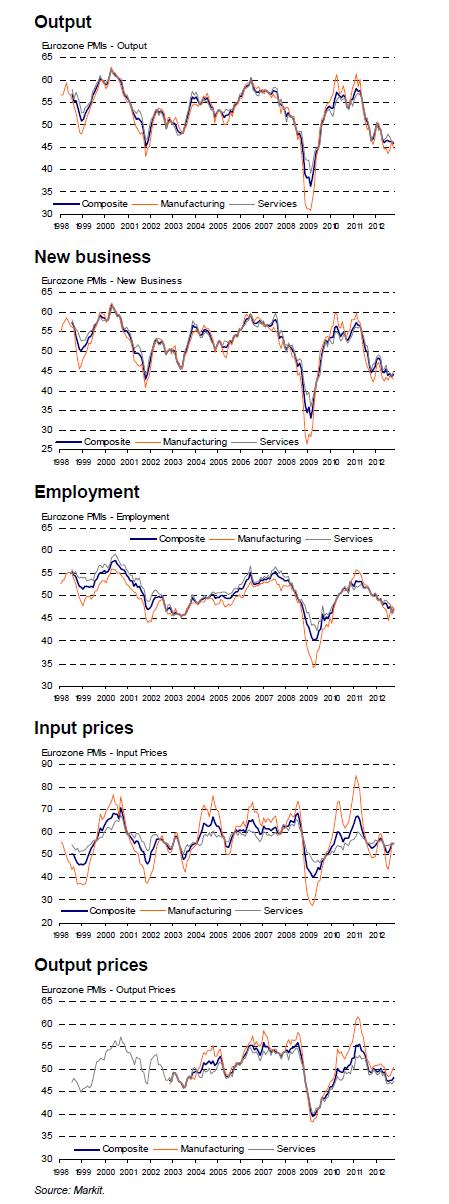
Flash Eurozone PMI Composite at 45.8, 40-month low.

Markit reported that output of the manufacturing and service sectors dropped at the fastest rate since June 2009.

Commenting on the flash PMI data, Chris
Williamson, Chief Economist at Markit said:
“The Eurozone has slid further into decline at the
start of the fourth quarter. The survey is running at
a level which is historically consistent with the
region’s economy contracting at a quarterly rate of
over 0.5%. Official data have shown surprising
resilience over the summer compared to the survey
data, but the underlying business climate has
clearly deteriorated markedly in recent months.
While GDP may decline only modestly in the third
quarter, a steeper fall looks to be on the cards for
the fourth quarter.

“The financial markets may have cheered the
positive developments from policymakers in
seeking to resolve the region’s debt crisis, notably
the promise of bond market intervention by the
ECB, but business appears to have been less
impressed. Sentiment about prospects for the year
ahead are now the gloomiest since early-2009,
when the post-Lehman Brothers crisis was in full
swing.

“In addition to worries about the health of domestic
markets, companies are also seeing demand
weaken further afield, notably in Asia and, to a
lesser extent, the US.

“Worries about the outlook have translated into
further job losses, suggesting companies are
moving increasingly into cost-cutting mode. Even
Germany is not immune, with October seeing the
first back-to-back monthly fall in employment since
early-2010.”

(click here if charts are not obserable) 

Posted in PMIs | Tagged , | 3 Comments

How tight is the U.S. presidential election?

The race is suddenly so tight in the nine battleground states that each side is looking at a single Congressional district in Maine whose one electoral vote, in the event of an exceedingly tight outcome, could decide whether Mr. Romney or Mr. Obama is in the White House come Jan. 20. – NY Times

Posted in Politics | Tagged , , | Leave a comment

Stratfor: Spain’s Geographic Challenge

Stratfor explains how Spain’s geography has played a role in the balance between its central government and autonomous regions.

For more analysis, visit: http://www.Stratfor.com

(click here if video is not observable) 

Posted in Geopolitical, Spain | Tagged , , | Leave a comment

Flash China Manufacturing PMI at 49.1, Three-month High

Markit reported this morning the October HSBC China Flash PMI rose to 49.1 from 47.9 in September.  The PMI is at a three-month high, though still in contraction mode.

Commenting on the Flash China Manufacturing PMI survey, Hongbin Qu, Chief Economist, China & Co-Head of Asian Economic Research at HSBC said:

“October’s flash PMI reading continues to recover for the second month, thanks in part to a gradual improvement in the new orders index which picked up to a six-month high (albeit marginally below 50). This is helped by the filtering-through of the earlier easing measures. However, external challenges are still abound and the pressures on job market are lingering. This calls for a continuation of policy easing in the coming months to secure a firmer growth recovery.” 

(click here if charts are not observable)

Posted in China, PMIs | Tagged , , | Leave a comment

Arbitraging the Intrade Volatility

U.S. stocks are not the only market experiencing volatility these days.  Take a look at the presidential contract over at Intrade.

We logged on tonight and found the President’s probability of winning the election had fallen to almost 51 percent at around 10 PM eastern time tonight.  This is way down from around 63 percent last night during the the debate.  It’s now back at around 54 percent.

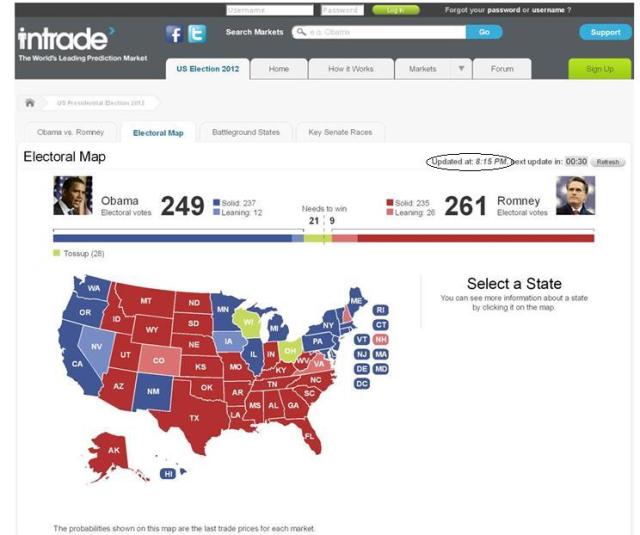
We also noticed that G0vernor Romney leads in the electoral college 261-249 with only Ohio and Wisconsin as toss ups.  Wait, now its 261-259 (270 to win presidency) as Wisconsin has just moved into the President’s column (see time stamps on charts below).

We also noticed that Romney had moved to over a 50 probability of winning Ohio.   Bells go off.   Arbitrage opportunity.   Buy Romney to win, sell the contract that has him winning Ohio.   We instantly go back to the contract and both Obama and Romney are now under 50 percent probability of winning.

That’s volatility, folks.  But the trend is clear,  no?

One last question that bothers us.  It appears to us that about $20 million per day trades for each of the presidential contracts.  How much do you think each campaign’s daily spend is on T.V. ads the battleground states?   Just askin’.

  (click here if charts are not observable)

Posted in Politics | Tagged , , | Leave a comment

Quote of the Day

“Oh, people can come up with statistics to prove anything, Kent. Forty percent of all people know that.” — Homer Simpson

Posted in Quote of the Day | Tagged , | Leave a comment

Are Economists and Market Stategists Next?

We don’t want to make light of the loss of life but we find this story incredible.  Prison for Italian scientists for getting the L’Aquila 2009 earthquate wrong, which left 309 people dead.

Six Italian scientists and a government official have been found guilty of multiple manslaughter for underestimating the risks of a deadly earthquake in the town of L’Aquila in 2009 that left 309 people dead. Judge Marco Billi on Monday sentenced all seven members of Italy’s Major Risks Committee to six years in prison for failing to warn the population of the risks just days before L’Aquila and surrounding towns were hit by the earthquake. The members were also ordered to pay court costs and damages. Claudio Lavanga reports from L’Aquila.   – AlJazeeraEnglish

Imagine if we held economists and market gurus accountable for their predictions or lack thereof, such as missing a recession or bear market?  Not sure what’s more difficult —  predicting an earthquake or where the S&P500 will be next year.

Let strategists and bloggers beware!

(click here if video is not observable)

Posted in General Interest, Video | Tagged , , | Leave a comment

Macro Notes from Caterpillar’s Earnings Release

Key Metrics

Caterpillar Inc. (CAT) announced third-quarter 2012 sales and revenues of $16.445 billion, a 5-percent increase from third-quarter 2011 sales and revenues of $15.716 billion. EPS per share for Q3 2012 was $2.54, up 49 percent from $1.71 per share in Q3 2011.

“Last quarter and then again a month ago at MINExpo, we discussed economic and geopolitical headwinds facing the world, and we are certainly continuing to see the impact of those uncertainties in our business,” said Caterpillar Chairman and Chief Executive Officer Doug Oberhelman. “Even so, we had a record third quarter, and our entire organization is focused on finishing 2012 as the best year for sales and profit in our history,” Oberhelman added. “Despite the turbulence in the global economy, we continue to track toward our
goals on cost control, margin improvement, product quality, safety and better product availability for our
customers.”

Earnings Release MACRO Notes

– From an economic standpoint, 2012 has been a disappointment with lower than expected growth in the United States and China, and with much of Europe in recession.
– While governments and central banks around the world have been easing policies, it is now evident that these actions have not been sufficient to benefit 2012 growth.
– While most countries have eased monetary and credit policies over the past year, and we expect continued easing in 2013, growth has been slow to respond. As a result, we are not expecting improvement in overall economic growth until the second half of 2013. We are expecting 2013 economic growth of about 2.7 percent, up slightly from the 2.5-percent growth we expect for 2012.
– In the United States, the Federal Reserve’s new emphasis on employment, along with signs that banks are increasingly willing to lend, are positives for private sector economic growth. Overall, we expect about 2 percent economic growth in the United States for 2013.
– We do not see signs that governments in the Eurozone and the European Central Bank will change economic policies to deal with recession, record unemployment and social unrest. Consequently, we are expecting only marginal growth in 2013, and construction activity will likely remain weak.
– The Bank of Japan is facing increased pressure to aggressively battle deflation, and we expect it will increase liquidity further. However, recent economic weakness is likely to persist well into 2013, resulting in economic growth below 1.5 percent.
– We expect low interest rates will benefit construction in Australia, but mining investment is likely to slow. We expect less than 3 percent economic growth in Australia for 2013.
– Developing economies, while slowing, have fared better than developed economies and are expected to respond more favorably to recent policy easing. We expect growth in these countries will improve more than a half percentage point in 2013 to around 5.5 percent.
– In China, banks have been increasing lending, and the government announced acceleration of infrastructure programs. We expect additional easing in 2013 and project economic growth will improve to 8.5 percent. Construction activity and demand for commodities will likely increase.
– Economic growth in Latin America is expected to improve to almost 4 percent in 2013, driven primarily by a rebound in Brazil. Economic growth in Africa, the Middle East and CIS should be around 4 percent. Slightly better world economic growth and higher commodity prices should benefit these regions.
– In assessing the last two years, we concluded the financial crisis left many economies in fragile condition and that quickly raising interest rates once the recovery started was a bad idea. Although most central banks retreated, the impact contributed to a decline in world economic growth from about 4 percent in 2010 to less than 2.5 percent in 2012. Business confidence deteriorated and another round of investment cutbacks is beginning. We are concerned that central banks will be too quick to raise interest rates when growth
improves, again preventing the world economy from completely recovering from the financial crisis.

Global Workforce

Caterpillar worldwide full-time employment was 129,113 at the end of the third quarter of 2012 compared with 121,513 at the end of the third quarter of 2011, an increase of 7,600 full-time employees. The flexible workforce decreased by 2,954 for a net increase in the global workforce of 4,646.

(click here if charts and tables are not observable)

Posted in Earnings, Employment | Tagged , , | Leave a comment

60 Minutes: Greg Smith, Goldman, & Muppets

In case you missed last night’s 60 Minutes interview with former Goldman Sachs investment banker, Greg Smith, click here.

When people leave Goldman, they tend to do it quietly. Though the firm’s gold-plated reputation took a big hit after the 2008 financial crisis, it’s still regarded as the smartest, most profitable and politically well-connected firm on Wall Street, and the toughest place to get a job. Now, on the eve of publishing a book about his experiences at Goldman, Greg Smith is talking for the first time about what led him to leave the firm, and to do it in such a public way.

Click here for video of full interview

(click here if picture is not observable)

Posted in Banking, General Interest, Video | Tagged , , , | Leave a comment

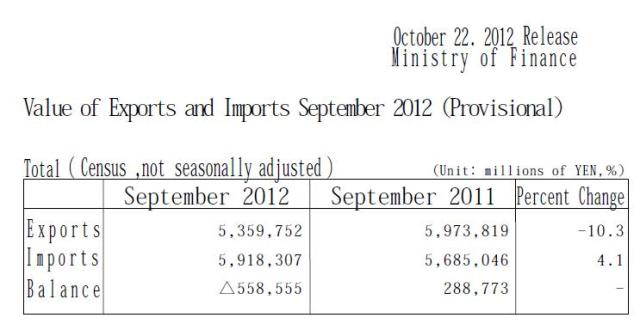
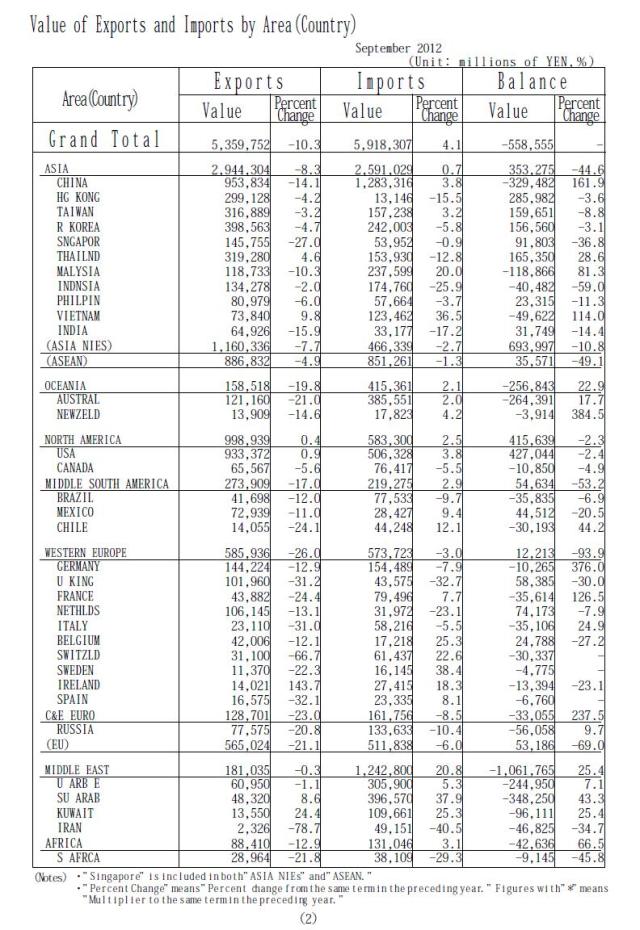
Japan’s September Exports Down 10.3% Y/Y

Great data from Japan’s Ministry of Finance (MOF) showing the sharp drop in exports to each of the country’s major trading partners.

TOKYO — Japan’s trade deficit widened in September as exports plunged 10.3 percent from a year earlier, weighed down by Europe’s debt crisis and a surge in antagonisms with China that have damaged close economic ties.

The deficit for the month was 558.6 billion yen ($7.2 billion), the Finance Ministry said Monday, higher than the forecasts of many analysts and bigger than a deficit of about $3.7 billion a year earlier. The deficit in August was $9.6 billion…

The strong Japanese yen has hurt the country’s export competitiveness, while demand has evaporated as growth slowed in most regions. Exports of consumer electronics, a mainstay, fell by double-digit figures from a year earlier.

Resource-scarce Japan is almost entirely dependent on imported fuel, and it has long relied on robust exports of high-value consumer goods and industrial products such as machine tools to help counter the cost of importing its energy needs.

With most of the country’s nuclear plants shut down, manufacturers and utilities have increased their reliance on traditional energy sources such as oil and gas, while stepping up conservation and investments in renewable energy.  –  AP

(click here if tables are not observable)

Posted in Economics, Japan | Tagged , , , | Leave a comment