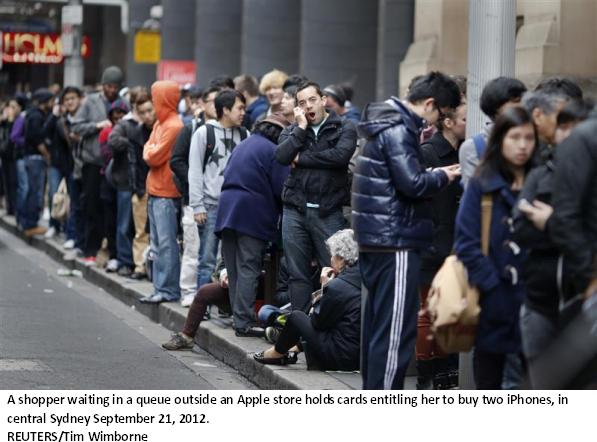
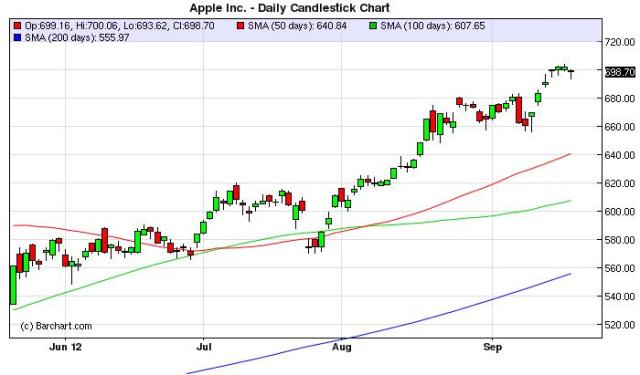
Apple Inc. (AAPL) is poised for a record iPhone 5 debut and may not be able to keep up with demand as customers lined up in Sydney, Tokyo and New York to pick up the latest model of its top-selling product (AAPL)…
The crowds reinforce estimates from analysts that the iPhone 5 will be the largest consumer-electronics debut in history. Apple may sell as many as 10 million iPhones during the weekend sales rush, according to Gene Munster, an analyst at Piper Jaffray Cos…
“We’ve never seen anything like this before,” said Andrew McAfee, principal research scientist at Massachusetts Institute of Technology’s Center for Digital Business. “It used to be that with tech products the nerds got them, obsessed about them, and talked about them, and the cool kids wanted no part of that conversation. That’s just not true anymore.” –Bloomberg
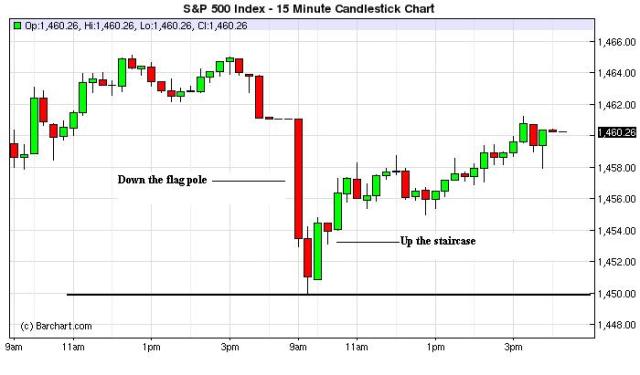
Low probability, high impact event and very unlikely but keep it on your radar.
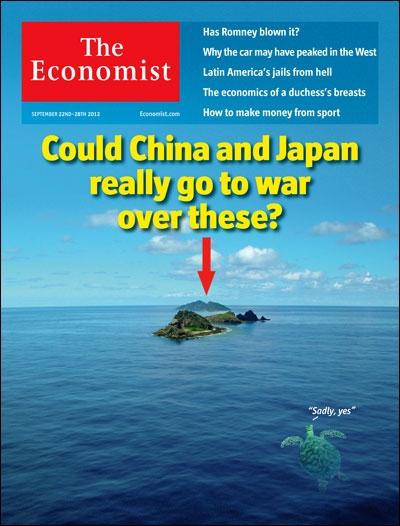
…Amid heated rhetoric on both sides, one Chinese newspaper has helpfully suggested skipping the pointless diplomacy and moving straight to the main course by serving up Japan with an atom bomb.
That, thank goodness, is grotesque hyperbole: the government in Beijing is belatedly trying to play down the dispute, aware of the economic interests in keeping the peace. Which all sounds very rational, until you consider history—especially the parallel between China’s rise and that of imperial Germany over a century ago. Back then nobody in Europe had an economic interest in conflict; but Germany felt that the world was too slow to accommodate its growing power, and crude, irrational passions like nationalism took hold. China is re-emerging after what it sees as 150 years of humiliation, surrounded by anxious neighbours, many of them allied to America. In that context, disputes about clumps of rock could become as significant as the assassination of an archduke.
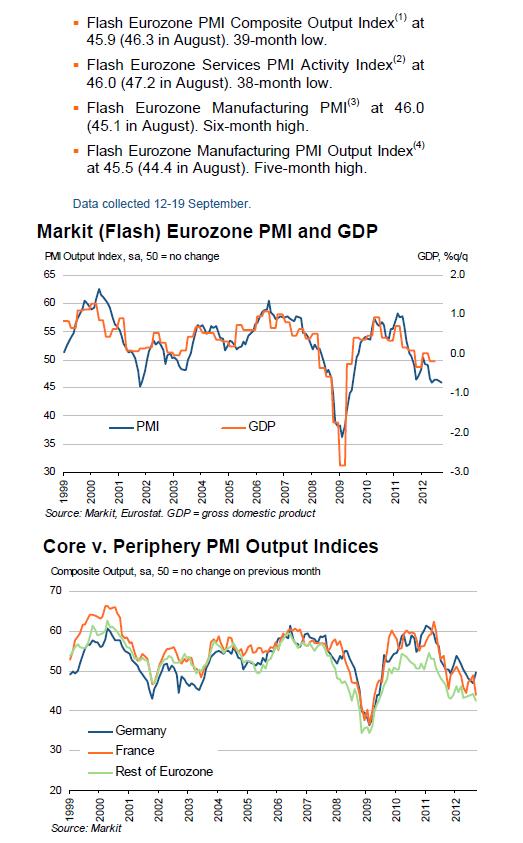
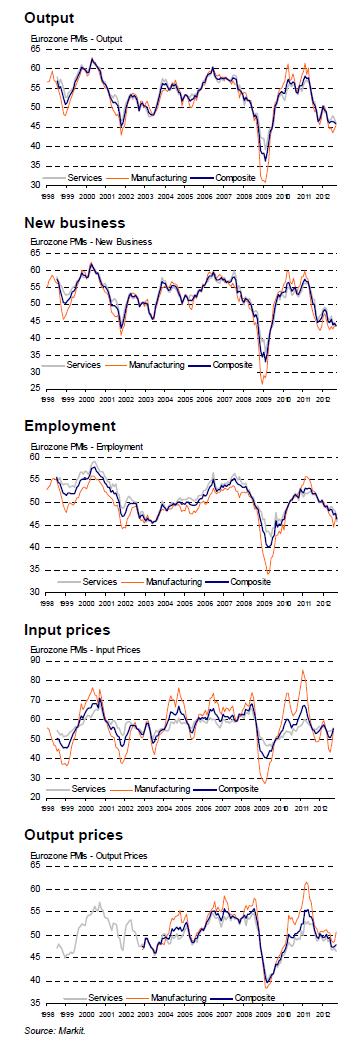
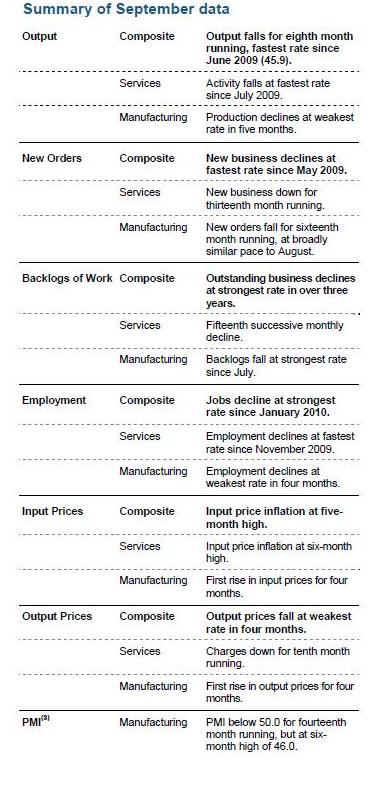
The Markit Eurozone PMI® Composite Output Index fell from 46.3 in August to 45.9 in September, according to the preliminary ‘flash’ reading, based on around 85% of usual monthly replies. The index therefore signalled that the private sector economy contracted for the twelfth time in the past 13 months, with the rate of decline accelerating slightly to reach the fastest since June 2009…
The falls in production and new orders were widespread across the single currency area, although a divergence was seen among the region’s two largest economies.
France saw output and new orders both fall at the fastest rates since April 2009, with rates of decline accelerating markedly in both manufacturing and services.
Germany meanwhile saw the rate at which output fell ease substantially to show only a modest decline, and the weakest since output began contracting in May. The rate of loss of new orders also eased. Services even saw a marginal upturn in activity for the first time since May, though the manufacturing sector continued to contract, led by a further sharp fall in new export orders.
Commenting on the Flash China Manufacturing PMI survey, Hongbin Qu, Chief Economist, China & Co-Head of Asian Economic Research at HSBC said:
“China’s manufacturing growth is still slowing, but the pace of slowdown is stabilising. Manufacturing activities remain lacklustre, thanks to weak new business flows and a longer than expected destocking process. And this is adding more pressures to the labour market and has prompted Beijing to step up easing over the past weeks. The recent easing measures should be working to lead to a modest improvement from 4Q onwards.”
A senior advisor to the Chinese government has called for an attack on the Japanese bond market to precipitate a funding crisis and bring the country to its knees, unless Tokyo reverses its decision to nationalise the disputed Senkaku/Diaoyu islands in the East China Sea.
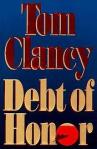
Clancy was prophetic in Debt of Honor x/one of the principals to the conflict,
On the Pacific island of Saipan, a wealthy Japanese businessman regards his new-bought land with satisfaction. In the Indian Ocean off Sri Lanka, a foreign navy begins a series of highly unusual exercises. At the headquarters of America’s major stock-clearing corporation, an engineer brings a customized computer program on-line for the first time, and smiles at his own private joke. Three seemingly unrelated incidents, but all just the first links in a chain of events that will stun the world.
Wikipedia provides an apropos synopsis of Debt of Honor,
Even as the military offensive begins, Japan engineers the collapse of the U.S. stock market by hiring a programmer in an exchange firm to insert a logic bomb into the system, which ends up deleting all trade records. The Japanese also attempt to assassinate the chairman of the Federal Reserve, but their target survives the attempt with a broken back. With a massive economic crisis and subsequent mass panic, the Japanese hope that America will be too distracted to quickly respond to Japan’s military actions.
Wow! Algo trading and all! Let’s hope and pray this remains fiction.
Global geopolitical events are getting downright weird, folks. But doesn’t that usually happen during tough economic times as governments attempt to wag the dog to order to deflect attention from its domestic problems?
Our go to source on geopolitical issues is Stratfor and here is their take,
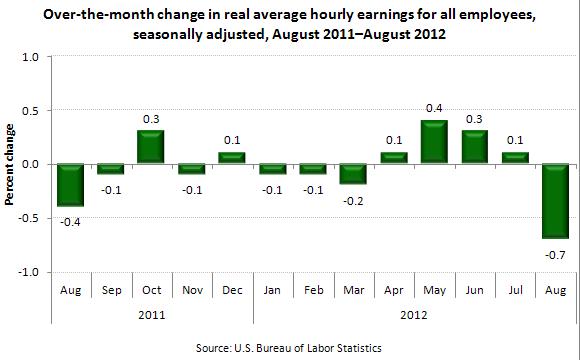
Real average hourly earnings for all employees fell 0.7 percent from July to August, seasonally adjusted. This decline resulted from unchanged average hourly earnings combined with a 0.6-percent increase in the Consumer Price Index for All Urban Consumers (CPI-U).
Real average weekly earnings fell 0.6 percent in August, resulting from the decline in real average hourly earnings combined with an unchanged average workweek. Since reaching a peak in October 2010, real average weekly earnings have fallen 1.3 percent.
Over the year (August 2011 to August 2012), real average hourly earnings were unchanged, seasonally adjusted. The unchanged real average hourly earnings combined with a 0.3-percent increase in the average workweek resulted in a 0.3-percent increase in real average weekly earnings over this period.
Good job, Felix! He gets it and provides a really cool graphic to prove it.
…This is the way sensible markets work. You start with high [PE] ratios with a low valuation and you move up to low ratios with a high valuation…. although Apple today has the same valuation as Microsoft did back in 2000, Microsoft in 2000 was an unsustainable bubble…..Apple today looks much more solidly valued.