Macro Notes from the FedEx Conference Call

The upshot – blame it on the global macroeconomic slowdown and they are  raising shipping rates.  Stagflation cometh?

FedEx Corp. reported the following consolidated results for the first quarter:

• Revenue of $10.79 billion, up 3% from $10.52 billion the previous year
• Operating income of $742 million, up 1% from $737 million last year
• Operating margin of 6.9%, down from 7.0% the previous year
• Net income of $459 million, down 1% from last year’s $464 million

During the quarter, improved FedEx Freight results and the continued strong performance at FedEx Ground were more than offset by lower demand for priority services at FedEx Express.

Outlook
FedEx projects earnings to be $1.30 to $1.45 per diluted share in the second quarter and $6.20 to $6.60 per diluted share for fiscal 2013, compared to the company’s previous full year forecast of $6.90 to $7.40 per diluted share.

This guidance assumes the current market outlook for fuel prices and does not include the impact of the cost reduction programs currently under review.

The company reported earnings of $1.57 per diluted share in last year’s second quarter. The capital spending forecast for fiscal 2013 remains $3.9 billion.

Raising shipping rates
FedEx Express will increase shipping rates by a net average of 3.9% for U.S. domestic, U.S. export and U.S. import services effective January 7, 2013.  The full average rate increase of 5.9% will be partially offset by adjusting the fuel price threshold at which the fuel surcharge begins, reducing the fuel surcharge by two percentage points. The FedEx Ground and FedEx SmartPost pricing changes for 2013 will be announced later this year.

Macro money quotes from conference call:

–  In the quarter just ended, while FedEx Ground and FedEx Freight improved their profitability in the first quarter, the slowdown in the global economy and global trade constrained revenue growth at FedEx Express and affected overall earnings

–  On the economic front, we continue to see modest growth in the global economy. Our calendar year ’12 U.S. GDP growth forecast is 2.2% and 1.9% for calendar year ’13, which is 0.5 points lower than our fourth quarter earnings forecast. For industrial production, we expect a growth of 4.2% in calendar year ’12, slightly below last quarter, and 3% in calendar year ’13, 0.5 points lower than our fourth quarter forecast. Our global GDP forecast is 2.3% for calendar ’12 and 2.7% for calendar ’13, 0.3 points lower than our last call.

–  For FedEx Corporation, revenues and operating income increased slightly in the first quarter due to improved profitability at FedEx Freight, the strong performance at FedEx Ground and partially offset by the impact of reduced demand for priority services at FedEx Express. Revenues increased 3% to $10.8 billion primarily due to yield increases, which Mike discussed, and higher volumes at FedEx Ground and FedEx Freight. Our EPS closed at $1.45 per share, which was a little better than we anticipated 2 weeks ago, slightly down year-over-year due to the tough global economy.

– Turning to the outlook and looking ahead, we’re expecting earnings per share of $1.30 to $1.45 for the second quarter and have lowered our guidance for the year to $6.20 to $6.60 per diluted share. This guidance assume weaker economic growth in the economy than we had expected when we first gave you guidance for FY ’13, as Mike described earlier.

–  when we see weakness in the economy, not unlike what happens in the United States, we see a shift from our Premium Services in the Priority network to deferred services to take advantage of lower transit times and lower rates. That’s just one way that customers manage their supply chains in difficult economic conditions, so I think that’s what we’re seeing.

– fundamentally, what’s happening is that exports around the world have contracted, and the policy choices in Europe and the United States and China are having an effect on global trade. Global trade has grown faster than GDP, except for the 2000, 2001 meltdown and 2008 and 2009, for 25 years. And over the last few months, that has not been the case. So that’s what’s really going on, is that exports and trade have gone down at a faster rate than GDP has.

–  as the Fed puts more money out there, people put more money into commodities and drive the price up. So you have products that are getting lower in value per pound, which is the key correlation for goods being moved by air. And so they’re going on the water to an improved container liner system that’s been developed over the last few years. So you’ve got a lot of things that are going on there, and the product launch of Apple’s and Microsoft is not going to provide the type of sustained growth in the international trade that the world has seen historically. So when that turns back around I think is directly related to the economic macro system in Europe, North America and particularly in China.

–   the global trading economy is still the largest single economy in the world. But over the last several months, particularly as we went into this fiscal year, it’s been disappointing, and I think it’s reflective of the low growth in the United States. You’ve got contraction going on in Europe. And because of North America and Europe, China’s export economy, which has been driven by the consumer economies in the United States, North America and Europe, are reflected in the lower trade numbers. So I think until some of these macro issues get resolved,

–  our global forecast is — for calendar year ’12 is 2.3%. In the developed countries, we’re expecting 1.3%; in emerging markets, which is 5.1%. Again, this is slightly lower than we were last quarter. In ’13, we’re looking for 2.7%. Again, developed countries, 1.5%, and emerging markets, 5.7%.  We’ve certainly seen a growth slowdown in the emerging Asia sector in the first half of Q1, but that’s probably run its course, and domestic demand remains robust in the global headwind — into global headwinds.

–  I can tell you this on China. The locomotive that has driven China’s growth is its export industries. And with the situation in Europe and, to a lesser degree, in North America, that is a significant issue for the Chinese economy. Now the consumer consumption in China is not increasing at a significant rate, contrary to everybody’s hopes. While exports from, say, the United States into China have grown, they are dwarfed by the exports from China into the United States. And as the big economies in Europe and the U.S. have grown or contracted — grown at a far lesser rate or, in the case of certain European countries, have contracted, that’s reflected in the numbers in China. And you can’t escape that. I’ve been somewhat amused watching some of the China observers, I think, completely underestimate the effects of the slower exports on the overall China economy.

– on a systemic basis, as the price of fuel has gone up inexorably, almost, over the last decade, what you’re seeing are these big trends that I talked about a little earlier. The air cargo market in its traditional definition is not growing. The door-to-door Express portion of it is growing relative to the overall market, and the — a lot of traffic is moving onto the water because moving goods by air is very energy-intensive. So a huge part of these things, of what’s going on, is driven by the price of fuel, and that’s going to change people’s decisions on manufacturing and supply chains. So we’re going to talk about that on October 9 and 10. But you can’t have jet fuel going up to close to $4 a gallon on occasion without it having a big effect on the choices people make in terms of the speed, price trade-off and the decision as to whether to move bulk commodities by air or on the water.

–  we have deferred deliveries of the 777s, because we are not going to escalate the scheduled aircraft in the near term, and we have accelerated the replacement of the MD-10s with 767s, which provide a high ROIC, and they’re 30% more fuel-efficient. And we’re going to continue to do that.

(click here if charts are not observable)
Posted in Earnings, Macro Notes from Conference Calls | Tagged , , | Leave a comment

Quote of the Day: Train Surfing QE∞

We are all train surfers now!

David Kotok of Cumberland Advisors couldn’t express our dilemma more perfectly.

Let me be very clear. I disagree with this Fed policy move. It was not my first choice. I think the Fed is now playing with fire. But our job is to manage portfolios and not to make policy. If the Fed is now in QE infinity and if the Fed is now buying duration from the market at a rate faster than the market is creating it, then we want to be on the bullish side of that trade.

Watch your head!

Posted in Monetary Policy | Tagged , , , | Leave a comment

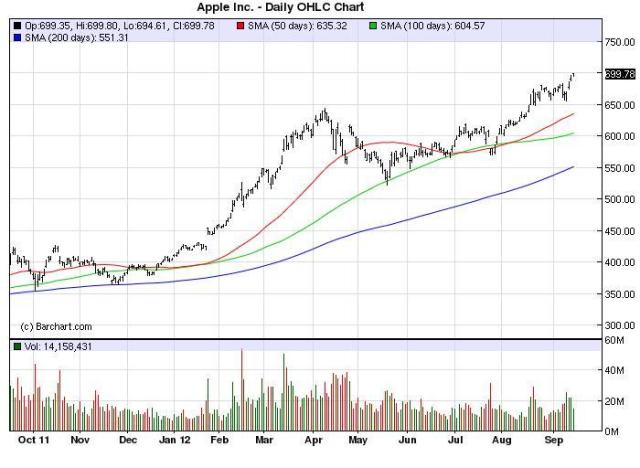
Apple Joins 700 Club in AH, Still Cheap?

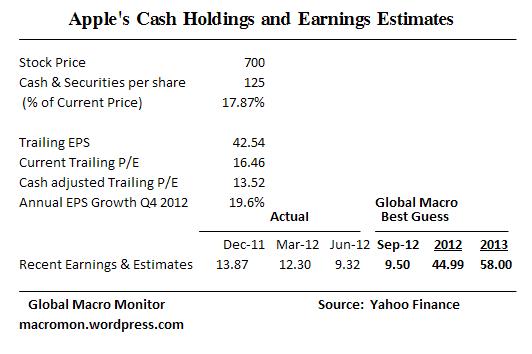
Apple closed at another all-time high just shy of $700.  It’s trading at $701 in after hours, however.   It’s been awhile since we’ve run our stock valuation sensitivity analysis and thought Apple’s  initiation into the 700 Club was as good a time as any to dust off the model and post the new results.

Apple’s balance sheet is currently loaded with $117 billion of cash, equivalents, and long-term securities.  This amounts to $125 per share or almost 18 percent of the current stock price.   Assuming the company earns $45 for fiscal 2012, which ends this month and right in line with current estimates,  the stock is trading at a cash adjusted trailing P/E of 12.8.

If earnings grow at 28 percent for fiscal 2013 to $58 per share,  in line with current estimates,  the cash adjusted forward P/E is 9.9,  which is highlighted in green in the valuation matrix.    Thus, the market still doubts Apple’s ability to continue to deliver, though a little less so today after the iPhone5 blowout over the weekend.

The valuation story for Apple remains positive even after its huge run.  Still lots of room for growth in China, for example, though doubts about that economy are growing.    We don’t know how high they will take the stock, but we’ve lost a ton of money trying to guess when the party will end and splitting too soon.  We will for the cops to arrive and let the market tell us when it’s over.

One more thing.  Mr. Bernanke just super spiked the punch bowl.    We wonder what impact QE∞ will have on Apple’s multiple and if it will make equity markets  “bubblicious” once again.    Always with a stop loss, folks.

(click here if graphics are not observable)

Posted in Apple | Tagged , , , | Leave a comment

Job Creators in Chief

Let us begin by saying we don’t like the title of this post and believe it is misleading.

The President cannot,  in our opinion, directly create permanent jobs in the private sector.  Of course, he can hire federal workers and/or direct taxpayer funds to, say, defense or infrastructure projects, which creates, though temporary, a derived demand for labor.   More important, however, is the administration’s policies that incentivize private sector hiring through creating an environment that empowers businesses and entrepreneurs and gives them confidence to expand capacity.

What seems evident, at least to us, in this sluggish recovery is that the business sector, after reacting to a surge in demand and expanding capacity during the dot.com and housing bubbles, is very reluctant to invest its excess savings and hire more workers.    We suspect a large portion of the investment capital being put to work today is in labor saving technology and equipment.    The private sector has been twice burned on demand surges caused by asset bubbles – i.e., the wealth effect — which were caused, in part, by irresponsible monetary policy.

Though stimulus can replace aggregate demand either through direct spending or indirectly though asset inflation and the wealth effect, the business sector, after being caught long excess capacity appears no longer to be a believer in “fake” or artificially inflated demand.  The private sector understands that interest rates will have to increase at some point and stimulus/government spending eventually reduced, which is exactly what is currently taking place at the state and local government level due to financing constraints.

Thus, witness no stimulus multiplier as Friedman’s permanent income demand hypothesis meets Ricardian equivalence.   Could it be the private sector has the right economic model and policymakers the wrong model?   We don’t know but do agree with Alan Greenspan that the correct model of the economy has yet to be discovered,

There is, regrettably, no simple model of the American economy that can effectively explain the levels of output, employment, and inflation. In principle, there may be some unbelievably complex set of equations that does that. But we have not been able to find them, and do not believe anyone else has either.

Consequently, we are led, of necessity, to employ ad hoc partial models and intensive informative analysis to aid in evaluating economic developments and implementing policy. There is no alternative to this, though we continuously seek to enhance our knowledge to match the ever growing complexity of the world economy.

Job Creation and Presidential Terms
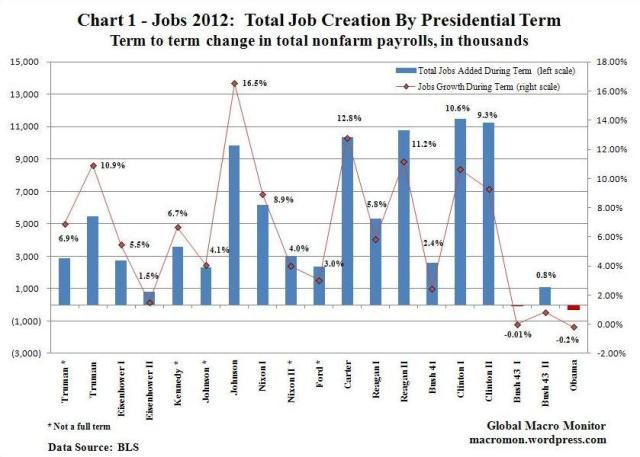
Nevertheless, because one of the presidential candidates seems to believe the election is one dimensional and only about jobs, we take a look at the nonfarm payrolls data in each presidential term since Truman assumed office after the death of President Roosevelt in August 1945.  The data surprised us.

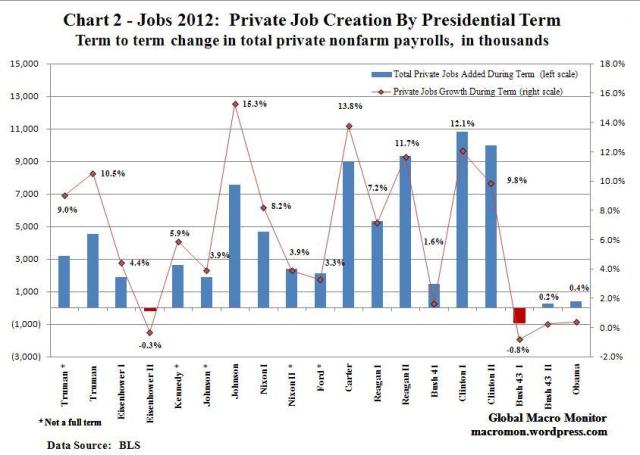
First, as Chart 1 illustrates, something happened to the economy and labor force at the turn of the new millennium.  During the last three presidential terms, for example, private sector net job creation has been negative, -231K, with total nonfarm payrolls increasing only 834K.  President Bush and President Obama inherited very ugly economies and had to clean up the aftermath of a “once in a generation” stock market and housing bubble, which devastated the labor market.

During the same period — January 2001 to August 2012 — the real effective monthly fed funds rate has been negative more than 60 percent of the almost 140 monthly observations.    This indicates, at least to us, and contrary to conventional policymaker wisdom that monetary policy has very limited impact on labor markets over the long run.

In the short term, however, quantitative easing and negative real interest rates can generate asset bubbles, which can affect the real economy and hiring.  But the experience of the collapse of two major bubbles in just a little over a decade illustrates there is always pay back and the monetary induced artificial boom will eventually turn to bust.

Second, and this really surprised us, the Carter Administration witnessed an almost 13 percent increase in nonfarm payrolls during its tenure as 10.3 million new jobs were created.  The growth rate in payrolls is second only to the LBJ’s s full term.  Surprising, given the widely held perception the Carter Administration was one of abject failure.  Must be more to a successful presidential term than job creation, no?

Third, though some manufacturing jobs have been recovered in the past few years, employment in this sector has declined in six out of the past eight presidential terms.

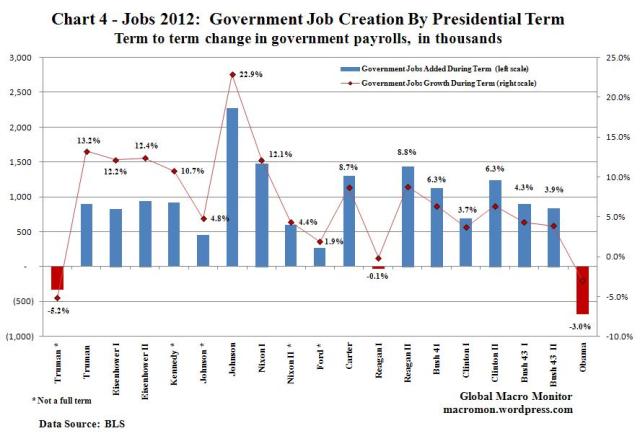
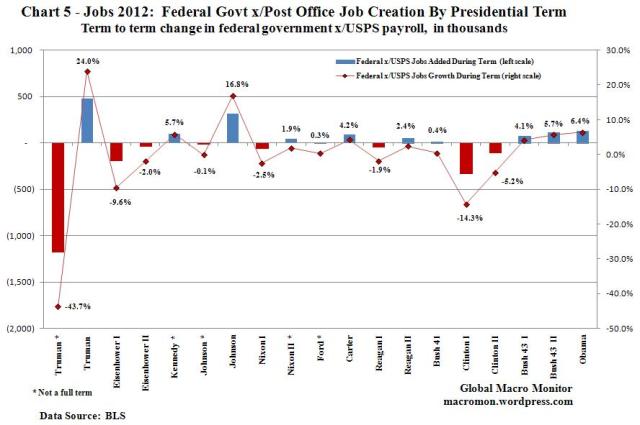
Finally, the Obama Administration has witnessed a decline of almost 700K government jobs, most of which have taken place at the local and state level.   However, excluding the loss of 118K post office jobs,  President Obama has expanded the Federal payroll by 6.4 percent (132K) the highest of any president since LBJ’s second term.

So there you have it, folks, the raw employment data for each presidential term since Truman and a couple of our observations, which we found quite surprising.   Let the spin begin!

Click table to enlarge and for better resolution.

(click here if charts are not observable)

Posted in Employment, Politics | Tagged , , | 1 Comment

Week in Review

(click here if charts are not observable)
Posted in Week in Review | Tagged , , , , , , , , , | Leave a comment

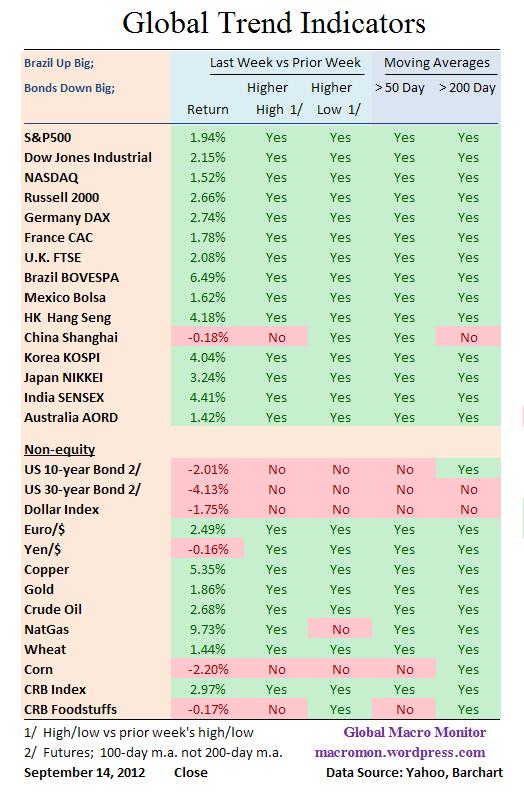
Global Trend Indicators

(click here if tables are not observable)

Posted in Global Trend Indicators | Tagged , , , , , , , | 1 Comment

Stratfor: Eurozone Outlook

(click here if video is not observable)

Posted in ECB, Euro | Tagged , | Leave a comment

Quote of the Day: From Can Kicking to Ass Kicking

Here’s then Fed Chairman, Alan Greenspan, speaking to the Economic Club of New York in 1997  during Asian Financial Crisis.

This is when “can kicking” by Asian policymakers transitioned into “ass kicking” by the financial markets,  which will surely take place in Europe again and also in the U.S. unless policymakers implement and maintain the necessary structural adjustment policies for economic and fiscal sustainability.   And no, folks,  QE is not structural adjustment.

We used to describe capital flight as “hot money”.  But we soon recognized that it was not the money that was “hot”, but the place it was running from…

Reality eventually replaces hope, and the cost of the delay is a more abrupt and disruptive adjustment than would have been required if action had been more pre-emptive.

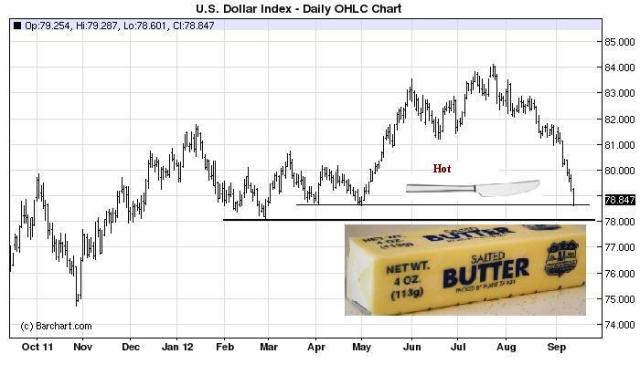
The  former Chairman also loved and used the term, “like a hot knife through butter,”  to describe how markets can tear through the international reserves of a country in disequilibrium or rip through technical support levels in various markets.

What would he say about the dollar right here, right now?

(click here if chart is not observable)

Posted in Dollar, Quote of the Day | Tagged , | Leave a comment

Weekend At The Movies: Arbitrage

We’re off to see this tonight.    Have a great weekend.

(click here if video is not observable)

Posted in Movies | Tagged , | Leave a comment

Rogue Trader Could Have Taken Down UBS

Euronews.com reports,

The prosecutor in the trial of UBS trader Kweku Adoboli has accused him of “naked gambling” with reckless, unauthorised investments that could have destroyed Switzerland’s biggest bank.

(click here if video is not observable)

Posted in General Interest | Leave a comment