Weekly Eurozone Watch: QE∞

Key Data Points
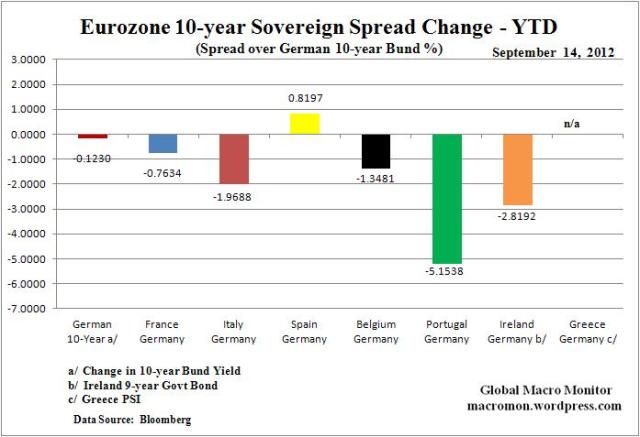
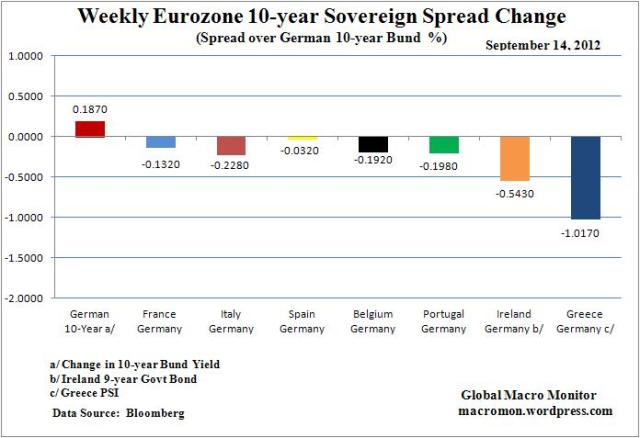
German 10-year Bund 19 bps higher;
Italy 10-year 23 bps tighter to the Bund;
Spain 3  bps tighter;
Portugal 20 bps tighter;
Ireland 54 bps tighter;
Greece 102 bps tighter;
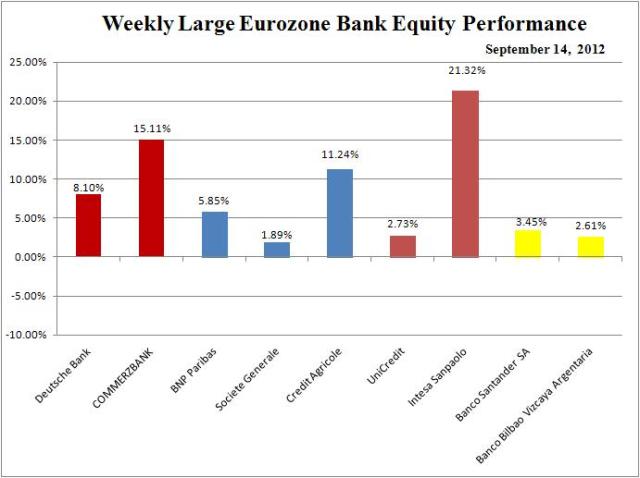
Large Eurozone banks 3-20 percent higher;
Euro$ up 2.7 percent.

Commentary
Spreads continue to trend tighter and bank stocks higher.  The Euro/$  moved above 1.30 confounding and hurting those betting on a move to parity by year-end.  Keep an eye on this key price as it will have a huge impact on the competitiveness of the periphery, which is more of a longer run concern, however.  To paraphrase Keynes, in the long run we’re all under performers.   Europe is coming off the table as a short-term concern that has kept  scared money on the sidelines.

Haven’t seen traders this giddy in a long time!  Giddy freakin’ up!
(click here if charts are not observable)

Posted in Weekly Eurozone Watch | Tagged , , , , , , | 1 Comment

QE3 Will Complicate Global Food Crisis

There is no doubt in our minds that some of the QE3 liquidity will leak into agricultural commodities.  In addition, a portfolio reallocation will take place as investors look to protect their purchasing power through buying finite “things.”

This will only fan the flames of the global food crisis,  generate hording and further driving up food prices.   Expect more political instability.

Can’t these guys see that the policy has become much of the problem?    Bad timing,  Black Hawk Ben.

(click here if video is not observable)

Posted in Commodities, Demographics, Geopolitical, Inflation/Deflation, Monetary Policy, Video | Tagged , , | Leave a comment

The Dow Breakout

The Dow has lagged the S&P500 and Nasdaq this year and may look to play some catch up.  Our friends over at trend-wise.com put together a nice chart here.

(click here if chart is not observable)

Posted in Equities | Tagged , | 2 Comments

Swan Dive!

The mutilation of savers and the working class continues.   QE3+ Fiscal Cliff =  More Jobs? The Nasdaq is up over 20 percent this year and we just got another monetary blast.  Who would of thunk it?  Think Kafka, folks.

(click here if chart is not observable)

Posted in Dollar, Monetary Policy | Tagged , | Leave a comment

Stratfor: Xi Jinping and China’s Politics

(click here if video is not observable)

Posted in China | Tagged , , , | Leave a comment

Slowing global economy turns the heat up in China

(click here if video is not observable)

Posted in China | Tagged , , | Leave a comment

Apple Drags Down Equities

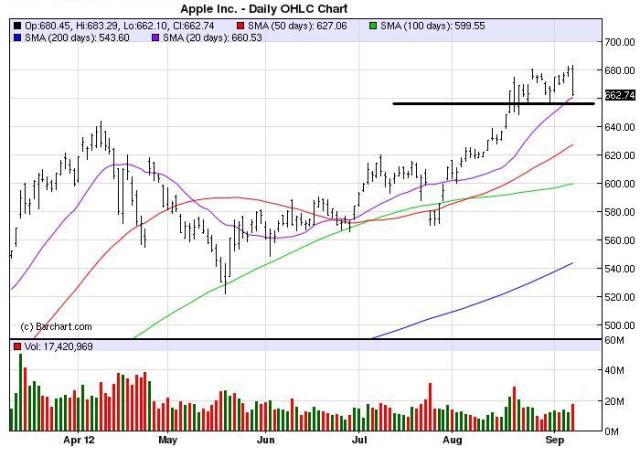
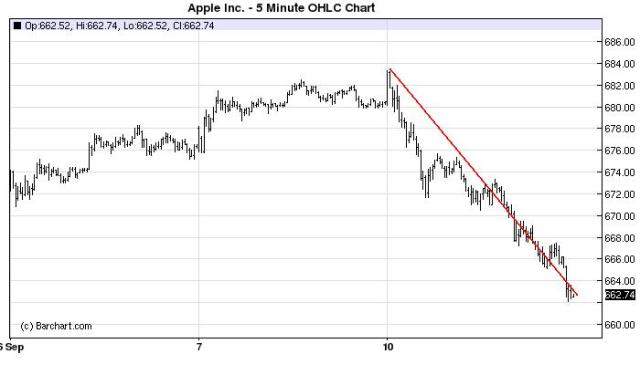
Apple opened at another all-time this morning then proceeded to trade straight down closing at its low of the day.   It’s down another two bucks in after hours at around $660.  It looks like a test of $657.25 support is coming.

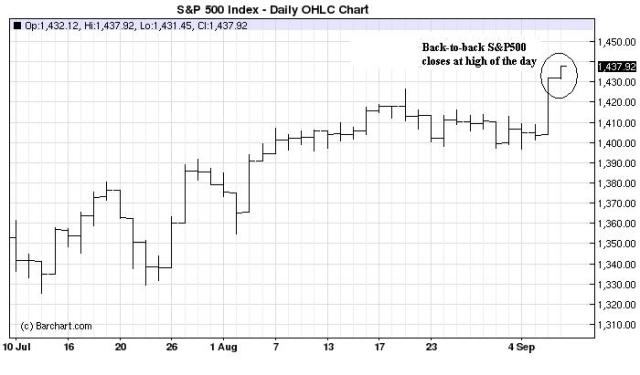
This hurt the S&P500’s ability to close positive today after two consecutive days of closing at its high of the day.   Anytime we see such a large reversal in a stock leader such as Apple it raises a red flag.   The price action in Apple and its impact on the overall market needs to monitored very closely.

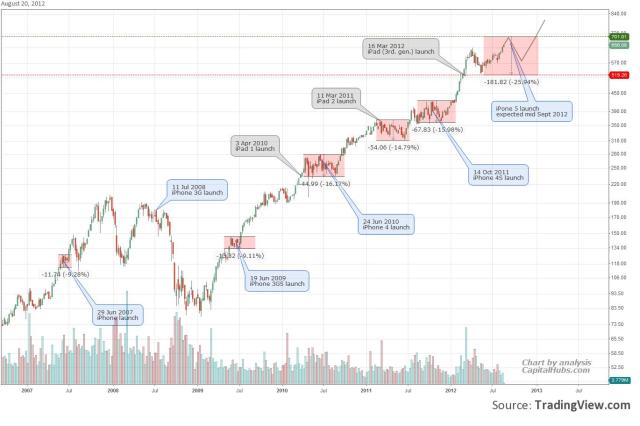
We also noted last week that Apple  tends to trade up into product launches then experiences a pretty decent sell-off.  This is reflected in the below chart from TradingView.com.  Given the frayed nerves of global macro issues it does look like sellers are jumping the gun on Wednesday’s product announcement.

Apple is not only the largest market cap stock in the market but also, in our opinion, a proxy for risk appetite of the fast money set.   Keep it on your radar.

Click chart to enlarge and for better resolution.

(click here if charts are not observable)

Posted in Apple | Tagged , , | Leave a comment

In Case You Missed It…..

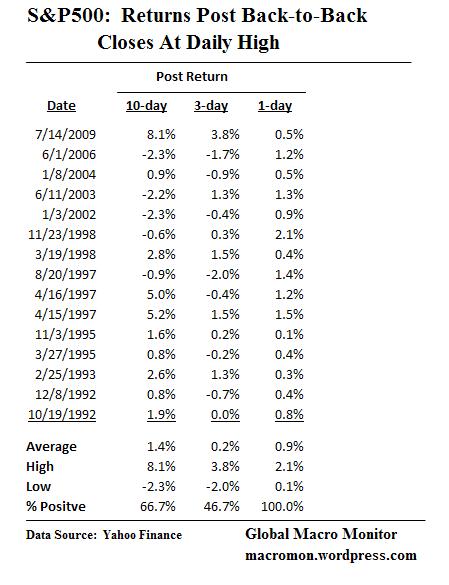
On Friday, the S&P500 closed at its high of the day for the second consecutive day.  This two-day streak is relatively rare and has happened only fifteen times in the past twenty years (see table below).

We are not certain what it means except it does seem, at least to us, to indicate market strength.  Tape painting?   Could be, but doubt it.   Markets gummed up with monetary stimulus?  Probably explains quite a bit.

It does feels, however,  there is a structural short in the market and/or lack of real sellers, which are providing a seemingly irrational bid to stocks given the global slowdown that will almost certainly hit earnings.

China’s announcement on Friday of new stimulus projects did complete a trifecta of policy responses the bulls were looking for:  1) ECB’s OMT;  2) Fed’s QE3 (almost certain); and 3) China stimulus.    It may or may not be enough to turn the global economic fundamentals, but it does appear to have turned market perceptions for now and caught many leaning the wrong the way.    Think animal spirits!

We wouldn’t sell it quite yet as the table below shows the S&P500 has on average continued to run after back-to-back closes at the daily high.  In fact, it will be interesting today to see if the index can maintain its run of positive 1-day returns, which the table shows averages 0.9 percent and has closed up the next day in all fifteen cases.

We’re nervous, as there is a lot out there to make one nervous,  but we will let the market tell us when its time to head for the hills.

(click here if charts are not observable)
Posted in Equities | Tagged , | 1 Comment

OECD’s Gurria on the ECB’s OMT

Great France24 interview with Angel Gurria, Secretary General of the Organisation for Economic Co-operation (OECD).  Have a look it’s worth your time and offers good insight into EU policymaker thinking.

Gurria is probably the world’s leading expert on sovereign debt issues.  Recall he was Mexico’s debt negotiator during 1980’s LDC debt crisis and negotiated the first Brady Plan commercial bank debt restructuring.

Here’s a little inside look how the world’s last debt crisis was resolved,

It will be twenty-two years ago this month when Mexico’s external debt negotiator, Angel Gurria, now Secretary-General of the OECD, fired the first pitch of the Brady Plan, named after the Treasury Secretary of new administration of President Bush #41. President Carlos Salinas of Mexico had taken office just four months earlier and stated his administration’s debt policy while campaigning: “If we don’t grow, we don’t pay.” He believed that only after addressing the debt overhang could Mexico return to stable economic growth..

In April 1989, Mr. Gurria brought his young team of Mexico’s “best and brightest” to New York, several of whom would go on to become presidents, cabinet ministers, and central bank presidents, to open negotiations with the country’s Bank Advisory Committee (BAC). This  committee represented the global banking community which held essentially all of Mexico’s $50 billion debt to foreign private creditors. Mr. Gurria opened negotiations by asking the BAC for a 55 percent haircut….

After listening to the proposal, one BAC member from a major Japanese bank turned to Mr. Gurria and said in his heavily accented English, “This menu is not edible!” It would take months of intense negotiations, which included a breakdown over the oil-linked value recovery rights and some arm twisting by President Bush and Fed Chairman, Alan Greenspan, for the two
parties to come to an agreement.

(click here if video is not observable)

Posted in Euro, Germany, Monetary Policy | Tagged , , , , | Leave a comment

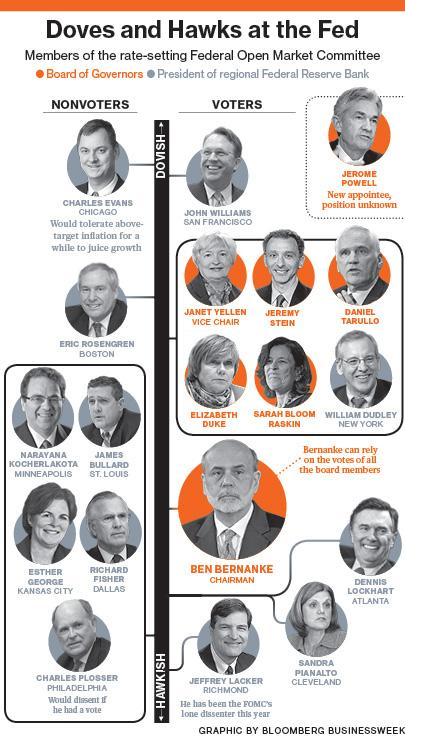
FOMC’s Hawks & Doves

(click here if graphic is not observable)

Posted in Monetary Policy | Tagged , , , | Leave a comment