Trading and the Placebo Effect

Is the market addicted to placebos?

Interesting video on the Placebo Effect.  When viewing try and keep it in the context of the markets and trading.   Valuation allows for great variance in perceptions and beliefs.

Markets change when perception changes, not fundamentals. Sometimes all it takes is a placebo and not a fundamental shift to get the party started.   The markets got a big one from the EU on Friday.

(click here if video is not observable)


Posted in General Interest, Video | Tagged , , | Leave a comment

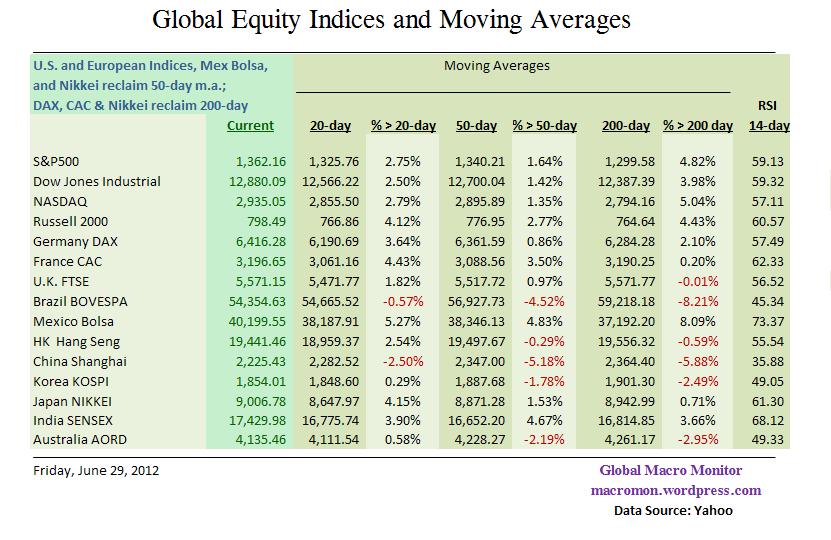
Global Trend Indicators

(click here if tables are not observable)

Posted in Global Trend Indicators | Tagged , , , , , , , , | 1 Comment

Stratfor: China’s Massive Port Expansion

(click here if video is not observable)

Posted in China, Geopolitical | Tagged , | Leave a comment

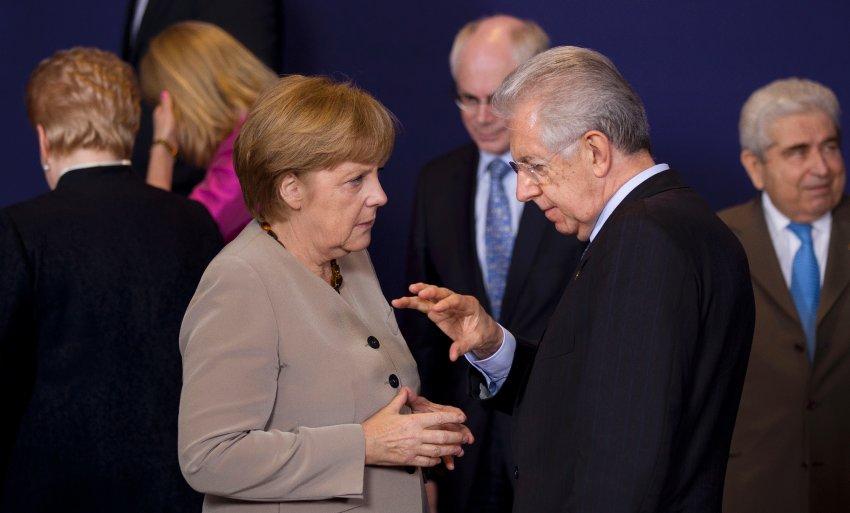
Inside the EU Summit


Fascinating piece over at Spiegel Online about what went on at the EU Summit Thursday night and Friday morning.  Not so sure this contributes to the long-term political stability of Europe and is sure to generate local political blowback in the North.  The Danish PM couldn’t frame it any better,

The threats apparently made an impact on the other delegates. Danish Prime Minister Helle Thorning-Schmidt asked pointedly whether the attendees were now all hostages.

Money quotes from the piece,

Monti’s uprising began at 7:00 p.m. on Thursday evening. That was when European Council President Herman Van Rompuy wanted to conclude the summit’s first working session and announce the growth pact to the press. According to participants, Monti was furious and asked Van Rompuy where he was going. Had the president perhaps not understand correctly, Monti reportedly asked. The Italian prime minister said he could not leave the summit without concrete measures to fight the high interest rates on Italian government bonds. He would not agree to the growth pact until that issue had been clarified. Rajoy lent his support to Monti and said that he too could not yet approve the pact…

After midnight, when the blockade had still not been resolved, representatives of the 10 non-euro EU members headed back to their hotels. Leaders of the 17 euro-zone countries remained in their seats and began a decisive round of negotiations. At this point, members of the German delegation were still insisting they would not give up their hardline position.

A few hours later, however, Monti and Rajoy had the chancellor where they wanted her. She agreed that countries would in the future be able to receive funds from the ESM without having to submit to troika oversight. Instead, only the European Commission’s annual targets will have to be met. Monti said that Italy would not ask the ESM for help. For now, he only wanted to send a signal to the financial markets in order to take the pressure off Italy.

But the decision raises all sorts of questions. What happens to the countries that have already received money from the temporary rescue fund, the EFSF? Officials in Brussels said that the new decision did not change anything about the programs for Greece, Portugal and Ireland. All the agreed goals will continue to apply and be monitored by the troika. But those countries might also start clamoring for the terms of their deals to be relaxed. The summit’s decision gives the Greek government in particular more ammunition for renegotiating the terms of its bailout, a step that new Greek Prime Minister Antonis Samaras has already said he wants to take.

Good read.

(click here if picture is not observable)

Posted in Black Swan Watch, Euro, Germany, PIIGS | Tagged , , , , , | Leave a comment

“Next Year We’ll Be Watching America” – Jim Rogers

(click here if video is not observable)

Posted in Black Swan Watch, Economics, Policy, Politics, Sovereign Debt, Sovereign Risk, Uncategorized | Tagged , | Leave a comment

Weekly Eurozone Watch

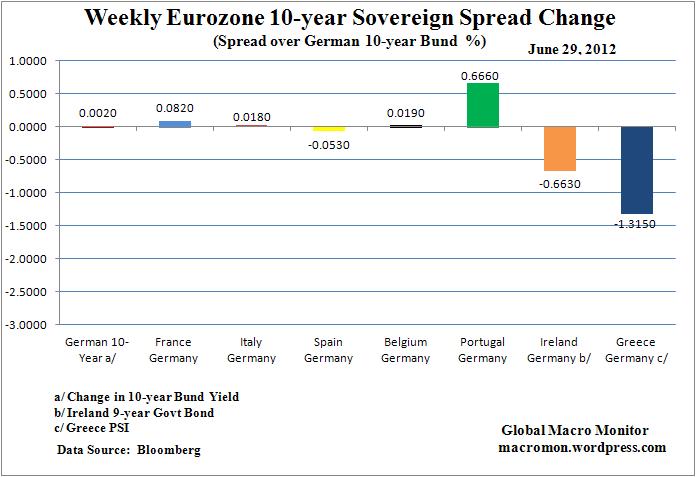
Key Data Points
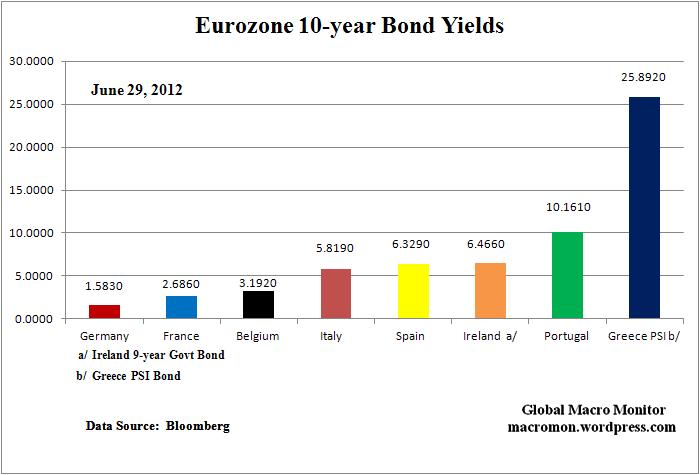
German 10-year bund 2 bps higher;
France 8 bps wider;
Spain 5 bps tighter;
Portugal 67 wider;
Ireland 66 tighter;
Greece 131 bps tighter;
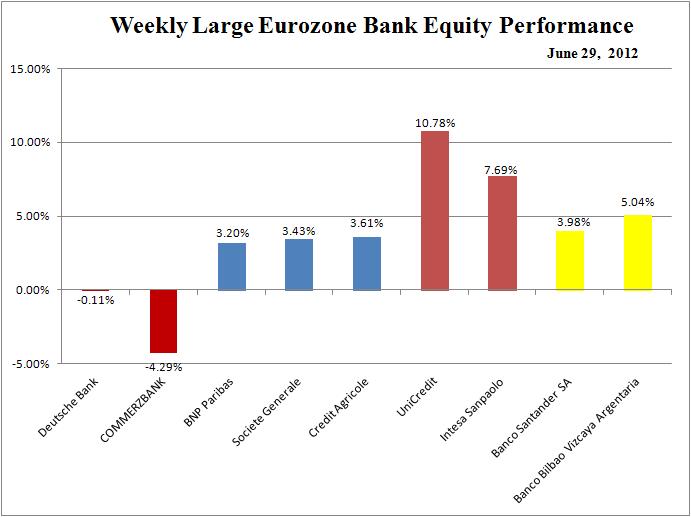
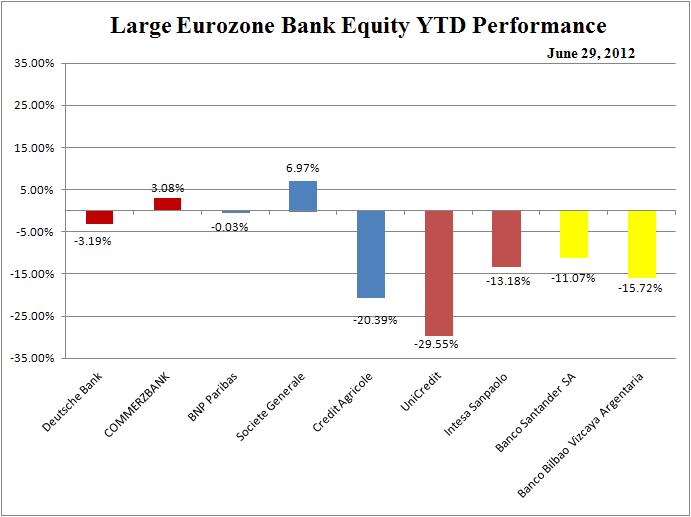
Spanish and Italian bank stocks 3-10 percent higher;
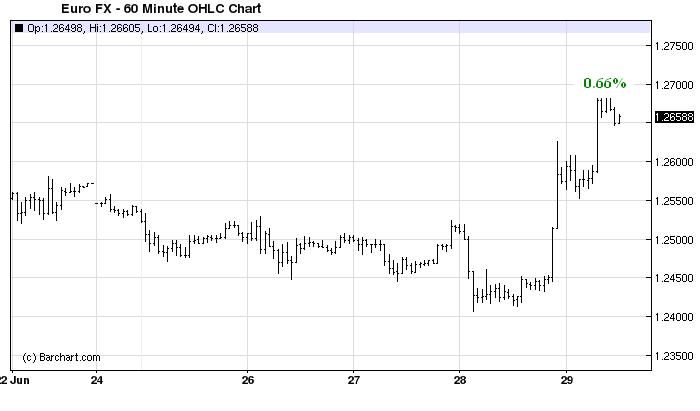
Euro FX up 0.66 percent;

Commentary
EU Summit announcements do the trick to stabilize markets.   Big one day tightening in Italian and Spanish spreads which had blown out earlier in the week but not reflected in the weekly change.  Irish spreads come in big on the possibility of a retroactive bailout of the financial sector relieving the sovereign of debt obligations and commitments.

(click here if charts are not observable)

Posted in Weekly Eurozone Watch | Tagged , , , , , , | Leave a comment

Euros Save the Day, But NIKE Takes Nasty Headbutt

Was it really that much of a surprise to move the Dow 400 points off yesterday’s low?   Nope.

Though we remain concerned about a “terminal” Euro, here’s our commentary from Weekly Eurozone Watch last week,

Post Greek election and rumors of German softening on sovereign bond buying send shorts scrambling.  Portugal closes below 10 percent for the first time in over a year.  Markets seem to be sniffing a bazooka and/or big policy shift.

And here’s an excerpt from a piece one of us co-authored in the FT last September.   Last September!

The eurozone is caught in a vicious circle. Sovereign credit is deteriorating, reducing confidence in banking systems, which in turn increases the likelihood that governments will have to assume additional bank liabilities. This further impairs sovereign credit, which further undermines confidence in the banks…

They [EU] must immediately demand consistent accounting treatment and regulatory oversight of European banks’ sovereign exposures. The International Accounting Standards Board has taken a first step, raising questions about whether eurozone banks are provisioning adequately for losses on government bonds. The problem it points to, inadequate reserves, is precisely what stops policymakers providing meaningful debt relief for the crisis countries.

Europe already has a model it can follow to ensure consistent accounting treatment and adequate reserves: the interagency country exposure review committee created by the US in 1979, and given powers to require banks to allocate specific reserves for assets impaired by country risk. This proved crucial in setting the stage for the Brady Plan that ultimately resolved the Latin American debt crisis.

The European Banking Authority could organise regulators into a similar committee. But it is essential that someone, as in the US, has the final say over the allocation of reserves. This should not be national regulators, who are too close to the institutions they regulate, but the EBA. The IMF and the international community should insist.

Second, the European financial stability facility should be used to inject capital directly into banks incapable of setting aside the required reserves, as Christine Lagarde suggested at Jackson Hole. But the problem the IMF’s managing director did not acknowledge is that the EFSF itself is inadequately capitalised. Hence, a facility financed by the G20 and led by the Asian countries, which are flush with funds, should be created to purchase preferred shares in European banks.

The level of market noise, which we confess to making our contribution,  doesn’t make it easy to trade.  The long-term blends with short run; the macro drowns out the micro; the falcon cannot hear the falconer; things fall apart; the market cannot hold its bid (hat tip W.B!)   The result is the big shorts push the markets around like a lion playing with a mouse and then rush to cover before everyone else.

Clearly the policy announcements from the EU summit are welcome short-term measures plans and the markets shorts are acting accordingly.  However, the long-term outlook for the Euro still remains bleak, in our opinion.

Think about it.

If Merkel was ganged up on or “outflanked” at the summit according to the press and the Germans hold the purse strings, how will the “no strings attached” bond purchases play in Berlin?   The potential political blowback reaffirms  our end game scenario that Germany eventually leaves the Euro and a new Deutschmark zone evolves in Northern Europe, which we think is the best worst path  for the Eurozone.

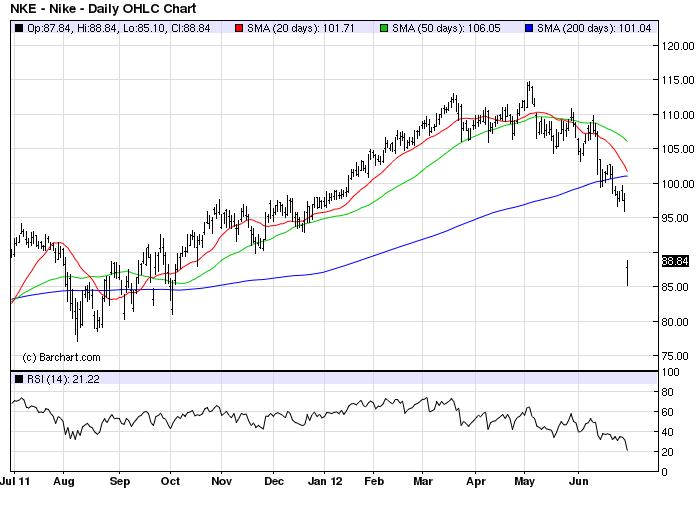
Furthermore,  the macro is now catching up with the micro.  Take a look at NIKE stock today.  This was THE play for the upcoming Olympics and 2014 World Cup in Brazil and is getting obliterated today after yesterday’s earnings release.

Nike management cites currency moves as a major cause of their lower guidance,

For our ongoing businesses, we expect FY ’13 constant-currency revenue growth at or slightly above our high single-digit target range, in line with the guidance we gave on our last call. However, on a reported basis, we now expect mid-to-high single-digit revenue growth, reflecting the recent erosion of foreign currencies, particularly the euro…

In aggregate, we expect our ongoing operations, excluding Cole Haan, Umbro and the associated divestiture impacts, to deliver high single-digit EPS growth in FY ’13. This is below our long-term goal of mid-teens EPS growth as a result of the significant negative impact of weaker international currencies on both gross margin and translated foreign earnings, as well as a higher effective tax rate.

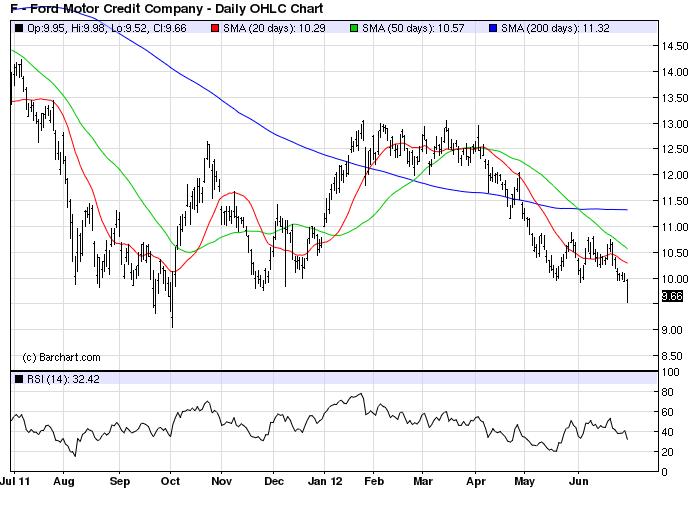
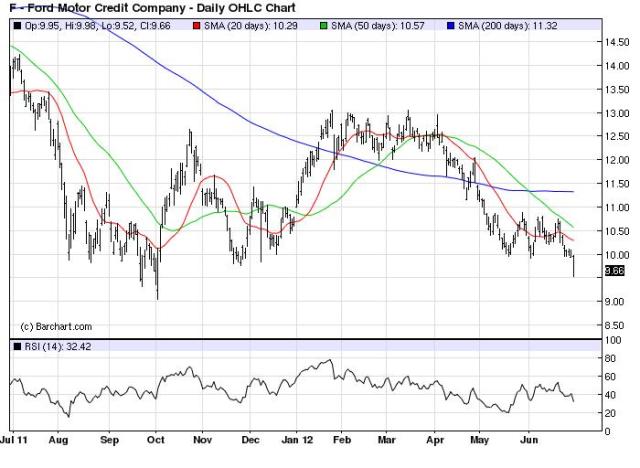
Ford is also not doing so well today after its earnings warning yesterday.  The negative macro environment is finally showing up in the micro with weaker earnings.  This should make for a rough earnings season and a volatile rest of summer.
We really what to buy American equities but think we get ’em at lower prices.  Think we’re really going fishing this time.

(click here if charts are not observable)

Posted in Black Swan Watch, Equities, Euro, Germany, Sovereign Debt, Sovereign Risk | Tagged , , , , , , | 1 Comment

EU leaders gather to solve debilitating debt crisis

(click here if video is not observable)

Posted in Black Swan Watch, Euro, Eurozone Sovereign Spreads, Germany, Sovereign Debt, Sovereign Risk | Tagged , , | 1 Comment

U.S. Unemployment Outliers

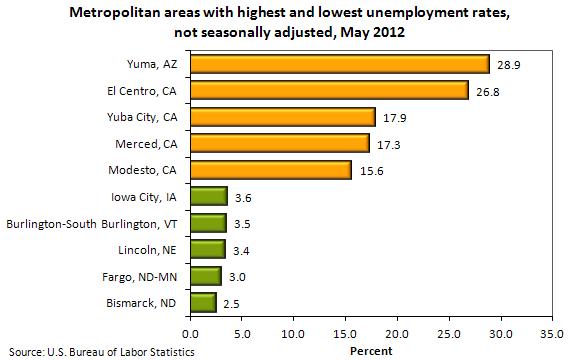
Interest chart from the BLS showing North Dakota cities with some of the lowest unemployment rates in the nation due to the Bakken Shale boom.

In May, five U.S. metropolitan areas recorded jobless rates of at least 15.0 percent, with Yuma, AZ (28.9 percent), and El Centro, CA (26.8 percent), recording the highest rates. Bismarck, ND (2.5 percent), and Fargo, ND-MN (3.0 percent), recorded the lowest unemployment rates among the metropolitan areas.

(click here if chart is not observable)

Posted in Employment | Tagged , , , , | Leave a comment

France Debates a “More Federal Europe”

The debate in Europe has finally crystallized into the the one point that matters.   How much sovereignty is each country willing to cede to a German led “Federal Europe.”   The following discussion on France 24 is very enlightening in that even the French, one of, if not, the most pro European country seem to be having their doubts.

(click here if video is not observable)

Posted in Black Swan Watch, Euro, Germany, Policy, Sovereign Debt, Sovereign Risk | Tagged , , , , | Leave a comment