
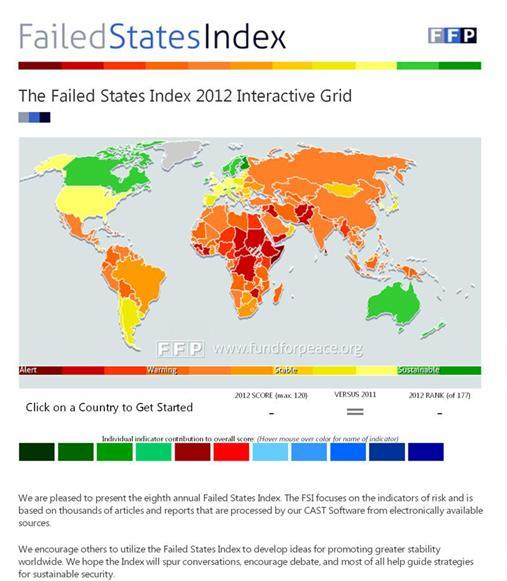
Foreign Policy magazine is out with their annual Failed State Index. No surprise Somalia, Congo, Sudan, Chad, and Zimbabwe top the list. Click here for interactive map and data.
(click here if chart is not observable)
Foreign Policy magazine is out with their annual Failed State Index. No surprise Somalia, Congo, Sudan, Chad, and Zimbabwe top the list. Click here for interactive map and data.
(click here if chart is not observable)
(click here if video is not observable)
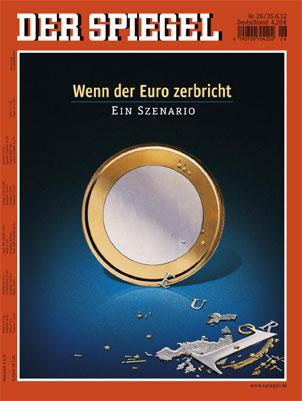
We posted yesterday that the Germans are starting to think out loud about the breakup of the Euro. Here’s an excerpt and chart on the economic aftermath of a Eurozone split from the Der Spiegel piece,
Collapse of Currency a ‘Very Likely Scenario’
Investment experts at Deutsche Bank now feel that a collapse of the common currency is “a very likely scenario.” German companies are preparing themselves for the possibility that their business contacts in Madrid and Barcelona could soon be paying with pesetas again. And in Italy, former Prime Minister Silvio Berlusconi is thinking of running a new election campaign, possibly this year, on a return-to-the-lira platform.
Nothing seems impossible anymore, not even a scenario in which all members of the currency zone dust off their old coins and bills — bidding farewell to the euro, and instead welcoming back the guilder, deutsche mark and drachma.
It would be a dream for nationalist politicians, and a nightmare for the economy. Everything that has grown together in two decades of euro history would have to be painstakingly torn apart. Millions of contracts, business relationships and partnerships would have to be reassessed, while thousands of companies would need protection from bankruptcy. All of Europe would plunge into a deep recession. Governments, which would be forced to borrow additional billions to meet their needs, would face the choice between two unattractive options: either to drastically increase taxes or to impose significant financial burdens on their citizens in the form of higher inflation.
A horrific scenario would become a reality, a prospect so frightening that it ought to convince every European leader to seek a consensus as quickly as possible. But there can be no talk of consensus today. On the contrary, as the economic crisis worsens in southern Europe, the fronts between governments are only becoming more rigid.
The Italians and Spaniards want Germany to issue stronger guarantees for their debts. But the Germans are only willing to do so if all euro countries transfer more power to Brussels — steps the southern member states, for their part, don’t want to take.
Is it just us or do you also sense an incredible amount of complacency in the markets about such a high impact event with a probability that is far from di minimis?

(click here if chart is not observable)
In case you missed it, Google’s project glass is very cool. It caught our attention in this month’s MIT Technology Review,
The spectacles take the place of his desktop computer, his mobile computer, and his all-knowing digital assistant. For all its utility, though, Starner’s machine is less distracting than any other computer I’ve ever seen. This was a revelation. Here was a guy wearing a computer, but because he could use it without becoming lost in it—as we all do when we consult our many devices—he appeared less in thrall to the digital world than you and I are every day. “One of the key points here,” Starner says, “is that we’re trying to make mobile systems that help the user pay more attention to the real world as opposed to retreating from it.”
The new hoodie?
In fact, wearable computers could end up being a fashion statement. They actually fit into a larger history of functional wearable objects—think of glasses, monocles, wristwatches, and whistles. “There’s a lot of things we wear today that are just decorative, just jewelry,” says Travis Bogard, vice president of product management and strategy at Jawbone, which makes a line of fashion-conscious Bluetooth headsets. “When we talk about this new stuff, we think about it as ‘functional jewelry.'” The trick for makers of wearable machines, Bogard explains, is to add utility to jewelry without negatively affecting aesthetics.
We sense a cottage industry evolving to deal with our connected and tech obsessed culture. Bloomberg cites a study that “almost 30 percent of people born after 1980 feel anxious if they can’t check Facebook Inc. (FB)’s website every few minutes.”
Not to worry, says Google,
One criticism of Google’s demo video of Project Glass is that it paints a picture of a guy lost in his own digital cocoon. But Starner argues that a heads-up display will actually tether you more firmly to real-life social interactions. He says the video’s augmented-reality visualizations—images that are tied to real-world sights, like direction bubbles that pop up on the sidewalk, showing you how to get to your friend’s house—are all meant to be relevant to what you’re doing at any given point and thus won’t seem like distracting interruptions.
Who would of thunk it thirty years ago.? And no limits x/ our imagination as to where technology is leading us.
(click here if video is not observable)
How will Greece’s official creditors react?
(click here if video is not observable)
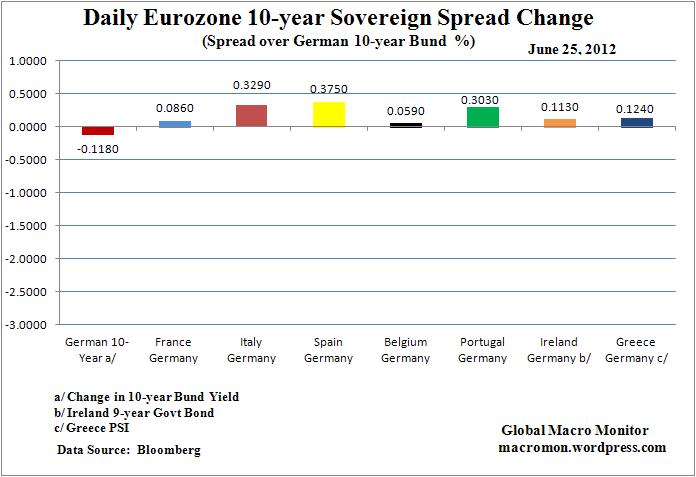
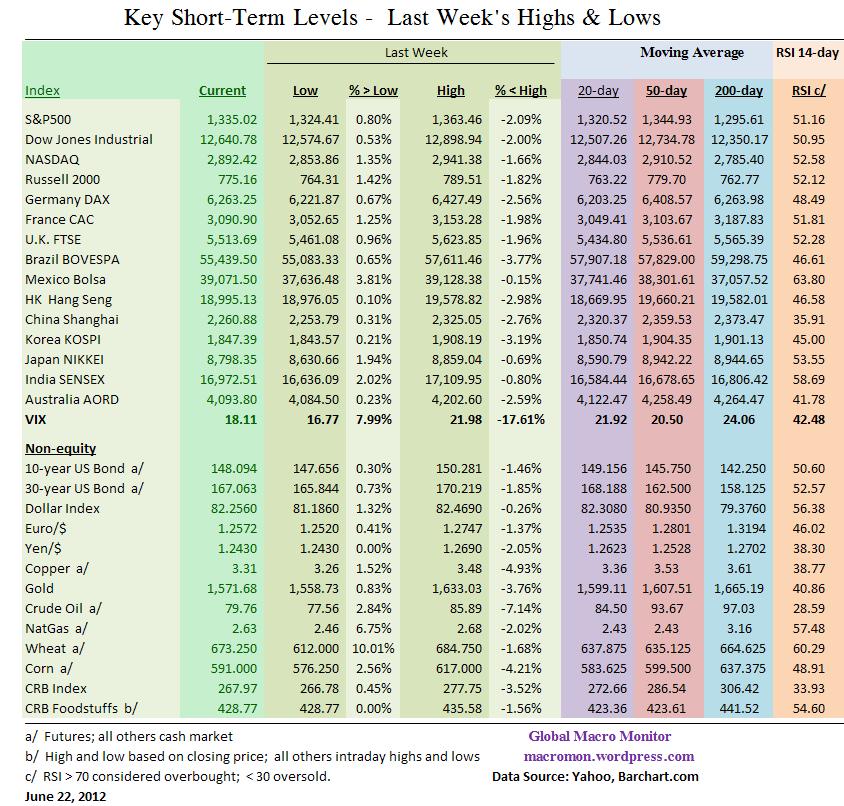
Last week’s rally in Euroland was short lived with today’s big sell-off (see charts below). The political tensions are coming to the surface and markets don’t like want they see and don’t see a positive outcome.
As the Germans think out loud about a Euro breakup (see cover Der Spiegel below) here’s an excerpt from an interview with German Finance Minister Wolfgang Schäuble. He sums up the fundamental and now core problem stifling a comprehensive solution to the Euro crisis — the surrender of national sovereignty.
Schäuble: The most important thing is that we create a fiscal union, one in which the nation states give up their jurisdiction in terms of fiscal policy. In addition, the problems of the Spanish financial institutions reveal, once again, that Europe would be better off with a bank union. We need a European supervisory authority, at least over the major lenders, which can then influence the banks directly. Then we can also save them with joint funds.
SPIEGEL: For months, Germany has been under pressure to agree to joint government bonds, the so-called euro bonds. It would certainly be seen as a confidence-building measure if you complied with the wishes of the other European countries.
Schäuble: As long as we don’t have a fiscal union, we cannot assume joint liability for debts.
The Germans and French are moving further apart at a very critical and dangerous moment in the crisis. Here’s how Angela Merkel closed Friday’s Rome meeting,
If I give money to Spanish banks, I’m the German Chancellor but I can’t say what these banks can do.
Stay tuned.
 (click here if charts are not obsevable)
 Charlie interviews Gary Gensler, chairman of the U.S. Commodity Futures Trading Commission. They discuss a wide range of issues, including risk in financial institutions, swaps and derivatives, and the challenge to the financial sector of a potential Grexit. The interview took place on June 14th. It’s worth the 30 minutes of your time, in our opinion.
Click here for interview.
(click here if pictures are not observable)


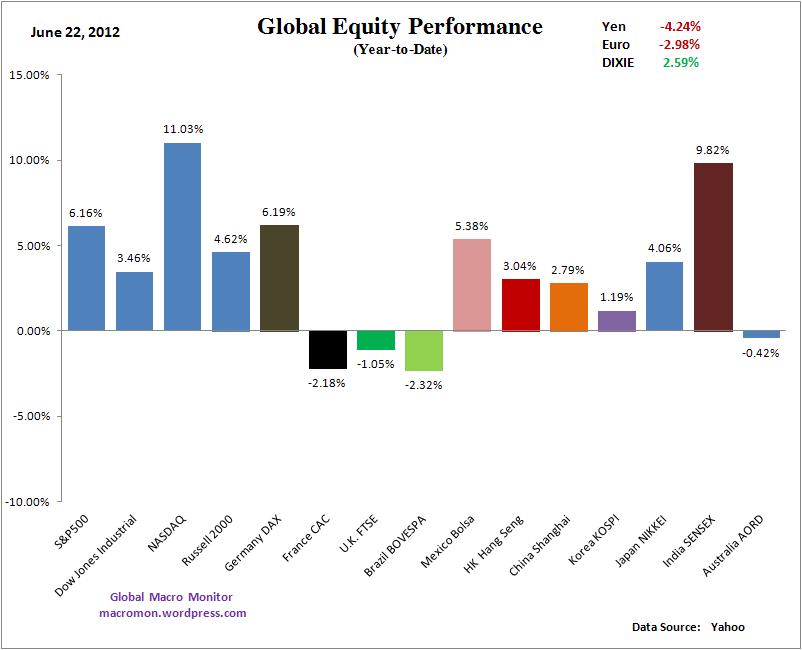
 (click here if charts are not observable)
Sound familiar?
(click here if video is not observable)
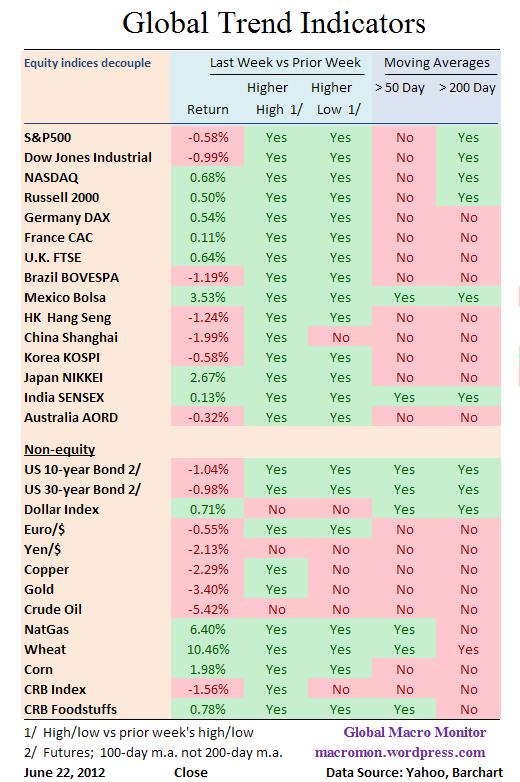
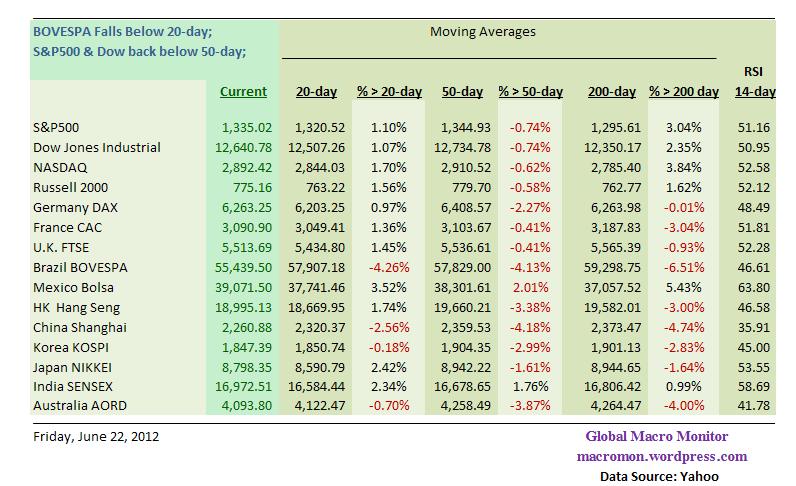 (click here if tables are not observable)



