Apple’s Market Cap Now Larger Than Poland & Belgium GDP

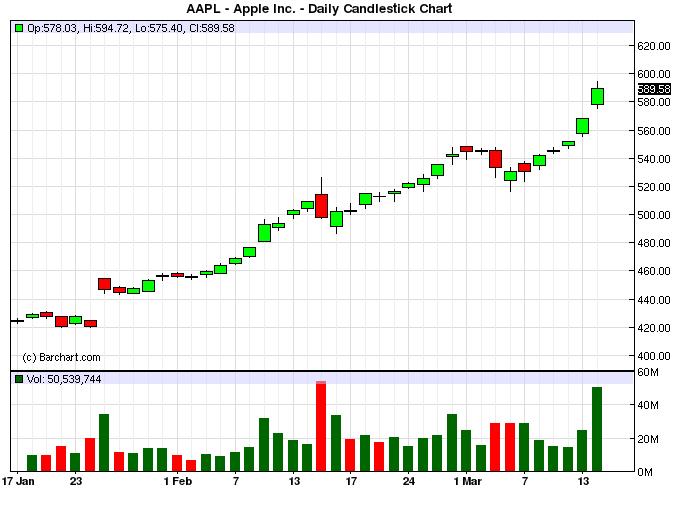
Apple’s parabolic repricing continues.

The stock was up over $21 today ($45 since Friday’s close) on the back of a Morgan Stanley report, which included a price target of $960.   The market is starting to reprice the stock to a valuation and multilple that we have long thought it deserves.

Trading this beast versus a buy-and-hold strategy has cost us,  but, hey  it’s all about risk management, no?

Apple’s market cap is now larger than the 2011 GDP of Poland, Belgium, Taiwan  and could surpass Saudi Arabia with another $5 move tomorrow.   Absolutely stunning!

The sheer size of Apple’s market cap now has asset allocation ramifications and may be one reason why volume has been so low in the rest of the market is so slow.  The dollar volume in Apple today was more than 10x that of JP Morgan.

(click here if charts are not observable)

Posted in Apple | Tagged , , , , , , | 3 Comments

Is the Bond Market’s Arab Spring Upon Us?

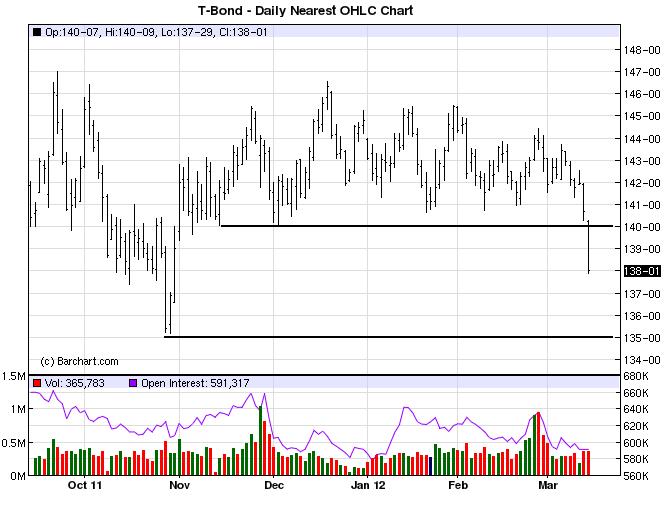
Ugly action in bonds over the past few days.

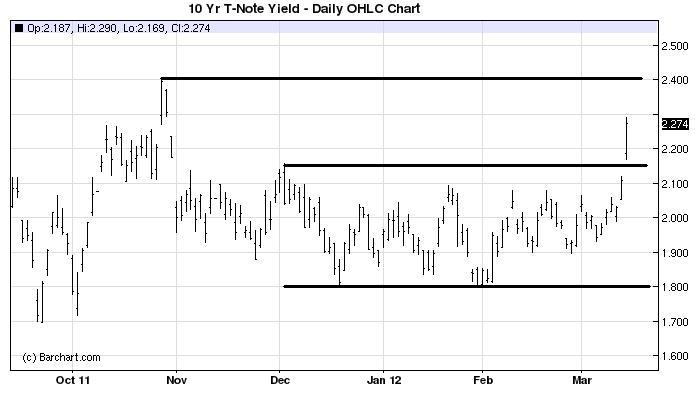
In last month’s post,  Is the Fed ready for the bond market’s Arab Spring?, we suspected the Fed needed more ammo to continue their repression of long-term rates.   Yesterday Mr. Bernanke offered no hint of further bond purchases post Operation Twist.

The market saw its chance to rise up against the Great Financial Repression and managed to  take 10-year Treasury yields up 25 basis points over the past two days.    So far,  so good, however, as bonds are currently reacting to a stronger economy and a Fed that may be handcuffed by rising oil prices,  a better economy, the recession of European sovereign risk, and domestic politics.

Nevertheless,  spiking bond yields have to be closely monitored in a country where sovereign debt exceeds or is around 100 percent of GDP because of the potential for an adverse budgetary feedback loop.   Another brick for the equity bull market’s wall of worry.

Here’s what we wrote back in February,

..the Fed holds over 40 percent of the Treasuries outstanding in several of the years in which they mature.  In many of the specific maturities, the Fed owns up 60-70 percent of the total outstanding issue. 

The Fed had to “relax” its self imposed 35 percent limit on SOMA holdings of individual issues and included recently issued securities in order to execute its maturity extension program announced last September. It’s going be interesting to see how longer-term interest rates behave as the economy regains some of its mojo and money comes out of the Treasury safe haven.    

The Fed has yet to fight the markets in its repression of long rates as Operation Twist has been riding the tail winds of positive market psychology and strong demand for safe havens due to Europe’s sovereign debt and banking crisis…

We’re the first to admit nobody knows the future, most of all us,  but we smell a potential fight or flight in the bond market, comrades.  An Arab Spring in the bond pit, if you will.    With oil prices north of $100 and rising rents, which is the largest component of the CPI, it is our sense the Fed better be able “to float like a butterfly and sting like a bee.”

The bond market landed a couple of huge body blows in the past two trading sessions.   Let’s now see how the Fed counterpunches.

More talk of sterilized’ bond buying?  Wouldn’t doubt it.

But how about letting markets find their equilibrium levels?

That could be dangerous, however,  with China and Japan’s current account surplus now shrinking or turning negative thus bringing an end — temporarily, or not — to the recycling of surplus dollars back into the Treasury market.    It is going to be interesting,  folks.

(click here if charts are not observable)

Posted in Black Swan Watch, Bonds, Budget Deficit, Sovereign Debt, Sovereign Risk | Tagged , , | 1 Comment

Nonlinear Thinking: 3D Printing 2.0

We’ve already posted a couple of pieces on 3D printing (see here and here).  Lisa Harouni does a good job in this video presenting the next big thing that will revolutionize manufacturing.  Total disruptive and transformative technology.

Imagine having your own 3D printer to make custom Christmas toys for the kids?  Or how ’bout Costco or WalMart having one hundred 3D printers on site to produce their own goods?

You think China understands the future?  Maybe that’s one reason why their moving away from low cost manufacturing and the end of “Cheap China.”   Imagine what this will do to international trade flows.

We’re long a little 3D Systems Corp (DDD) as a play on this tech trend.

(click here if video is not observable)

Posted in Nonlinear Thinking | Tagged , , , | 2 Comments

‘Toon of the Day: Time to Pause

(click here if cartoon is not observable)

Posted in Cartoon of the Day | Tagged , | Leave a comment

Euro Fracture: Cradle of Civilization Headed for Revolution?

Interesting interview with British MEP, Paul Nuttal.    He worries about political instability spreading in the Eurozone and raises the notion of a harder euro for the northern countries.

We believe the best case, at the end of the day,  is that the north leaves for a harder euro and the southern countries remain with all debt denominated in the old and softer euro.   This will take a toll on bank balance sheets in Germany and the harder euro countries,  however,  so time and strong leadership are absolute prerequisites.

(click here if video is not observable)

Posted in Black Swan Watch, Euro, PIIGS, Politics, Sovereign Debt, Sovereign Risk | Leave a comment

What Drives Crude Oil Prices?

(click here if chart is not observable)

Posted in Black Swan Watch, Crude Oil | Tagged , , | Leave a comment

Nassim Taleb: The Next Black Swan

In case you missed Nassim Taleb’s interview on CNBC this morning.

He endorsed Ron Paul and is a bit cryptic in his four points, one of which,  that a sovereign debt crisis is coming to the United States.   Rather than doing the necessary “root canal” to deal with the economy’s structural problems,  the government is giving novocaine in the form of large budget deficits,

You have to start with government budget that is in control.  You start with that.   It’s unconditional.  You don’t gamble with future generations’ money and you don’t gamble with hyperinflation.  You want the government first, like we’re doing with the Greeks. We’re doing it to the Greeks.  We should do it to ourselves.  You start with that.  That’s 90% of the problem.

Click here for full interview.

Posted in Black Swan Watch, Interviews, Policy, Politics, Sovereign Debt, Sovereign Risk | Tagged , , | 2 Comments

S&P500 Breakout & The Ambiguity of Stock Value

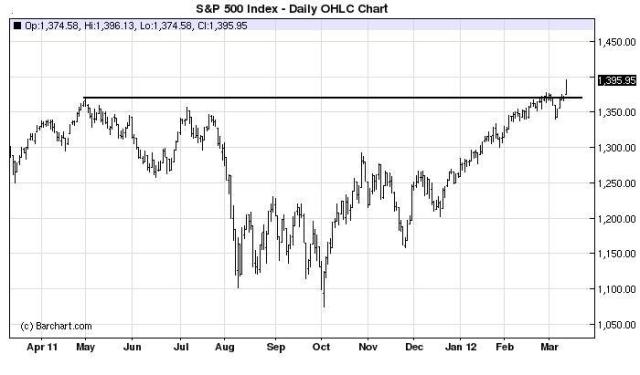
Today has to be the least appreciated breakout that’s ever happened.   Tonight’s Fast Money crowd, for example, described it as the long awaited blow-off top.  You know, the same guy that has been wrong for the last 600 S&P points and is now trying to get the last 50 points correct.

We don’t know if equities are blowing off or not.   Are we scared?  We’re always scared.

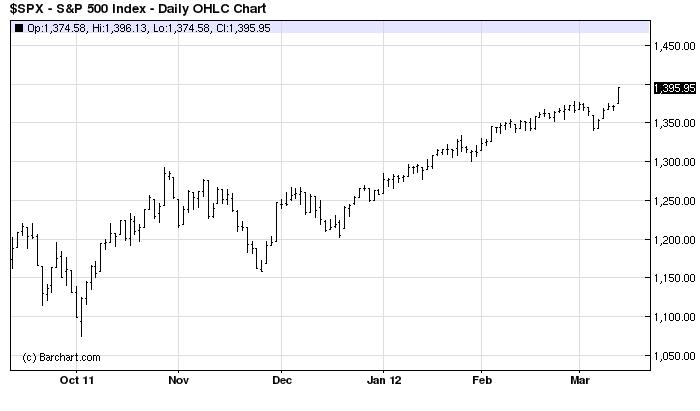
What we do know is the market is moving higher;  volatility is collapsing;  the S&P500 moved, with gusto, to new post crash highs today;  and everyone most are still nervous about the macro swans of Christmas past.
So where is fair value on the S&P500?   Don’t know.

We’ll get bearish and short when the market lets us know when it’s time to be bearish.  A quick reversal of today’s gains could do that, for example.  We’ve missed too many moves because the macro picture wasn’t perfect and have fought too many bull markets in our life.

So let us repost a piece from December 2010 which explains our view on fair value in the equity market.  Have a read.  We think you’ll find it interesting and quite helpful in understanding current market conditions.  We updated the charts and dates in the piece.

The Ambiguity of Stock Value

Posted on December 27, 2010

Professor Robert Shiller,  of Yale University,  is probably best known for his book, Irrational Exuberance, which called the top of the dot.com bubble and the second edition called the top in the housing market.  During our days on Wall Street, we were big fans of Shiller’s book,  Market Volatility.

We asked him once  to visit us in our offices and the meeting took place the day after then Fed Chairman Alan Greenspan’s famous Irrational Exuberance speech in December 1996,

But how do we know when irrational exuberance has unduly escalated asset values, which then become subject to unexpected and prolonged contractions as they have in Japan over the past decade?

The professor said he was in town to meet with Greenspan who was concerned about the run-up in stock prices.  During the meeting Greenspan solicited his thoughts on why stocks were rising.  The professor answered maybe it was just “irrational exuberance” among investors.  Hmmmm….

We think Shiller’s best work was Martket Volatility and specifically the following,

The Ambiguity of Stock Value

Stock prices are likely to be among the prices that are relatively vulnerable to purely social movements because there is no accepted theory by which to understand the worth of stocks….investors have no model or at best a very incomplete model of behavior of prices, dividend, or earnings, of speculative assets.

Shiller nails it here.  Stock values are ambiguous as there are no models to determine their “true” price. Even at the macroeconomic level this is true and Greenspan addressed it in his Irrational Exuberance speech,

There is, regrettably, no simple model of the American economy that can effectively explain the levels of output, employment, and inflation. In principle, there may be some unbelievably complex set of equations that does that. But we have not been able to find them, and do not believe anyone else has either.

Consequently, we are led, of necessity, to employ ad hoc partial models and intensive informative analysis to aid in evaluating economic developments and implementing policy. There is no alternative to this, though we continuously seek to enhance our knowledge to match the ever growing complexity of the world economy.

So to it is with our job in forecasting asset values, which can only be done with “ad hoc partial models” in the ether of ambiguity.   Because prices are determined by simple buying and selling, we paraphrase Shiller in constructing our ad hoc model,

Stock prices are likely to be among the prices that are relatively determined by capital flows because there is no accepted theory by which to understand the worth of stocks.

In our experience getting ahead of the capital flows has been more profitable than buying what we believe to be a “cheap” stock or selling an “expensive” stock.

And that leads us into the next issue of perspective based on reference points, time frames, and historical bias.

Take a look at the three objects.   Two charts of the exact same market, the S&P500 over different time horizons;   and one picture.

Do you see an S&P500 that is overvalued?  Undervalued?  Oversold? About to rollover or break to new highs?   Do you see a young lady or an old hag?  It most likely depends on your confirmation bias.     Larry Summers, who will leave the White House at the New Year,  coauthored a paper in the late 1980′s stating market volatility is caused by investors and traders with different time horizons.

But, like Keynes’ beauty contest analogy, the true question to ask for [the rest 2012] is not what we see, but what we believe the market – i.e., the dominant marginal buyers – will see.  Do they  see the young lady or the old hag?

Or maybe beauty is relative, or even ambiguous,  and we have to determine which markets will be deemed the least old or the most pretty.   And that just may be the best lesson here, which we think certainly is the case for the world’s major currencies.  Dollar strength doesn’t necessary equate to the young lady!

(click here if chart is not observable)

Posted in Black Swan Watch, Equities | Tagged , , | 5 Comments

Stratfor: Enforceability and Credibility in the EU

No street cred?   Double standard?

Take a look at this piece at Spiegel Online on how even Germany is violating its own austerity measures,

SPIEGEL reports this week that the German government didn’t reach even half of its planned savings in the federal budget. Only 42 percent of the spending cuts named by Merkel’s coalition government, comprised of the conservative Christian Democrats and the business-friendly Free Democratic Party, were actually not implemented…

This lapse is particularly embarrassing for the German government because the news comes just after 25 European Union member states agreed in early March to an international fiscal pact obliging them to adhere to greater fiscal discipline. The pact also calls for the creation of balanced budget initiatives modelled on Germany’s debt brake legislation that would be enforced by the EU’s court, the European Court of Justice in Luxembourg.

(click here if chart is not observable)
Posted in Black Swan Watch | Tagged , , , | 3 Comments

Romney Tops Obama in Latest WaPost/ABC Poll

The results of the latest WashPost/ABC poll are a bit surprising and should have the White House a little worried,

Public disapproval of President Obama’s handling of the economy is again on the rise, alongside increasing gas prices. One political consequence: The president’s momentum has stalled, with Mitt Romney and Rick Santorum running about evenly against him in hypothetical general-election matchups.

(Click here for related article)

We’re fairly nonpartisan and independents here at the Global Macro Monitor but if Romney gets the Republican nod and this trend continues,  the markets will begin to price a change in Administration.    And it’s our bet they will like a Romney Presidency and equities will rocket higher.   Recall the 14 percent move in the S&P500 from August to December 2004 as Bush 43 began to and ultimately secured his second term.

It’s going to be an interesting rest of the year. Stay tuned!

P.S.  If it’s gas prices driving down the President’s poll numbers,  how long before the USG releases some oil from the SPR?

(click here if poll is not observable)

Posted in Politics | Tagged , , | 2 Comments