Angry Greeks: “EU, IMF Out!”

(click here if video is not observable)

Posted in Black Swan Watch, Euro, PIIGS, Sovereign Debt, Sovereign Risk | Tagged , , , | Leave a comment

The Consequences of Euro Debt Monetization

As the pressure on ECB grows to step up its “bid of last resort” for European sovereign bonds, the folks over at Zero Hedge ask the very important question what are consequences if the ‘zone  resorts to massive debt monetization?    Here is one plausible scenario we’re looking at.

Let’s start with the simple observation that there are, at the moment, massive capital flows taking place under the surface within Europe, reflecting capital flight out of the periphery and into Germany.   The ECB is providing support to  financial institutions that are experiencing liquidity pressures as a result of these flows.

During the 1980’s and 1990’s, the exchange rate of an emerging market country experiencing a monetized bank run would come under tremendous pressure as depositors and investors exited the currency.  The central bank would hopelessly intervene, lose billions of dollars of reserves in an effort to hold the exchange rate, and then be forced to devalue.   The classic case was the 1994 Venezuela banking collapse.

We suspect euro denominated deposits in the periphery are  being exchanged for the same in the stronger core countries, alleviating much of the pressure that might otherwise mount on the exchange rate.  No doubt some leaks out of the eurozone into the Swissie, the dollar,  or, the Scandinavian currencies.  The situation in Europe is somewhat similar to a U.S. saver moving his/her savings from say Downey Savings to JP Morgan as the housing crisis began to accelerate.

Whatever the case,  the demand for the euro has remained relatively strong in the core countries as the ECB reportedly sterilizes all bond purchases and liquidity injections. Witness the limited pressure on the currency and its surprising relative strength versus the dollar during the past few months as the crisis has spread.

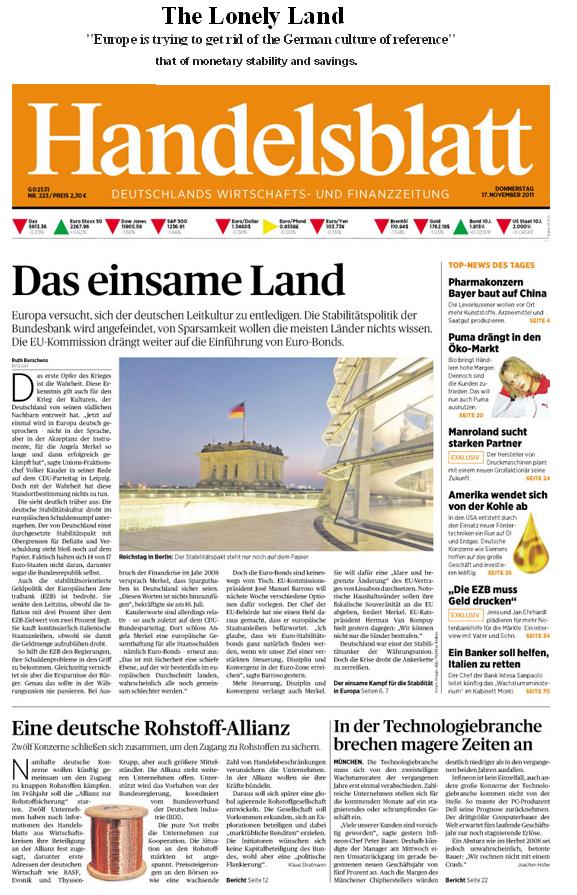
The question is:   what will happen to German money demand if the ECB is forced/resorts to massive monetization of periphery sovereign debt?    Just as confidence in a sovereign’s credit worthiness can evaporate quickly, so to can confidence in a central bank.   As the Hadledsblatt states below monetary stability and savings is part of the German culture.

Will the German public’s demand for euros remain strong  if the ECB begins a mass monetization?   If not, will the euro collapse and what will be their currency and “store of value” of choice?   Gold?  The dollar?

Furthermore, will the Fed and  global central banks try an reduce this risk with coordinated quantitative easing?   Imagine the reaction of the  “crack”/liquidity addicted markets to such a policy surprise.   Gold would likely soar $200-300 on such an announcement.

One last point.  The Fed’s quantitative easing is not an explicit monetization of U.S. government debt to make up for a  loss of confidence by the markets.    A de facto monetization of the deficit or a “helicopter drop” of money?   Probably.   But comparing what the Fed is doing and has done to the situation the ECB currently finds itself in is complete nonsense, in our opinion.

We concede an argument can be made that some of the Fed’s purchases of mortgage securities has been a monetization of bad debt but these securities are being paid off at maturity, we assume, and are rolling off the Fed’s balance sheet.   The proceeds, of which, are being used to purchase more securities.

If the U.S. ever reaches a point where the Fed has to fully backstop the U.S. government, or even just 40 percent of the government,  are you going to be caught long dollars and Treasury bonds?   Some believe it will never happen because of the Fed’s backstop.    We’re not so sure.

The nonlinear dynamics of the crisis which began 2008 makes the end game more uncertain and unpredictable.   Nobody knows when, where, and what are the tipping points.  Not even the “Super Committee” of the U.S. Congress.

  (click here if paper is not observable)

Hat tip N.M.!

Posted in Black Swan Watch, Bonds, Budget Deficit, Dollar, Euro, Sovereign Debt, Sovereign Risk | Tagged , , | 6 Comments

Difficult Markets

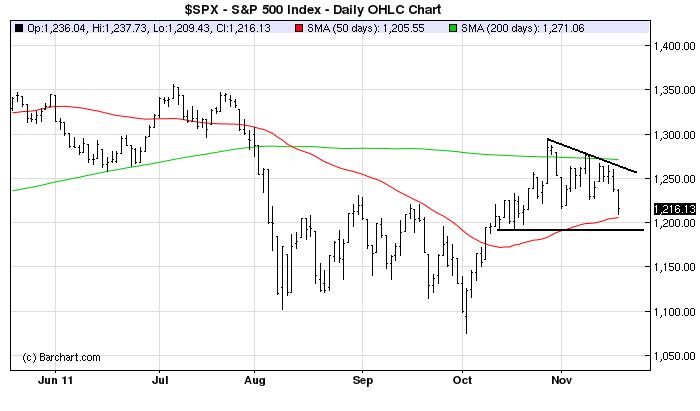
Is it just us or is anyone else out there having trouble navigating these treacherous markets?  The events that you believe will move markets just aren’t gaining traction and it now feels we’re in full blown preservation of capital mode.  But what do we know?

The S&P5oo held its 50-day moving average, which is a positive, but we think it will be tested again as soon as tomorrow.   The 50-day at 1205 and 1191 are short-term support levels.

This market is tired and has beat the living daylights out of traders.   Good luck!

(click here if chart is not observable)

Posted in Charts, Equities | Tagged | 1 Comment

Hours of Work Needed to Buy An Ounce of Gold

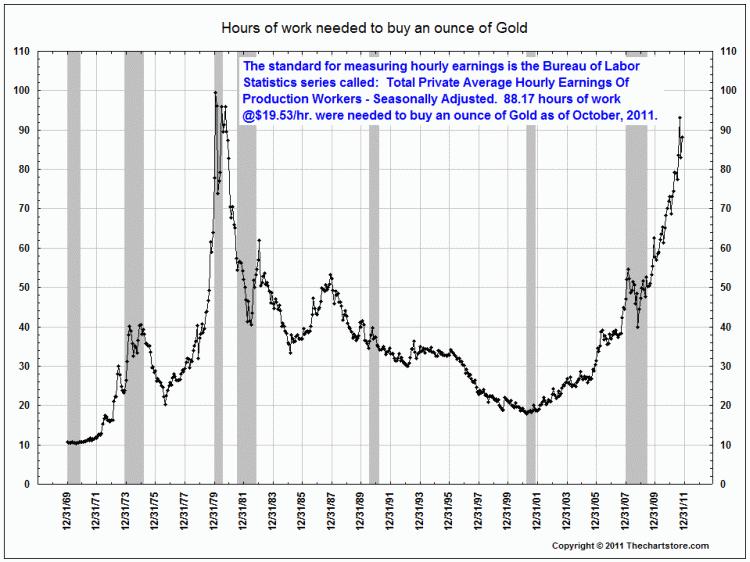
More great work from our friends at The Chart Store.  It now takes over 88 hours of work at the average hourly wage to buy an ounce of gold.   What an incredible increase in the relative price of gold and loss of confidence in fiat currency.   Sorry, PK,  it ain’t just about Glenn Beck’s marketing campaign.

Could it be the anticipation of a period of massive monetization of unpayable sovereign debt?   Or could it be just a huge bubble?  You decide.

Let’s hope we’re not running charts in a few years (let’s hope we’re still around) on the number hours needed to buy a loaf of bread. Stay tuned, BTW,  for the number hours work needed to buy a bushel of wheat.

And there’s the rub.  Central banks have done a great job at driving up the price of gold but a horrible job at creating wage inflation.   If it now takes 88 hours to buy an ounce of gold versus 20 hours in 2000, hasn’t that grossly deflated real wages in a strict monetary sense?   Just askin’.

(click here if charts is not observable)

Posted in Black Swan Watch, Gold | Tagged , | 2 Comments

The Pain in Spain

Our friends and former colleagues over at Macro Synergy Partners, a London based hedge fund, which is performing well this year,  really nails it on Spain.  Note this was written before the recent blowout in spreads.

Spanish policy makers made the wrong assessment of the situation in the last year by believing that:

a. Their banking system was adequately provisioned to deal with the bursting of the real estate bubble.

b. By underestimating how much the devolution of responsibilities to the regions has aggravated corporatism/clientelism and corruption (see Cajas), and how it has also undermined the competitiveness of the economy.

These are smart guys.    Spain’s debt problem is much different than that of Greece and Italy and is, like Ireland, rooted mainly with backstopping a problematic banking system.

Imagine how the average German feels, which didn’t experience a housing bubble as Spain and Ireland did and is now asked to pay for the clean up of the party they never attended.   That, in a nutshell, should give a sense of the political frictions in the ‘zone.

(click here if chart is not observable)

Posted in Black Swan Watch, PIIGS, Sovereign Debt, Sovereign Risk | Tagged , , | Leave a comment

Those MF Global MFs!

We have a good friend with money tied up in the MF Global debacle.  As of November 1st, he had close to $100K in his “segregated”  futures account with no open positions.  He says the MF Global  website is shut down and the phones don’t ring when he calls.   This guy was a “big swinging Richard” at one of Wall Street’s biggest firms and now trades his own account.

Here is his letter of rebuke to MF Global, which he passed on to us.  Can you tell he is a little peeved?

Dear MFGI Correspondence Team:

Since you have been taciturn and uncommunicative – I thought I might lighten the mood, break the ice so to speak.

You do realize that the theft of customer funds is a first. So congratulations, even in the dark days of Hank Paulson and his ummm-how to put this delicately, … “… you are all screwed anyway ..” policy – none of the Oligarchs had descended to just outright theft. Even Madoff had the class to run a proper Ponzi scheme requiring charisma, finesse and time. Outright crude theft – well that is indeed a new phase in our culture. It is a progress from infidelity to gang – bang – from the Sublime to the SubSlime. And So …we are now in uncharted waters.

Just for fun , I like to speculate on what the Oligarchs think will happen once they get all the loot and leave the smoldering remains of a once great country – i wonder if they think we are still in a Rudyard Kipling world where the bare-assed natives in Asia and Africa will welcome them as Gods. I bet not many have actually tried to set up a bank account overseas – they will find that no one wants American clients! They will also find that the pittance they looted won’t go too far – maybe a studio apartment on the outskirts of town, a couple of beers and some local hookers – your money is no good here etc etc.  Most of all they will be aliens – have to line up to get temporary visitor visas etc

And until they are able to give up their US citizenship – which would be unwise until some other country grants them citizenship on a refugee or other basis – they will have to file US tax returns and report their earnings from all their world wide sources.

 In short – if the Oligarchs think they are going to flee to a life of opulence , they will be bitterly disappointed. But they will unfortunately probably have to flee in any event – take your malaria pills along.

Posted in General Interest | Tagged | 1 Comment

Debt Diets & Riots: Euro Lose/Lose?

Here’s an interesting take on the euro crisis from Russia Today.   BTW, hearing rumors that Germany is kicking around a Eurobond type structure, which skirts their constitutional constraints on increased lending to the ‘zone.  Just rumors.

(click here if video is not observable)

Posted in Black Swan Watch, PIIGS, Sovereign Debt, Sovereign Risk | Tagged , , , | Leave a comment

The Biggest Bubble in History?

We are baffled by the analysis of the analyst community, some, of which, are not so analytical.  They say that  Europe’s fundamental problem is that it  has a central bank which is unwilling to monetize sizeable debt maturities which bondholders are unwilling to refinance .    They look to the Federal Reserve as a model  and as proof that  the U.S. does not and will not have a sovereign funding crisis.

Maybe that’s why the U.S. Congressional “Super Committee” is having trouble reaching an agreement on a fiscal program.  Talk about the Fed creating moral hazard!

If a sovereign crisis is the result of an intransigent central bank that refuses to print money to refinance maturing bonds that the government can’t afford or is unwilling to pay, why in the world did the Russian government default on its local treasury securities in 1998?

Remember that crisis?  It eventually led to the collapse of Long Term Capital Management and what President Clinton called the greatest economic crisis since the Great Depression.  He was only about ten years early.

Why didn’t the Russian government simply monetize the existing treasury securities, known as GKOs?  Couldn’t they hold rates down to say 10 percent instead of letting them soar to 200 percent?

We don’t know for sure and are too lazy to research it (impossible to prove a counterfactual!) but maybe it was because they  didn’t want to inflict hyperinflation upon the Russian people.    What would Russia be like today if they had monetized?  Ironically, Russia chose to default on its  local currency debt, much of it held by foreigners, including David Tepper, and decided to pay their hard currency Euro bonds.   Go figure.

We’ll also never forget being in the Bulgarian central bank in 1996 just before some very large maturities of treasury bills were coming due.  The market had lost confidence in the government and a high ranking central bank official looked us straight in the eye and said “we will not let the government default.”

We knew instantly a massive amount of liquidity was about to hit the local markets, the demand for the currency was going to collapse, and the country was headed for hyperinflation.   Rioting broke out, the government fell, and the country eventually implemented a currency board, not too dissimilar from  that of the Euro, in order to enforce fiscal discipline upon the government.

Here at the Global Macro Monitor we believe it is one thing to monetize the small debt maturities of Greece and, say, Portugal, but Italy, the third largest debtor in the world, is in a totally different league.   Surprisingly, the markets don’t seem to make the distinction, but, no doubt, German policymakers do.

It doesn’t help that many of Italy’s bondholders are some of Europe’s largest banks who have been recently rewarded by the markets for reducing their sovereign bond holdings.   Some of the French banks, for example, saw their stock prices soar after they announced  sizeable reductions in their European sovereign exposure in the latest earnings releases.  There is no question,  at least in our mind, they’ll continue to be under pressure to sell down their sovereign exposure.

But to whom we ask?   The ECB?    More importantly will the ECB’s “bid of last resort” at a subsidized bond price for the seller result in Italy’s return to full market access at sustainable interest rates?   This is the question Mario Draghi must be asking himself every minute of every day.   The answer will largely depend on Mario Monti’s political ability to motivate Italians to swallow the necessary austerity measures to win back market confidence, which could take some time.

We’re not sure of the economic and political consequences of the monetization of Italy’s debt, but unlike many, we are sure there will be unintended consequences, both economic and political.

We just may be in the midst of the biggest bubble in history.  The complacency that the accumulation of all the ills of the many and massive bubbles that have ripped through the global economy in the past twenty years can simply be resolved by quantitative easing, monetization, printing money or whatever you wish to call it is simply stunning to us.

The loss of confidence, to paraphrase Rudiger Dornbusch, takes longer to happen than you think it should and happens faster than you thought it could.   Governments can finance themselves until they can’t.  Risk free is risk free until it isn’t.

Posted in Black Swan Watch, Bonds, BRICs, Budget Deficit, Commodities, Credit, Currency, Euro, Monetary Policy, PIIGS, Sovereign Risk, State and Local Government | Tagged , , , , , , , | 17 Comments

60 Minutes: Congressional Insider Trader

In case you missed it last night here is one that is sure to get your feathers up.  It’s about time they Occupy Congress.

Steve Kroft reports, members of Congress and their aides have regular access to powerful political intelligence, and many have made well-timed stock market trades in the very industries they regulate. For now, the practice is perfectly legal, but some say it’s time for the law to change.

Click here for full report and interviews.

                       (click here if picture is not observable)

Posted in General Interest, Policy, Politics | Tagged , , | 1 Comment

Ominous

This shouldn’t be happening after this weekend’s  good political news.  The spread widening is weighing on France who will be on the hook for their banks who are heavily exposed to European sovereigns.  Where are you ECB?

         (click here if charts are not observable)

Posted in Black Swan Watch, Budget Deficit, Charts, Euro, PIIGS, Sovereign Debt, Sovereign Risk | Tagged , , , , | 1 Comment