“Fort Sumter” Opens Fire: Battle for the Public Sector Is On

The battle for the public sector is on.  The Governor of Wisconsin just announced what amounts to be the abolishment of public sector unions in his state.   What an incredible contrast of the health of the private sector x/banks, reflected is in higher equity prices, and the sickness of the public sector reflected in huge budget deficits and collapsing bond prices.

Some macro traders are having difficulty making this distinction and have missed the equity move.  There is a tipping point, however,  where the public sector crisis does spillover into a general risk aversion.   Ms. Whitney thinks it is close.  We’re not so sure and think it will probably start with concerns over the Federal government’s budget imbalances.

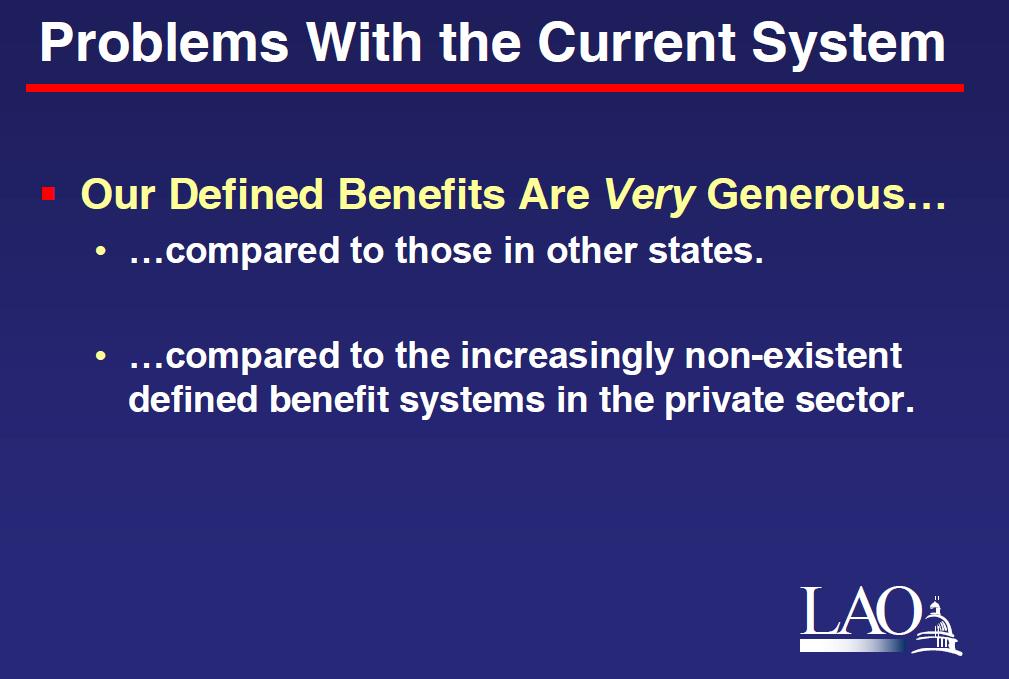
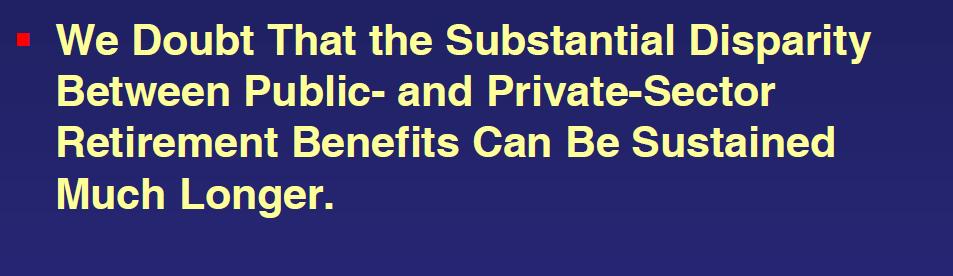
The California Legislative Analyst’s Office (LAO) really nails the issue with the below quotes, which embodies what is going to create real political conflict between those with defined benefit pensions versus those who don’t and the younger generation who has to pay for them.   The sad thing is that it’s not the fault of government retirees but the political leaders who set up the system.  Their incompetence has sown the seeds for the coming ugly war between generations.   The LAO is correctly reading the political tea leaves,  “We doubt the substantial disparity….can be sustained much longer.”

We just read a report of a retired county employee in Northern California who will receive his highest year’s pay for life,  $208k,  and in eight years will be eligible  to collect social security benefits.   Seriously, should this  guy be able to collect SSI when his all in private pension will probably exceed $250K per year at the same time the Feds are cutting veteran benefits?  We have nothing personal against the  guy, but come on?  Henry Blodget also made promises to retirees dependent on 401Ks, who now are their playing golf on muni courses rather than Pebble Beach.

How do think the young teachers who are getting their $32K salaries cut feel?  Or citizens who feel less safe because counties are gutting their sheriff department budgets?  Even worse,  we’re cutting classroom education budgets to finance these types of pensions, while the Chinese doubles, triples, and multiplies their education budget.   A spectre is haunting the public sector and his name ain’t Phil! (click here if chart is not observable)
Posted in Bonds, General Interest, Muni Market, State and Local Government | Tagged , , , | Leave a comment

STRATFOR: Egypt’s Tipping Point

“There are some very heavy and complex negotiations underway. These negotiations are not just about titles or positions. There is also a lot of money involved, a lot of assets at stake, a lot of political careers on the line, and that has resulted in a lot of confused signals and messages that we have seen going back and forth throughout the day. Despite all of this, the military has a very difficult decision to make, and that is why we are going to be watching to see if the military actually follows through, steps in and forces Mubarak out.”

Read more: Dispatch: Egypt’s Tipping Point | STRATFOR

(Click here if video is not observable)

Posted in Egypt, Geopolitical, Politics | Tagged , | Leave a comment

Irish Opposition Balks At Bank Bailout, Moody’s Downgrades

The Irish Times is reporting this morning that the two main opposition parties, Fine Gael and Labour, want to delay the banking system’s recapitilasation until April, when the stress testing of lenders is complete.

The Labour Party is taking an even harder line,

Labour party leader Eamon Gilmore was even more emphatic, saying his party would not put any further capital into Bank of Ireland, AIB and EBS building society before renegotiating the bailout with the International Monetary Fund (IMF) and the EU…Under that renegotiation, Labour would insist on “burden sharing” with bondholders as part of bank restructuring, he said.

Moody’s just downgraded the unsecured bonds of some major Irish Banks.

We’ve consistently maintained the European debt crisis is all about the politics and it appears they’re moving against a unified solution. German Bundesbank President Axel Weber’s decision to pull out of the running to replace Jeane Claude Trichet at the ECB complicates matters even further.   This tips the balance toward a weaker Euro going forward, in our opinion.  (click here if chart is not observable)

Posted in Euro, PIIGS, Policy, Politics, Sovereign Debt, Sovereign Risk | Tagged , , , | 1 Comment

Nonlinear Thinking: 3D Printing To Revolutionize Manufacturing

The Economist has a great piece out today on the coming revolution in manufacturing with 3D printing, which could have as a profound impact on the world as the factories once did.

It works like this. First you call up a blueprint on your computer screen and tinker with its shape and colour where necessary. Then you press print. A machine nearby whirrs into life and builds up the object gradually, either by depositing material from a nozzle, or by selectively solidifying a thin layer of plastic or metal dust using tiny drops of glue or a tightly focused beam. Products are thus built up by progressively adding material, one layer at a time: hence the technology’s other name, additive manufacturing. Eventually the object in question—a spare part for your car, a lampshade, a violin—pops out. The beauty of the technology is that it does not need to happen in a factory. Small items can be made by a machine like a desktop printer, in the corner of an office, a shop or even a house; big items—bicycle frames, panels for cars, aircraft parts—need a larger machine, and a bit more space…

By reducing the barriers to entry for manufacturing, 3D printing should also promote innovation. If you can design a shape on a computer, you can turn it into an object. You can print a dozen, see if there is a market for them, and print 50 more if there is, modifying the design using feedback from early users. This will be a boon to inventors and start-ups, because trying out new products will become less risky and expensive. And just as open-source programmers collaborate by sharing software code, engineers are already starting to collaborate on open-source designs for objects and hardware.

This fits our theme of decentralization, from farming to energy, which we believe will be a mega trend over the next 50 years.  There may be little need for factories as local towns or businesses have their own fabricators and could result in a massive repatriation of manufacturing back to developed countries from low wage manufacturing countries.

Our sense is the Chinese are already onto this and is a major reason why they’re moving quickly as possible away from the Chimerica model.   The article is worth a read and we highly recommend taking an hour or two getting familiar with the theme.  A lot of money is going to made with this theme, both at the micro and macro level, in our opinion.   (click here if video is not observable)

Related Articles
Print me a Stradivarius – Economist
3D printing: The printed world – Economist
3-D Printing Spurs a Manufacturing Revolution  – NY Times
Scott Summit — The Future of 3D Printing – Video

Posted in BRICs, China, General Interest, Japan, Nonlinear Thinking, Technology | Tagged , , , | 5 Comments

Deep US-Saudi rift over Egypt – Debka

Another must read from Debka.  These guys give a good inside scoop of what’s happening and explains why Mubarak is not stepping down and it’s not good,

The conversation between President Barack Obama and Saudi King Abdullah early Thursday, Feb. 10, was the most acerbic the US president has ever had with an Arab ruler, debkafile’s Middle East sources report. They had a serious falling-out on the Egyptian crisis which so enraged the king that some US and Middle East sources reported he suffered a sudden heart attack. Rumors that he had died rocked the world financial and oil markets that morning and were denied by an adviser to the ruling family. Some Gulf sources say he has had heart attacks in the past…

The king chastised the president for his treatment of Egypt and its president Hosni Muhbarak calling it a disaster that would generate instability in the region and imperil all the moderate Arab rulers and regimes which had backed the United States until now…

This could be a high impact event.  We’re getting long gold and oil as a hedge.  The U.S. is getting some bad intelligence. 


Posted in Commodities, Crude Oil, Egypt, Energy, Geopolitical, Gold | Tagged , , | 1 Comment

Ken Rogoff Expects “Serious Social Unrest” in the U.S.

Now this is depressing but not surprising.  Forbes writes,

Harvard economist Kenneth Rogoff, co-author of a best-selling book on financial crises, This Time It’s Different, told Forbes today in an exclusive interview that the high unemployment rate and high levels of debt in the U.S. will sooner or later trigger serious “social unrest from the income disparities in the U.S.”


Posted in Employment, Geopolitical, Politics, Sovereign Risk | Tagged , | 1 Comment

Sarkozy and G20 to Crackdown on Food Specs

The following is an excerpt from the recently released European Commission report on commodity derivatives   The two charts, from the St. Louis Fed,  illustrate the parabolic rise in Commodity Index-Funds  over the past 8 years and the huge increase in correlation of commodities and equities.  This has gotten Sarkozy & Co all lathered up and he will likely use the French Presidency of the G20 to push tough reforms of commodity derivatives in the next year.  Be sure to keep this on your radar as not to be blindsided.

The financialization of commodities is a symptom of lose monetary policy and global imbalances of the past ten years, in our opinion.    After all, the money to speculate has to come from somewhere.   The recent spike in correlation of commodities and stocks illustrates that both have become,  at least in part, an inflation hedge.   We are sympathetic to limiting speculation in energy and foodstuffs, which can cause economic and social damage, but policymakers are mistakenly treating the symptom rather the root cause.    Furthermore,  gold is a relatively benign store of value  — food and energy are not  — and should be supported as such.    (click here if charts are not observable)

Posted in Commodities, Crude Oil, Food Prices, Policy | Tagged , , | Leave a comment

Quote of the Day

The Stone Age did not end because of lack of stones, and the Oil Age will end soon and not because of lack of oil. –  Sheik Ahmed Yamani, 2000 Saudi Arabia

Posted in Crude Oil, Quote of the Day | Tagged , | 1 Comment

Egypt’s economy close to meltdown – Debka

We highly recommend you read the latest from Debka on Egypt.  Here is the money quote:

A high-ranking US source in Washington told debkafile’s sources that the situation in Egypt is so appalling that a military takeover of the regime is no longer a threat but the only hope of rescuing Egypt from economic meltdown. Yet at this critical moment, he said, “the Egyptian army appears to have no figure capable of saving Egypt.”

Posted in Economics, Egypt, Geopolitical, Politics | Tagged , , | 1 Comment

Nonlinear Thinking: The Skin Gun

We’ve written about our belief of the coming explosion of new technologies.  Go no further than this video.   If governments will balance their budgets, minimize the economic distortions of their actions,  provide quality education,  and stay out of the way and let these guys/gals innovate and do their thing,  our children and grandchildren will have a better life.   Hat tip to Larry W. !   (click if video is not observable)

Posted in Nonlinear Thinking, Policy | Tagged , , | 2 Comments
