Risk Management: Watch the Hang Seng

You know our schtick by now that we view the Hang Seng Index as the indicator species for global risk appetite and a signal as to whether the Mainland’s economy will land hard or soft.  Since returning from the Lunar holiday the Hang Seng is down 3.1 percent and has broken its 50-day moving average.   We  sense a growing concern about China’s economic situation as they continue to tighten monetary policy.

We’ve lightened up a little and monitoring the Hang Seng closely and a break of 22,600 would lead us to reduce risk across the board and get short certain commodities.  A break in China would almost instantly turn all the market chatter about inflation into deflation, in our opinion.   We are not certain where the Hang Seng and China are headed but we do know our action plan if certain support is broken.

By the way, have you been watching the bloodbath in Brazil and India, and today’s flop in the Korean ETF?  Also watch carefully the response of the British Pound if the BoE raises rates tomorrow.    (click here if chart is not observable)

Posted in China, Equities, Monetary Policy | Tagged , , , , , | 2 Comments

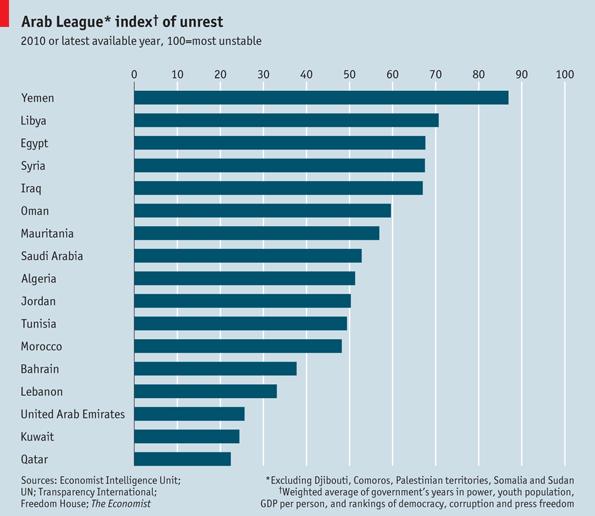
Measuring Arab Unrest: The Shoe Thrower’s Index

Here’s something interesting from the Economist,

An index of unrest in the Arab world

IN THIS week’s print edition we ran a table showing a number of indicators for members of the Arab League. By adding a few more and ascribing different weights to them we have come up with the Shoe Thrower’s index, which aims to predict where the scent of jasmine may spread next. Some factors are hard to put a number on and are therefore discounted. For instance, dissent is harder in countries with a very repressive secret police (like Libya). The data on unemployment were too spotty to be comparable and so this important factor is discounted too. We took out the Comoros and Djibouti, which do not have a great deal in common with the rest of the group, and removed the Palestinian territories, Sudan and Somalia for lack of data. The chart below is the result of ascribing a weighting of 35% for the share of the population that is under 25; 15% for the number of years the government has been in power; 15% for both corruption and lack of democracy as measured by existing indices; 10% for GDP per person; 5% for an index of censorship and 5% for the absolute number of people younger than 25. Jordan comes out surprisingly low on the chart, which suggests the weighting might need to be tweaked. Post suggestions in the comments below and we will refine it.

(click here if chart is not observable)
Posted in Egypt, Geopolitical, Policy, Politics, Sovereign Risk | Tagged , , , | Leave a comment

The Russia Forum 2011 – Faber and Taleb

Is Russia the Best or Worst in BRIC?

The discount to which Russia trades when compared to Brazil, China, and India begs the question of whether Russia is in fact a fast growing emerging economy. Whilst the consumer and financial sectors are positioned to for sustainable secular growth, corporate governance, minority investor protection, a very small domestic intuitional investor base, and the dominant role of the state in the economy unquestionably impacts the valuation of Russian financial assets. The discussion is prescient as it will cross over into the issue of governance.

(Click here if video is not observable)

Posted in BRICs, Video | Tagged , , , | 1 Comment

Egypt nears military coup. US warships in Suez Canal – Debka

Debka reports,

A fresh surge of popular anti-Mubarak protest ripping across Egypt Tuesday, Feb. 8 has brought the country closer to a military coup to stem the anarchy than at any time since the street caught fire on Jan. 25.

Vice President Omar Suleiman warned a group of Egyptian news editors that the only choice is between a descent into further lawlessness and a military takeover in Cairo. The distinguished political pundit of the 1960s and 1970s Hasnin Heikal saw no other way out of the crisis but a government ruling by the army’s bayonets.

The arrival of US naval, marine and air forces in the Suez Canal’s Greater Bitter Lake indicated that the crisis was quickly swerving out of control.

Debkafile’s military sources report that the American force consists of the USS Kearsarge Expeditionary Strike Group of six warships. Helicopters on some of their decks are there to carry and drop the 2,200 marines of the 26th Marine Expeditionary Unit which has been bolstered by two special operations battalions.

The flotilla has a rapid strike stealth submarine, the USS Scranton, which is designed to support special forces’ operations.

The US strike force has taken up position at a strategic point opposite Ismailia between the west bank of the Suez Canal and its eastern Sinai bank. It is poised for rapid response in the event of the passage of about 40 percent of the world’s marine freights through the Suez Canal being threatened or any other extreme occurrence warranting US military intervention.

For a few hours Tuesday, it looked as through Egypt was finally going back to normal after a two-week popular uprising. But then, suddenly, thousands again took to the streets and squares of Egyptian towns – from the Western desert on the Libyan border up to the northern Sinai town of El Arish in the east, recalling Hosni Mubarak’s warning of chaos if he were to depart too soon.

Tuesday, the protesters mounted their biggest demonstrations of their campaign to oust Mubarak – in Cairo, Alexandria, the Delta Cities, the industrial belt around Mahalla-el-Kebir and the steel city of Heluan, shouting “Death to Mubarak!” and “Hang Mubarak!”
Although reforms and pay hikes have been pledged by the new Egyptian government, large groups of workers, mainly in Cairo, rebelled against state-appointed managements and set up “Revolutionary Committees” to run factories and other work places, including Egyptian state TV and Egypt’s biggest weekly “Ros el-Yusuf.”

The stock market and the pyramids remained closed and traffic blocked solid on the streets of Cairo.

Posted in Egypt, Geopolitical, Uncategorized | Tagged , | 1 Comment

Real Gas Prices Approaching 1918 Peak

Yes, 1918!  This is one incredible chart from the American Petroleum Institute illustrating the secular decline in real gas prices for the past century with episodes of periodic price spikes, which lasted a decade or so.

So what was it that caused the reversal in the 80-year secular declining trend and huge price spike, which began in 2002/03?  Supply shock? Demand shock?  A sudden epiphany about the  potential rise of Chinese and Indian drivers?   Speculation?   Easy Monetary Policies?

We do find it interesting that it coincided with simultaneous price breakouts in almost all asset and commodity markets which eventually led to the 2008 economic and financial collapse.  The sharp rise in home prices, collapse of credit spreads, flattening of yield curves, rise in commodity prices, strength of foreign currencies against  the dollar, rally in global equity markets, and even the collapse of implied volatility all began in late 2002 – early 2003.

The credit bubble clearly gave the energy bull market its jump start and it seems just  yesterday (1998) that we were buying crude futures at $10 per bbl.   Did the credit bubble accelerate the Chimerica story and its subsequent global monetary imbalances?  Another interesting question/observation is that the last big spike in real gas prices, which began with the first OPEC supply shock peaked with the appointment of Paul Volcker as Chairman of the Federal Reserve.  And to think the political hacks in the Obama White House neutered his influence.  Shame on them!

We’re going to explore all these issues in future posts so stay tuned!

(click here if chart is not observable)

Posted in BRICs, Charts, China, Commodities, Crude Oil, Monetary Policy, Real Estate | Tagged , , | 2 Comments

Meryl Streep to Play Maggie Thatcher in “Iron Lady”

One of the last leaders who had spine and could say no.  Her advice to Bush 41, who was wavering on the first Gulf War, “Don’t go wobbly on me now George,” was classic.

She was referred to sometimes as “Reagan with balls.”  Her famous line,  “T.I.N.A” –  There  Is No Alternative – will be appropriate during the public sector restructuring, which is coming and will be both painful and full of strife.   The government’s “free lunch” is pretty much spent.

Regardless of your politics you had to respect her for toughness and leadership.  Meryl’s resemblance of the Iron Lady is striking.  Here is Deadline London‘s take on the movie,

Pathé UK has released the first shot of Meryl Streep as British Prime Minister Margaret Thatcher. Streep is in the 2nd week of filming The Iron Lady here in London. It’s the first feature from director Phyllida since she directed Streep in Mamma Mia. Jim Broadbent plays Thatcher’s husband Dennis. Damian Jones is the producer. Fox will release here in Britain through its output deal with Pathé, which is handling international sales itself. Pathé will unveil footage at Cannes. North American rights are still unsold. “I am trying to approach the role with as much zeal, fervour and attention to detail as the real Lady Thatcher possesses – I can only hope my stamina will begin to approach her own,” says Streep.

(click here is picture is not observable)

Posted in General Interest, Politics | Tagged , | 1 Comment

Witness List for Ron Paul’s Fed Hearing

Domestic Monetary Policy and Technology Subcommittee Chairman Ron Paul announced the witnesses for the Subcommittee’s hearing to examine the impact of Federal Reserve policies on job creation and the unemployment rate. The hearing will be held on Wednesday, February 9th at 10 am in room 2128 Rayburn.

No Fed Officials scheduled to testify at the hearing.

Thomas J. DiLorenzo, professor of economics, Sellinger School of Business, Loyola University, Baltimore, Maryland

Thomas James DiLorenzo (born August 8, 1954) is an American economics professor at Loyola University Maryland.[1] He is an adherent of the Austrian School of Economics. He is a senior faculty member of the Ludwig von Mises Institute and an affiliated scholar of the League of the South Institute, the research arm of the League of the South,[2] and the Abbeville Institute.[3] He holds a Ph.D. in Economics from Virginia Tech.[1]

Dr. Richard Vedder, professor of economics, Ohio University

Ph.D. University of Illinois, 1965.

FIELDS OF SPECIALIZATION: His major fields of specialization are Economic History and Public Policy.

RESEARCH ACTIVITIES: American immigration, economic issues in American education, and the interrelationship between labor and capital markets.

Dr. Josh Bivens of the Economic Policy Institute, Washington, D.C.

Areas of expertise
Macroeconomics • Globalization • Social Insurance • Public Investment

Biography
Josh Bivens joined the Economic Policy Institute in 2002. He is the author of Everybody Wins Except for Most of Us: What Economics Teaches About Globalization and has published numerous articles in both academic and popular venues, including USA Today, The Guardian, The American Prospect, Challenge Magazine, and Worth. He is a frequent commentator on economic issues for a variety of media outlets, including NPR, CNN, CNBC, Reuters and the BBC.

Education
Ph.D., Economics, New School for Social Research
B.A., Economics, University of Maryland at College Park

Complete listing of EPI publications by Josh Bivens

Posted in Monetary Policy, Politics | Tagged , , | Leave a comment

Trichet Says Bond “Haircuts” Would Reward Short Sellers

A few week ago ECB President, Jean Claude Trichet, torched the short sellers of the Euro and he is now warning Members of the European Parliament (MEPs) that demanding “haircuts” from bondholders in Greece and Ireland would reward the short sellers.

This guy either: 1)  dislikes the short sellers;  2)  has huge exposure to the PIIGS banks and is denial that they can’t pay it all back;  3)  realizes that the European banking system is overly exposed to the PIIGS and cannot yet afford to take haircuts and/or fully reserve their exposure;   4) is buying time before the inevitable haircuts take place to give European banks time to reduce their exporsure; 5) waiting for a more comprehensive agreement and political unity on how to deal with the Eurozone sovereign/bank crisis; and 6) working behind the scenes designing a Greek haircut that will even wow Parisians.     We vote all of the above.

You can read more and listen to the Trichet response by clicking here.

Posted in Credit, Economics, Euro, Monetary Policy, PIIGS, Sovereign Debt, Sovereign Risk | Tagged , , | Leave a comment

Germany Rising – Keine Gehäuse Bubble

The latest Economist reports the Germans are the most optimistic they have been since 2000 and business confidence is at its highest level  since the Ifo institute began tracking it 20 years ago.    The Economist writes,

What’s Germany’s secret? It helps that the country did not experience a property or credit bubble, and that it has kept its public finances admirably under control. But above all Germany’s success has been export-driven: unlike most other big rich economies it has maintained its share of world exports over the past decade, even as China has risen.

No housing bubble and an export driven economy.   Here’s a chart which provides a sense of why the Germans are so incensed at bailing out their Eurozone brethren.  They’re paying for the cleanup for a party they didn’t attend.  German house prices basically flatlined during the great global housing bubble.  (click here if chart is not observable)


Posted in Economics, Euro, Geopolitical, Sovereign Debt, Sovereign Risk | Tagged , , | 2 Comments

Peru’s Meltdown

A  good friend from the hedge fund community and one of the best economists to have ever worked in the financial markets, and who also happens to be from Peru sent over a piece on the Andean glacier melt from the Washington Post.   He’s a very smart guy and when he gets lathered up on an issue we listen.

Peru is home to 70 percent of the world’s tropical glaciers and world’s largest tropical ice mass, which are vital to the Andean region’s electricity production, drinking water, and irrigation.  The glaciers are melting much faster than scientists had predicted and some now estimate that entire glaciers across the Andes will disappear in 10 years due to rising global temperatures.

You think Egypt and North Africa are unstable?  Imagine the economic and social devastation ergo political instability that will take place in the region over the next decade if these guys are right and nothing is done.

The Washington Post writes,

More than 2 million people, stretching from the Andes to the coastal cities, get their drinking water and irrigation from rivers fed by glacier runoff from Cordillera Blanca. But research by Cesar Portocarrero, the Peruvian government’s lead glacier scientist, shows the Cordillera Blanca has lost 30 percent of its glaciers since 1970.

Most of Peru’s agriculture is fed by water from the Andes. Glacier-fed rivers also support the nation’s largest hydroelectric plants. Lima, the world’s second-largest desert city, is almost totally dependent on Andean rivers from the Cordillera Central, where some mountains have lost more than 60 percent of their glaciers in the last 40 years.

Water conflicts have been frequent in southern Peru over the last few years, and glacier melt will create even more across the country, and, in extreme cases, spreading to neighboring countries, said retired Maj. Gen. Luis Palomino Rodriguez, head of Peru’s National Civil Defense Institute, in an interview.

The Pentagon is starting to address the impacts of climate change. It gave the Southern Command, in charge of Latin America, $600,000 to develop a mapping tool that will allow Latin America and the United States to share information about climate change risks. It is also spending $1.4 million to study the climate change effects on foreign military bases.

By the way, a new study has found that 65 percent of the Himalayan glaciers, which feed 10 rivers that provide water to 20 percent of the world’s population, are also melting at an alarming rate.  We’ve seen the damage the housing bubble deniers have done.  The fallout from the climate change deniers, who raise just enough doubt and uncertainty to justify not acting and/or to paralyze the political process, could destroy civilizations.  No wonder capital is flowing into liquid assets.

(click here if picture is not observable)

Posted in Clean Tech, Commodities, Economics, Food Prices, Geopolitical, Policy, Politics | Tagged , , | Leave a comment
