Ron Paul to Hold Feb 9th Hearing on Federal Reserve

Press Release,  February 2, 2011

WASHINGTON:   Domestic Monetary Policy and Technology Subcommittee Chairman Ron Paul announced today the Subcommittee will meet for a hearing to examine the impact of Federal Reserve policies on job creation and the unemployment rate. The hearing will be held on Wednesday, February 9th at 10 am in room 2128 Rayburn.

Subcommittee Chairman Paul said, “I’m very pleased to hold our first subcommittee hearing in the new Congress on a topic that could not be more critical, namely unemployment.  Despite enormous amounts of monetary and credit expansion by the Federal Reserve in recent years, the nation’s unemployment picture remains bleak.  While many focus on the impact of fiscal policies on employment,  the effect of monetary policy often goes unexamined.  In my view we are now experiencing the bust that inevitably results from the misallocation of capital and human resources in a period of artificially cheap credit.  It is important to understand the Federal Reserve’s role in creating today’s unemployment crisis, while also highlighting that high unemployment and low economic growth can persist even in the face of tremendous monetary inflation.”

The Federal Reserve has taken unprecedented action to provide liquidity to financial markets and some U.S. corporations; however, unemployment remains above 9 percent.  The hearing, entitled Can Monetary Policy Really Create Jobs?, will focus on the Fed’s recent actions, the likelihood those actions will reduce unemployment, and the critical role of the private sector in job creation.

While the Obama administration and Democrats in Congress believe increased government spending will improve the nation’s economy, Republicans on the Financial Services Committee know economic growth depends on providing the private sector, especially small businesses, with the certainty they need to create jobs.  The Fed’s policies, as well as the Obama administration’s unsustainable debt and spending, continue to prevent small business owners from growing and hiring because of continued uncertainty over new taxes, higher interest rates, and the expanding role of government in the economy.

On November 3, 2010, the Federal Reserve announced that it planned to purchase $600 billion in long-term Treasuries (dubbed “QE2”).  This is the second time since the 2008 financial crisis that the Federal Reserve has engaged in quantitative easing. The latest round of quantitative easing, along with the Fed’s action to bailout financial companies, has added trillions of dollars to the government balance sheet.

Click here for witness list
Posted in Employment, Monetary Policy | Tagged , , , | 1 Comment

Motorola’s Superbowl Smackdown of Apple

Did the Motorola Xoom commercial look a little familiar?  We like competition and trying to limit it may be Apple’s Achilles’ heel.

For those too old or too young to recall,  here is Apple’s 1984 Superbowl commercial introducing the Mac, which was a smackdown of the IBM PC.

(click here if videos are not observable)

Posted in Apple, General Interest, Video | Tagged , , | 1 Comment

Week in Review: Bonds Crack and EU to Crack Specs

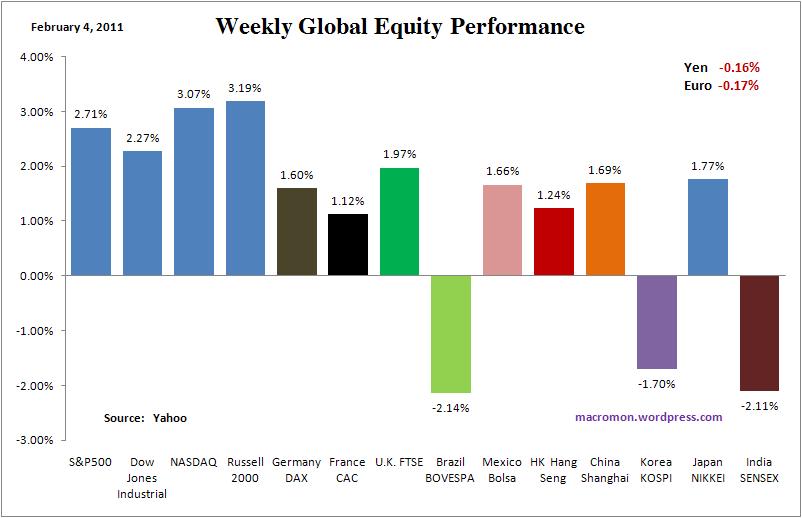
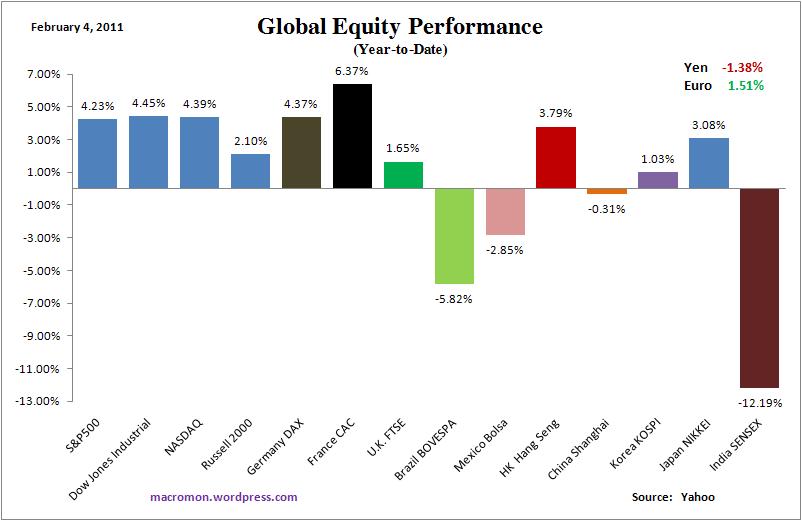
Nice bounce back last week for equities x/emerging markets.  The Russell and Nasdaq were up 3 percent with the S&P500 and Dow increasing over 2 percent.  France continued its run and is now up almost 6 ½ percent for the year.  Asia was out most of the week on holiday.  Brazil and India continued to get hammered, both down over 2 percent for the week.  Money is clearly coming out of emerging equities and there just doesn’t seem to be any sellers of U.S. equities to feed the shorts and those looking for a correction.

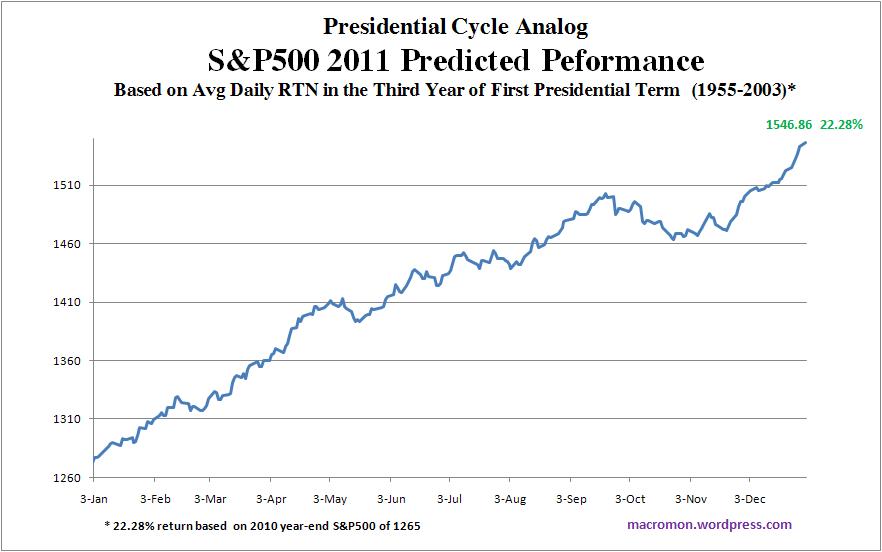
Furthermore,  U.S. equity markets are not giving the under invested much of a chance to get in.  This is not surprising given the behavior of Presidential Stock Cycle.  The third year of the first Presidential term is usually a straight shot up and has, on average, generated a 22 percent annual return since 1955.   We, in hindsight, got overly cautious last week on the Egypt noise and didn’t benefit as much from last week’s bounce back.   This is the cost of risk management in trading, however.

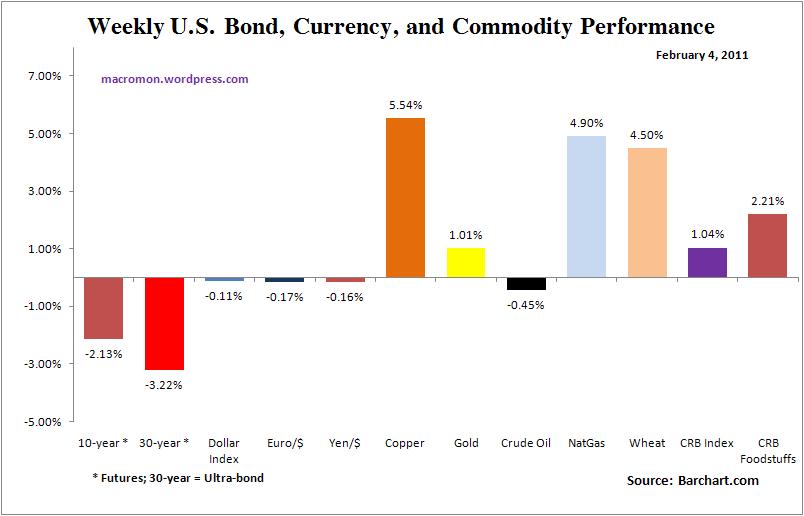
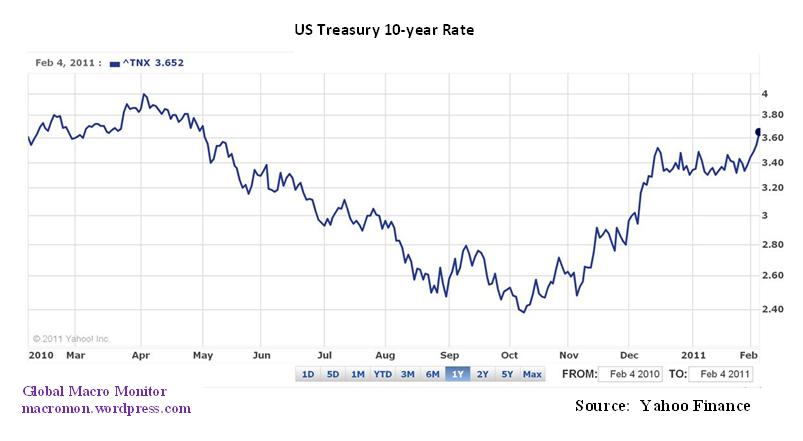
The brighter outlook for the developed economies continued to pressure bonds with the 10-year U.S. Treasury rate piercing key resistance at 3.52 percent.  The next stop for the 10-year looks to be last April’s high of 4 percent.  The key is the reason and how fast we get there.

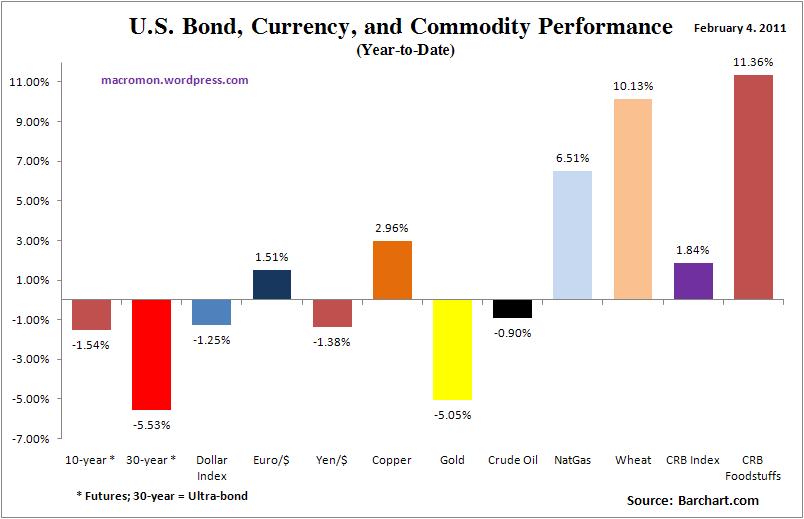
The dollar was relatively flat and copper, natural gas, and the foods had good moves.  The CRB foodstuffs sub-index and wheat prices are now up over 10 percent for the year.  Full blown panic buying and hoarding is driving the market and we expect a G20 crackdown on speculation in the next few months.  The EU just released their report on the financialization of commodities and the future exchanges are increasing margin requirements.

Gold is behaving as if monetary policy in the Europe and the U.S. may be changing sooner rather than later and having trouble with the rise in long-term rates.  The market also may be concerned about a short-term reversal in capital flows to emerging markets, which would slowdown reserve accumulation.  We’ve gotten whipsawed trading the yellow metal in the past few weeks and are waiting patiently to see if first the recent low of $1,311 holds and  watching the 200-day moving average at $1,290.

The ECB dismissed rumors of an imminent hike  in rates and it now looks like their tough talk on inflation was mainly designed to squeeze the Euro shorts.  We may see some follow through selling in the Euro this week.  Are the Eurozone countries going to agree to a more uniform retirement age?  We restate our position that there is an abundance of short-term liquidity in Europe, but a shortage of political unanimity and the potential for adjustment fatigue.    We just witnessed in Egypt how politics can at times be just as unpredictable, volatile, and unstable as markets.

We remain bullish on U.S. equities, particularly transformative tech, such Apple, Micron, Arm Holdings (UK company), among others of the mobile revolution.   We’re still concerned about China, emerging equities, and commodities and betting on a nice pullback in crude oil.  If concerns grow over a hard landing China, commodities could sell-off hard here.

The key issues for next week:  1) the Bank of England’s decision on monetary policy, where economists now think there is a 33 percent probability of a rate hike, and how markets react if they do hike rates; 2) How the markets and Chinese workers behave after the return from Lunar New Year holiday;  and 3) Ron Paul’s first hearing as Chairman  of the Domestic Monetary Policy and Technology Subcommittee on Wednesday;  and 4) long-term U.S. bond rates;  and 5) Bank of Korea on Friday.   Have a great week!

(click here if charts are not observable)

Posted in Week in Review | Tagged , , , , | 1 Comment

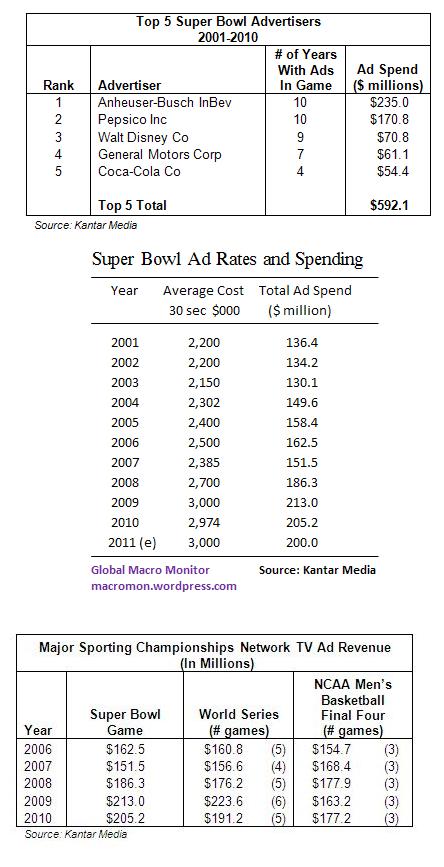
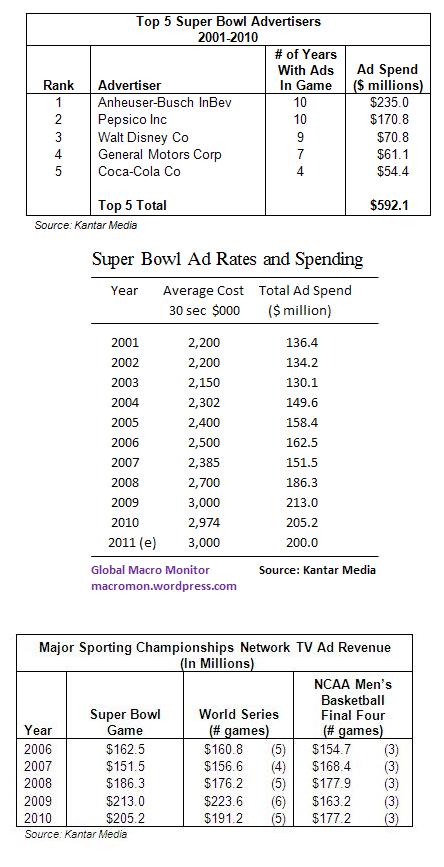
Annualized Cost of Super Bowl Ad = $3.2 TN, German GDP

Here’s a little fun breaking the law of large numbers on the eve of the Superbowl.   The cost of a 30 second ad during game time will average around $3 million.  You we do the math:

That’s one big nut and almost equivalent to the size of German GDP, the world’s fourth largest economy!  It also illustrates the law of compounding recurring revenue, the goal of every good business on earth.

Also check out this Nightline video on Superbowl advertising and this on how Go Daddy is once again testing the limits of the “value at risque” model!   (click here if tables are not observable)

Posted in Charts, Economics, General Interest, Uncategorized | Tagged , | 5 Comments

The Weekend Read: Superbowl Sunday

Sunday’s game featuring the Green Bay Packers and Pittsburgh Steelers is believed to be the first Super Bowl without cheerleaders since Super Bowls II, said NFL Films president Steve Sabol.

Only six NFL franchises do not use official cheerleaders, including the Steelers and the Packers. The others: Cleveland Browns, Chicago Bears, Detroit Lions and New York Giants.   – USA Today

Bonds
Bonds Tumble After Snow-hampered Payroll Report – Daily Markets
Japan debt bubble likely to burst in few years – Bloomberg
Treasuries May Crash, But Shorting Them Isn’t Worth the Risk – SF Gate
Treasury to Roll Out Fannie, Freddie Reform Next Week – CNBC

China
Inflation Slowing China’s Export Engine – NY Times
U.S. Declines to Call China a Currency Manipulator, Progress ‘Insufficient’ – Bloomberg
What China’s Leaders Need to Learn from Egypt’s Turmoil – CNBC

Commodities
Chinese corn imports forecast to soar – FT
Corporate America braces for commodity crunch – CNN
Rising Commodities Put Profits Through the Wringer – Barron’s
U.S. Commodities: Oil Falls on Jobs Data, Gasoline Inventories – Bloomberg
Yum Faces Commodities Headwinds As It Plans More Expansion – WSJ

Credit
Hungry investors return to ‘covenant-lite’ deals – FT

Economy
Falling U.S. housing prices and rising foreclosures cause a policy quagmire – Economist
Global Economic Data Watch – FT
The Inequality Wildcard – Ken Rogoff
The Jobs Report, And America’s Two Economies – Robert Reich
U.S. Economy Turns the Corner – Economist
U.S. Job growth remains sluggish, though unemployment drops to 9% – LAT

Emerging Markets
Chile peso hits 1-mo high, Mexico breaks 12/dlr – Reuters
Latam stocks fall as Brazil hits 5-month low – Reuters
IMF’s Lipsky: Emerging Markets Need Tighter Monetary, Fiscal Policies – WSJ
Important Fibonacci Level To Watch In India Nifty INDY – Daily Markets

Eurozone
Cracks over Franco-German eurozone plan – FT
Divergence over convergence – Economist
Europe’s Futile Search for Cheaper Money – Daniel Gros
France, Germany Launch Competitiveness Pact – CNBC
Merkel’s Plan Could Transform the European Union – Der Spiegel
What Germany’s got right, and what it hasn’t – Economist

Flows
Investors pull $7bn from emerging funds – FT

Geopolitical
Mubarak Hired Rural Poor to Attack Opposition – Der Spiegel
The Tunisian Catalyst – Joseph Stiglitz
The West should celebrate, not fear, the upheaval in Egypt – Economist
“Youth of Tahrir Square Won” – Egyptian CEO – CNBC

Monetary Policy
Economists warn of one-in-three chance BoE raises rates next week – Mail Online
Fed denies policy is causing food rises – FT
Is Bernanke Nuts — Ignoring Inflation? – Forbes
SF Fed’s Williams: Economic Models Show Fed Funds Rate Should Be -4% – MNI

What Really Matters This Weekend
Do Top-Rated Super-Bowl Ads Get A Post-Game Bounce? – CNBC
Chrysler looks to score with 2-minute Super Bowl ad – Reuters
Kantar Media Reports Super Bowl Spend Reached $1.62 Billion In Past 10 Years – Kantar
The 10 best Super Bowl ads of all time – MSNBC
Watch the top Super Bowl Commercials from the past 13 years – SuperBowl-Ads.com
What Ad Airs When: The SuperBowl-Ads.com Cheat Sheet – SuperBowl-Ads.com

(Click here if tables and video are not observable)

Posted in The Weekend Read | Tagged , | 1 Comment

Mubarak Hired Rural Poor to Attack Opposition – Der Spiegel

This is stunning yet not surprising.  The German newspaper Der Spiegel reports,

In exchange for the equivalent of a few euros, poor seasonal workers have taken part in street fighting in Cairo on the side of Egyptian President Hosni Mubarak. The thugs, who fight with iron bars, knives and clubs, have been recruited by privileged members of the regime, including party officials, security forces and rich business people with lucrative state contracts…

These individuals have everything to lose — and are now depending on those who have nothing left to lose. The privileged members of the regime don’t want to get their hands dirty. Instead, they recruit their helpers from the rural and semi-rural regions, particularly from two provinces north of Cairo: Bahtim and Qalyub. The poor, who make up the majority of the population here, are easy prey. Many are distrustful of the demonstrators’ motives and fear that the movement is secretly pursuing other aims.

Posted in Egypt, Geopolitical | Tagged , | 1 Comment

Au revoir, Hosni?

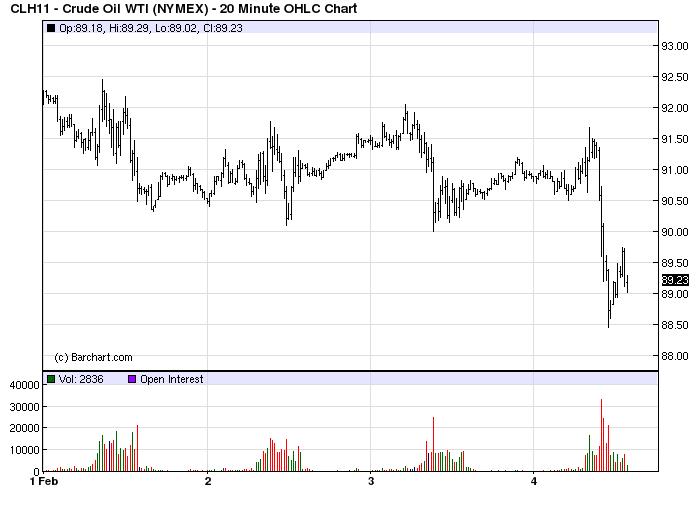
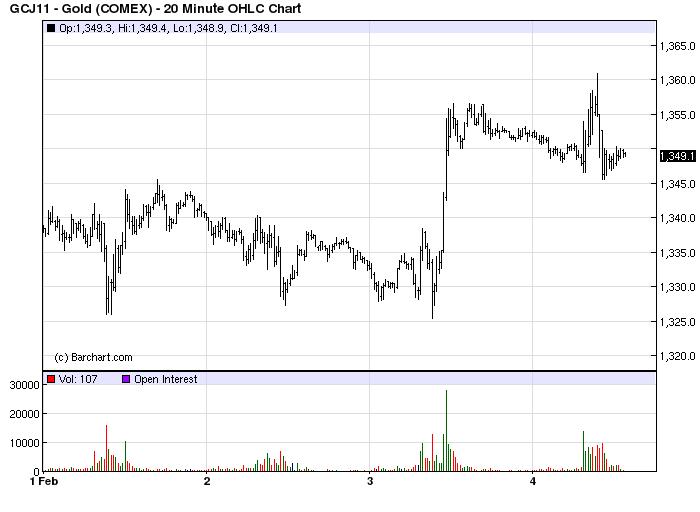
The crude and gold market are certainly trading as if Mubarak will be out before the weekend is over.  We heard an oil trader say that if democracy breaks out in Egypt, i.e., Mubarak is forced out, it would be positive for oil as instability would increase throughout the region.

Is the guy joking?  Freedom of expression,  freedom of press,  political participation will release pressure in the repressed powder kegs.  The rulers of these countries appear to get it and are moving to make political concessions in order to preempt the chaos and anarchy we are witnessing in Egypt.   Isn’t the world better off if the youth in Yemen are marching for democracy rather than joining terrorist groups?

No doubt uncertainty increases if democracy breaks out throughout the region, but we heard the same about the former Soviet Union, Eastern Europe, and even South Africa.   Long the “Arab Spring” and puts on crude oil.  (click here if charts and video are not observable)

Posted in Crude Oil, Egypt, Geopolitical, Video | Tagged , , | Leave a comment

America’s FIRE Economy

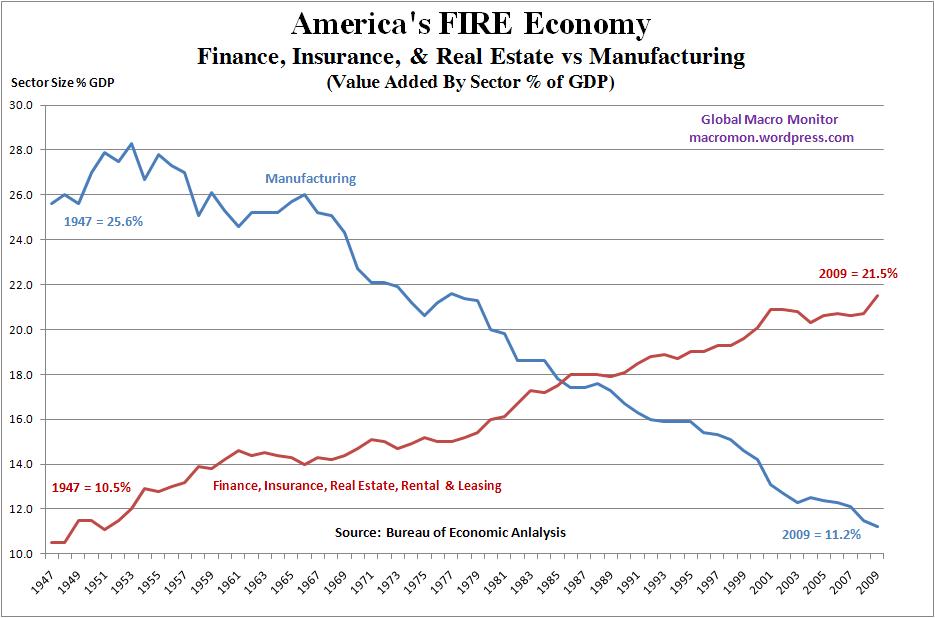
We suspect you’ve seen a version of the following chart, which illustrates the secular decline in manufacturing and the rise of finance, insurance, and real estate (FIRE) in proportion to U.S. GDP.   We’ve added a few years to the data series to give a better historical perspective of what’s taken place in the U.S. economy over the past 60 years.   Note the crossover in 1986 and depending on where you sit it was either the Death Cross or the Golden Goldman Cross.

(click here if chart is not observable)

Posted in Economics, General Interest, Real Estate | Tagged , , | 25 Comments

Middle East Social Indicators

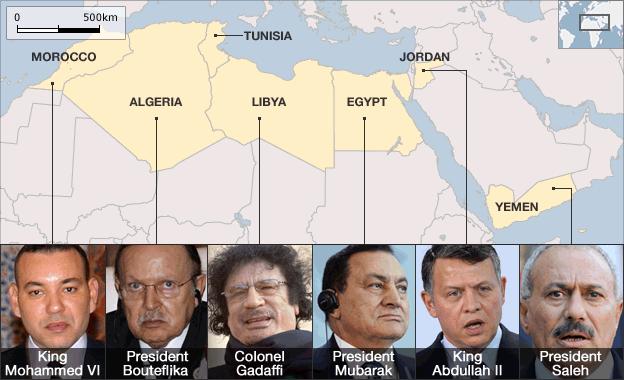
The BBC has a pretty good piece looking at Middle East countries where the unrest in Egypt could potentially spread.  We’ll let you link to the story, but we  found some data from article interesting and after tweaking and adding a few variables constructed the following table.

Note how young the median age is in these countries compared to, say,  Germany and Japan.   Yemen’s median age of just 17.9 years is stunning and it seems the only thing the country’s government has going for it in order to avoid contagion is the relatively low percentage of the population using the internet.

As an aside, we were also surprised to discover that China’s median age in only 1.6 years younger than the U.S. median age.  If repression wins,  Facebook and Twitter are going to be big shorts in these countries as they will be increasingly seen as political enemy number one by regimes under threat.  (click here if table is not observable)

Posted in Black Swan Watch, Egypt, Geopolitical, Politics | Tagged , , | Leave a comment

Will the Egyptian Army Remove Mubarak?

During the recent events the Global Macro Monitor, along with most of the rest of the world, has been impressed by the discipline of the the Egyptian army and their unwillingness to use force against their own people.  This reminds of us of the final days of the Soviet Union where the Red Army was unwilling to fire on its own people thus delivering the fatal blow to communist government and the ascendency of Boris Yeltsin.

It is hard to believe the widely respected Egyptian army will stand idly by as the country descends into chaos and anarchy and some in country seem to agree,

A former general from the Egyptian secret services told to Al Jazeera that he “expects the army will act to remove Mubarak from power … Mubarak is ready to burn the country”.

And this,

An unnamed former Egyptian intelligence general quoted by Al Jazeera has stated he expects the army to aid in removing President Hosni Mubarak from office amid protests turned violent again Wednesday.

“I expect the army will act to remove Mubarak from power … Mubarak is ready to burn the country,” said the ex-high ranking security officer according to the Al Jazeera live blog on events in Egypt.

What are they waiting for?  That is what is most troubling and it may reflect an epic struggle is also taking place in the highest ranks of the military. 

Posted in Egypt, Geopolitical | Tagged | 2 Comments