A must read from Der Spiegel of the inside account of Axel Weber’s resignation.
Bundesbank head Axel Weber’s resignation has made one thing clear: The debate about the future of the euro has become intense — and bitter. Indeed, Chancellor Angela Merkel’s efforts at mandating strict monetary discipline for the euro zone may ultimately fail. And German euro skeptics may be gaining ground.
The Germans have been the anchor of a “hard” Euro. Der Spiegel reports,
But then last May the ECB, in an effort to save the euro, decided to buy up government bonds of highly indebted countries like Greece, Portugal and Ireland. In Weber’s view, this was a serious violation of the ironclad principle that money should not be printed to finance government debt. In addition to criticizing the measure internally within the ECB council, Weber took the unusual step of making his reservations public. In doing so, he not only incurred the wrath of ECB President Trichet (“There is only one ECB statement, and it comes from me”), but he also ran afoul of most other members of the ECB governing council.
Finland’s Central Bank President, Erkki Liikanen, now appears to be the favorite to head the ECB. We look for continued selling in the Euro here.
We found some excellent data from a March 2010 USDA report on cross-country food expenditures and to no surprise lower income countries are getting slammed by the recent price spike. The table is fairly self-explanatory showing the proportion of expenditures allocated to food ranked by per capita real income relative to the United States. For example, Tanzania’s income is 2.04 percent of the U.S. and allocates 73.24 percent of expenditures to food.
The chart is also very interesting and illustrates how a marginal increase of one dollar in income would be allocated to various expenditures across the 114 countries listed in the table. The authors write the chart,
measures how consumers would allocate, say, an additional dollar of income across consumption goods, in our case, across nine broad categories of goods. They are also plotted in figure 1, which illustrates how the calculated marginal shares for the aggregate consumption categories vary across countries based on country income levels. The pattern is quite striking, with low-income countries allocating an additional unit of income for necessities (luxuries) at a higher (lower) relative share than high- and middle-income countries. For example, if incomes go up by $1 across all countries, the expenditures on food would increase by 54 cents in Tanzania and by 2 cents in the United States.
In further contrast, an additional $1 of income in Tanzania would increase expenditures on other, recreation, and medical care by 5 cents, 3 cents, and 4 cents, respectively, while the same additional dollar in the United States would increase expenditure on these three goods by 18 cents, 9 cents, and 13 cents, respectively (a difference in magnitude of 3 to 4 times). The difference in the magnitude of marginal spending by consumers in the two countries is about double for clothing and footwear, gross rent, fuel and power, housing operations, and transportation, while it is only about 1.3 times for education.
(click here if chart and table are not observable)
What a stock market! Just 29 days (11.5 percent of the year) of trading into the year and the S&P500 is already up 5.94 percent, outperforming the Presidential Stock Cycle chart analog by 150 bps. This market is not allowing anyone to get in and those who take profits end up buying back their stock 2 percent higher.
If you’re a buyer of this chart analog, the S&P500 is due for a rest and some sideways consolidation over the next month before making its next 6-7 percent move into May. That is, unless, of course, the S&P500 and other developed country stock markets, along with certain commodities, have become a global inflation hedge. Stay tuned!
Good piece in the USA Today about the headwinds the clothing industry is facing and the expected reversal of the almost 20-year decline in apparel prices. The USA Today/AP reports,
Clothing prices have dropped for a decade as tame inflation and cheap overseas labor helped hold down costs. Retailers and clothing makers cut frills and experimented with fabric blends to cut prices during the recession…But as the world economy recovers and demand for goods rises, a surge in labor and raw materials costs is squeezing retailers and manufacturers who have run out of ways to pare costs…Cotton has more than doubled in price over the past year, hitting all-time highs. The price of other synthetic fabrics has jumped roughly 50% as demand for alternatives and blends has risen…Clothing prices are expected to rise about 10% in coming months, with the biggest increases coming in the second half of the year, said Burt Flickinger III president of Strategic Resource Group.
We’ve charted inflation (see below) of the apparel component of the U.S. CPI, which amounts to only 3-4 percent of the consumer’s basket. The data clearly illustrates that a structural shift in apparel prices took place around January 1994, the month NAFTA was implemented. Since February 1994, the apparel component of CPI has registered year-on-year deflation in 68 percent of the monthly observations.
Mexico initially contributed to the decline in apparel costs and forced foreign textile manufactures to become more competitive due to the trade diversion caused by NAFTA. By the turn of the millennium China had developed into the world’s low cost textile manufacturer. The Dallas Fed studied this,
Comparing the trends in U.S. apparel imports from Mexico, China and countries that eventually became part of the Dominican Republic–Central American Free Trade Agreement suggests that trade diversion was behind the boom-and-bust cycle in Mexico’s textile and apparel maquiladoras.
In the early 1990s, China topped Mexico in apparel exports to the U.S. (Chart 2). A shift toward Mexico began with NAFTA’s signing in 1993 and accelerated with implementation in 1994.
When NAFTA lowered U.S. barriers, Mexican producers could compete in the huge market north of the border, even though other countries could produce textiles and apparel more cheaply. By the late 1990s, Mexico was picking up market share so rapidly against China that it briefly became the No. 1 apparel supplier to the U.S.
With NAFTA in place, Mexico also began to increase its U.S. sales more rapidly than the Central American nations. The gains continued until 2000, when the U.S. offered low-wage Caribbean and African countries some of the same benefits it had bestowed on higher-wage Mexico under NAFTA. Last year, the United States signed a broader preferential trade agreement with DR-CAFTA.
Meanwhile, China had developed highly competitive apparel export industries, helping it become the world’s low-cost producer. In 2001, China joined the World Trade Organization, just as the group was dismantling the Multifiber Arrangement, the textile and apparel quotas rich countries had maintained to protect their industries from imports. On a leveled playing field, China regained market share at the expense of both Mexico and Central America.
We haven’t seen the data but we hear and read of wage pressures in China pushing textile manufacturing off-shore to other low cost textile producing countries, such as the Philippines and Vietnam, for example. If global trade doesn’t breakdown, could Africa be the next big growth area for textile manufacturing or will the manufacturing ball be passed to technology? How about a shift to virtual apparel? (click here if chart is not observable)
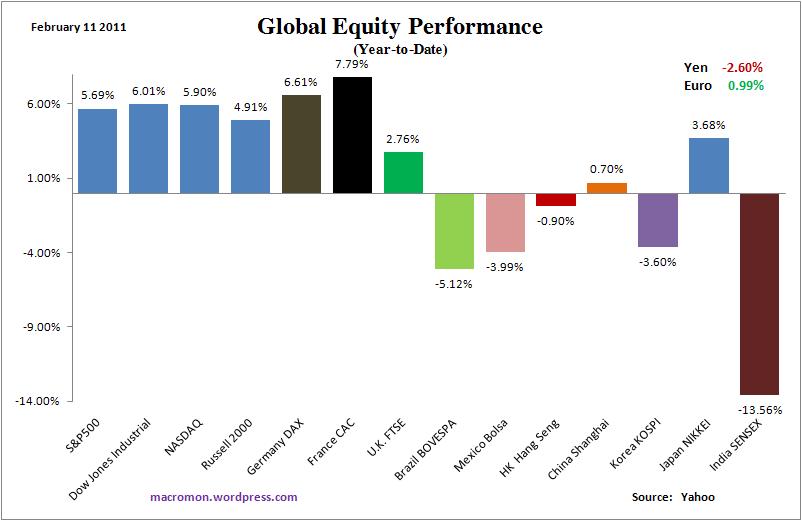
Most of the week’s focus was on Egypt and managing risk around China’s tightening cycle as Asia returned from the holiday. Developed equities continued their relentless rally with the Russell 2000 increasing 2.75 percent. The Hang Seng and KOSPI got crushed falling over 4 percent. We’re watching the 22,600 level on the Hang Seng as continued weakness and a break there could signal the correction in developed equity markets that everyone is waiting for.
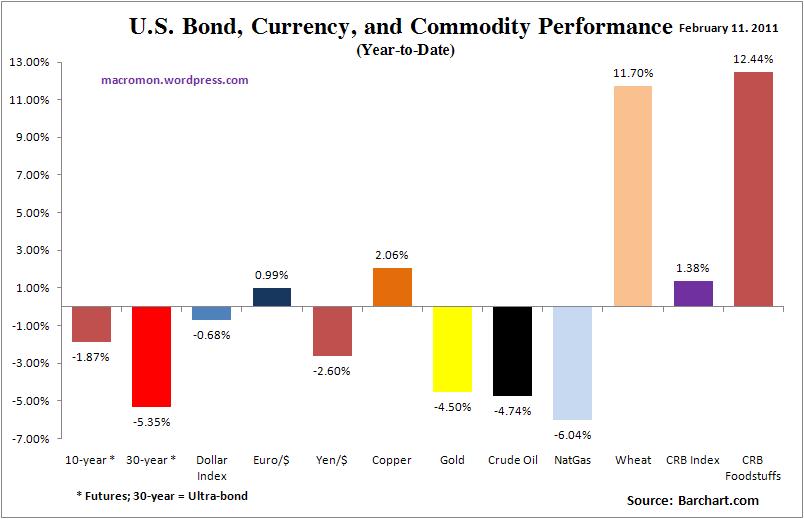
Commodities were weak, especially natural gas and energy though wheat and the foodstuffs continued their parabolic increase. Our sense is the foods are setting up for a correction here.
The flows remain bullish on U.S. and developed equities and we expect to see a little bounce in emerging equities in short term. Bespoke points out that the S&P500 needs a 1.79 percent gain to hit the 100 percent increase mark from the March 9, 2009 low and just a 17.76 percent increase to make it back to the all-time high. You think we can make the 17.76 number by July 4th? Don’t hold your breath but wouldn’t that be patriotic? (click here if charts are not observable)
State Sen. Lee Bright introduced legislation to create a new state currency in the event of a breakdown of the Federal Reserve System. The Spartanburg Herald Journal reports,
The Federal Reserve System has come under ever-increasing strain during the last several years and will be exposed to ever-increasing and predictably debilitating strain in the years to come, according to the legislation.
“If there is an attempt to monetize the Fed we ought to at least have a study on record that could protect South Carolinians,” Bright said in an interview Friday.
“If folks lose faith in the dollar, we need to have some kind of backup.”
…Per the legislation, South Carolina’s new currency could consist of “gold or silver, or both.”
Ultimately, the solution is, the root cause of the problem is we’re not printing our own debt free money. That is what we need to do. Like Abraham Lincoln’s greenback , we need to get back to printing our own debt free money.
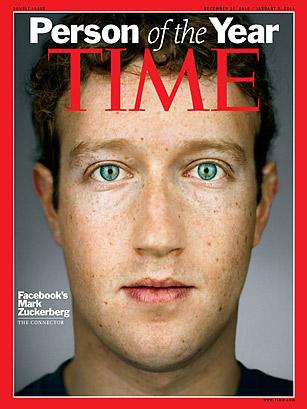
Time’s Man of the Year. Now the new Moses? The guy who’s invisible connectivity community helped bring down the Pharaoh of Egypt. Mark Zuckerberg getting credit for Egypt’s revolution? We were stunned last night as we watched Anderson Cooper and Wolf Blitzer interview the de facto leader of Egypt’s revolution, the “Google Ganhdi,” Wael Ghonim.
During the course of the interview Wolf Blitzer asked Ghonim where the next revolution would take place. He answered, “Ask Facebook.”
Isn’t the leader of a revolution in a Muslim nation supposed to answer, “Ask God?” In Tahrir Square square you could hear chants, “Muslim, Christian, doesn’t matter; We’re all in this boat together!” Didn’t Obama give a speech about this in Cairo in June 2009? This isn’t your father’s Islamic revolution, our friends.
You can watch the entire interview with the Google Ghandi in the video below. Here is the relevant excerpt from the transcript,
BLITZER: Wael, this is Wolf Blitzer in Washington. So first Tunisia, now Egypt. What’s next? GHONIM: Ask Facebook. BLITZER: Ask what? GHONIM: Facebook. COOPER: Facebook. BLITZER: Facebook. You’re giving Facebook a lot of credit for this? GHONIM: Yes, for sure. I want to meet Mark Zuckerberg one day and thank him, actually. This revolution started online. This revolution started on Facebook. You know, I always said that if you want to liberate a society, just give them the Internet. If you want to have a free society, give them the Internet.
The one meme of the Global Macro Monitor is “transformative tech” and it is now transforming the map of the Mid-East just as it did in the 2008 U.S. Presidential election. Lookout! Next up, Algeria?
Many people don’t know this, but China was the first country in the world to use a true fiat paper money currency system during the Yuan Dynasty from 1271-1368. The name of this currency was called the Chao. Eventually, the Chao collapsed due to excessive inflation and rampant printing of money. China’s current money-supply is of deep concern to many, even its own economic advisors, who often must comment with a limited amount of negativity regarding their own economy.
BLITZER: Wael, this is Wolf Blitzer in Washington. So first Tunisia, now Egypt. What’s next?
GHONIM: Ask Facebook.
BLITZER: Ask what?
GHONIM: Facebook.
COOPER: Facebook.
BLITZER: Facebook. You’re giving Facebook a lot of credit for this?
GHONIM: Yes, for sure. I want to meet Mark Zuckerberg one day and thank him, actually. This revolution started online. This revolution started on Facebook.
You know, I always said that if you want to liberate a society, just give them the Internet. If you want to have a free society, give them the Internet.
Bonds
Watch out for the canary in the Treasury coal mine – FT
Ask most investors where they are putting their money to work this year and not many will put up their hand and say US Treasuries… not only did the buyers turn up the next day, they did so in record numbers as 71.3 per cent of the $24bn issue was bought by large US and foreign investors, well above their recent average of 44 per cent.
It seems some large domestic and foreign investors, including central banks, are certainly happy buying Treasuries at current yields. Indeed, on Thursday, pension funds and long-term investors stepped up and bought a higher than usual share of the $16bn 30-year issue.
China
China Researcher: Emerging Economies Capital Inflows Face Some Reversal Risk-Report – WSJ
BEIJING (Dow Jones)–Emerging economies should be cautious as capital inflows to these markets face a higher risk of reversal this year, the central bank-backed Financial News reported Saturday, citing a researcher with an institute affiliated with the Ministry of Commerce.
Mei Xinyu, a researcher at the ministry-backed Chinese Academy of International Trade and Economic Cooperation, said emerging markets face difficult decisions in macroeconomic adjustment, and the U.S. and European economies have shown stronger data than expected.
The message for China from Tahrir Square – FT
The uprising in Egypt must have stunned Chinese leaders. Beijing has heavily censored news of the uprising, strongly indicating that the Chinese Communist party (CCP), which narrowly avoided collapse during a similar popular revolt in 1989, is gripped by the fear that it could encounter the same fate as befell Hosni Mubarak.
U.S. files two new trade cases against China with WTO – WashPost
The Obama administration said Friday that it had launched two new appeals against China to the World Trade Organization as new data showed the trade gap between the two countries rose to a record level last year.
Credit
First CDS traded and cleared under Dodd-Frank rules – FT
The first electronically executed and cleared credit derivative trades that follow the guidelines set out under the Dodd-Frank Act were conducted on Thursday via the Tradeweb platform
Geopolitical
In final hours, defiance surprises U.S. and threatens to unleash chaos – WPost
After a week of crossed signals and strained conversations, the Obama administration finally had good news: Late Wednesday, CIA and Pentagon officials learned of the Egyptian military’s plan to relieve President Hosni Mubarak of his primary powers immediately and end the unrest that had convulsed the country for more than two weeks…
But the Egyptian president decided at the last minute to change the ending.
“Mubarak called an audible,” the official said.
The Egyptian president startled many of his aides with an address, unseen by others, in which he appeared determined to cling to office. The speech surprised and angered the White House, enraged Cairo’s legions of protesters and pushed the country closer to chaos, current and former U.S. government officials said in interviews recounting the events of the past 48 hours.
Uncharted Ground After Stunning End of Egypt’s Regime – NY Times
CAIRO — One revolution ended Friday. Another may soon begin.
In a moment that may prove as decisive to the Middle East as the 1967 Arab-Israeli war, 18 days of protest hurtled Egypt once again to the forefront of politics in the Middle East. In the uprising’s ambition, young protesters, savvy with technology and more organized than their rulers, began to rewrite the formula that has underpinned an American-backed order: the nation in the service of a strongman.
Global Economy
U.S. Economy: Sentiment Climbs to Eight-Month High – Bloomberg
Consumer confidence rose in February to the highest level in eight months as decreasing unemployment lifted Americans’ spirits.
Eurozone
IMF, EU tell Greece to privatize $67 billion in state assets – Canadian Press
ATHENS, Greece — European and IMF debt inspectors told Greece Friday to privatize euro 50 billion (C$67 billion) in state assets and push through a punishing overhaul of government-run institutions in the next few months to keep the country’s troubled finances afloat.
Unanimity on euro reform will be sought at summit – Irish Times
EURO ZONE leaders will be pressed to reach unanimous agreement on new competitiveness measures in the single currency area when they meet at a summit next month to discuss reforms to their bailout scheme.
With many countries strongly resisting a German drive to deepen the scope of European economic governance rules, the push for a unanimous deal suggests Berlin’s proposal may have to be watered down.
Ireland’s negotiating position is not strong but any dilution of the German plan would be to Dublin’s advantage, given fresh pressure to harmonise corporation tax rules or rates.
Weber agrees departure date in April – FT
Germany’s Bundesbank president will stand down at the end of April, it was agreed on Friday, after a week of confusion that threw into doubt the country’s chances of securing the European Central Bank presidency later this year.
Axel Weber would step aside with effect from April 30, the government said after a meeting in Berlin between the Bundesbank president and Angela Merkel, the chancellor.
Monetary Policy
Bank of Korea’s timid monetary policy – The HANKUOREK
Yesterday, the Bank of Korea’s (BOK) Monetary Policy Committee froze the key interest rate at 2.75 percent. This indecisive approach followed hints last month at the possibility of a hike. It is questionable whether such measures are capable of reining in rapidly rising consumer prices. The house has started burning, yet they continue to stress the need not to rush into anything.
Technology
Global Data Storage Capacity Totals 295 Exabytes: USC Study – eWeek
How much information is there in the world? University of Southern California researchers calculated that the world has access to enough data storage capacity to hold 295 exabytes (295 followed by 20 zeros) of information.
There are reports aplenty about technology driving a data explosion. University of Southern California researchers actually sat down and calculated that humans can store, communicate and compute about 295 exabytes of information, or about 404 billion CDs..