Sensitivity Analysis of Higher Gas Prices

We‘ve constructed the following cheat sheet to give a sense of how higher oil and gas prices will impact the pocketbook of individual consumers and families given various gas prices and average miles driven.   Of course, much depends on the initial conditions of each driver, such as gas mileage per car.    The matrix assumes the national average of 17.4 miles per gallon and a 2010 average gas price of $2.50, which we think is a pretty close approximation.  (click table for better resolution)

The data show that if gas prices continue to rise from here and average $4.00 per gallon in 2011, for example,  the additional annual expenditure on gasoline for a person who drives 50 miles per day (18,000 annual) at 17.4 mile per gallon will total $1,551.72.  Using the same assumptions and with three cars in the family fleet (50 miles is a trip to the grocery market in some parts of the country), we’re talking a real hit to purchasing power.

To calculate the additional monthly expenditure of, say,  a more temporal price spike divide the data point by 12.  (click here if matrix and chart are not observable)

Posted in Commodities, Crude Oil | Tagged , , | 2 Comments

S&P500 Best Start Since 1997, Digestion/Correction to End Q1?

The S&P 500 is off to its best start of the year since 1997 and ranks 11th with respect to the highest return for the first 34 days of trading in all years from 1950-2011.  This is, surprisingly, only the fourth year since the start of the new millennium where the index has had a positive return in the first 34 days of trading.

The table ranks the Top 15 best yearly starts since 1950 and shows that every year the S&P 500 has finished with a positive return, averaging 21.92 percent with a high of 31.55 percent in 1975 and 1987’s low of 2.03 percent, even including the record October crash.  We found 1980  interesting , starting up 6.17 percent, then falling 10.92 percent through the end of Q1 only to rally 18.46 percent in Q4 on the election of Ronald Reagan.

There are so many uncertainties this year, especially given the recent increase in geopolitical risk, the path to year end is impossible even to guess, much less project.   The table does show, however, that the average return for the Top 15 from Day 34 to the end Q1 is flat.  We’re willing to bet history will at least rhyme in the next five weeks and that market momentum takes a rest to digest recent gains and price in the higher geopolitical and inflation risks.  It does feel the market is,  and,  should be heading into to some choppy trading.  Watch carefully how the market reacts after the first bounce. ( click here if table and chart are not observable)

Posted in Equities, Geopolitical | Tagged , , | 3 Comments

US warships box in Iranian flotilla – Debka

Seems like all hell is breaking lose in the Middle East.  Debka is reporting,

...Iranian warships found themselves cheek to jowl with a major concentration of America naval might piling up in the Red Sea and Suez and were not sure what would happen if they went forward with their mission to transit the Suez Canal for the Mediterranean for the first time in 30 years on their way to Syria.
Sunday night, the Canal authorities announced another 48 hours delay shortly after Tehran state TV claimed the warships were already through to the Mediterranean.

And, finally, the USS Abraham Lincoln carrier was quietly transferred from Bahrain, headquarters of the US Fifth Fleet amid the anti-government uprising, to a point opposite the Iranian Gulf coast.

This pile-up of US naval, air and marine might at strategic points in the Middle East is a warning to meddlers to keep their hands off the revolutions, uprisings and protests sweeping Arab nations. It carries a special message for Tehran that the Obama administration will not permit the Islamic Republic’s rulers to make military and political hay from the unrest – in Bahrain or anywhere else.

This happening while the “mad clown of Tripoli” has unleashed snipers and Libya’s Air Force on his own people.   Think we’re in for a bumpy ride?


Posted in Commodities, Crude Oil, Geopolitical | Tagged , , , | Leave a comment

Quote of the Day

Any people anywhere, being inclined and having the power, have the right to rise up, and shake off the existing government, and form a new one that suits them better. This is a most valuable – a most sacred right – a right, which we hope and believe, is to liberate the world.   –  Abraham Lincoln

أي شعب في أي مكان، ويجري يميل وجود السلطة، لديها الحق في الانتفاض، والتخلص من الحكومة الحالية، وتشكيل واحد جديد الذي يناسبهم أفضل. هذا هو الأكثر قيمة — وهو حق أقدس — وهو حق، ونحن نأمل ونعتقد، هو تحرير العالم. — ابراهام لينكولن

Posted in Egypt, Geopolitical, Quote of the Day | Tagged | 1 Comment

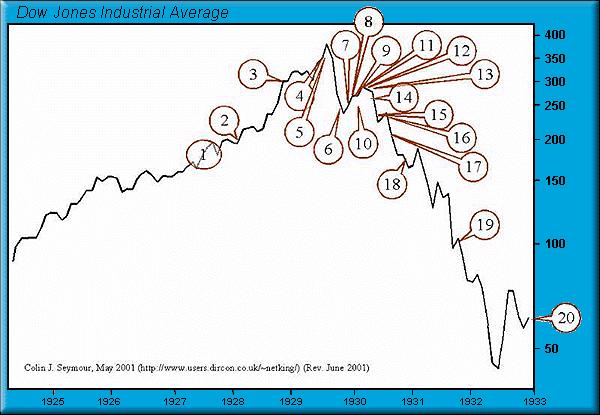
History Shows Why Prognosticators Should Be Discounted

(click here if chart is not observable)

1927-1933 Chart of Pompous Prognosticators

1.  “We will not have any more crashes in our time.”
– John Maynard Keynes in 1927

2.  “I cannot help but raise a dissenting voice to statements that we are living in a fool’s paradise, and that prosperity in this country must necessarily diminish and recede in the near future.”
– E. H. H. Simmons, President, New York Stock Exchange, January 12, 1928

“There will be no interruption of our permanent prosperity.”
– Myron E. Forbes, President, Pierce Arrow Motor Car Co., January 12, 1928

3.  “No Congress of the United States ever assembled, on surveying the state of the Union, has met with a more pleasing prospect than that which appears at the present time. In the domestic field there is tranquility and contentment…and the highest record of years of prosperity. In the foreign field there is peace, the goodwill which comes from mutual understanding.”  – Calvin Coolidge December 4, 1928

4.  “There may be a recession in stock prices, but not anything in the nature of a crash.”
– Irving Fisher, leading U.S. economist , New York Times, Sept. 5, 1929

5.  “Stock prices have reached what looks like a permanently high plateau. I do not feel there will be soon if ever a 50 or 60 point break from present levels, such as (bears) have predicted. I expect to see the stock market a good deal higher within a few months.”
– Irving Fisher, Ph.D. in economics, Oct. 17, 1929

“This crash is not going to have much effect on business.”
– Arthur Reynolds, Chairman of Continental Illinois Bank of Chicago, October 24, 1929

“There will be no repetition of the break of yesterday… I have no fear of another comparable decline.”
– Arthur W. Loasby (President of the Equitable Trust Company), quoted in NYT, Friday, October 25, 1929

“We feel that fundamentally Wall Street is sound, and that for people who can afford to pay for them outright, good stocks are cheap at these prices.”
– Goodbody and Company market-letter quoted in The New York Times, Friday, October 25, 1929

6.  “This is the time to buy stocks. This is the time to recall the words of the late J. P. Morgan… that any man who is bearish on America will go broke. Within a few days there is likely to be a bear panic rather than a bull panic. Many of the low prices as a result of this hysterical selling are not likely to be reached again in many years.”
– R. W. McNeel, market analyst, as quoted in the New York Herald Tribune, October 30, 1929

“Buying of sound, seasoned issues now will not be regretted”
– E. A. Pearce market letter quoted in the New York Herald Tribune, October 30, 1929

“Some pretty intelligent people are now buying stocks… Unless we are to have a panic — which no one seriously believes, stocks have hit bottom.”
– R. W. McNeal, financial analyst in October 1929

7.  “The decline is in paper values, not in tangible goods and services…America is now in the eighth year of prosperity as commercially defined. The former great periods of prosperity in America averaged eleven years. On this basis we now have three more years to go before the tailspin.”
– Stuart Chase (American economist and author), NY Herald Tribune, November 1, 1929

“Hysteria has now disappeared from Wall Street.”
– The Times of London, November 2, 1929

“The Wall Street crash doesn’t mean that there will be any general or serious business depression… For six years American business has been diverting a substantial part of its attention, its energies and its resources on the speculative game… Now that irrelevant, alien and hazardous adventure is over. Business has come home again, back to its job, providentially unscathed, sound in wind and limb, financially stronger than ever before.”
– Business Week, November 2, 1929

“…despite its severity, we believe that the slump in stock prices will prove an intermediate movement and not the precursor of a business depression such as would entail prolonged further liquidation…”  – Harvard Economic Society (HES), November 2, 1929

8.  “… a serious depression seems improbable; [we expect] recovery of business next spring, with further improvement in the fall.” – HES, November 10, 1929

“The end of the decline of the Stock Market will probably not be long, only a few more days at most.”
– Irving Fisher, Professor of Economics at Yale University, November 14, 1929

“In most of the cities and towns of this country, this Wall Street panic will have no effect.”
– Paul Block (President of the Block newspaper chain), editorial, November 15, 1929

“Financial storm definitely passed.”
– Bernard Baruch, cablegram to Winston Churchill, November 15, 1929

9.  “I see nothing in the present situation that is either menacing or warrants pessimism… I have every confidence that there will be a revival of activity in the spring, and that during this coming year the country will make steady progress.”
– Andrew W. Mellon, U.S. Secretary of the Treasury December 31, 1929

“I am convinced that through these measures we have reestablished confidence.”
– Herbert Hoover, December 1929

“[1930 will be] a splendid employment year.”
– U.S. Dept. of Labor, New Year’s Forecast, December 1929

10. “For the immediate future, at least, the outlook (stocks) is bright.”
– Irving Fisher, Ph.D. in Economics, in early 1930

11.  “…there are indications that the severest phase of the recession is over…”
– Harvard Economic Society (HES) Jan 18, 1930

12.  “There is nothing in the situation to be disturbed about.”
– Secretary of the Treasury Andrew Mellon, Feb 1930

13.  “The spring of 1930 marks the end of a period of grave concern…American business is steadily coming back to a normal level of prosperity.”
– Julius Barnes, head of Hoover’s National Business Survey Conference, Mar 16, 1930

“… the outlook continues favorable…”  – HES Mar 29, 1930

14.  “… the outlook is favorable…”  – HES Apr 19, 1930

15.  “While the crash only took place six months ago, I am convinced we have now passed through the worst — and with continued unity of effort we shall rapidly recover. There has been no significant bank or industrial failure. That danger, too, is safely behind us.”
– Herbert Hoover, President of the United States, May 1, 1930

“…by May or June the spring recovery forecast in our letters of last December and November should clearly be apparent…”  – HES May 17, 1930

“Gentleman, you have come sixty days too late. The depression is over.”
– Herbert Hoover, responding to a delegation requesting a public works program to help speed the recovery, June 1930

16.  “… irregular and conflicting movements of business should soon give way to a sustained recovery…”  – HES June 28, 1930

17.  “… the present depression has about spent its force…” – HES, Aug 30, 1930

18. “We are now near the end of the declining phase of the depression.”- HES Nov 15, 1930

19.  “Stabilization at [present] levels is clearly possible.” – HES Oct 31, 1931

20.  “All safe deposit boxes in banks or financial institutions have been sealed… and may only be opened in the presence of an agent of the I.R.S.” – President F.D. Roosevelt, 1933

Colin J. Seymour, June 2001
http://www.users.dircon.co.uk/~netking
20 June 2001

Posted in Charts, Economics, General Interest, Policy, Politics | Tagged , , | 2 Comments

Week in Review

As we suspected, emerging equities bounced nicely last week with Brazil and Hong Kong leading the major indices, both up over 3 percent.   Developed equity markets continued to move higher with France now up close to 10 percent for the year.  The FTSE is the laggard of the majors as the country’s monetary authority debates raising interest rates.

The Russell 2000 led the U.S. equity indices higher, increasing 1.55 percent for the week.   The Russell is widely used by traders to get short the market or as a hedging instrument.  The Dow moved higher and is now up over 7 percent for the year.

Treasuries were relatively flat and the U.S. dollar index closed down a little over 1 percent for the week.  Gold was up 2.27 percent and we believe the December 7th $1,430 all-time high will be taken out in the next few weeks.   Crude oil was relatively flat.   The foods traded off and may have seen their short-term high. Wheat was off over 6 percent.

We’re expecting a pause in the powerful equity rally and think geopolitics could get a little ugly here.  Gold, oil, and the dollar should do well, in our opinion.

Ireland holds elections on Friday and the center-right opposition party, Fine Gael, is set to be the next ruling party.  Though the leaders of the party have said there will be no default, a recent poll showed that 84 percent of the population backed renegotiating terms with bondholders.

We’re monitoring the action in Apple as the downdraft over the past few days has us a little concerned.  The stock was down over 2 percent on Friday in an up market on relatively high volume, 75 percent above the 20-day average.  (click here if charts are not observable)

Posted in Apple, Bonds, Charts, Crude Oil, Currency, Equities, Week in Review | Tagged , , , , , , | 3 Comments

Soros: Regime Change in Iran, Bond Crisis is U.S.

Fareed Zakaria discusses current events with George Soros on today’s GPS.   Click here for the entire interview.   It’s well worth your time.

Money Quotes:

Comparison 1989 fall of the Berlin Wall and Middle East Uprisings

SOROS: It is very similar. It’s — it’s a historic event, at least equal in importance to what happened then. And it — it really is a spontaneous desire of people living in closed societies to shake off the dictatorship and — and corrupt regimes, and to move towards democracy.

The big difference between 1989 and now is that there it was a — the Soviet dictatorship that was collapsing. Here, its our allies that — that are changing. And now we have to actually regain the confidence and alliance of the people in these countries.

The big difference between 1989 and now is that there it was a — the Soviet dictatorship that was collapsing. Here, its our allies that — that are changing. And now we have to actually regain the confidence and alliance of the people in these countries.

SOROS: Yes. But, I must say that in this respect, President Obama did an — an outstanding job. It’s — it’s not sufficiently appreciated. Really, what a big difference it was that he was — he is our president at this time.
Just imagine if Bush and Cheney would have been in charge. I don’t think you would have had a peaceful revolution in Egypt.

Iran

I would like to bet that the Iranian regime will not be there in a year’s time.

U.S. Economy

ZAKARIA: Now, you know what the Republicans will say. They say that if we don’t do this, we will face a crisis because we are borrowing all this money and the bond market wouldn’t let us the money.

Now, you are maybe the world’s leader expert on this subject because you — you have literally accumulated a fortune of tens of billions of dollars figuring out when bond markets will — will support governments and when they wouldn’t. When you look at the U.S. government right now, do you think it is in danger of facing a crisis where it wouldn’t be able to borrow any more, that the bond market will — will punish it?

SOROS: Yes. That’s more or less in — in the cards because — because we are not applying fiscal stimulus because the ideology is that the governments can’t do anything right, right? So we can’t expect the government to — to help.

So you have vital resources, and the Federal Reserve is providing quantitative easing. Well, I think when it expires they wouldn’t do any — wouldn’t give it any more, but it does create access, money supply, and — and when you stop pushing money into the economy, interest rates are going to go up. And it will be the rise of interest rates that is going to choke off the economic recovery.

ZAKARIA: So you foresee a rise in interest rates in — in the United States which will kill growth?

SOROS: That’s right.

Tea Party

ZAKARIA: What do you think of this broader movement of the Tea Party, of — of what’s going on on the right?

SOROS: Look, I think the people in the Tea Party are very decent people, hard-working. They’ve been hit by a force that — that comes from somewhere which they can’t fully understand, and — and they are being misled. And they are misled by people who are using it for their selfish purposes, namely to remove regulations and — and reduce taxation. So reduce taxation and regulation, and they are being used and deceived.

(click here if video is not observable)

Posted in Fiscal Policy, Geopolitical, Sovereign Debt, Sovereign Risk, Uncategorized, Whales | Tagged , , , | Leave a comment

The Weekend Read: Greece Comes to Wisconsin

The television screen showed angry shouting demonstrators filling the streets of the city. At first I thought I was looking at Athens, Paris or Madrid, where angry civil workers fill the streets when their socialist governments suggest the retirement age be increased from 53 to 55. Oh the wailing and gnashing of teeth! The burning of cars! The breaking of glass! The stamping of feet!

Then I realized the streets filled with demonstrators were American and it was happening right here in the USA, the heartland of the country, Madison Wisconsin. – Irish Central

China
China Drafts Measure to Control Food Prices – WSJ
China’s Luxury Boom – Economist
China raises bank reserves to record in inflation fight – Reuters
Chinese stance throws G20 indicator deal into doubt – Reuters
Morgan Stanley lays out China doomsday scenario – MarketWatch

Commodities
Gold: the ultimate inflation hedge – Telegraph
Greenland: Final Frontier for Rare Earth Elements – Seeking Alpha
How safe are North America’s pipelines? – The Globe and Mail
India to resume rare earth exports after seven years – The Hindu

Credit
Corporate Bond Issuance Shows Signs Of Slowing – WSJ
Is Emerging Markets Debt Cheap? – Forbes
Junk bond yields fall to all-time lows – WSJ
U.S. Company Credit Swaps Index Holds Near Lowest in 13 Months – Bloomberg

European Sovereign Debt
Banks Crucial to Euro Grand Bargain – WSJ
ECB buys Portuguese debt as yields soar – FT
European Banks: Invest or Divest? – Seeking Alpha
European Sovereign Debt Crisis in Pictures – Mish
Germany signals readiness to back Portugal – Reuters
Ireland’s Fine Gael Leader Sees No Default On Sovereign Debt – WSJ
Macau Monetary Authority buys Portuguese sovereign debt bonds – Macau Hub
Portugal Says Delay in European Response to Crisis Harms Euro – Bloomberg
Spain back in favour after debt fears ease – FT
The Future of the EU: Shaping economic governance – Triple Crisis

Emerging Markets
Argentina grows 9.1 pct in 2010; fastest in 5 years – ForexYard
Trichet: Rapid Recovery In Emerging Economies Led To Inflation Spike – RTTNews

G20
As G20 squabbles, monetary policy may work itself out – The Globe and Mail
Brazil calls for currency system overhaul – FT
G20:  Fed, BoJ defend loose monetary policy – Reuters
Inflation Is the Taboo Subject at the G20 – CNBC

Geopolitical
Arab World Awakening – Economist
As violence escalates, Libya cuts off the Internet – Computer World
Iran’s Opposition is Still Alive – Economist
Why Should Americans Care About Bahrain? – Foreign Policy

Japan
Can Japan’s spirited youth save their aging nation? – Reuters
Japan PM weakened by party revolt – AFP
Kan’s Debt Reduction Is Threatened by Japanese Ruling Party Rebellion Plan – Bloomberg
‘X Day’: How To Trade a Japanese Bond Implosion – CNBC

Monetary & Fiscal Policy
A Full Frontal View of the World’s Uneven Monetary Policy – WSJ
Bernanke says foreign investors fuelled crisis – FT
Central banks have been supporting share prices – Economist
Chile Central Bank Raises Benchmark Rate 25BPs To 3.5% – WSJ
Citigroup Now Forecasts Three BOE Rate Hikes This Year – Dow Jones
Effects of Food Costs, Inflation, and Monetary Policy on Developed Markets – Minyanville
Fed Tightening: When and How Are Key – Barron’s
Krugman:  Living Without Discretionary Fiscal Policy – NY Times
Who will win war of words between Mervyn King and Andrew Sentance? – Telegraph

Stocks
“Buy everything” sentiment continues on Wall Street – Reuters
Stocks Close at 2½-Year High – WSJ
The Zero Gravity Market – Bespoke
Why Investors Can’t Get More Cash Out of U.S. Companies – WSJ

U.S  Debt
Bill Gross slashes government debt holdings – The Trading Report
China unloads more US debt holdings – People’s Daily
Treasuries Pare Weekly Gain on Bets Inflation Will Accelerate – Bloomberg
Worried About U.S. Debt? Shiller Pushes GDP-Linked Bonds – WSJ

Wisconsin: The New Greece?
35,000 protest Wisconsin plan to bust public unions – Agence France-Presse
Wisconsin police hunt Dem. leader, protests continue – Wash Post
Thousands fill the streets, is Greece in Wisconsin? – Irish Central

(click here if video is not observable)

Posted in The Weekend Read | Tagged , , | 3 Comments

Gold Ready to Make New Highs

Gold is acting as if it is ready to make its next move taking out the triple top and beyond.   After spending 28 days below its 50-day moving average the gold ETF (GLD) has recaptured it and is generating a buy signal.  We thought we’d see a test of the 200-day moving average and wrong.   Gold is a very technical trade and usually follows the rule of technical analysis fairly well.

Inflation is clearly picking up and the hard (a misnomer?) currency central banks are timid and losing cred.  This includes the People’s Bank of China, in our opinion.   We recently had some bookshelves made for our office and were so happy with our guy’s work wanted to order a few more.  He said it would cost us an extra 50 percent as the price of the lumber spiked on him in the past few weeks.   It’s here folks and we think part of the incredible strength in equities is the result that stocks are an inflation hedge.

Nevertheless,  gold has put in its time consolidating, shaken out the weak hands and gotten enough players short to potentially make a big move here.   Geopolitical risk is increasing, inflation is rising, and short term rates are at zero percent.   We took some of the gold ETF with a stop about 1 percent below the 50-day.    The risk is the Fed starts talking tough.  Yeah, right!  (click here if chart is not observable)

Posted in Uncategorized | 6 Comments

“Better Than Rubin” – 12 Things You Don’t Know About Tim Geithner

Noam Scheiber’s piece in The New Republic, The Escape Artist: How Timothy Geithner survived, is a good read and very informative.  If you have a few minutes have a look.   Here are 12 points we found interesting about our SecTreas:

1)  Geithner..[was]…class president during his senior year of high school. “That was my last experience as a politician”

2)  Geithner spent his high school years in Thailand, where his father held another senior position with the Ford Foundation.

3)  In 1988, after graduate school and a brief stint at Kissinger Associates, he joined Treasury as a junior trade official.

4)  Geithner played a key role in persuading the Japanese to increase their financial contribution to the first Gulf war, part of a U.S. government effort dubbed “Operation Tin Cup.”

5)  Geithner caught the attention of another prominent patron—Larry Summers—whom Bill Clinton had appointed as his treasury undersecretary.

6)  When the Clinton administration ended, Geithner …eventually accepted a job as the head of policy development for the IMF, essentially the organization’s third-ranking position.

7)  Geithner [is] scrupulously attuned to the temperament of the boss. Like Obama, he evinced a strong aversion to blather. During meetings with the president, he would say little, and usually not until the end, when his opinion was solicited.

8)  He’d often joke that, if you wanted to get Summers to embrace an idea, you had to adopt its opposite, which Summers would then shoot down.

9)  As treasury secretary…[initial]… refusal to think of himself as a public figure was proving extremely [politically] damaging.

10) Volcker told the president he approved of Geithner’s plan but also wanted to stop government-backed banks from making risky bets for their own bottom line—in effect, from acting like taxpayer-subsidized hedge funds.

11) According to people familiar with the decision, Summers was upset, believing it impossible to draw a line between the banks’ proprietary trading and trades that benefited clients, which would render the proposal unenforceable.

12) Before leaving to run for mayor of Chicago, Emanuel had taken to uttering the phrase “better than Rubin” in connection with Geithner’s name.

Posted in Economics, Policy, Politics | Tagged , | Leave a comment