Saudi stocks flop, gold rocks as US weighs action in Libya

Debka reports the U.S. naval and air fleet is repositioning around Libya for potential “hit-and-run” raids to cripple Qadaffi’s air capability.  This isn’t new news, but we’re wondering out loud if the Saudis have been consulted and are on board.

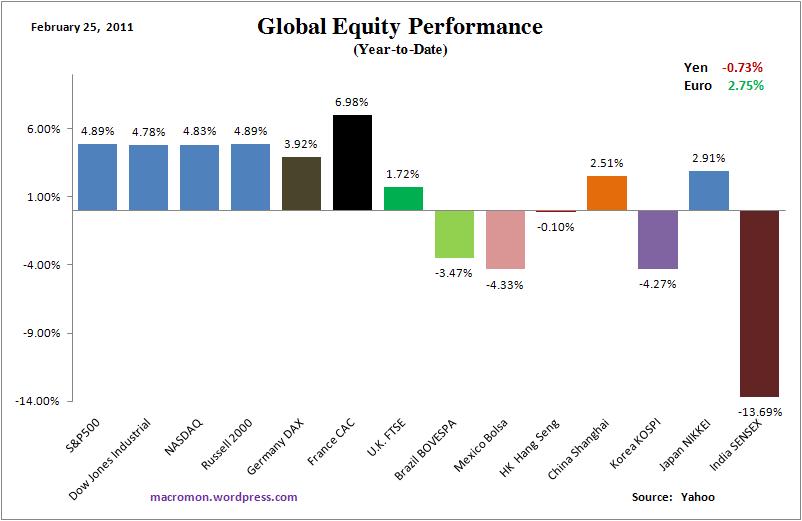
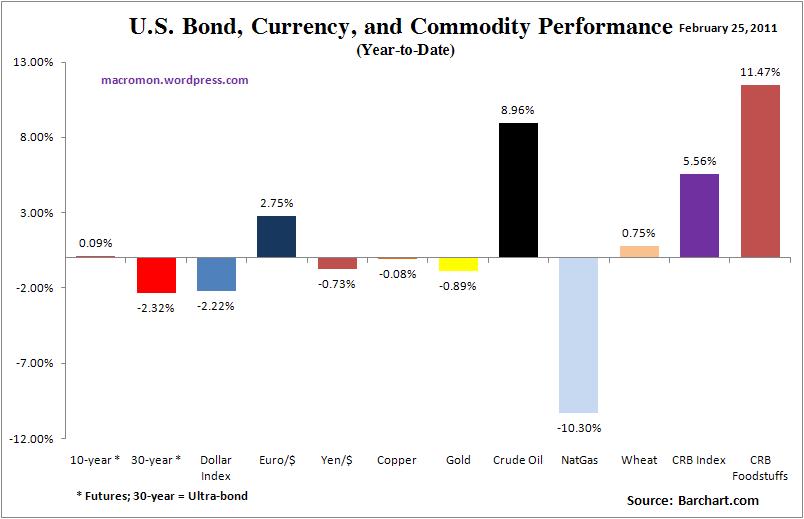
Remember,  King Abdullah was so upset after speaking with President Obama on the U.S. handling of Mubarak that he reportedly had a heart attack, which was later denied.   Saudi stocks down big,  global risk off, Euro/$ up, and gold taking out the old high.  Is this the markets voting?  Here is Debka’s  money quote,

The US is repositioning its naval and air forces around Libya, Pentagon spokesman Col. David Lapan stated Monday, Feb. 28, indicating possible military steps to break the standoff between Muammar Qaddafi’s army and rebel forces in the fighting for control of the towns commanding the roads to the capital Tripoli where Qaddafi is barricaded.  The reported rebel capture of the key towns of Misrata and Zawiya is technically correct. In fact, they are both surrounded by Libyan troops who control their road links with Tripoli. In Misrata, the army has a valuable edge over opposition forces in its control of the local airfield.

This is a very fluid and nontransparent situation and could potentially kick us into a high risk/high impact trading and investment environment.  Ain’t no time to be a hero, in our opinion.   

Posted in Black Swan Watch, Commodities, Crude Oil, Geopolitical, Global Stock Performance, Gold, Politics | Tagged , , , , , , | 1 Comment

Connecting the Dots: The Coming War Between Generations

Almost everyday the newspaper headlines across the country warn of problems with local government budgets centered around public sector employee wages and benefits.  Today one read,  County Pension System Hits Tipping Point.  The other day it was how one city wasn’t funding its medical retirement benefits.

Some are trying to make what is happening in Wisconsin a workers rights issue.  This is complete nonsense, in our opinion.  Though the political approach to a solution may differ, this is more about the beginnings of the coming war between generations that we have written about in prior posts.  President Obama — of all Presidents — should understand this and it may be why younger voters stayed at home during the mid-term elections, resulting in the political facial he received from the Tea Party.

The fact is, we have never fully funded our defined benefit public sector retirement programs (including social security and medicare), relying instead on rosy scenarios and fantasy assumptions about investment returns either to prevent tax increases or a reduction in public services.  The markets have started to revolt and the chickens are  coming home to roost.

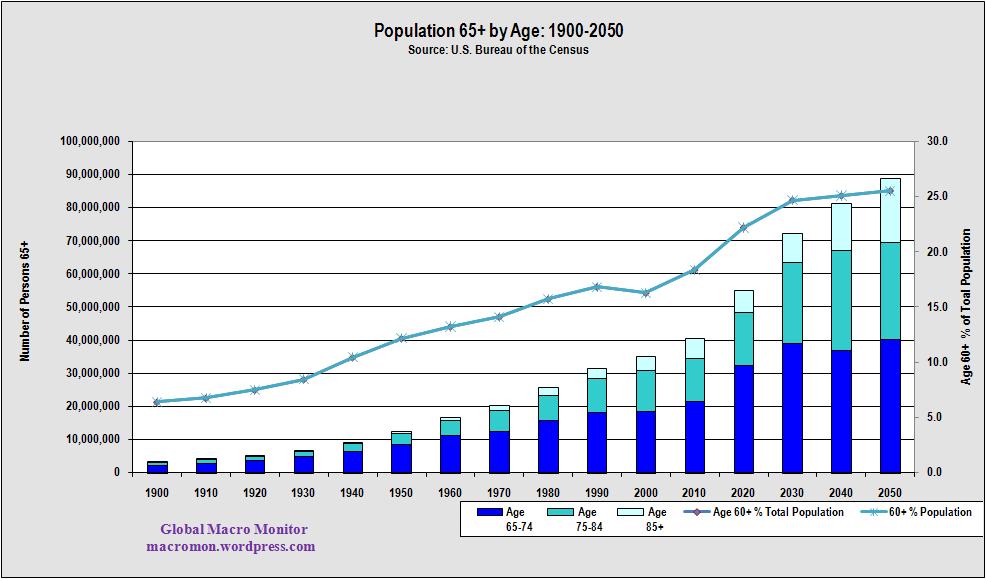
It is also time to connect some dots.  What we are witnessing in the Middle East where the young, who have little or no political voice and a not so bright future are throwing off their autocratic gerontocracies at an incredible pace.   Something similar will manifest here and the rest of the aging west, though probably in different way, when younger generations realize the consequences of being saddled with a massive debt and declining public services as the tax revenues are diverted to debt service and retirement benefits.   Not to mention the world full of carbon they have inherited.

They to, like their Facebook brethren in the Middle East, will revolt and throw off the gerontocracy that will control the political system as baby boomers age, which over taxes them to pay the debt used to finance the excessive consumption and current retirement benefits of their parents and/or grandparents generation.

It doesn’t take a C.I.A. analyst with a Ph.D. to realize the potential for political blowback when one generation is rendered into servitude due to the excesses of another.   Or does it?

This, of course, assumes our creditors don’t beat them to it.   Even then, we’re starting to have our  doubts about the country’s  political capacity to deal with these issues.  We spent years as analysts in Latin America during their days of hyperinflation and witnessed that public sector unions, though not the only problem,  were a big part of the fiscal imbalances, which were financed by the printing presses.

This is really a problem of state and local governments and not so much at the Federal level.  We cannot, however,  blame the public employees who are just playing by the rules that our political leaders and unions have set up.   But shame, shame, shame on those leaders who have not led and have failed Demographics 101 in such a big way.

The Wall Street Journal really nails it today,  writing about the huge distinction between public and private sector unions,

We’ve previously mentioned FDR and Fiorello La Guardia. But George Meany, the legendary AFL-CIO president during the Cold War, also opposed the right to bargain collectively with the government.

Why? Because unlike in the private economy, a public union has a natural monopoly over government services. An industrial union will fight for a greater share of corporate profits, but it also knows that a business must make profits or it will move or shut down. The union chief for teachers, transit workers or firemen knows that the city is not going to close the schools, buses or firehouses.

This monopoly power, in turn, gives public unions inordinate sway over elected officials. The money they collect from member dues helps to elect politicians who are then supposed to represent the taxpayers during the next round of collective bargaining. In effect union representatives sit on both sides of the bargaining table, with no one sitting in for taxpayers.

We’re hoping that our generation, the baby boomers,  will do the right thing here and give the younger ones a fighting chance.    If that means playing muni golf courses instead of Pebble Beach and Pinehurst as we move into our sunset years, so be it. (click here if charts are not observable)

Posted in Budget Deficit, Currency, Demographics, Dollar, Economics, Employment, State and Local Government | Tagged , , , , | 11 Comments

Week in Review: Just Plain Crude

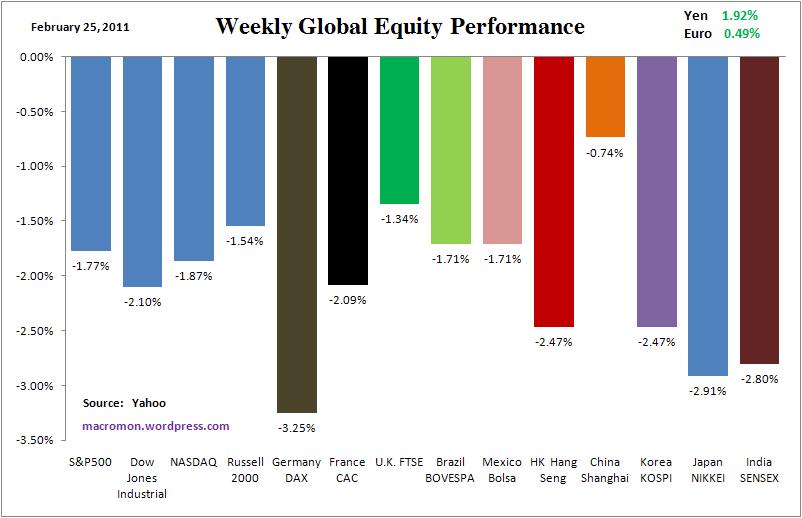
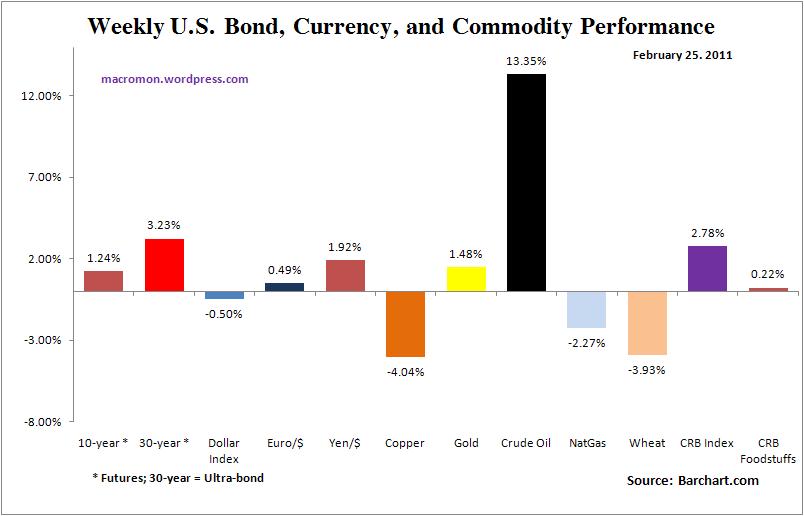
The past week was all about oil with West Texas up over 13 percent on fears of political instability spreading into Saudi Arabia.   Every major stock market we monitor in the Week in Review was down with the German DAX taking the biggest hit, falling 3.25 percent and the Shanghai down the least, 0.74 percent.

We were surprised equities were not down more and that the Russell 2000 outperformed the U.S. majors.  The equity market appears to believe:  1)  the crude price spike is only temporal;  2)  is in denial;  3) believes the economy is not as vulnerable to higher oil price;  or 4) all of the above.

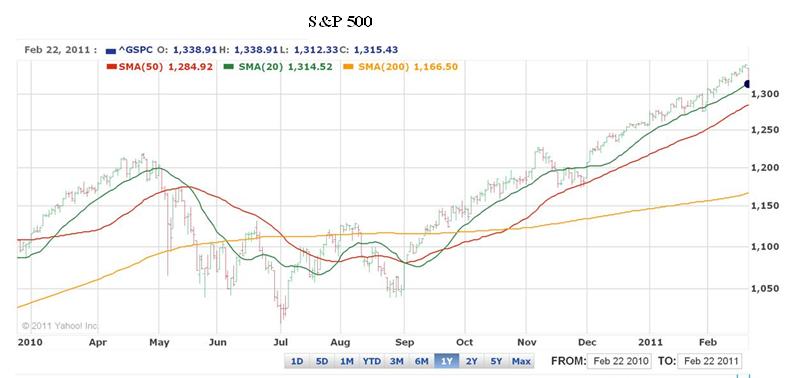
The S&P 500 made its intraday low for the week at 1294.96 on Thursday about 10 points above its 50-day moving average.  This is the level to watch next week.   The other market we’re monitoring closely is the Hang Seng which once again bounced off key support at 22,600.

The dollar was surprisingly non-bid during such an increase in geopolitical risk, which may be a sign the Fed is losing credibility in the global market place.   Gold was up 1.48 percent and next week will be a key test for the yellow metal.  Gold needs to take out last week’s high of $1,417.88 to challenge the all-time of $1,430.   This is chip shot from current levels and the only issue from a fundamental perspective to keep gold from making new highs is a hawkish Fed.   Technically,  gold has come along way in a short period of time, up over $100 in less than a month.

We’re keeping positions light and tight and watching key levels for direction.   Have a good week.  (click here if charts are not observable)

Posted in Week in Review | Tagged , , | 3 Comments

The Weekend Read

“There has been a complete and utter lack of leadership in Ireland,” Professor Ferriter said. As for Fianna Fail, he said, “They’ve actually managed to alienate all sections of our society.” – NY Times

China
A Balanced Look at Sino-American Imbalances – Yu Yongding
China authorities block democracy campaigns – FT
China’s economic turning point – Steve Roach
Chinese internet censorship hits LinkedIn – FT
China’s Search for a Grand Strategy – Foreign Policy

Commodites
Commodity prices will hinder global recovery – Investment Week
G-20 Interim Study Points To Short Supply Behind Commodity Price Rise – WSJ
WGC: China and India to Support Gold Market No Matter the Price of Oil –CNBC
Why Spiking Oil is Deflationary – Seeking Alpha

Crude Oil
Saudi raises oil output as Libyan exports disrupted – Reuters
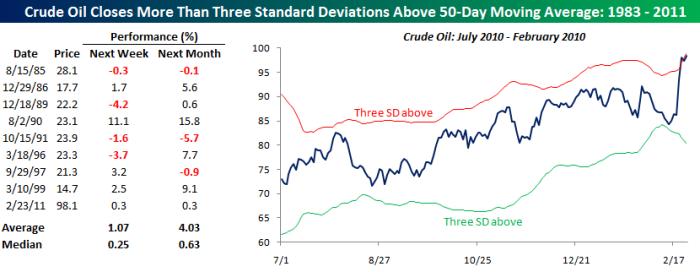
Oil Hits Most Overbought Level Since 1999 – Bespoke

Currencies
Liquidity Glut At US Banks May Ultimately Swamp Dollar – WSJ

Economics
Can the Economy Recover Without Housing? – NY Times
Mary Meeker’s plan to turn the country around – Washington Post
Oil surge puts fragile US recovery at risk – FT
Rosenberg: Oil Isn’t US’s Big Worry – Deflation Is – MoneyNews
U.S. 4Q GDP Growth Revised Down To 2.8% – Daily Markets
Yes, Robert Prechter Is Still Worried About Deflation – Yahoo

Europe
Election Defeat Predicted for Ireland’s Ruling Party – NY Times
German inflation holds at multi-year high in Feb – LA Times
Greece’s EU commissioner assails austerity – UPI
Irish fertility rate highest in EU – Irish Times
Speculators steer wide berth round euro debt – FT
Turnout in Ireland general election estimated at 70% – BBC
Why Europe Needs Automatic Haircuts – Hans-Werner Sinn

Equities
Private-Equity Firms Gained 17.6% in Year – WSJ

Geopolitical
Clashes spread across Cote d’Ivoire – Aljazeera
Food for Thought in North Korea – Christopher Hill
Libya: Live Blog – Aljazeera
Libya’s Lord of the Flies – Omar Ashour
Person in the News: the Arab youth – FT
Qaddafi Forces Violently Quell Capital Protest – NY Times
The Middle East Awakening – Joschka Fischer
UN considers response to Gaddafi – FT

Japan
Japan Bonds Post Biggest Weekly Gain in 4 Months as Oil Soars on Turmoil – Bloomberg

Monetary Policy
Chicago Fed chief casts doubt on US tightening – FT
Fed’s Hoenig: Inflation Starting To Show Increases – WSJ
Quantitative Easing and America’s Economic Rebound – Martin Feldstein

Politics
The Tea Party and American Foreign Policy – Foreign Policy
Why Boehner Doesn’t Want a Government Shutdown – Time

Technology
Tapping the Innovative Masses – Tech Review
Rumor: Apple to add carbon fiber body to iPad 2 – CNET
Verizon CEO refutes claims of low iPhone sales – CNET

(click here if video is not observable)

Posted in The Weekend Read | Tagged , , | Leave a comment

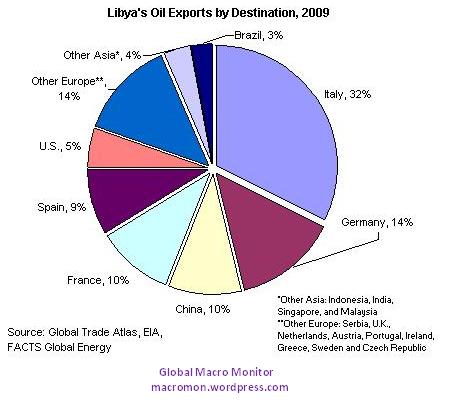
Chart of the Day: Destination of Libya’s Oil Exports

(click here if chart is not observable)

Posted in Crude Oil, Energy, Geopolitical, Uncategorized | Tagged , , | 2 Comments

U.S. Dependent on Middle East Oil? Think Again.

Given the unrest in the Middle East we’re hearing a lot of noise these days about how the U.S. is totally dependent on oil imports from that region of the world.   The data, however, does not confirm these assertions.

We were surprised by the following table from the E.I.A. which shows the U.S. imports only about 25 percent of its crude oil from the Middle East and just 10  percent when Saudi Arabia is excluded.  It is our sense that Saudi is much more politically stable than oil traders believe. This is not to say the U.S. won’t have to pay the world market price if supply is disrupted from Libya or elsewhere, however.  (click here if table is not observable)

Posted in Crude Oil, Politics | Tagged , | 23 Comments

Will Higher Prices Show Up in the CPI?

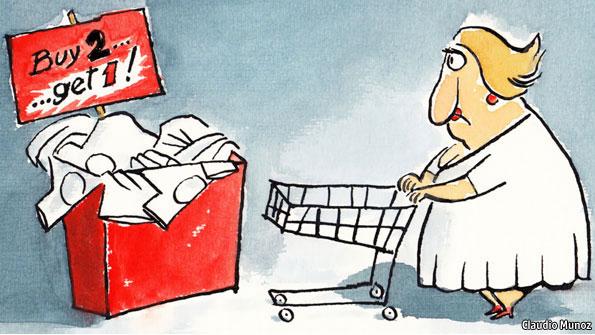
Great ‘toon from the Economist.  Maybe the bureaucrats can argue that the higher commodity price component of goods and services is only temporary and can be counted as a surcharge as not be be included in the inflation stats.  On a more serious note, the Economist writes,

When retailers decide to pass on higher costs to consumers, they are increasingly trying to do so in ways that hint that they still offer value for money. One ruse is to offer a wider range of products in a particular category, including a no-frills version that will remain cheap and higher-quality ones that grow more costly. Another is to raise prices discreetly by offering smaller products. But this can backfire: customers noticed when Kimberly-Clark sold them smaller sheets of toilet paper.

(click here if cartoon is not observable)

Posted in Economics, Food Prices | Tagged , , , | Leave a comment

The 50 Most Innovative Companies

MIT’s Technology Review ranks the 50 most innovative companies.  The list is divided into public and private companies.

A123 Systems
Why: Lithium-ion batteries make electric cars possible at mass-market prices.
Key innovation: Nanostructured electrodes result in lithium batteries more durable and safer than those in cell phones and laptops.

Akamai
Why: The exponential growth in traffic on the Web is possible because of services that route data intelligently.
Key innovation: Its algorithms optimize online routes for content delivery.

Amazon.com
Why: E-books are finally becoming a large, mainstream market.
Key innovation: Even as it seeded the e-book market with the Kindle, Amazon has made it easy for people to read e-books on other devices, such as the iPad.

American Superconductor
Why: Smart electrical grids and more efficient power cables can help save money and energy.
Key innovation: Underground superconductor power cables using AMSC’s Amperium™ high temperature superconductor wire can carry up to 10 times as much electricity as conventional copper cables.

Amyris
Why: Advanced biofuels could help reduce the use of gasoline and diesel.
Key innovation: Its genetically engineered yeast turns sugars into a building block of diesel fuel, which is usable in the existing transportation infrastructure.

Apple
Why: The rest of the consumer electronics industry is scrambling to catch up to the iPad. The iPhone still sets the standard for smart phones, even if its market share slips.
Key innovation: Its limited lineup of mobile devices all run on the same easy-to-use software.

Applied Materials
Why: Powerful computing devices are proliferating because of chips that incorporate ever-smaller features without rising in price.
Key innovation: Its machines can make chips that have both vertical and horizontal connections, to pack in more computing power.

ARM Holdings
Why: It is redesigning smart phones and tablets so that they’ll use much less power and need recharging less often.
Key innovation: Developed energy-efficient customizable chips for mobile devices.

Complete Genomics
Why: Many doctors and researchers lack the resources to sequence genomes and analyze them themselves.
Key innovation: Sells sequencing as a service, analyzing DNA samples that customers send in.

First Solar
Why: New types of photovoltaics are reducing the cost of solar power.
Key innovation: “Thin-film” solar panels based on cadmium telluride, which are cheaper than conventional silicon panels, have made the company one of the world’s largest photovoltaic manufacturers.

Geron
Why: Embryonic stem cells provide a potential source of replacement tissue for use in treating an array of degenerative diseases and injuries.
Key innovation: Has begun clinical trials for a spinal-cord therapy derived from these cells.

Goldwind Science and Technology
Why: Increasing the time that turbines are operational will lower the cost of wind power.
Key innovation: Co-developed a direct-drive wind turbine that eliminates the need for a gearbox. Having fewer moving parts reduces the chance of costly mechanical failure.

Google
Why: It still sets the agenda in Web search, even as it pushes the development of Android for mobile devices.
Key innovation: Its software development process remains relatively fast even as the company has gotten very big.

HTC
Why: Smart phones that run Android have become an alternative to Apple’s mobile devices.
Key innovation: Designed well-crafted devices in partnerships with Google and wireless carriers.

IBM
Why: Computing can transform infrastructure such as electric grids and traffic control systems.
Key innovation: Is drawing on its research expertise and that of software companies it’s acquired to develop services for many infrastructure industries and expand the market for information technologies.

iRobot
Why: Robots can save lives by doing jobs too dangerous for people.
Key innovation: Its small, agile robots can detect and dispose of explosive devices for the military.

Life Technologies
Why: Quick, cheap DNA sequencing will lead to new diagnostic tests and targeted treatments.
Key innovation: Its desktop gene-sequencing machine costs $50,000, about a 10th as much as other machines.

Netflix
Why: Inexpensive video on demand, delivered over the Internet, undercuts cable and points the way to a likely future for TV.
Key innovation: Built demand for a streaming video service by including it free with DVD-by-mail subscriptions.

Nissan
Why: Mainstream use of electric cars could benefit the environment, especially where power is produced relatively cleanly.
Key innovation: Nissan’s new electric car, the Leaf, has a reasonably modest sticker price of $32,000.

Novartis
Why: Understanding molecular pathways of rare diseases can shed light on common ones.
Key innovation: Introduced the first medication for patients with benign brain tumors associated with a particular genetic disorder; now the drug is approved for treatment of kidney cancer and is in testing for other types.

Pacific Biosciences
Why: DNA sequencing provides a way to detect microbes in the environment and monitor the spread of viruses in our bodies.
Key innovation:Its sequencing machine can read single strands of DNA in real time.

Roche
Why: Drugs that target genetic mutations unique to cancer cells may be more effective than ones that act more broadly.
Key innovation: A new drug blocks the effects of a mutation thought to be present in as many as 8 percent of all cancers.

Siemens
Why: Improving the electric grid is crucial to making alternative energy sources less expensive.
Key innovation: Developed wind turbines and other technologies for different aspects of the electric grid, from generation to transmission to distribution.

Suntech
Why: Extremely large-scale production of solar panels is reducing the technology’s cost.
Key innovation: Developed its own solar cells and equipment for manufacturing them cheaply.

Toyota
Why: Hybrid cars can significantly reduce gasoline consumption by using an electric motor alongside a gasoline engine.
Key innovation: A market leader with its Prius model, it is developing battery technologies that are helping to make these cars less expensive and more energy-efficient.

Private Companies

BIND Biosciences
Why: Targeting cancer drugs narrowly to tumor cells will reduce the side effects of chemotherapy.
Key innovation: Its delivery system uses peptides to deliver drugs to specific cells.

BrightSource Energy
Why: It efficiently produces solar thermal power, which focuses sunlight to heat water into steam.
Key innovation: A boiler is heated directly with sunlight that bounces off mirrors.

Calxeda
Why: Its technology can reduce the cost of computing in data centers.
Key innovation: Runs servers with cell-phone chips rather than processors built on industry–standard designs, which are more power-hungry.

Cellular Dynamics International
Why: Screening drugs on human heart cells will help researchers find treatments for cardiac problems and test drugs for toxic side effects.
Key innovation: Uses induced pluripotent stem cells to make large numbers of heart cells for testing.

Cotendo
Why: Web applications must get faster and feel much more responsive to users if cloud computing is to keep growing.
Key innovation: Its technology efficiently routes traffic across the Internet and makes websites faster.

Crowdcast
Why: Corporate decision-making gets smarter if it taps the insights of rank-and-file employees.
Key innovation: Private prediction markets let employees forecast the results of corporate choices.

eSolar
Why: Reducing the cost of constructing solar thermal plants will make them more competitive with fossil-fuel plants.
Key innovation: Software controls the mirrors that focus rays from the sun, eliminating the need to position them by hand.

Facebook
Why: Social networking on the Web is becoming a powerful advertising medium and a platform for startups that offer add-on services.
Key innovation: Adapts quickly to shape its site into a medium that advertisers consistently want to use.

Groupon
Why: By encouraging millions of people to sign up for quirky daily advertising e-mails, Groupon has created one of the fastest-growing revenue generators on the Web.
Key innovation: Offers local businesses a way to guarantee a return on their promotional budget, thereby tapping into a huge advertising pool that has eluded many Web companies.

Joule Unlimited
Why: Biofuels could be far cheaper if they weren’t made from corn, sugarcane, and other forms of biomass.
Key innovation: Designed microbes that convert carbon dioxide and water directly into fuels.

Lattice Power
Why: Light-emitting diodes are an energy-efficient option for lighting in buildings and homes, but they are still expensive.
Key innovation: Its low-cost process produces LEDs on the same equipment used to make semiconductors.

Layar
Why: Augmented reality enhances the value of a mobile device, employing its camera and GPS and displaying information about the user’s surroundings.
Key innovation: Its development platform lets businesses and advertisers add AR functions to their own apps.

Lyric Semiconductor
Why: Computer chips that operate with probabilities instead of binary logic could speed applications such as fraud analysis and machine vision.
Key innovation: Its microprocessor uses electronic signals to represent probabilities rather than binary 0s and 1s.

Novomer
Why: Biodegradable plastics that aren’t made from petroleum offer several environmental benefits.
Key innovation: Its polymer-¬manufacturing processes use carbon dioxide to make plastics needed for packaging.

PrimeSense
Why: User interfaces based on gesture recognition make possible new applications in gaming and everyday computing.
Key innovation: Developed the 3-D sensor system that Microsoft’s Kinect device uses to track movement.

Serious Materials
Why: Retrofitting existing buildings is a cost-effective way to increase energy efficiency.
Key innovation: Mass-produces windows with energy-saving features such as coatings and gas insulating layers.

Silver Spring Networks
Why: Computer intelligence in the electric grid will make energy distribution more efficient.
Key innovation: Developed hardware and software that standardize the way disparate parts of the grid communicate.

SpaceX
Why: Budget cuts will force NASA to rely on private companies for supply missions and other tasks.
Key innovation: Introduced a low-cost production method for everything from rocket engines to astronaut capsules.

Square
Why: Expanding the use of mobile payments will help small businesses.
Key innovation: Built technology that lets anyone accept credit cards using smart phones.

Synthetic Genomics
Why: Genetically engineered microbes are a promising way to make biofuels.
Key innovation: Created synthetic bacterial cells, possibly paving the way for organisms specifically tailored to make fuels.

1366 Technologies
Why: Conventional solar power is still too expensive to compete with fossil fuels, in part because of the cost of manufacturing silicon-based solar cells.
Key innovation: Developed a cheaper method for making silicon wafers, the most expensive component of a solar module.

Twitter
Why: Now that the company has begun to make money from its large user base, a service that has woven its way into everyday life is more likely to stick around.
Key innovation: Its business model offers selected opportunities for advertisers while drawing income from deals that let search engines index its content.

Ushahidi
Why: Web tools can help people respond to crises such as earthquakes and political protests.
Key innovation: Its open-source crowdsourcing tool overlays field reports on maps, providing critical and often life-saving data during emergencies.

Zynga
Why: Companies are building ¬businesses inside platforms like Facebook.
Key innovation: Its social games offer people a new way to interact online.




Posted in Apple, Clean Tech, Electric Vehicles, Nonlinear Thinking, Technology | Tagged , | 2 Comments

Nonlinear Thinking: The New Breakevens

With crude oil now officially back over $100 it’s our sense that markets will begin an intense focus on electric vehicles (EV).     Rather than TIPS, the new breakeven obsession will be at what price of gasoline does an electric vehicle make economic sense.

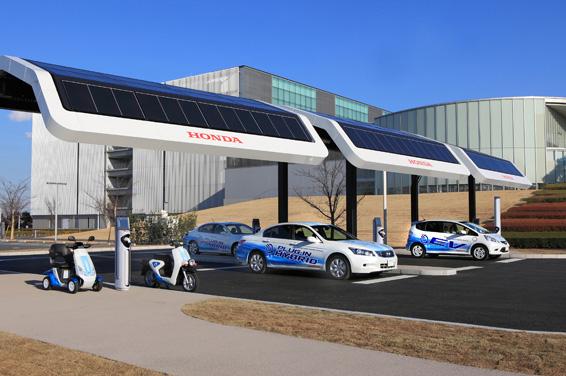
One problem is the grid, which still needs energy from coal or natural gas,  couldn’t handle a massive surge in EV battery recharging.   But technology is progressing, our friends,  as the picture of Honda’s solar recharging station in the picture above and the video below illustrates.  Almost 75 percent of U.S. crude consumption is used in transportation.

These are no longer just concepts but new technologies already in the market place and we’re much closing to the “tipping point” than most think, in our opinion.    In five years, the world of transport and crude oil is going to look a whole lot different,  either by choice or by necessity.   (click here if picture and video are not observable)

“The Stone Age did not end because of lack of stones, and the Oil Age will end soon and not because of lack of oil.” –  Sheik Ahmed Yamani, 2000


Posted in Clean Tech, Crude Oil, Electric Vehicles, Nonlinear Thinking | Tagged , , | Leave a comment

Apple Sitting on 50-day Moving Average

Apple is now testing its 50-day moving average for only the second time during the incredible 55 percent rally, which began in late August.   If it breaks here,  the next key level of support will be the .618 Fibonacci at $315.50.

We’re keeping positions very light to flat and the only dip we’re interested in buying right now is a French Dip at Mel’s Dinner.   This has been a very powerful rally, but the S&P5oo probably needs to,  at the very least,  test its 50-day at 1285 before making the next move higher, in our opinion.  (click here if charts are not observable)

Posted in Apple, Charts, Equities | Tagged , , | Leave a comment