(click here if not observable)
(click here if not observable)
Money Quote of the Week:
On China: “Real estate is the dragon head that drives industry, design, construction, steel and cement companies along”…Lending is not a problem. Banks need to lend money out and the top 10 property developers will get special treatment. – Sydney Morning Herald
Bonds
30-year Treasury may be better barometer – FT
China
China should learn from Japan – AsiaOneNews
Crouching tiger, soaring cranes, rumbling doubts – Sydney Morning Herald
Commodities
A shift in dynamics has led to the exuberance in prices of key commodities – Malaysia Star
Bet on Gold Nets Paulson $5 Billion – NY Times
Egypt Unrest Stokes Oil, Gold – WSJ
Oil near $100 level as Mideast tensions grow – FT
The threat of rising food prices – Vox
Currency
Asia Currencies Gain on Optimism Emerging Markets Growth – Bloomberg
The new carry trade – Vox
Demographics
In Japan, Young Face Generational Roadblocks – NY Times
Economics
Consumption jump powers US growth – FT
Equities
Funds Offer Exposure To Consumers In Emerging Markets – Barron’s
Geopolitcal
Jordanians march for political reform – FT
Protesters back on Cairo streets – Aljazeera
Monetary Policy
Bernanke’s QE2 efforts receiving mixed signals – FT
Could U.S. Monetary Policy Ignite World War III? – Taipan Daily
How inertial is monetary policy? Implications for the Fed’s exit strategy – Vox
The Week in Monetary Policy Analysis – Minyanville
Sovereign Risk
Downgrade a worry for debt-laden Japan – Daily Yomiuri
EU considers loans to Greece to buy back bonds – Bloomberg
Video: What Mattered Most
(click here if video is not observable)
Things fall apart; the centre cannot hold; Mere anarchy is loosed upon the world – W.B. Yeats
Here’s a report from India’s NDTV on the “hyperinflation” in food prices in some countries, which already is and could further destabilize regimes around the world. No doubt supply shocks are contributing to higher food prices, but we believe the marginal buyer sets market prices and the marginal buyer these days are hoarders, who is in panic mode, and the speculators. With the later trying to dishoard its excess money balances and motivated by the search for a store of value.
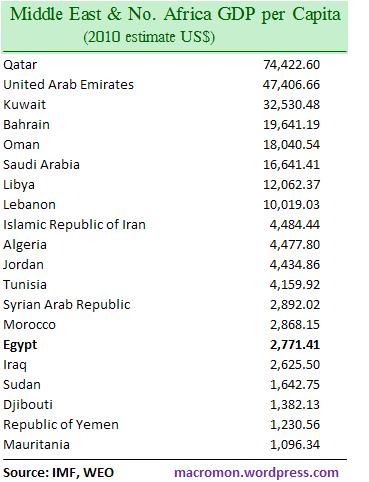
The global imbalances appear to have reached a “tipping point” and regimes are now starting to topple. Who’s next is anyone’s guess, but our candidate would be a country with the preconditions: 1) where food is a high proportion of the consumer’s basket; 2) food prices are rising rapidly; 3) the government is trying to monetize the price hikes; and 4) political expression has historically been deeply repressed.
(click here if video is not observable)
(Click here if not observable)

In the context of S&P’s recent sovereign downgrade of Japan we thought you’d be interested in this IMF piece published in October. The basic thesis is that Japanese commercial banks have been the main buyers of JGBs over past few years and are at risk of sovereign rate shock.
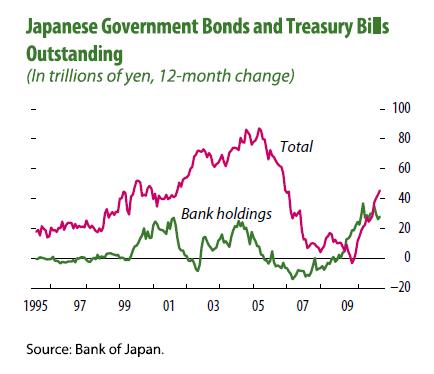 Our sense it may be only a matter of months before Japan comes under intense scrutiny and pressure from the markets. The government’s massive funding needs suck up almost all the country’s savings and explains why the Nikkei is still down over 70 percent lower than its December 1989 peak.
The “crowding out” of the equity market shows, at least to us, that the country’s stock market cannot rally unless: 1) foreign capital inflows increase; 2) Japanese funds invested abroad are repatriated; or 3) massive quantitative easing and direct purchases of equities by the Bank of Japan. The recent pop in the equity market began after the BoJ’s announcement that it would directly purchase Nikkei ETFs.
When the sovereign debt crisis spreads to Japan the U.S will be viewed as “on-deck” and the tremors of the coming of the next crisis will be felt in the bond, currency, and commodity markets, in our opinion. Is Washington listening?
Related Articles
Hedge Funds Face `Sputnik Moment’ in Japan: Commentary by William Pesek – BB
U.S., Japan warned by IMF, rating agencies on debt – Reuters
Japan Rating But Heralds Spread of Sovereign Debt Crisis – Midas Letter
Japan downgraded over debt – CNN
Japan’s Savings Crisis – Martin Feldstein, Project Syndicate
Moody’s says U.S. credit rating risks are rising – Reuters
(click here if charts and tables are not observable)

 Here’s an interesting video from Davos. Fareed Zakaria moderates a panel discussion on the next potential macro shock. The panel includes JP Morgan’s CEO, Jamie Dimon. Go to 15 min 55 seconds into video and listen to Dimon’s brilliant response on the European debt crisis.
With lingering doubts over recent repairs to the financial system, how can industry and government leaders prepare for the next shock to the global economy?
The following dimensions will be addressed:
– Potential geopolitical shocks
– Vulnerability of emerging markets
– Social instability in industrialized economies
– Regulatory readiness worldwideModerated by
Fareed Zakaria
Panellists
Dominic Barton, Eckhard Cordes, James Dimon, Klaus Kleinfeld, Maurice Lévy
(click here if video is not observable)
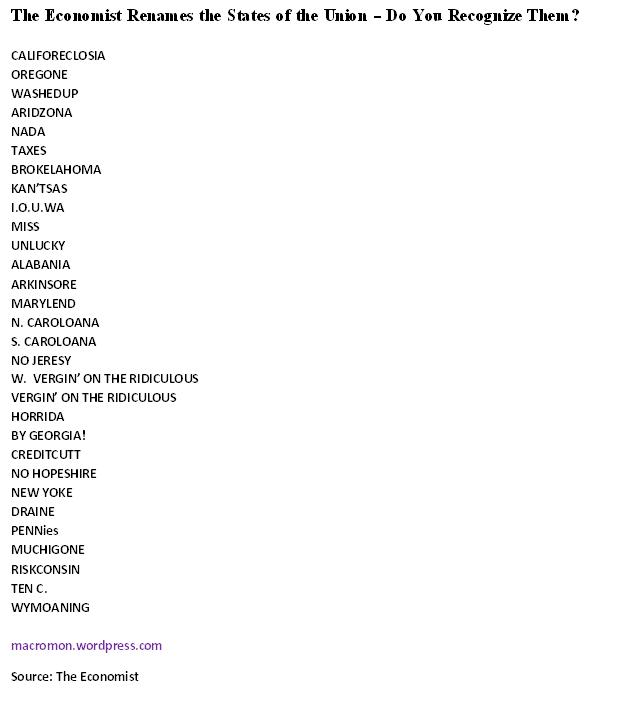
The Economist rips President Obama for failing to address the country’s real problems. This week’s cover, just out, is very creative and quite amusing. The Economist renames every state in the Union with a debt related pejorative. This must be a sign of the bottom, no? Here are some of our favorites (click here if not observable),

The hits just keep on coming in the foods. Futures Magazine reports,
Hogs: April futures rallied limit-up on Wednesday. Traders are noting South Korean buyers will cram orders in quickly to get product in under the 60,000 tonne no-tariff limit that was announced Tuesday. That is why April rallied so hard compared with the deferred months. June futures hit up to 99.45 today. That is just under the 100.20 record that the June 2009 contract posted when it was trading in the summer of 2008. Traders were excited in the summer of 2008 when China was buying pork for the Olympics.
Traders beware, Sarkozy and the G20 are coming,
France’s stance on commodity-market regulation comes amid evidence of surging speculative investment in resources. In the run up to commodities boom, institutional investors boosted inflows into commodities markets from $15 billion in 2003 to between $250 and $300 billion in 2008.
Secretary-general of the Organization for Economic Co-operation and Development Angel Gurria Tuesday welcomed Sarkozy’s push to make the regulation of volatility in commodity markets a priority.
Commodity markets need to function better and more transparently, Gurria said in a statement. Other institutions have been more cautious in ascribing blame to speculators, with one study by the IMF earlier this month suggesting rising demand from emerging nations such as China and India was the driving factor for commodity prices.

(Click here if the chart is not observable)
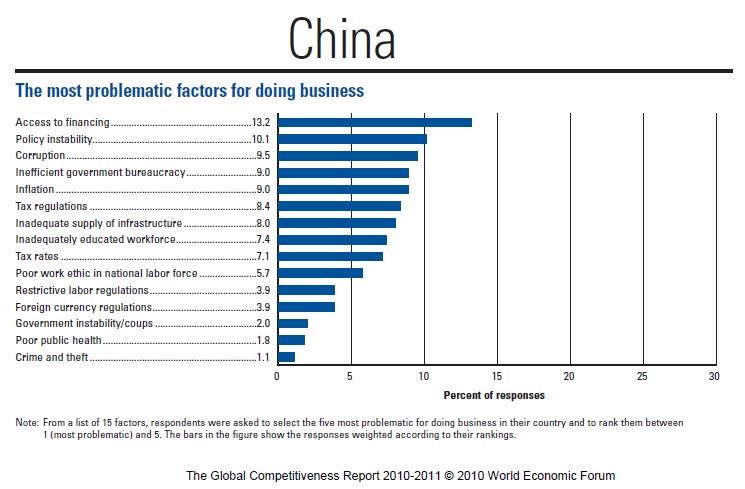
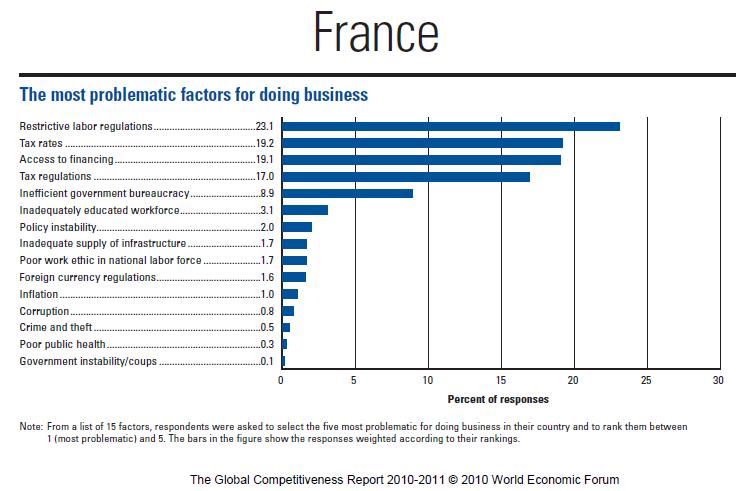
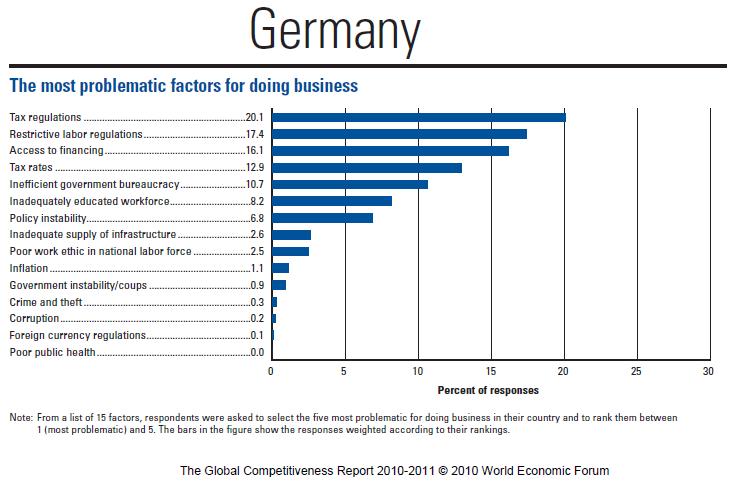
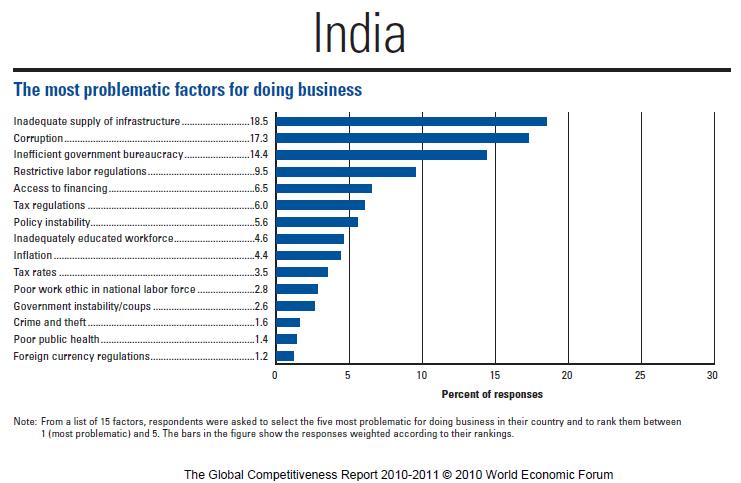
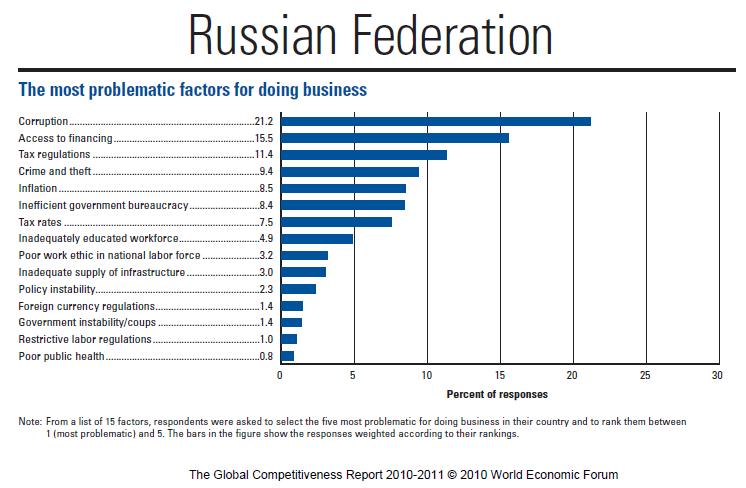
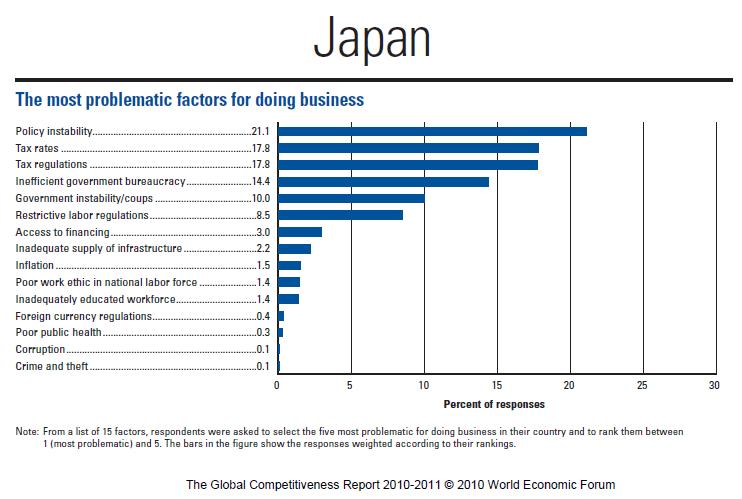
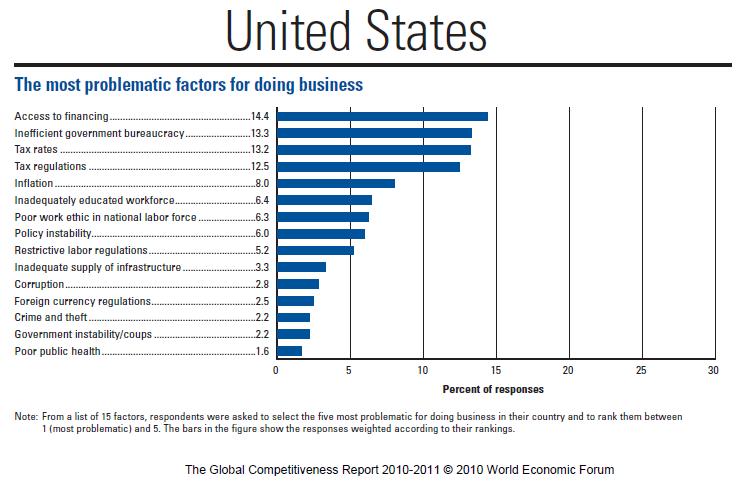
 The President spoke a lot about competitiveness in his State of the Union last night so we thought we’d do a little comparative analysis. Sorry to throw so many charts at you but we think they’re a little more sexy than just looking at the data in the raw.
The comparison of the most problematic factors of doing business in the these countries is very interesting and, in some cases, a bit surprising. The data and charts are from a World Economic Forum survey of real business executives doing real business in these countries. (Click here if charts are not observable)