Jerermy Grantham – Presidential Cycle and Career Risk

Jeremy Grantham, who we really respect, weighs in on the Presidential Stock Cycle and career of risk of straying too far from the crowd and how it contributes to asset bubbles.  From his latest letter,

So, where are we now? Although “quality” stocks are very cheap and small caps are very expensive (as are lower quality companies), we are in Year 3 of the Presidential Cycle, when risk – particularly high volatility, but including all of its risky cousins – typically does well and quality does poorly. Not exactly what we need! The mitigating feature once again is an extreme value discrepancy in our favor, but this never matters less than it does in a Year 3…

As a simple rule, the market will tend to rise as long as short rates are kept low. This seems likely to be the case for eight more months and, therefore, we have to be prepared for the market to rise and to have a risky bias. As such, we have been looking at the previous equity bubbles for, if the S&P rises to 1500, it would officially be the latest in the series of true bubbles.

We especially like this and the great chart,

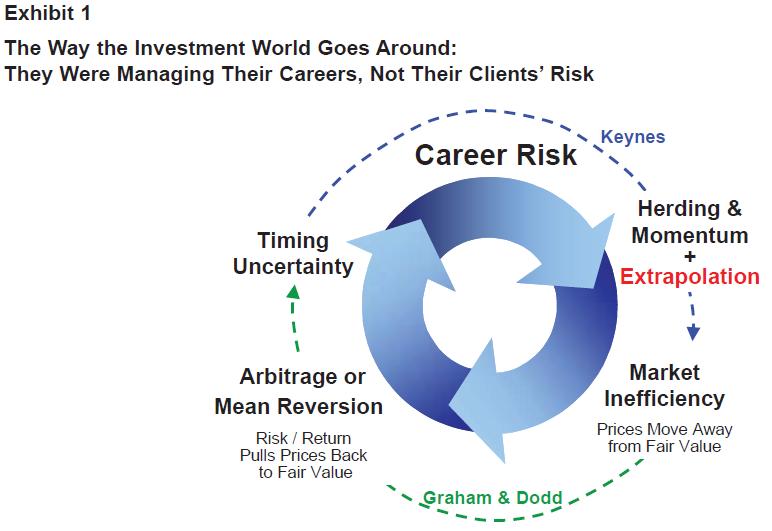
Moving on to asset bubbles and how they form brings us to Exhibit 1. It shows how I think the market works. Remember, when it comes to the workings of the market, Keynes really got it. Career risk drives the institutional world. Basically, everyone behaves as if their job description is “keep it.” Keynes explains perfectly how to keep your job: never, ever bewrong on your own. You can be wrong in company; that’s okay. For example, every single CEO of, say, the 30 largest financial companies failed to see the housing bust coming and the inevitable crisis that would follow it.

Naturally enough,  “Nobody saw it coming!” was their cry, although we knew 30 or so strategists, economists, letter writers, and so on who all saw it coming. But in general, those who danced off the cliff had enough company that, if they didn’t commit other large errors, they were safe; missing the pending crisis was far from a suffi cient reason for getting fi red, apparently. Keynes had it right: “A sound banker, alas, is not one who foresees danger and avoids it, but one who, when he is ruined,  is ruined in a conventional and orthodox way along with his fellows, so that no one can really blame him….

Keynes also had something to say on extrapolation, which is very central to the process of momentum. He said that extrapolation is a “convention” we adopt to deal with an uncertain world, even though we know from personal experience that such an exercise is far from stable. In other words, by definition, if you make a prediction of any kind, you are taking career risk. To deal with this risk, economists, for example, take pains to be conservative in their estimates until they see
the other guy’s estimates.But there is a central truth to the stock market: underneath it all, there is an economic reality. There is arbitrage around the replacement cost. If you can buy a polyethylene plant in the market for half the price of building one, you can imagine how many people will build one…

The problem is that some of these cycles happen really fast, and some happen very slowly. And the patience
of the client is three point zero zero years. If you go over that time limit, you are imperiled, and some of
these cycles do indeed exceed it.
(Click here if chart is not observable)

Posted in Equities, Whales | Tagged , | Leave a comment

Natural Gas, The “Widow Maker”

Check out the long-term chart of natural gas from Managed Futures Today and you can see why they call nattie the “widow maker.”    Long periods without a trend will grind your capital into hamburger and drive you to drink.    We just can’t understand why our electric bill keeps going up while natural gas keeps going down.   Must be nice being a natural monopoly.

Nevertheless,  natural gas’ share of the world’s primary energy mix will continue to increase according the latest BP Energy Outlook.  (Click here if charts are not observable)

Posted in Commodities | Tagged , | Leave a comment

PBS: How Severe Is Europe’s Intertwined Debt Crisis?

The PBS NewsHour ran this piece tonight titled, How Severe Is Europe’s Intertwined Debt Crisis? Note how Iceland is rising as the model debtor and listen carefully for the “politics of bailouts,”

“Germany does not have pockets deep enough to bail out half of Europe…  If Spain were to fall…If there were a bailout of Spain, then you would see serious discussions in Germany about a breakup of the Eurozone…and a fracturing the Euro down the road…”

We read some headline somewhere today about the Euro is going to $1.60.  Can you hear the rivets popping in Ireland and Greece?   Hat tip to John Porter!

(Click here if video is not observable)

Posted in Currency, Euro, PIIGS, Sovereign Debt, Sovereign Risk, Video | Tagged , , , , | Leave a comment

Tracking the Presidential Stock Cycle and Decennial Chart Analogs

Today we look at how the S&P500 is tracking the two chart analogs, which we wrote about at the end of last year.   We don’t “bet the ranch” on these, but we do know many smart people look at them to give a sense how history might rhyme.    The current S&P500 is beating both the Presidential Stock Cycle and the Decennial Cycle for the first 15 days of trading in the new year. (Click here if charts are not observable)

By the way,  according to CNBC  the market is up 26 percent on average in years when the Steelers win the Super Bowl and 23 percent when the Packers win.    Therefore,  the Presidential Stock Cycle, which has on average generated a 22.3 percent return on the S&P500 in the third year of first term Presidents confirms a Packers victory!  Don’t bet the ranch.

Posted in Equities | Tagged , , , , | 2 Comments

Why Apple Rocks and Is Rocking Today…

Apple is bouncing back nicely today after some real panic selling at Friday’s close.  We thought there would be some follow through selling creating a nice gift to pick up the stock on the cheap.  We were wrong.

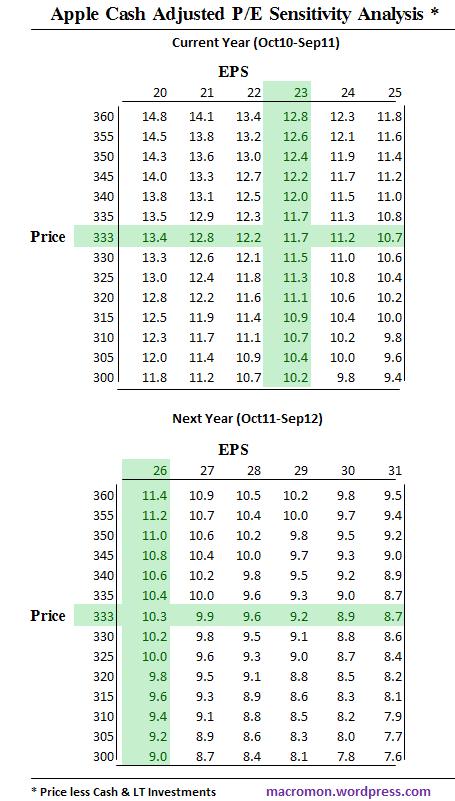
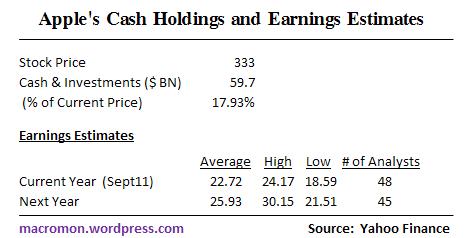
The stock, when adjusted for the $59.7 BN of Cash and LT Investments on the balance sheet, which equates to $65 per share,  is just too cheap based on earnings estimates and the market is now onto the value story.   Our sense is that Apple is a big holding of the fast money crowd and levered set,  which explains, in part, the bouts of increased volatility.

We’ve constructed a sensitivity analysis (see table below) of the stock’s cash adjusted P/E ratio based on various earnings estimates and market prices.   It illustrates at the current price of $333 the stock trades at 10.3x next year’s estimates.   Apple has consistently beat analyst estimates by 10 percent or more in almost every quarter since its reemergence.

The fact the company was able to grow at such a rapid pace over the past few years during what has been,  effectively,  a depression is remarkable.  Imagine the case during steady state growth or a boom?


Apple embodies and has executed on what we believe it will take for the U.S. to emerge and get though its current difficulties:  Innovation.   We think the President gets it.  Listen carefully in his speech tomorrow night.   (Click here if the tables are not observable)

Posted in Apple, Equities | Tagged , | 1 Comment

Why Los Angeles Doesn’t Have An NFL Football Team

We grew up in Los Angeles watching our beloved Rams, who fled for St. Louis in 1994.  The city was also temporary home for the  Oakland Raiders from 1982-94 as the Rams played their home games in Anaheim for almost 15 years.  It has always been a mystery to us why Los Angeles, the second largest city in the U.S., has been without an NFL team since 1994.

In his excellent piece posted on the Globe and Mail blog, Frances Wooley, a professor at Carleton University, states it all about economics. He points out something we did not know,

The NFL, however, is egalitarian. All national revenues, such as sales of television rights, are divided 32 ways. Each NFL franchise receives an equal share. It is impossible to say how important national revenues are relative to other revenues for the league as a whole, as only one NFL team — the publicly owned, small-market Green Bay Packers — makes its financial information publicly available. In 2010, three-fifths of the Packer’s income – $157- out of $258-million – came from its 1/32 share of national revenues.

The revenue sharing system means there is little incentive for a team to move from a small to a large market. Yes, if the Vikings moved to LA, the NFL could potentially gain millions of additional Southern California viewers – and millions more in revenue. Yet the Vikings would only receive 1/32, or about 3 per cent, of that revenue. That’s not enough to offset higher stadium or property tax costs…

Interesting and helps explain why two relatively small market teams are headed to the Super Bowl and why the NFL, unlike Major League Baseball, has fewer major market Yankee-like dynasties.   The piece is short, concise, and worth the read.

Posted in Economics, General Interest | Tagged , , | 1 Comment

Confessions of a Rare Earth Day Trader – FP

Interesting piece in Foreign Policy titled,  I Was a Rare Earths Day Trader.   More interesting, however, is the subtitle, How a naval confrontation in the South China Sea created a global investment bubble — and cost me half my life savings.

The author is a bit cryptic on how he actually blew up, but it sounds like he started dabbling in Rare Earth Element (REE)  penny stocks, made some money then started shorting too early.   Day traders should not base their decisions on long-term fundamentals.   The same is mostly true for traders in general,  in our opinion, though having a “fundamental story” helps navigate market noise and prevents from being shaking out during periods of increased volatility.

What differentiates traders and investors is time horizon.  And, we, like the author,  have donated a lot capital to Mr. Market learning this lesson the hard and costly way.

Nevertheless,  we were all over this story the day China cut off REE exports to Japan.  We suspected the market would soon begin an intense focus on the sector as the world had their “Sputnik moment” over China’s monopoly and control of 95 percent of the world’s production of REEs.   We’ve traded in and out of Molycorp (MCP) during the price spike.

The author does make some good fundamental points that traders and investors will find interesting and the article is,  in our opinion,  a must read for anyone interested or active in the sector.   We found his points on the company Rare Elements Resources (REE) especially interesting,

In fact, Rare Element Resources’ total holdings consist of a few small plots of land, the most promising of which had been abandoned by at least three previous miners (including Molycorp). Unlike the Bre-X scam, the company’s Wyoming land does indeed have rare earths, but they are in small concentrations and are mostly the less-desirable sub-group of the elements. The company’s chief financial executive and spokesman, Mark Brown, and secretary, Winnie Wong, are regulars on Canada’s penny stock scene — they’ve run at least 18 different businesses with names like Deal Capital, Cordova Industries, Apoquindo Minerals, Pivotal Corporation, Globemin Resources, and Everclear Capital.

Wow, sounds like this stock is headed back to penny stock status.   Our sense is that REE stocks are about to get slammed by the fundamentalists. 

Posted in Commodities, Rare Earth Elements | Tagged , , | Leave a comment

The Week in Review: BRICs to FRICs?

Vive la France!
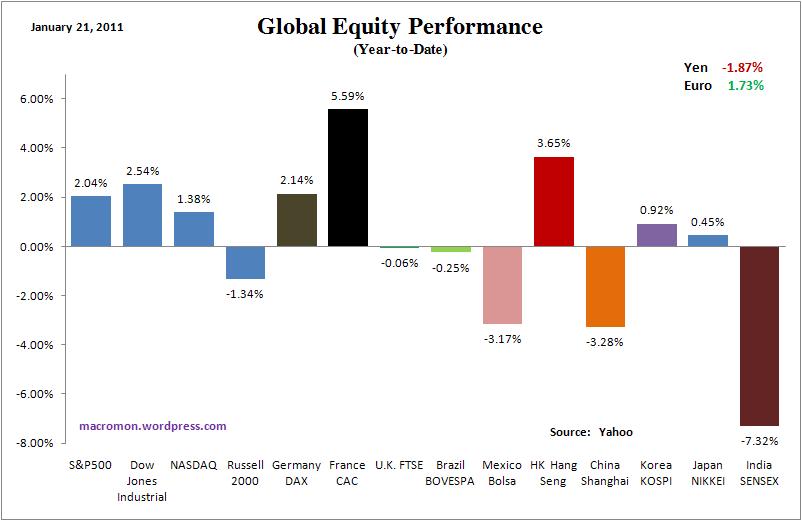
Who would of “thunk” it? The French CAC outperforming India by 13 percent in the first three weeks of the year? Will Goldie’s Jim O’Neill now replace Brazil with France in the BRIC countries and rename the block the FRICs?

Whatever the case, it was a “fricking” painful week for many, but you’d never know it from the headline, Dow Rises for Eighth Week in Row. True, the Dow was up on good earnings and big moves in GE and IBM, but risk got hammered.

The Russell 2000 was down 4.26 percent and the Nasdaq fell 2.39 percent, led by huge reversals in Apple and Google after reporting good earnings. The S&P500 was down 0.76 percent, breaking its streak of 37 consecutive days without a 1 percent correction on

Big Reversals
The theme of the week in U.S. equities was “crush the highfliers.”  F5 Networks, which had risen almost 60 percent since September 1st, plunged 26 percent from last Friday’s close to Thursday’s intraday low on a revenue miss.

Apple rebounded smartly from the Steve Jobs news and traded over $355 in after hours on Tuesday’s 20 percent earnings beat only to reverse and close down 6.24 percent with some ugly selling at the close on Friday. Google traded up on good earnings and also reversed to close down almost 2 percent for the week.

Both stocks will now price a premium for management uncertainty and probably experience further liquidation, in our opinion.  We’ve been bloodied too many times trying to catch a falling knife, but believe the markets are going to provide a nice gift here in transformative tech for those with patience.

Emerging equities were also hammered over worries of more monetary tightening in China, now the locomotive of global growth.  The Shanghai and BOVESPA were down over 2.5 percent. India’s stock market rebounded 0.78 percent after two weeks of pounding. The SENSEX is still down over 7 percent year-to-date.

Japan’s NIKKEI was down 2 percent and the only major European equity market we follow that was up on the week was France. European equities did rally at the end of the week on news of Spain’s bailout of its savings banks, or “cajas.”

Euro Rising, Commodities Rolling
The Euro rallied almost 2 percent as sovereign debt fears receded and, more importantly, as the market begins to contemplate European monetary tightening sooner rather than later.  We have always believed Europe’s sovereign debt crisis is more of a political problem and potential banking crisis, which could evolve and spread into a full blown debt crisis.

It’s clear the EU will insure that the necessary liquidity is there in the short term but the underlying fundamental and structural problems will take time to resolve. The politics of adjustment and bailout fatigue will therefore continue to weigh on the markets from time to time, in our opinion, including Ireland’s election now slated for March.  Imagine the increase in political friction if the ECB raises rates while the periphery is still deflating and/or in recession.  Germany is doing fine,  Greece is not.

Most commodities, including crude oil,  which is testing key support at $88, also experienced ugly reversals on the China fears.  We wrote earlier in the week our view that commodities could roll as the Shanghai broke its 200-day moving average.  The “widow maker”, natural gas, continued its climb, now up over 9 percent for the year on frigid weather.  The CRB foodstuffs index was up slightly, with wheat up over 3 percent.  The metals continued south with gold down 1.25 percent.

We’re waiting for the 200-day moving average around $1,280 for a reentry into gold.   If it breaks the 200-day,  we suspect the market sniffs a reversal in monetary policy in the U.S. and Western Europe, and, or,  the correcting of global imbalances, which would slow the accumulation of foreign exchange reserves by the world’s central banks.

On the Radar
Last week our suspicion was a correction was coming after Apple’s earnings and given the week’s performance we believe it’s just getting started.  We suspect the highfliers will continue to get hammered even on good earnings reports and Apple won’t rebound until it is cheap enough to absorb the supply of those looking to get out.   This will be a gift, in our opinion.

In Tuesday’s  State of the Union address to Congress, the President needs to lay out a comprehensive plan to address the U.S. structural budget deficit and debt overhang, which should have big macro implication either way.  On the macro radar next week: 1) China interest rates;  2) the Hang Seng and  Russell:Dow divergence;  3) State of the Union; earnings; and, 4) listening carefully for more whispers of tightening in Europe and for hints of a changes in U.S. monetary policy.    (If charts are not observable, click here)

Posted in Budget Deficit, Charts, China, Crude Oil, Economics, Equities, Gold, Monetary Policy, Sovereign Debt, Week in Review | Tagged , , , , , | Leave a comment

The Divergence to Keep on Your Radar

Just looking at the the Dow, which was up 0.72 percent,  it wasn’t a bad week.   Look again!

Mr. Market inflicted some heavy pain this shortened trading week and we’re feeling some of it.  We’ll discuss  in more detail what took place during the past few days in our upcoming Week in Review post.

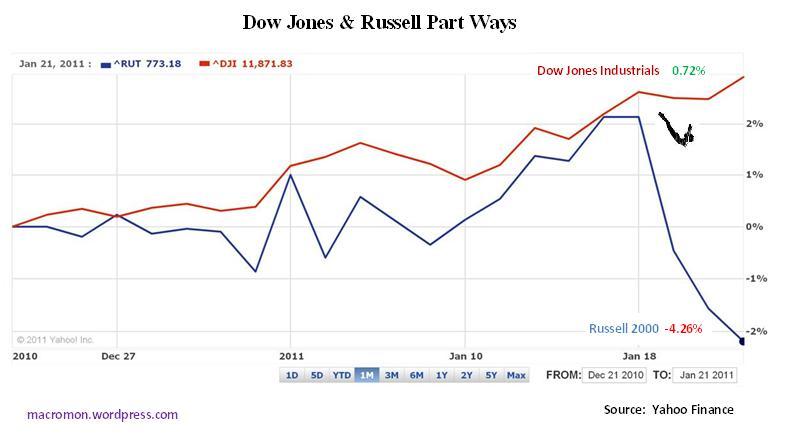
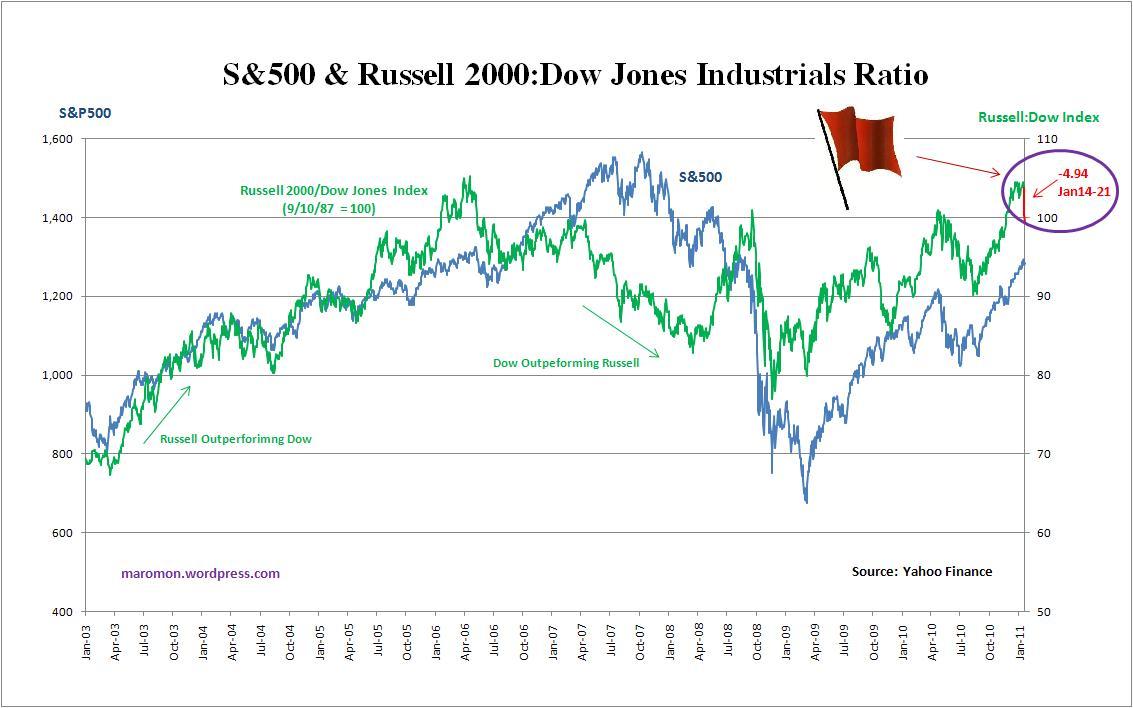
Check out these charts, which illustrate  the huge divergence this week between the small caps and the Dow.   The Russell 2000 began its 4.26 percent swan dive at the open on Wednesday to close at its lows on Friday.  Meanwhile,  the Dow Jones Industrial Average closed up 0.72 percent for the week led by big gains in GE, IBM, Hewlett Packard, and Exxon.

We suspect this just may be profit taking from the Russell’s huge run-up in 2010 as many of the stocks that were up big over the past year also got whacked during the week.    The size of the divergence does raise a red flag, however.

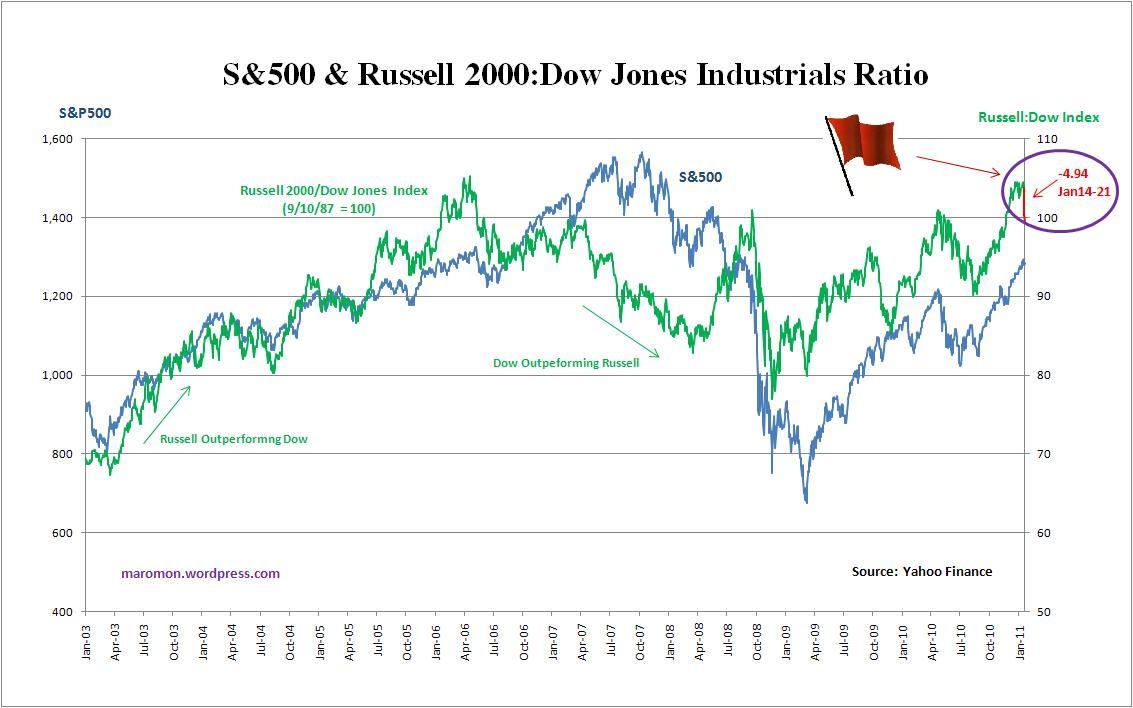
Only twice in the past seven years has the Dow and Russell experienced close to a 5.0 percent performance divergence in just four trading days and those occurred in 4Q 2008, during the height of financial collapse.   The Russell 2000 is a favorite hedging and shorting vehicle for the fast money crowd and the divergence may be a false signal as the shorts rush to cover,  but it’s worth keeping on your radar.

The last chart also shows that the two bull markets of the new millennium,  reflected in the S&P500, have been confirmed by the Russell 2000 outperforming the Dow.   The converse is true during bear markets.    The S&P500 can continue to rally even as the Russell:Dow ratio turns down,  but it’s clear the ratio is a  leading indicator of major trend reversals and deeper corrections.

Posted in Equities | Tagged , , , | 3 Comments

Charts from the Google Conference Call

Posted in Earnings, Equities | Tagged | Leave a comment