Nonlinear Thinking: Surfing Wave Energy

Posted in Uncategorized | Leave a comment

Where The Next Financial Crisis Begins

Our good friend, King David, just forwarded this Bloomberg headline to remind us of a post we made back in 2018, which we have reposted below.  Maybe, or maybe not, but you should have the following analysis in your quiver, at the very least to stress test your market narrative.   We do need to update the data, which are quite stunning and rather surprising.

It also fits hand in glove with our recent post, The Great Reset: The Bond Yield-Dollar Feedback Loop.

See Bloomberg article here.

Where The Next Financial Crisis Begins

Originally Posted on October 25, 2018 by macromon

We are not sure of how the next financial crisis will exactly unfold but reasonably confident it will have its roots in the following analysis.   Maybe it has already begun.

The U.S. Treasury market is the center of the financial universe and the 10-year yield is the most important price in the world, of which, all other assets are priced.   We suspect the next major financial crisis may not be in the Treasury market but will most likely emanate from it.

U.S. Public Sector Debt Increase Financed By Central Banks 

The U.S. has had a free ride for this entire century, financing its rapid runup in public sector debt,  from 58 percent of GDP at year-end 2002, to the current level of 105 percent, mostly by foreign central banks and the Fed.

Marketable debt, in particular, notes and bonds, which drive market interest rates have increased by over $9 trillion during the same period, rising from 20 percent to 55 percent of GDP.

Central bank purchases, both the Fed and foreign central banks, have, on average, bought 63 percent of the annual increase in U.S. Treasury notes and bonds from 2003 to 2018.  Note their purchases can be made in the secondary market, or, in the case of foreign central banks,  in the monthly Treasury auctions.

In the shorter time horizon leading up to the end of QE3,  that is 2003 to 2014,  central banks took down, on average, the equivalent of 90 percent of the annual increase in notes and bonds.  All that mattered to the price-insensitive central banks was monetary and exchange rate policy.   Stunning.

Greenspan’s Bond Market Conundrum

The charts and data also explain what Alan Greenspan labeled the bond market conundrum just before the Great Financial Crisis (GFC).   The former Fed chairman was baffled as long-term rates hardly budged while the Fed raised the funds rate by 425 bps from 2004 to 2006, largely, to cool off the housing market.

The data show foreign central banks absorbed 120 percent of all the newly issued T-notes and bonds during the years of the Fed tightening cycle, freeing up and displacing liquidity for other asset markets, including mortgages.   Though the Fed was tight, foreign central bank flows into the U.S., coupled with Wall Street’s financial engineering, made for easy financial conditions.

Greenspan lays the blame on these flows as a significant factor as to why the Fed lost control of the yield curve.  The yield curve inverted because of these foreign capital flows and the reasoning goes that the inversion did not signal a crisis; it was a leading cause of the GFC as mortgage lending failed to slow, eventually blowing up into a massive bubble.

Because it had lost control of the yield curve,  the Fed was forced to tighten until the glass started shattering.  Boy, did it ever.

Central Bank Financing Is A Much Different Beast

The effective “free financing” of the rapid increase in the portion of the U.S debt that matters most to markets, by creditors who could not give one whit about pricing,  displaced liquidity from the Treasury market, while, at the same time,  keeping rates depressed, thus lifting other asset markets.

More importantly, central bank Treasury purchases are not a zero-sum game. There is no reallocation of assets to the Treasury market in order to make the bond buys.  The purchases are made with printed money.

Reserve Accumulation

It is a bit more complicated for foreign central banks, which accumulate reserves through currency intervention and are often forced to sterilize their purchase of dollars, and/or suffer the inflationary consequences.

Nevertheless, foreign central banks park much of their reserves in U.S. Treasury securities, mainly notes.

Times They Are A-Changin’

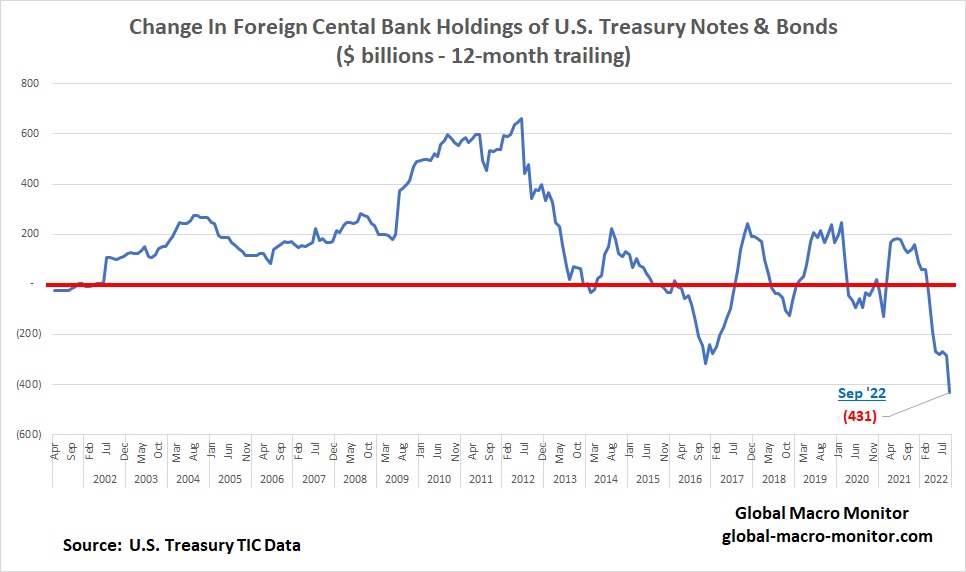
The charts and data show that since 2015,  central banks, have, on average been net sellers of Treasury notes and bonds, to the tune of an annual average of -19 percent of the yearly increase in net new note and bonds issued.  The roll-off of the Fed’s SOMA Treasury portfolio, which is usually financed by a further increase in notes and bonds, does not increase the debt stock, but it is real cash flow killer for the U.S. government.

Unlike the years before 2015, the increase in new note and bond issuance is now a zero-sum game and financed by either the reallocation from other asset markets or an increase in financial leverage.  The structural change in the financing of the Treasury market is taking place at a unpropitious time as deficits are ramping up.

Because 2017 was unique and an aberration of how the Treasury fnanced itself due to the debt ceiling constraint,  the markets are just starting to feel this effect.   Consequently, the more vulnerable emerging markets are taking a beating this year and volatility is increasing across the board.

The New Market Meta-Narrative 

We suspect very few have crunched these numbers or understand them, and this new meta-narrative, supported by the data, is the main reason for the increase in market gyrations and volatile capital flows this year.   We are pretty confident in the data and the construction of our analysis.   Feel free to correct us if you suspect data error and where you think we are wrong in our analysis.  We look forward to hearing from you.

Moreover, the screws will tighten further as the ECB ends their QE in December.  We don’t think, though we reserve the right to be wrong, as we often are,  this is just a short-term bout of volatility, but it is the beginning of a structural change in the markets as reflected in the data.

Interest Rates Will Continue To Rise

It is clear, at least to us, the only possibility for the longer-term U.S. Treasury yields to stay at these low levels is an increase in haven buying, which, ergo other asset markets will have to be sold.   If you expect a normal world going forward, that is no recession or sharp economic slowdown, no major geopolitical shock, or no asset market collapse,  by default, you have to expect higher interest rates.  The sheer logic is in the data.

Of course,  Chairman Powell could cave to political pressure and “just print money to lower the debt” but we seriously doubt it and suspect the markets would not respond positively.

Stay tuned.

Central Bank_2
Central Bank_5
Central Bank_10
Posted in Black Swan Watch, ECB, Fed, Uncategorized | Tagged , , | 1 Comment

U.S. To Annouce New Limits On China Chips

Posted in Uncategorized | Leave a comment

Seriously? Swissie a Safe Haven During a Banking Crisis?

Repost of an oldie but goldie, (as in a decade old), especially relevant given the rumors in today’s market.  Here’s to hoping the policymakers have rectified some of the issues, but in our experience goveventments are reactive to a crisis rather proactive to prevent one. More research needed, another post coming.

Seriously? Swissie a Safe Haven During a Banking Crisis?

Here’s in an interesting chart, originally posted over at Zero Hedge, that makes us wonder do we really want to be long the Swiss franc during a European banking crisis?   Note the chart may be a little dated, but we think you get the picture.  Click chart for bigger picture and better resolution.

(click here if chart is not observable)

Posted in Black Swan Watch, Currency, Sovereign Debt, Sovereign Risk | Tagged , , | Leave a comment

This Quarter Was Different: The Big Reversal

We’ve been all over the “Big Reset,” which is upending many things.  It’s disheartening to hear most of the Street analysts speak as if nothing has changed but prices. 

All things as we have known and have become comfortably numb with, such as zero interest rates, negative real interest rates, quantitative easing (digital money printing), [Chimerica, a placid labor market, trade and investment flows] and Pax Americana, [and central bank dominance of the U.S. bond market] are being upended and overturned.  Beware of recency bias, folks, as the global structural shifts and changes are now ubiquitous. – GMM, Sep 23rd

Here’s an example of how markets are convulsing to the Big Reset.  

“Painful Regime Change”

The third quarter will also get its place in the history books for one of the biggest reversals: It is the first quarter since 1938 that the S&P 500 Index closed in the red after gaining more than 10%. 

All in all, 2022 is the year that reflects a “painful regime change,” said Michael Hartnett, BofA’s chief investment strategist. – Bloomberg

Nowhere To Hide

Even during the Great Depression, bonds made money, but not in stagflation, including during the 1970s.  There has been nowhere to hide this year. 

Posted in Equities, The Big Reset | Leave a comment

Global Macro Watch – September 30

Posted in Interest Rate Monitor | Tagged , , , | Leave a comment

Friday CK Chart Fest – September 30

Forced Liquidation 

G7 Yields, Inflation, & Policy Rates 

Euro Inflation Spike

This image has an empty alt attribute; its file name is euro-inflation-1.jpg

German Inflation Soars

Gilts Gone Wild

Mortgage Spreads Blowing Out

Cue The Corporate Debt Reckoning

Dollar Strength In Context 

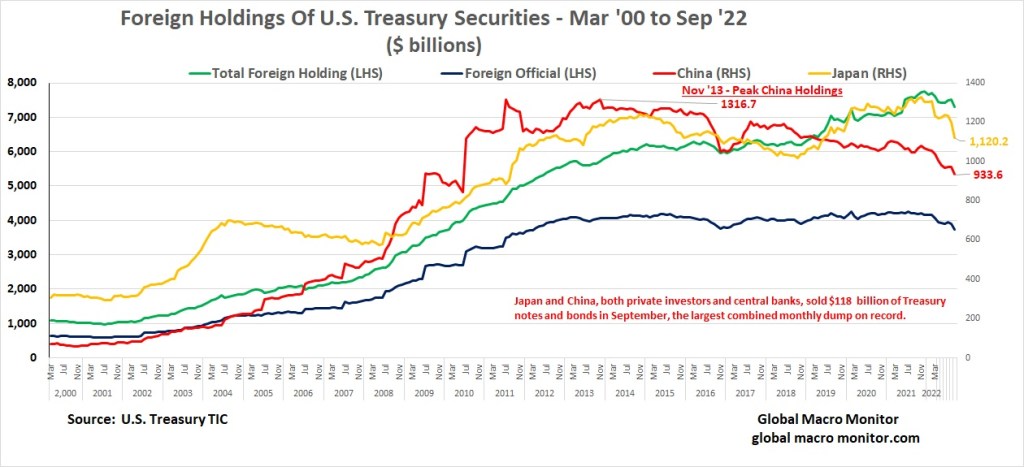
China Selling U.S. Treasuries 

Inflation 101:  The Wage-Price Spiral 

Hitting An Oil Slick 

Can Brazil’s Lula Get To 50% On Sunday?

How To Spot A U.S. Political Swinger

How Not To Run An Economy

China Increasing Naval Presence Near Taiwan

The World’s Most Powerful Man

Posted in Charts | 2 Comments

The Great Reset: The Bond Yield-Dollar Feedback Loop

The Great Reset is upon us. 

All things as we have known and have become comfortably numb with, such as zero interest rates, negative real interest rates, quantitative easing (digital money printing), and Pax Americana, [and central bank dominance of the U.S. bond market] are being upended and overturned.  Beware of recency bias, folks, as the global structural shifts and changes are now ubiquitous. – GMM, Sep 23rd

Here’s a quick primer that may explain the current global macro dynamic between the strong dollar and rising bond yields. We’ve been beating this drum for years.

Central Banks Will Be Net Sellers Of Treasury Securities

Central banks, both foreign and the Fed, who are and have never been price and market sensitive, have been the predominant buyers of Treasury coupon securities over the past 20 years. 

Look at the following table from a July 2021 post, which set the stage for the inflation we are now experiencing. 

This image has an empty alt attribute; its file name is central-bank-holdings_covid-1.jpg

Granted, the massive ramp in the budget deficit during COVID – to a 12-month trailing high of 19 percent of GDP in March 2021 – is unlikely to repeat, but ditto for the Fed’s Treasury purchases.  The markets did not have the ability to absorb such a massive new issuance without a major financial disruption and a spike in interest rates. 

The markets will now have to absorb or step in and replace both the Fed’s demand as the balance sheet runs off (effective net Treasury selling) and the foreign central bank selling. Both have now morphed from the largest buyers to net sellers.

Also, note from the above table the Fed’s purchase of almost 200 percent of TIPs issuance during the period; that is, all of it and then some.  Inflation expectations?  Managed!

This image has an empty alt attribute; its file name is foreign-central-bank-purchases-2.jpg

China Selling Treasury Holdings

Once the largest foreign holder of U.S. Treasury securities, China has sold down its holdings by over 26 percent from its November 2013 peak.  We also have no doubt Japan’s holdings are down from the latest observation in July. However, the Bank of Japan (BoJ) seems more comfortable with a weakening yen but not at the recent rapid clip, which forced them to intervene in the currency market. 

Japan intervened in the foreign exchange market on Thursday to buy yen for the first time since 1998, in an attempt to shore up the battered currency after the Bank of Japan stuck with ultra-low interest rates.   –  Reuters, Sep 22nd

This image has an empty alt attribute; its file name is china-japan-treasury-holdings.jpg  

Global Capital Flows And The Great Financial Crisis

Before the Great Financial Crisis (GFC), the Fed raised its policy rate by 425 basis points, and long-term yields barely budged.  Were financial markets efficient in anticipating the GFC?  

Hardly.  The technical position of the yield curve contributed to and helped cause the GFC.

Alan Greenspan argued that the Fed lost control of the U.S. yield curve. Foreign central banks recycled their massive dollar purchases back into the U.S. bond market after intervening in home markets to keep their currencies from appreciating.  Central banks were still reeling from the 1997 Asian Financial Crisis, which taught them a hard lesson about letting currencies become too overvalued.    

The foreign central bank Treasury purchases suppressed long-term rates and allowed the credit and housing bubble to continue for much longer than the Fed anticipated and desired.  

Looking back, he [Alan Greenspan] says today: “We tried in 2004 to move long-term rates higher in order to get mortgage interest rates up and take some of the fizz out of the housing market. But we failed.” Something besides Fed policy was at work. Both Mr. Greenspan and his successor, Ben Bernanke, point to an unanticipated surge in capital pouring into the U.S. from overseas. – Council of Foreign Relations

Are We Now In A Rising Bond Yield/Strong Dollar Feedback Loop?

In our 2017 post, Orwellian Monetary Policy, we posited that tighter domestic monetary policy in a globalized capital market could, in effect, and paradoxically, create looser domestic financial conditions as foreign capital is sucked back into the U.S. markets.  We suspect that is what happened before the GFC and agree with Greenspan and Bernake on this point. 

We wrote in the dystopian 1984 language, 

“Tightening is Easing”

Today’s World

The moves in exchange and interest rates over the past few months have been violent.

We suspect we are now in a bond yield-dollar feedback loop, where many central banks are forced to intervene in their home currency markets, selling their Treasury holdings to raise the dollars to ease the pressure on the home currency.

On the margin – and prices are set by marginal buyers and sellers — their actions put downward pressure on U.S. bond prices, causing yields to rise.  

We are unsure whether this is a reality or GMM fitting reality to a nice theory, but we deduce it fits the action we are currently witnessing in the global markets. 

The same is true for all central banks whose currencies are under pressure.  Witness the positive feedback loop.

This image has an empty alt attribute; its file name is bond_dollar-feedback-loop-3.jpgReflexivity

Reflexivity in economics is the theory that a feedback loop exists in which investors’ perceptions affect economic fundamentals, which in turn changes investor perception. The theory of reflexivity has its roots in sociology, but in the world of economics and finance, its primary proponent is George Soros. – Invetopedia

We don’t know if the markets are in a period of Soros’ reflexivity, where traders and investors understand the above model and are trading on it, causing yields to rise and the dollar to strengthen even further in a self-fulfilling prophecy. 

We suspect it is so; in the same spirit of Milton Friedman’s pool player analogy, acting as if they understand the laws of physics even though they don’t. 

Consider the problem of predicting the shots made by an expert billiard player. It seems not at all unreasonable that excellent predictions would be yielded by the hypothesis that the billiard player made his shots as if he knew the complicated mathematical formulas that would give the optimum directions of travel, could estimate accurately by eye the angles, etc., describing the location of the balls, could make lightning calculations from the formulas, and could then make the balls travel in the direction indicated by the formulas. Our confidence in this hypothesis is not based on the belief that billiard players, even expert ones, can or do go through the process described; it derives rather from the belief that, unless in some way or other they were capable of reaching essentially the same result, they would not in fact be expert billiard players. – Milton Friedman, Essays in Positive Economic, 1953

Where Are The Dollars Going?

Moreover, where is all the liquidity going from the King-Kong dollar strength?  

Our priors are more, or some are being transferred from foreign central bank holdings of Treasuries into private sector hands and recycled back into the U.S. short-end bond and money markets.  

Nobody knows for sure, but after three 75 bps rate hikes and quantitative tightening well underway,  one would think that money liquidity would be shrinking.   However, it doesn’t seem to be the case as the Fed’s overnight reverse repo facility remains at record highs. 

We suspect foreign capital is flowing into the short-end, which now provides decent yields of 3-4 percent, giving the gorilla strength to the U.S. dollar. 

Are Financial Conditions Tight?  

After the jumbo rate hikes and $90 billion per month being drained from the domestic financial markets as the notes and bonds roll off the Fed’s balance sheet, one would think so. 

Our favorite indicator of U.S. financial conditions,, the Chicago Fed’s National Financial Condition Index (NFCI), a weighted average of a large number of variables (105 measures of financial activity). tells a different story, however.   Financial conditions remain slightly loose. 

Upshot

The U.S. financial markets are still flush with too much money, and the Fed has once again lost control of events. Something big will eventually break, but in the words of the great-late MIT professor Rudy Dornbush,

In economics, things take longer to happen than you think they will, and then they happen faster than you thought they could. – Rudiger Dornbusch

Because we have reached the tipping point of excess money, liquidity, capital, or however you define it, which are creating global inflationary pressures, don’t count on the monetary cavalry coming to the rescue anytime soon or returning to the good old days of hurricane force central bank tailwinds..

Look how markets reacted to the U.K.’s unfunded tax cuts this week. 

Britain’s new government announced a sweeping series of tax cuts on Friday, betting it had found the path to economic growth despite high inflation.

But the market verdict was swift and negative: The value of British stocks and bonds fell sharply, while the pound sank to lows against the U.S. dollar not seen since 1985. – NY Times

The Great Reset is upon us, folks.  Don’t fight it. 

We expect global policymakers will eventually be forced to coordinate their actions.   

Posted in Uncategorized | 22 Comments

Putin’s Nuke Threat, Biden’s Decision Tree

That brings us to the other notable part of Putin’s call-up speech: the not-very-veiled nuclear threat. Would he really go that far?

There are plenty of reasons to suggest that he wouldn’t. A tactical nuclear strike wouldn’t do much to advance his war effort; holding freshly nuked territory isn’t an attractive proposition; and fallout might blow back into Russia. Yet Hal Brands believes it’d be wise to take the threat seriously. Using a nuke might not actually backfire: Those desperate to end the fighting immediately may be willing to make concessions to Putin. Retaliating with nuclear strikes risks an escalatory spiral. Plus, as Leonid noted in a Twitter Space with Clara Ferreira Marques and Bobby Ghosh on Thursday: “If [Putin] loses, he’s finished and it’s not going to be very nice for him.” At this point, Putin may be willing to do anything to ensure survival.

All these things are no doubt weighing on US President Joe Biden’s mind right now. No one rational would envy the decisions he’ll have to make in the coming weeks and months. – Lara Williams, Bloomberg 

Great podcast on all of the above:

https://twitter.com/i/spaces/1nAJErvnBYYxL


Posted in Uncategorized | Leave a comment

Global Macro Watch

What a historic week in all global markets!

Posted in Uncategorized | Leave a comment