Speculative manias gather speed through expansion of money and credit. Most expansions of money and credit do not lead to a mania; there are many more economic expansions than there are manias. But every mania has been associated with the expansion of credit. –Kindleberger & Aliber
M2 Money Supply Growth
Social Movement
Stock prices are likely to be among the prices that are relatively vulnerable to purely social movements because there is no accepted theory by which to understand the worth of stocks….investors have no model or at best a very incomplete model of behavior of prices, dividend, or earnings, of speculative assets. – Robert Shiller
Galloway attributed part of Tesla’s (TSLA) meteoric rise to the buying influence of “mostly young men, mostly spending their stimulus checks, levering up their purchases and juicing the stocks.” – Yahoo Finance
Know Thy Marginal Buyer
This person willing to pay top dollar is called the “marginal buyer”. Most of us don’t really think about him [her] much, but he (or she) is very, very important.
Why? Because the marginal buyer not only determines price levels, but also their stability and degree of volatility. The behavior of the marginal buyer, as well as the degree of competition for his/her “top dog” spot, sets the prices of nearly every asset class held by today’s investors. – Peak Prosperity
Crazy Town Valuation
This Time Is Different
• The central bankers, policymakers and investors involved in every financial bubble are utterly convinced that, in terms of economic events, “this time is different.” • Otherwise-savvy people ignore the telltale signs of a bubble when they are in the grasp of “this-time-is-different syndrome.” • Even brilliant thinkers like former Federal Reserve Chairman Alan Greenspan fall victim to this syndrome. • Bankers and economists in the ’20s predicted that wars would not recur and the future would be stable. • From 2003 to 2007, conventional wisdom said central bankers’ expertise and Wall Street innovations justified soaring home prices and rising household debt. • In fact, rising home prices and financial innovation are strong indicators of a bubble. • Currency debasement was common for centuries. In the past 100 years, inflation has replaced debasement. • Financial crises have occurred regularly over the past two centuries. – Reinhart & Rogoff
Of course. And as I already noted: the US is actually doing better re durable goods than nondurables (which includes food), in terms of value-added or gross output. This includes things like planes, cars, medical goods, computers, etc etc. https://t.co/Ohlz4aBxoc
So we had to run some numbers on job growth in the manufacturing sector using the BLS Data Base.
Craft Beer and Cupcake Jobs Outperforming
First, our use of the term “Craft Beer” is a bit of a misnomer. The BLS defines this category as all employees in breweries, wineries, and distilleries. So too with our use of the term “Cupcakes”, which the BLS defines as employees in chocolate and confectionery manufacturing.
We choose to use these terms to emphasize our priors that higher-paying manufacturing jobs continue to be replaced by lower-paying jobs even in the manufacturing sector and that the headline numbers should be more closely dissected and analyzed.
Craft Beer & Cupcake Manufacturing Jobs Rocking
Nonetheless, however, defined, the growth in both subsectors — albeit a very small proportion of nondurable manufacturing goods employment — are far outpacing the overall manufacturing job growth, which is kind of/or could be a fractal of what is taking place in the overall sector. Emphasis on could as this is really a fun MM exercise and if we were serious we would spend more time on it but you’re not paying enough and we will leave that to you and the Fellows above.
Nevertheless, the data show that from just before the Great Financial Crisis (GFC), in August 2008 to peak employment prior to the COVID crisis in February 2020, job growth in the “Craft Beer” sector increased by a stunning 145.15 percent compared to 11.11 percent for total nonfarm payrolls, -3.79 percent for total manufacturing job growth, and -2.72 percent for nondurable manufacturing jobs.
“Cupcake” jobs growth also significantly outperformed, up 17.78 percent — again, albeit from a low base.
Upshot
Not a very bankable analysis but does give you sort of a sense and story of what’s going with employment in the manufacturing sector, which, by the way, is also very sensitive to the movements in the dollar. We highly recommend you check it out for yourself.
Good cocktail conversation and some potentially nice political fodder for those who understand how to mine data and waterboard it until it confesses whatever you want it to.
We also defer all things confectionery to the daughter of GMM’s chief stock picker, Carol K., who is a master pastry chef, very impressive for a young teenager.
Stunning transformation of the world’s largest stocks over the past decade-and-a-half. When normalized to global GDP it also illustrates the economic and market power of the largest stocks. The data in the below table show that the the top eight most valuable companies were just 4.4 percent of global GDP in 2005 compared to 12.3 percent today.
Moreover, three of the largest U.S. companies, Microsoft, Google and Facebook do not have supply chains in the traditional sense, which puts downward pressure on labor demand. Even Apple, which outsources most of its production, employs only 140k workers — many of which are lower paid workers in the retail stores — compared to GE’s 320K in 2005, and only 12k employees at its Cupertino campus, where the good paying jobs are located, or were before the pandemic.
Apple closed Friday with a stunning market capitalization of $2.127 trillion. Just for some context, the company is now worth more than every state’s GDP in the country with the exception of California ($3.1 trillion), and larger than all but seven of the world’s economies, just behind France’s $2.71 trillion GDP.
Spare us the lectures, professors, we understand the complexities of comparing flow (GDPs) with stock (market capitalization) variables.
While the macro boys at GMM are off hunting Black Swans, I am making money to keep the lights on. – Carol K., GMM, August 11th
Yes, Carol K is correct, and we thank her for keeping the lights on at GMM. We do like hunting Black Swans though if purely defined we wouldn’t know what we are hunting. You know, the unknown unknowns thingy.
By the way, the three ETFs that Carol K. fancied in her August 11th post, Investing In The Economy Of The Future, are up 9.30 percent, 6.41 percent, and 11.95 percent vs. the S&P’s 1.90 percent. Thanks, CK, for subsidizing our trophy hunting.
Here’s a macro swan we recently discovered that really worries us and may help explain the spike in gold prices as Treasury rollover risk has increased markedly because of it.
Just so we don’t set the MMT crowd’s hair on fire, we will define rollover risk as the market becoming hesitant to refinance the $5 trillion of T-bills maturing in the next year, which will force the Fed to step up to monetize the maturing bills to prevent short-term yields from spiking and/or the government from defaulting, which, of course, will send gold to the moon and the dollar to the deepest parts of Hades.
Or, as Russia did in 1998 and Argentina chose to do recently, rather setting off an inflationary spiral — yes, inflation even with an output gap — the U.S. G could choose to default/restructure and reprofile its short-term debt. Highly unlikely but not impossible (if the political calculus favors it) as some suggest.
T-Bill Financing Spikes As Percent Of Total Marketable Debt
Take a look at the chart of the Treasury’s marketable debt profile held by the private sector (x/ Fed). Anyone who has worked in the emerging markets understands how dangerous it is for a sovereign to depend on short-term financing to fund a swelling budget deficit and a rapidly growing debt stock.
The current stock of T-bills outstanding is now around 26 percent of GDP compared to 14 percent during the last big spike during Great Financial Crisis (GFC).
Treasury officials do not seem concerned, however,
The recent rise in private sector savings is the largest on record and flows associated with that savings growth should continue to support private sector demand for T-Bills. – Treasury Presentation To TBAC
We understand the COVID crisis has put extraordinary stress on the U.S. budget, much of it will be temporary (fingers crossed), and at zero interest rates is essentially free financing for the taxpayer.
Moreover, yield curve management attempts to prevent interest rate spikes on the long end, which would result if the Treasury listened to the idjits who advocate a trillion-dollar issuance of 30-year bonds to finance, whatever.
My god, who is going to buy $1 trillion or even $100 billion of 30-year bonds at a 1.35 percent nominal yield or a negative real yield of around 50 bps? Expected inflation and breakeven rates are even distorted as the FED now owns over 18 percent of TIPs.
Benchmark U.S. Treasury yields surged to seven-week highs on Thursday after the Treasury sold a record amount of 30-year bonds to weak demand, the final sale of $112 billion in new coupon-bearing supply this week.
The Treasury sold $26 billion in bonds, up from $22 billion at its last quarterly refunding in May.
The debt sold at a high yield of 1.406%, around three basis points higher than where the debt traded before the sale. Primary dealers took a larger than average share of 28% of the bonds, indicating tepid demand from investors. The bid-to-cover ratio of 2.14 times was the lowest since July 2019. – Reuters, August 13th
Treasury Curve Distortion
Ground control to Investor Tom, take your reality pills, and put your thinking caps on. Current interest rates are relatively meaningless in terms of resembling anything close to fundamental reality or an economic signal.
There are few real money buyers of Treasury coupons at current rates.
77 percent of Treasury Curve Held By Fed And Foreigners
The following table illustrates that both the Fed and foreign central banks hold 57 percent of the current stock of outstanding Treasury coupon securities, who have no sensitivity to market prices, are not directed by market forces except to keep asset prices elevated. Private foreign investors hold about 20 percent of the $13 trillion of marketable notes and bonds held by the public.
Together, the Fed and foreigners control over 77 percent of the Treasury curve, leaving a residual of only about $3 trillion held by domestic U.S. investors.
Apple & Microsoft’s Market Cap > Treasuries Held By U.S. Domestics
To further illustrate how distorted financial markets are Apple and Microsoft’s combined market cap, alone, at Friday’s close was 126 percent of the total stock of Treasury notes and bonds held by U.S. private domestic investors.
Now, what is the bond market telling us?
Still wondering why the financial markets are behaving like a whacko from Waco?
Hidden Faultline In Bills & May Show Up In Repo Market Again
Nonetheless, short-term T-bills will have to be paid off or rolled over. There is no free lunch and we suspect this is where a big potential problem hides.
As the above chart shows, T-Bills have gone from about 15 percent of a much smaller stock of total marketable debt at the end of January to 30 percent of outstanding Treasury securities privately held at the end of June, while the total stock of marketable debt has increased by 19 percent in just five months.
Declining Trend In Bid-to-Cover Ratios
The Bid-to-Cover ratio for bills has been in a declining trend over the past decade.
Could it because they now yield zero percent? However, T-Bills yielded zero percent during the first ZIRP road trip, which lastest for almost five years after the Great Financial Crisis (GFC) so something else must be going on. We are open to suggestions.
Contrary to conventional wisdom the relative demand for Treasury securities by foreigners has been waning. Foreign holdings of U.S. T-bills has declined from over 50 percent of the total stock to around 20 percent over the past five years. Moreover, the percentage of foreign holdings of Treasury coupon securities, TIPs, and FRNs have fallen from as high as 60 percent of the total stock to 40 percent, levels not seen since the early aughts.
Though foreign central banks still hold about 28 percent of the stock of coupons, the Fed has really stepped up as the marginal buyer during the COVID crisis, increasing its holdings of notes and bonds from $2.384 trillion at the end of January to $4.177 trillion by end-June. During the same period, foreign central banks have reduced their holdings from $3.875 trillion to $3.760 trillion.
Upshot
The global financial markets are extremely distorted primarily due to how central banks have manipulated their government bond markets. Because the U.S. remains the world’s dominant reserve currency, foreign central bank recycling of their foreign exchange reserves back into the U.S. Treasury market has, for many years, further distorted U.S. interest rates.
The COVID crisis and the subsequent huge financing requirements of the U.S. Treasury have created anomalies in how the government finances itself, including an over, and what we deem a potentially dangerous, dependence on short-term debt. This is a faultline on nobody’s radar.
There you have it, folks, now you’re in the know. It’s no longer a Black Swan.
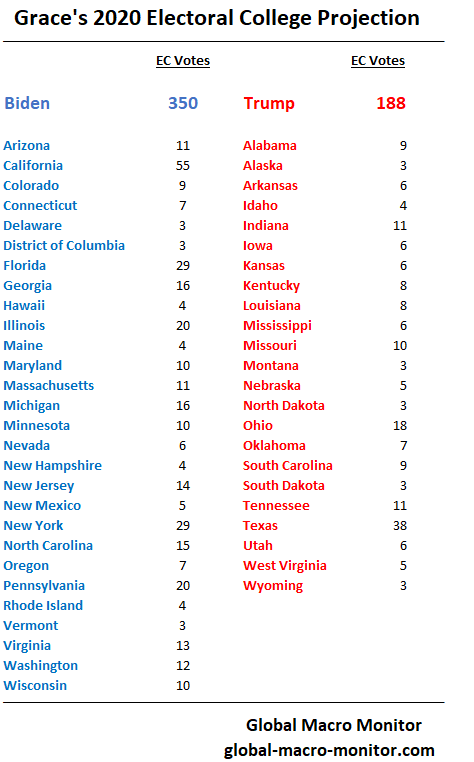
Joe Biden currently stands a good chance of winning the presidency. He is a lifelong centrist but could turn out to be the most ambitious Democratic president in generations.
We’re reposting our piece from November 2017 on the retail space in Manhattan along with a recent video Tweet we found today, which is un-fricking-believable. The video is a bit dated but our ears on the ground say it’s still pretty bad. Who is holding the mortgages on these buildings and why isn’t it making headlines or even adding one brick in the Wall of Worry?
Bleecker Street, said Faith Hope Consolo, the chairwoman of the retail group for the real estate firm Douglas Elliman, “had a real European panache. People associated it with something special, something different.” Ms. Consolo, who has negotiated several deals on the street, added: “We had visitors from all over that said, ‘We’ve got to get to Bleecker Street.’ It became a must-see, a must-go.”
Early on, Ms. Consolo said, rents on the street were around $75 per square foot. By the mid-to-late 2000s, they had risen to $300. Those rates were unaffordable for many shop owners like Mr. Nusraty, who was forced out in 2008 when, he said, his lease was up and his monthly rent skyrocketed to $45,000, from $7,000. – NY Times
Retail not just being Amazoned in Manhattan, retailers are being priced out of business by exorbitant rents. Note to commercial landlords: Lower your rents! But, God forbid, that would be deflationary!
One response to the neoclassical argument is that, in fact, prices are not perfectly flexible (they exhibit “stickiness”). For this reason, the economy is not self-correcting, at least not in the short run. Wages and prices may be “too high” (and, therefore, result in suppliers offering larger quantities for sale than demanders are able and willing to buy), but not come down quickly and eliminate the market surplus. This view has been widely attributed to John Maynard Keynes, and is, in fact, a key argument in what is known as “New Keynesian” economic theory. – Dollars & Sense
.
.
During its incarnation as a fashion theme park, Bleecker Street hosted no fewer than six Marc Jacobs boutiques on a four-block stretch, including a women’s store, a men’s store and a Little Marc for high-end children’s clothing. Ralph Lauren operated three stores in this leafy, charming area, and Coach had stores at 370 and 372-374 Bleecker. Joining those brands, at various points, were Comptoir des Cotonniers (345 Bleecker Street), Brooks Brothers Black Fleece (351), MM6 by Maison Margiela (363), Juicy Couture (368), Mulberry (387) and Lulu Guinness (394).
Today, every one of those clothing and accessories shops is closed.
Mr. Sietsema, the senior critic at Eater NY, has watched with mild schadenfreude but greater alarm as his neighborhood has undergone yet another transformation from a famed retail corridor whose commercial rents and exclusivity rivaled Rodeo Drive in Beverly Hills, Calif., to a street that “looks like a Rust Belt city,” with all these empty storefronts, as a friend of Mr. Sietsema’s put it to him recently.
In the heart of the former shoppers’ paradise — the five-block stretch running from Christopher Street to Bank Street — more than a dozen retail spaces sit empty. Where textured-leather totes and cashmere scarves once beckoned to passers-by, the windows are now covered with brown construction paper, with “For Lease” signs and directives to “Please visit us at our other locations.”
– NY Times, May 31, 2017