
Hat Tip: @LanceRoberts

Hat Tip: @matthewjdowd
It makes us a little nervous when we see our ideas, opinions, and charts starting to be adopted as conventional wisdom.
A New Bull Market…In Bullshit
Though the cheerleaders are still preaching a new bull market, the only new bull market I can conceive of is one in FinMedia bullshit.
Seriously? Look at the chart?
The start of a new bull market at these valuations would be tantamount to a 95-year old woman having her first child.
I guess it’s possible if her name is Sarah and married to a man named Abraham, coupled with a little divine intervention.
As always, strong convictions held loosely, and we reserve the right to be wrong.

Seemingly defying all that‘s going on in the United States at the moment, the stock market continued its general upward trend in the beginning of June. The tech-heavy NASDAQ Composite Index even reached a new all-time high, closing above 10,000 points for the first time on Wednesday, shrugging off the COVID-19 pandemic and the slew of negative economic indicators that came with it. While the NASDAQ’s latest rally was greeted with celebrations by some people, others were eyeing it with suspicion, worried about what looks like a growing disconnect between the stock market and reality.
All three major indices in the U.S. are now up more than 40 percent from their late March lows, despite the fact that the U.S. is now officially in a recession and the world economy is facing its biggest contraction since World War II this year. “The gap between markets and economic data has never been larger,” Matt King, global head of credit strategy at Citigroup wrote in a research note in April and several analysts have chimed in since, calling the recent rally a huge disconnect from reality. So is the stock market really overheated or are investors simply looking beyond present conditions, anticipating a strong recovery for 2021?
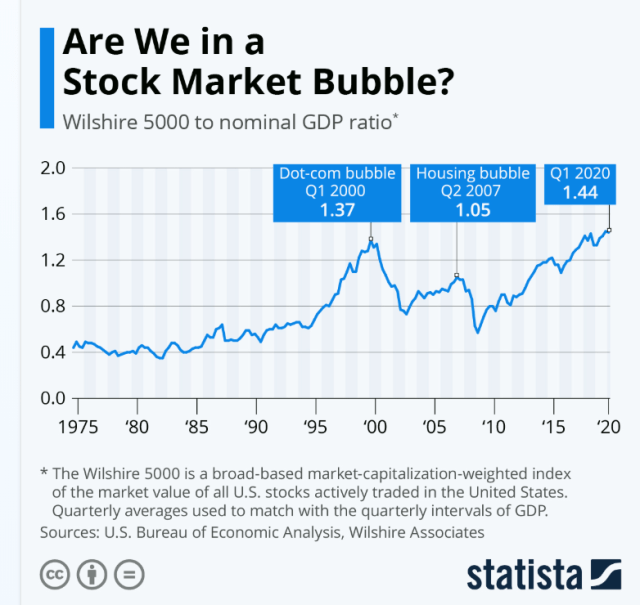
One way of looking at stock valuations is the market value of all publicly traded companies as a percentage of GDP, which Warren Buffett described as “the best single measure of where valuations stand at any given moment” in a Fortune interview in 2001. “Two years ago the ratio rose to an unprecedented level,” Buffett said shortly after the tech bubble had burst. “That should have been a very strong warning signal.”
As the following chart shows, the ratio of market capitalizations (as measured here by the very broad Wilshire 5000 index) to GDP is even higher now than it was shortly before the dot-com bubble burst. Using quarterly average closes of the Wilshire 5000 Total Market Index and dividing it by quarterly GDP figures shows that the ratio is unprecedentedly high at the moment, which, following Buffett’s rationale, could be seen as an ominous sign of things to come. — Statista
Summary
Good question, easy answer.
Probabilities Are Against Bears
First, the bears begin in a big hole with the probabilities stacked against them. We wrote an extensive analysis on this subject in our March 2019, Permabulls For Long Run.
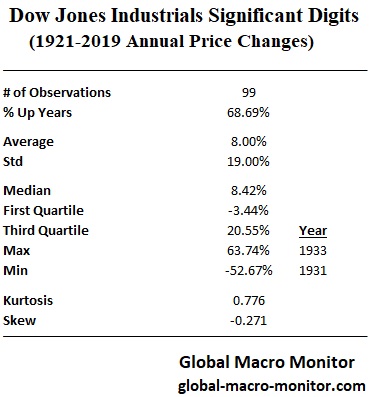
The above data show the stock market in terms of the Dow Jones Industrials has generated positive returns for almost 70 percent of the past 100 years. Those are difficult probabilities to bet against and remain solvent.
Growth
The stock market is invariably linked to the economy over the long run, and the natural state of the economic trajectory is for growth, which, in most cases, generates profits that fuel stock rallies. Betting against that scenario for a prolonged period is the fastest way to the poor house.
Rent-seeking Shareholder Class
Second, we have been working on a piece for weeks, which has turned into a tome, Rent-Seeking Nation. It should be out soon but our idea was sparked by an excellent piece written by our good friend, Joe Calhoun, CEO of Alhambra Investments, titled Here Come The Crony Capitalists. If you haven’t read it, run don’t walk to consume it.
Joe understands what is current at stake for the global economy, the consequences of bad policy, and understands risk, and how to manage it. We mentioned in an earlier post that we live in times where it is important to have an experienced portfolio manager, who understands how to manage left-tail risk. Joe is one of the best.
Rent-Seeking
Rent-seeking
the fact or practice of manipulating public policy or economic conditions as a strategy for increasing profits. “cronyism and rent-seeking have become an integral part of the way our biggest companies do business – Lexico
Bears face another difficulty in that the investor class, led by Wall Street and the financial media have tremendous influence over public policy, monetary policy, in particular.
It seems evident, at least to us, that when market forces assert themselves to pressure stocks to move back to more realistic and reasonable valuations, monetary policymakers intervene and change the rules of the game against the bears. We are not arguing this the primary objective of monetary policy but it is, in fact, the end result.
The Stock Market and Economy
The chart below illustrates how divorced the current stock market is from economic reality. It is just another form of our favorite valuation metric, stock market capitalization-to-GDP.
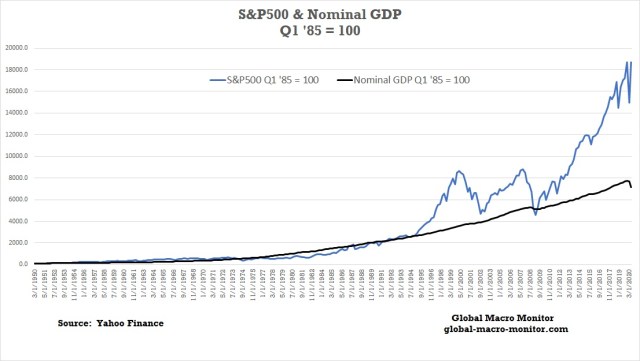
The above data show that the annual trend growth of the S&P500 and nominal GDP tracked quite well up until the dot.com bubble, which began in the mid-1990s. The major bear markets of 2000–02 and 2007-09 caused the stock market to revert back close to trend GDP but stocks were soon reflated again by easy monetary policy.
There are many plausible reasons that caused this structural shift, which we won’t go into now. Contact us if you’re interested.
Economic Stability
The optimal and most stable dual path, in our opinion, is where both series track each other as was the case pre-1995.
At current levels, the stock market is way out of line with trend GDP. Yet, we heard, even today, on the financial television that we may be at the start of a new bull market. Seriously?
Stare at the chart for a few minutes and ask yourself, is that a realistic, high probability scenario? It is possible the laws of gravity with respect to stock valuations have been permanently suspended but we don’t think it is likely.
What is also notable from the chart is that the bubbles keep getting larger and larger. In fact, stocks may now be so far out of line with the economy that it is impossible to “land the plane” without destroying the world. How did we allow ourselves to get here?
Laws Of Economics Suspended
There is now a rapidly growing group of people who think the laws of economics have been suspended. That is there are no constraints on financial resources and don’t seem to have a problem with trillion-dollar deficits, most of which are now monetized, weak bond auctions (today’s 10-year), and a weakening currency
As macro observers, we are not fond of that cocktail, though, given the COVID crisis we don’t seem to have much choice on the massive deficit and debt monetization.
The macro boys at GMM remain uncomfortable, however, and that is why our position remains in cash and gold. Let them have their bull market.
Note this is not the case with our stock picker, Carol, who is fighting some health issues and probably would have weighed in here.
Initial Conditions For A New Bull Market
By the way, the average initial valuation of new bull markets from 1974 to 2009, was a stock market capitalization-to-GDP of 53.1 percent. The new bull market, which they tell us began on March 23rd was almost double that at 105.3 percent and now approaching 170 percent, more the 25 points above the peak level of the dot.com bubble. Sure the economy has bottomed and should get a record bounce in Q3, but stunning, nonetheless.
Upshot
The market — well, not really a market anymore after the Fed has effectively nationalized the bond markets — looks like a screaming short given the above chart. Just remember bears, you’re betting against the long-run probabilities skewed against you, and also understand that the referees will change the rules of the game if you start winning big. Rent-seeking is ubiqutious and now trumps market forces, which is a major factor why even the United States is morphing into a zombie economy.
COTD: Chart of the Day
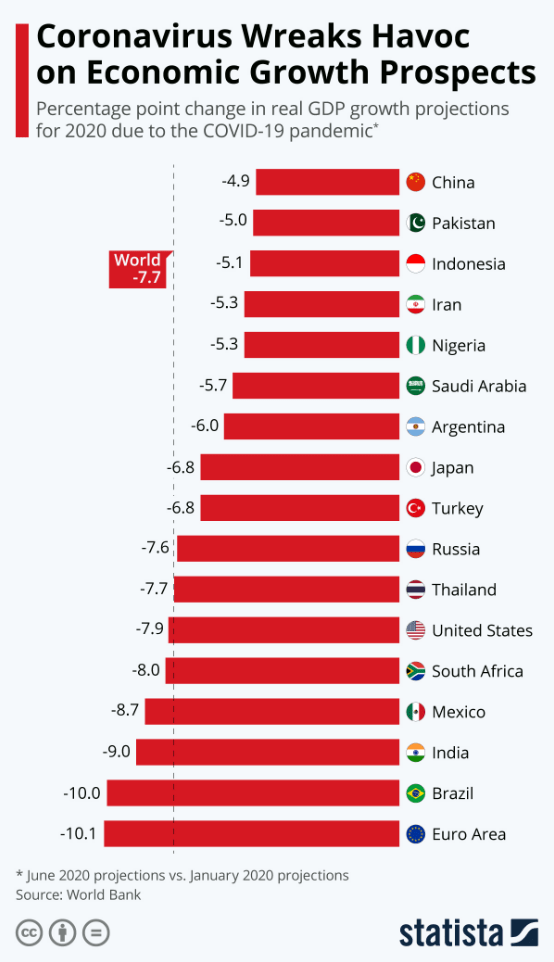
The World Bank published its latest Global Economic Prospects report on Monday, providing us with another glimpse of the expected economic fallout of the COVID-19 pandemic. According to its revised forecasts, the global economy will shrink by 5.2 percent this year, which would mark the deepest recession since World War II.
“This is a deeply sobering outlook, with the crisis likely to leave long-lasting scars and pose major global challenges,” said World Bank Group Vice President for Equitable Growth, Finance and Institutions, Ceyla Pazarbasioglu, who urged the global community to “unite to find ways to rebuild as robust a recovery as possible to prevent more people from falling into poverty and unemployment.”
While countries with high case and death counts and those relying heavily on tourism, global trade and commodity exports are expected to be hit hardest by the pandemic, this is a truly global crisis affecting more countries than any other economic downturn since 1870, according to the World Bank. As our chart shows, the economic impact of the coronavirus outbreak is expected to be severe across the globe, with no regions spared. Compared to its January 2020 projection, the World Bank revised its global growth estimate by 7.7 percentage points, with the Euro Area and Brazil suffering the biggest hit to their economic growth prospects. – Statista
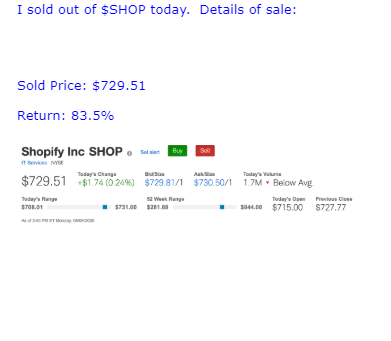
Carol sold her entire position in Shopify (SHOP) yesterday. Here’s the trade ticket.
Cue the “Buffett is an idjit” Tweets. Then run like hell.
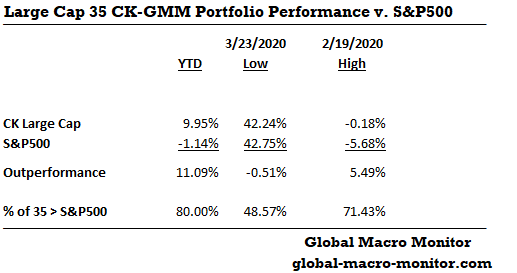
We have been teasing you over the past month about rolling out the CK-35 portfolio of GMM’s new crack stock picker, Carol K. The CK-35 has a nice ring to it, no? Kinda the like the NIkkei 225?
Huge Outperformance
We feel fortunate to have Carol on board because she is a much-needed voice to balance our macro views and brings a very unique and strong set of analytical skills, a vast amount of experience in investing, and a pretty damn good track record.
Health Issues
Carol has some ongoing health issues she’s currently battling — nothing a former USMC Captain can’t lick — and would be presenting and writing this post herself if not for feeling under the weather. We have also disagreed on whether GMM should try and monetize this information.
Carol wants to provide to it our readers for no charge but given my greedy capitalist instincts, I thought GMM should get paid for such quality work. She won but if you feel inclined you can make a donation clicking the widget on the right side of the webpage.
Portfolio Changes
We are rolling it out tonight because Carol is considering tweaking the portfolio and making some changes. This way you will have the original picks and can go back and recreate the returns we began posting and revealed a few months ago. Our credibility remains intact and you know we are not promoting some mystery valise of supercharged stocks
100 percent of Carol’s Work
This is all Carol’s work and nobody else at the Global Macro Monitor has anything to do with it. She deserves full credit, not only because of the massive YTD outperformance relative to the S&P but, what impresses us even more. is the outperformance on the downside since the February high.
These stock picks are just Carol’s opinions and favorites, which she may or may not own in her own personal account, and are not recommendations or investment advice.
Find A Good Investment Manager
If you’re looking for advice, I suggest — not Carol speaking — you find a good manager that is experienced and knows how to manage left-tail risk. I can think of a few.
I also don’t think passive investing or a 60/40 portfolio are going to fare well over the next few years.
Feel free to contact us if you have any questions.

Note the exact returns may differ a few bps as some data sources may have a slightly different December 31st prices
The information in this post represents our own personal opinions and are not investment recommendations. We may or may not hold positions or other interests in securities mentioned in the post or have acted upon what has been written.
All information posted is believed to be reliable and has been obtained from public sources believed to be reliable. We make no representation as to the accuracy or completeness of such information.
TOTD – Treat of the Day
Bloomberg QuickTake Originals
Research shows that our brains are designed to be distracted. Scientists from Princeton University and the University of California found that our brain refocuses our attention four times every second. So as you read this sentence your brain is periodically scanning your surroundings to see if there is a more important location to focus on.Video by Abi Morgan

 Global Macro Monitor