Global Risk Monitor: Weekly Update – April 25

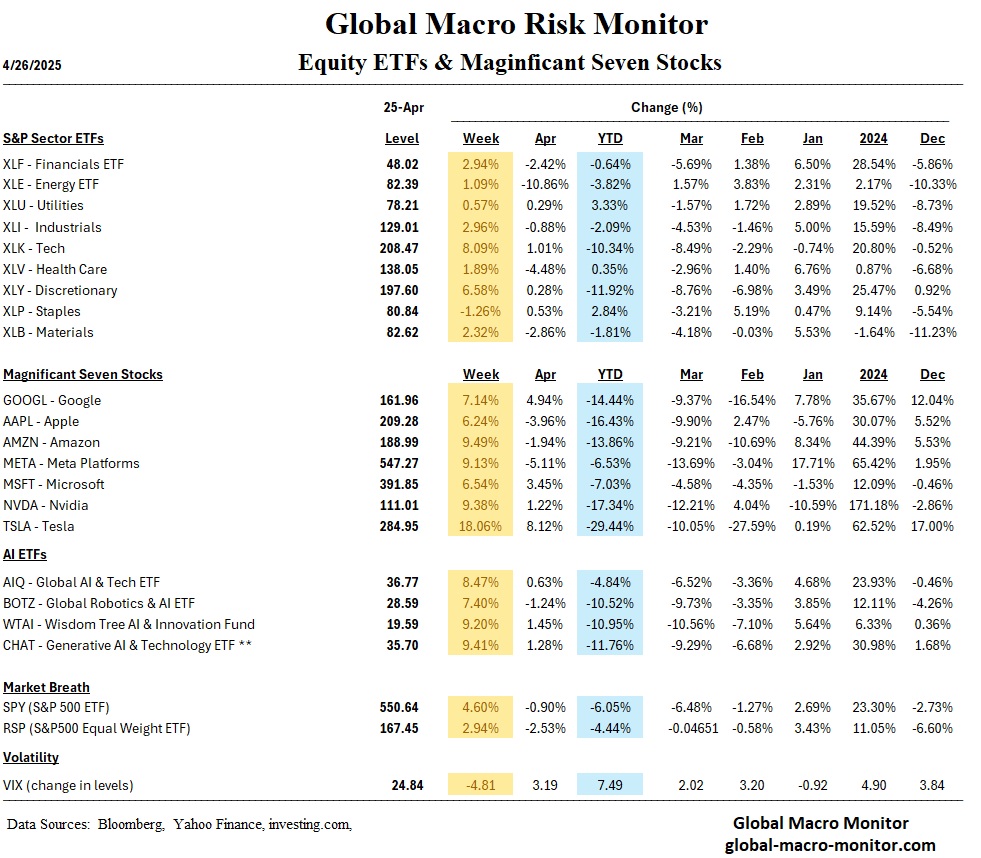
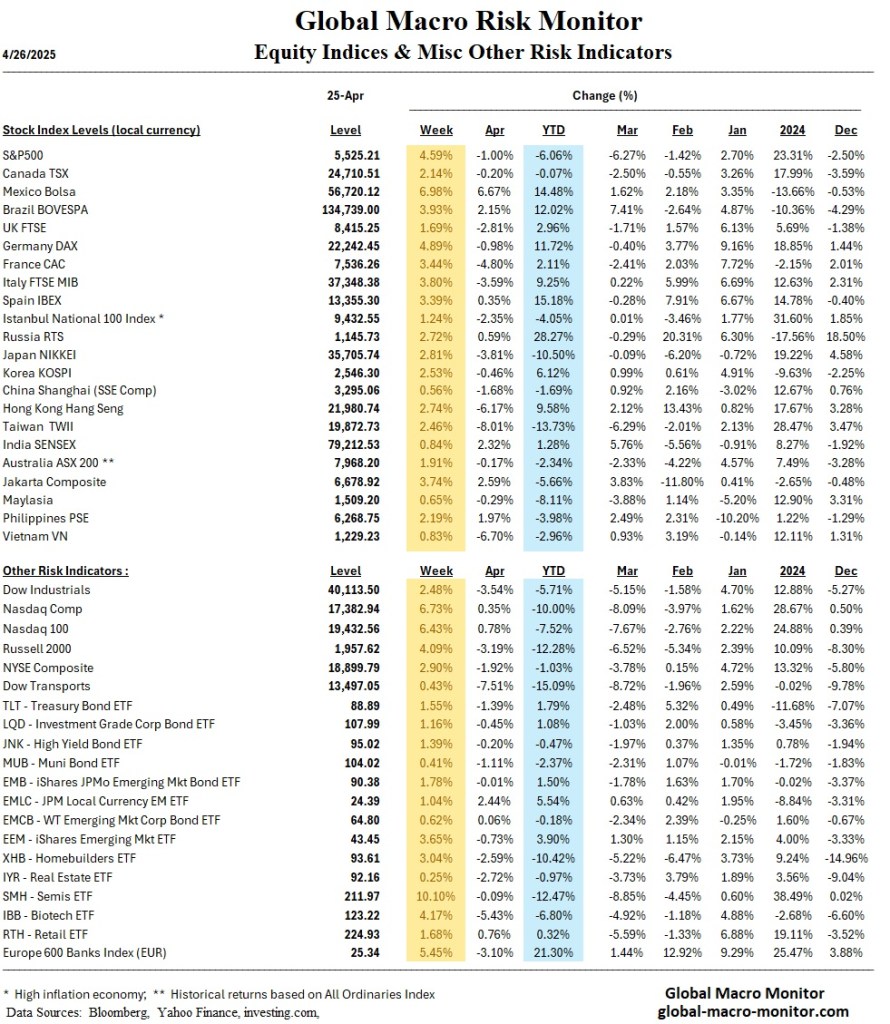
Global markets staged an impressive rebound this week, fueled by growing optimism that trade tensions between the United States and China may soon ease and that some bilateral trade deals are imminent.  Investors eagerly latched onto comments from U.S. Treasury Secretary Scott Bessent and President Trump suggesting that tariff levels were unsustainable and that some dialogue, formal or informal, might be underway. This generated a powerful relief rally, with the S&P 500 and Nasdaq surging approximately 4.6 percent and 6.7 percent, respectively. However, despite the ebullient market response, no formal negotiations or agreements have been reached, and the underlying political dynamics remain deeply adversarial.

Hope v Reality

The reality is that while hopes of de-escalation buoy markets, the U.S.-China standoff is mired in political ego. President Trump appears reluctant to make the first move toward a deal, wary of appearing weak ahead of the 2026 elections. Conversely, President Xi Jinping, emboldened by China’s relative economic stabilization and newly announced stimulus plans, is taking a patient, strategic approach. With no official meetings scheduled, the current atmosphere reflects more wishful thinking than tangible progress.

Therein lies the core risk: investors may be underestimating the political barriers to resolution. Trump’s current position is precarious. Without a trade breakthrough, the U.S. could soon face visible consequences—empty store shelves, rising consumer prices, and a dent in consumer confidence—as tariff impacts cascade through supply chains beginning next month. If economic pain intensifies, Trump may be forced into a humiliating climbdown to avoid severe electoral damage.

Bulls Back In Charge

Nevertheless, the S&P500 bulls captured a key level on Friday, the .5 Fibonacci retracement at 5491, putting the bulls in charge for now.  Shorts are foolish to fight this market, especially knowing it is very likely that some large traders/investors have access to material non-public information and are trading on it, which is an absolute f$%king disgrace.

Watch Your Time Horizons

We believe that medium to long-term optimism may be mispriced. There is a prevailing belief that resolving trade tensions would automatically unlock a fresh wave of global growth. Yet this is misleading. Even if tariffs were significantly reduced from current levels, the global economy will still face the structural headwind that tariffs will be much higher than they were at the beginning of the year, reducing world trade and therefore global growth.

Imagine, for example,  if Macy’s doubled its prices, then announced a 25% off weekend sale. Are customers really better off than before the price hikes? Of course not. Yet that’s exactly how the market seems to be reacting to the latest headlines. Sure, 25% off sounds better than a 100% increase—but seriously, Mr. Market? Tariffs will remain much higher than they were before this entire mess began.

Moreover, the uncertainty generated by the tariff wars has already inflicted lasting damage on investment confidence. The idea that a quick deal would fully reverse these scars is naïve.

A Zero Tariff Deal?

One significant development this week was the soft proposal, or more like an idea thrown out by German Finance Minister Jörg Kukies, for a comprehensive zero-tariff agreement between the U.S. and Europe. Kukies eloquently argued, “The easiest way to ensure balance and fairness is for everyone to go to zero. Then we have free trade, efficiency, and economies of scale. We can think about standardization, mutual market access, and many other things”.

From a pure economic perspective, this is sound logic. True free trade would enhance productivity, lower costs, and strengthen growth on both sides of the Atlantic.

However, President Trump does not align with free trade orthodoxy. His administration’s goal is not greater global economic efficiency; it is to reshore manufacturing and generate tariff revenues to finance prior tax cuts. These objectives fundamentally conflict with a zero-tariff deal. Accepting such an agreement would dismantle the entire strategic rationale, if there is one at all, behind the tariff regime. Thus, despite Germany’s overtures, it is highly unlikely that Trump would agree to zero tariffs—unless political and economic pressures render his position untenable.

Looking ahead, while the recent rally in equities has been impressive, there are clear limits to upside potential unless there is a definitive resolution on trade. The markets are functioning on hope rather than substance. Earnings risks are rising, though Q1 is shaping up to be better than expected, economic indicators are softening, and monetary policymakers, including the Fed and ECB, are increasingly hamstrung by uncertainty.

If trade tensions linger—and especially if tariffs continue to feed into inflation and constrain growth—the global economy could be pushed into a downturn in the coming quarters. The durability of the current market rally is, therefore, suspect. As real economic impacts begin to materialize, the cheerful narrative driving markets today may give way to renewed volatility and risk aversion.

Summary

While the past week brought a welcome reprieve to markets and may continue, the fundamental dynamics have not changed. The U.S.-China standoff remains unresolved, driven as much by political pride as economic strategy. The German proposal for a zero-tariff regime, while admirable, is almost certainly dead on arrival in Washington. Thus, caution remains warranted. Investors should not be lulled into complacency by superficial signs of progress; instead, they must prepare for the possibility that the real economic fallout of tariff escalation is only just beginning.

Markets

U.S. Market Analysis

Markets Rebound Sharply:
U.S. equities posted their strongest week since late 2023, buoyed by optimism over potential de-escalation in U.S.-China trade tensions. The S&P 500 rose 4.6%, the Nasdaq surged 6.7%, and the Dow gained 2.5%.

Small-Caps Lead Gains:
The Russell 2000 rose 4.1%, outpacing large caps for the second consecutive week, helped by strong tech earnings and expectations of a more dovish Fed.

Market Breadth Improves:
Participation broadened across sectors. The percentage of S&P 500 stocks above their 200-day moving average rose to 34.2%, up from 29.4%.

Bond Yields Ease:
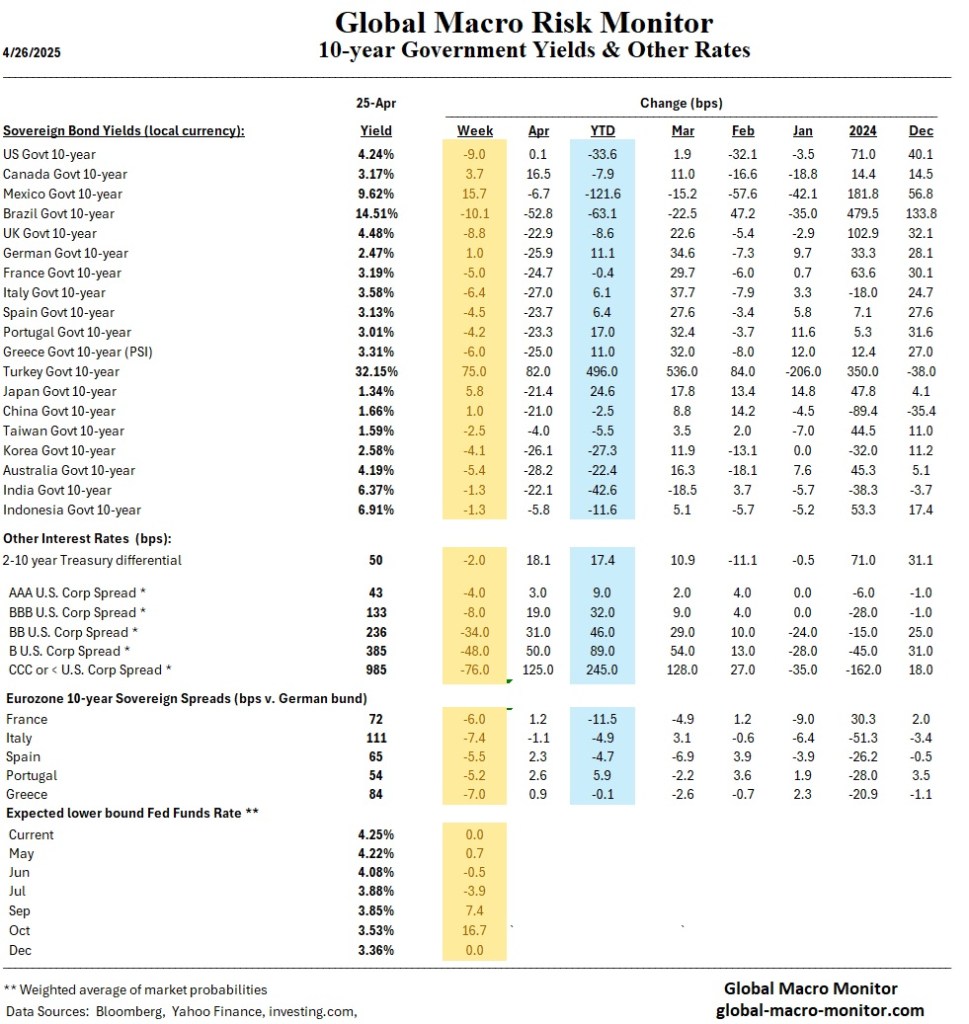
10-year Treasury yields fell 8 bps to 4.24% as safe-haven demand moderated and growth concerns lingered.

Bitcoin Rally Continues:
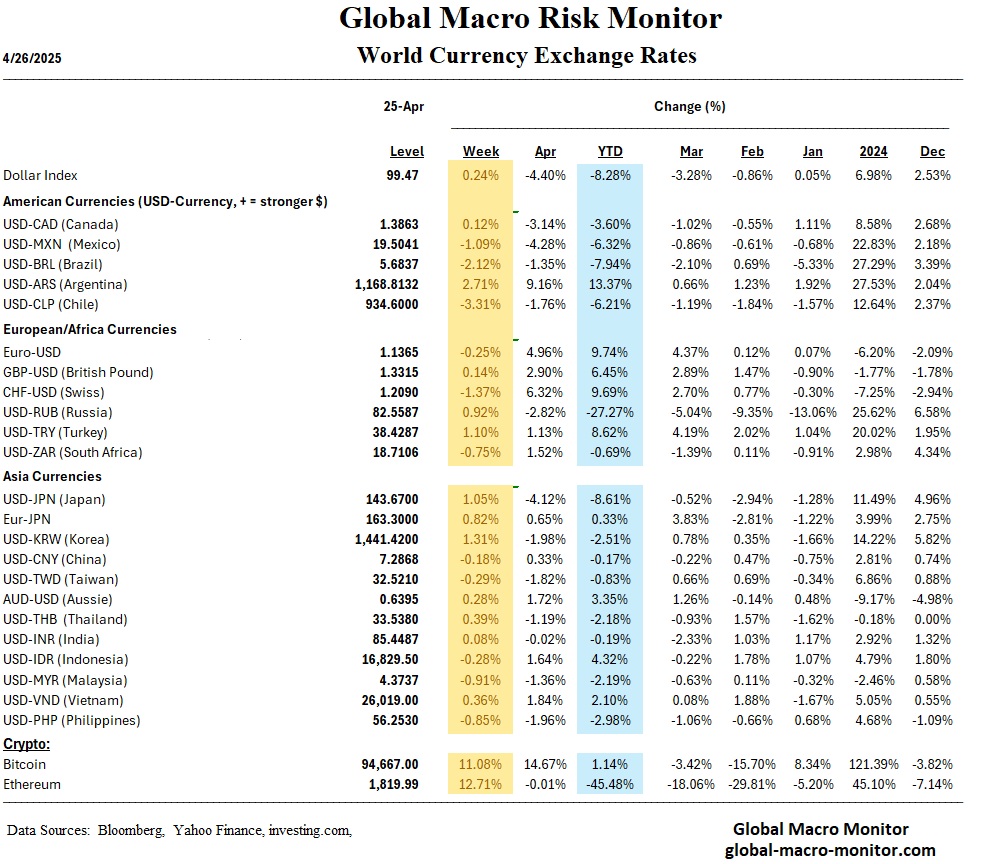
Bitcoin surged over 11%, rebounding toward the $100K mark, supported by optimism around broader risk appetite.

Credit Spreads Tighten:
Investment-grade credit spreads narrowed slightly, indicating improved investor risk sentiment amid hopes of trade stabilization.

Global Market Analysis

Europe:
STOXX Europe 600 gained 2.77%, led by Germany’s DAX (+4.89%) and France’s CAC 40 (+3.44%), following Trump’s softer tone on tariffs and improving earnings sentiment.

Asia:

  • Japan:
    Nikkei 225 advanced 2.8%. BoJ policymakers hinted at maintaining easy monetary policy amid tariff uncertainty.
  • China:
    Shanghai Composite rose 0.56% as stimulus expectations bolstered sentiment despite continuing trade tensions.

Emerging Markets:

  • Emerging Asia:
    GDP downgrades for Singapore, Malaysia, and Korea weighed on sentiment, but policy stimulus measures are expected to cushion the slowdown.
  • Latin America:
    Held up relatively well as supportive domestic factors offset external headwinds.
  • EEMEA:
    Caution prevails amid capital flow risks, but no immediate crises are detected.

Economics

U.S. Economic Overview

Positive Earnings, But Slower Growth:
73% of reporting S&P 500 companies beat earnings expectations. However, S&P Global PMI data showed business activity slowing to a 16-month low, especially in services.

Tariff Inflation Risks Reemerge:
Prices charged for goods and services rose at the fastest pace in over a year, largely due to tariffs.

Consumer Sentiment Weakens:
University of Michigan’s Consumer Sentiment Index fell for the fourth consecutive month, highlighting persistent uncertainty around trade policy.

Fed Outlook Steady:
Markets maintain expectations for two Fed rate cuts in 2025. Longer-term rates fell this week amid rising concerns about Q2 growth.

Housing Market Softens:
Existing home sales plunged 5.9% in March to the lowest March level since 2009, weighed down by high mortgage rates.

Global Economic Overview

Eurozone:
Growth outlook dimmed as April PMI data pointed to weakening services and manufacturing. German GDP forecasts downgraded to zero growth for 2025.

China:
Despite better-than-expected Q1 GDP, new tariffs threaten future exports. Beijing’s Politburo announced preparations for emergency stimulus measures.

Japan:
Tokyo CPI inflation rose faster than expected, bolstering the case for a BoJ rate hike later this year, but tariff risks complicate the timeline.

Australia & Colombia:
Central banks kept rates steady; rate cuts still expected as global risks intensify.

India:
RBI expected to cut rates by 25 bps following softening inflation and weaker growth.

Mexico & Norway:
Key inflation data due next week will likely dictate the timing for further easing.

Week Ahead (April 28–May 2, 2025)

Key U.S. Events:

Economic Data:

  • Tue (Apr 29): Advanced International Trade, Consumer Confidence
  • Wed (Apr 30): ADP Jobs Report, Q1 GDP, Pending Home Sales
  • Thu (May 1): ISM Manufacturing Index, Jobless Claims
  • Fri (May 2): Nonfarm Payrolls, Unemployment Rate

Earnings:

  • Mega-Cap Tech Reports: Microsoft, Meta (Wed); Apple, Amazon (Thu)

Key Global Events:

  • China PMIs: Wednesday—will gauge early tariff impact.
  • Eurozone GDP & CPI: Wednesday—critical for ECB policy outlook.
  • Bank of Japan Meeting: Thursday—no change expected, but tariff commentary crucial.
  • Tariff Developments: Any new trade announcements could cause sharp market moves.
Posted in Uncategorized | Tagged , , , , | 1 Comment

QOTD: The Fog & Confusion of a Trade War

QOTD: Quote of the Day

What does this administration exactly want? Do they want a new trade deal? Do they want tariffs? We just don’t know,” – Eelco Heinen, finance minister of the Netherlands.

Posted in Uncategorized | Leave a comment

Viva Free Trade: How Tariffs Make Us Poorer

Great video, must view.

Posted in Uncategorized | Leave a comment

HOTD: Not So Fast

HOTD = Headline of the Day

Click here to view the SCMP article. 

Posted in Uncategorized | Leave a comment

Are Trade Deficits Bad?

Posted in Uncategorized | Leave a comment

The Anatomy of a Bond and Currency Crisis

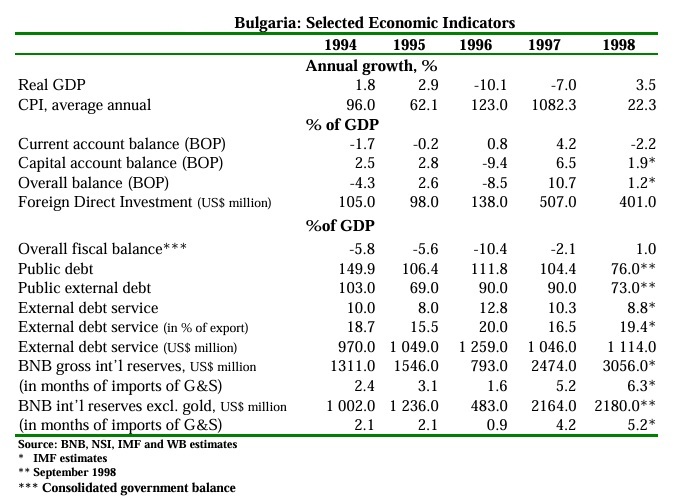
It was the autumn of 1996 when I arrived in Sofia, Bulgaria.  I was working for a major Wall Street investment bank and had a clear and urgent mission to assess the sustainability of Bulgaria’s sovereign debt. The atmosphere in the capital was tense; the economic and political uncertainty hung thick in the air. The government was hanging by a thread while struggling to roll over its maturing Treasury bills.  The early signs of a major burst of inflation were no longer subtle, as confidence in the Bulgarian currency was rapidly diminishing. In a series of high-level meetings with senior officials, one stood out: a particularly strained and revealing encounter at the Bulgarian National Bank (BNB), where the full scale of the crisis came into sharp focus.

Central Banker Confession
What I remember most vividly was sitting across from a senior BNB official. When I asked how the government would roll over its large tranches of domestic Treasury bills coming due, he looked me in the eye and said, “Gregor, we will not let the government default.”

Hyperinflation
It was less reassurance than a veiled admission—the central bank would monetize all the debt coming due if need be.  At that moment, I knew a currency collapse and hyperinflation were imminent.   As soon as I stepped out of the central bank, I called our trading and sales desk in New York to warn that the lev was about to collapse and hyperinflation was coming. 

Indeed, within months, monthly inflation hit 242%, and the lev was virtually worthless, losing 90 percent of its value before the country was forced to implement a currency board.   I remember buying a bottle of good wine for the equivalent of 27 U.S. cents. During a hyperinflationary spiral, the exchange rate moves first, and domestic prices follow.  

Bad Economic Policy
Bulgaria’s crisis was the product of delayed reforms, systemic banking fragility, and most importantly, a collapse of market confidence. After the fall of communism, its banking sector remained riddled with non-performing loans and politically motivated credit issuance. When the government failed to roll over its domestic debt, the central bank was forced to buy unsold Treasury bills, initiating a fatal inflationary spiral. By late 1996, the BNB had monetized nearly the entire public domestic debt, with inflation exploding and currency substitution rampant. There was no functmioning bond market—no buyer of last resort except the printing press.

U.S. Economic Policy
In contrast, during the COVID-19 crisis, the U.S. Federal Reserve engaged in massive Treasury purchases, effectively monetizing the new debt.  In the table below, we illustrate how the U.S. government issued almost $5 trillion of new debt to finance the massive COVID deficits.  The markets could not absorb such a large new issuance, and the Fed stepped in and took down 91 percent of all net new debt — not through the auctions but indirectly from primary dealers — including 84 percent of all coupon securities and much of the incremental increase in T-bills.   

This move, however, did not trigger hyperinflation. Why? Because global confidence in the U.S. dollar remains deeply entrenched. As Ray Dalio, Barry Eichengreen, and other economists note, the dollar’s role as the world’s reserve currency allows the U.S. to borrow cheaply despite a public debt exceeding 120% of GDP

Fading Confidence
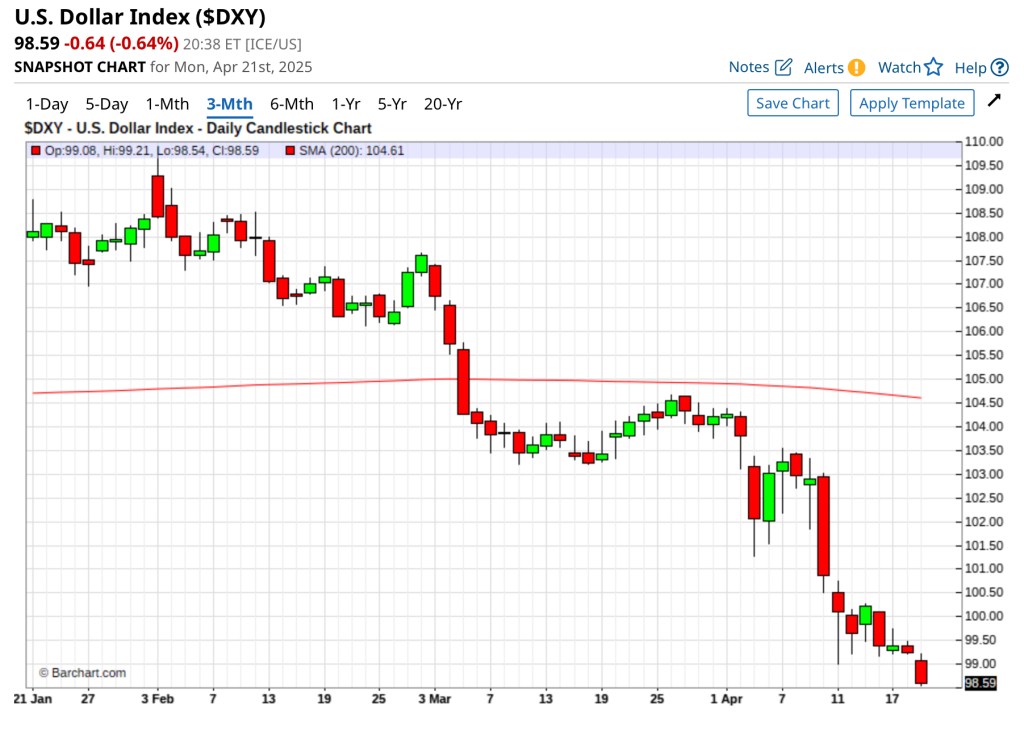
But that privilege appears to be eroding. Recent headlines reveal a sharp sell-off in the dollar, rising Treasury yields, and spiking gold prices not from inflation fears alone, but from doubts and lack of credibility in the U.S. government itself

If a similar crisis were to hit today,  given current market conditions, particularly the falling confidence in U.S. assets, it is questionable whether the Fed could act so aggressively. 

The “exorbitant privilege” is now in question​. Foreign holders of U.S. Treasuries, possibly China and Japan, appear to be quietly trimming their U.S. debt exposure. The traditional “flight to safety” into Treasuries during crises is faltering. Even safe-haven capital is drifting elsewhere—into German bunds, gold, the Japanese yen, and the Swissie.

Heed the Lesson
Bulgaria’s crisis teaches a painful lesson: when confidence is lost, governments can’t borrow, and central banks must print. That’s not theoretical—it happened. It happened in many of the countries that I worked with, including Argentina, Venezuela, Poland, and Brazil. And while the U.S. is a world apart in size and economic complexity, the fundamental rules of finance still apply. If global investors lose faith in the dollar the way they lose faith in an emerging market, the U.S. will face higher borrowing costs, capital flight, and weakened policy flexibility.

The Congressional Budget Office now warns of “significant fiscal risk” if current debt trends continue. Tariff wars, political instability, and threats to Federal Reserve independence all compound this risk. The next crisis may not grant the U.S. the luxury of borrowing its way out. If that confidence evaporates, we will be staring into the mirror of Bulgaria’s past.

Confidence is Fragile
I’ll leave you with a fitting quote from the GOAT of NFL quarterbacks, Joe Montana:

“Confidence is a very fragile thing.”

Let’s hope the President takes that to heart—and soon.

Posted in Uncategorized | Tagged , , , , | 2 Comments

QOTD: “Ejectoral” College Is Voting

QOTD = Quote of the Day

A currency is only as good as the government that backs it. – Economist 

Chart Source: Barchart.com

Posted in Uncategorized | Leave a comment

Amazon’s China Exposure

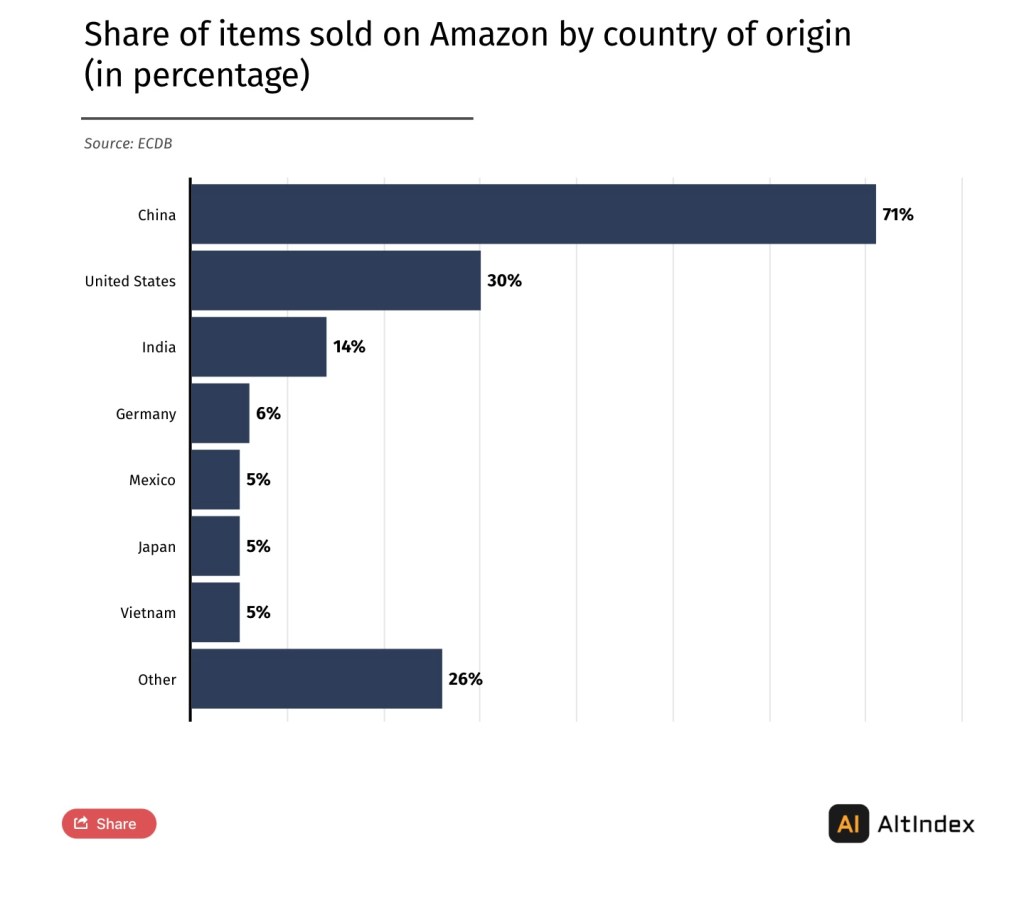
As the single largest player in the ecommerce industry, Amazon generates between 10% and 15% of global online sales. In its home market, the US ecommerce giant makes up to 40% of total ecommerce sales and generates the highest revenue in three out of four major product categories, outperforming competitors by a large margin. But ironically, while Amazon is seen as emblematic of American success in ecommerce, Chinese products are the backbone of its marketplace.

According to data presented by AltIndex.com, more than 70% of all products sold on Amazon are made in China…

Statistics show that 71% of the products that wholesalers and retailers sell on Amazon are produced in China, or 2.4 times more than in the United States, illustrating China’s importance for Amazon’s business. US products have a much smaller share and account for 30% of all total goods sold through the US e-commerce giant, while India stands in third place with a 14% share. – AltIndex

Screenshot
Posted in Uncategorized | 1 Comment

POTD: Tariff Rhymes

POTD = Picture of the Day

Source: FT

Posted in Uncategorized | Leave a comment

Global Risk Monitor: Weekly Update – April 18

Happy Easter, folks!

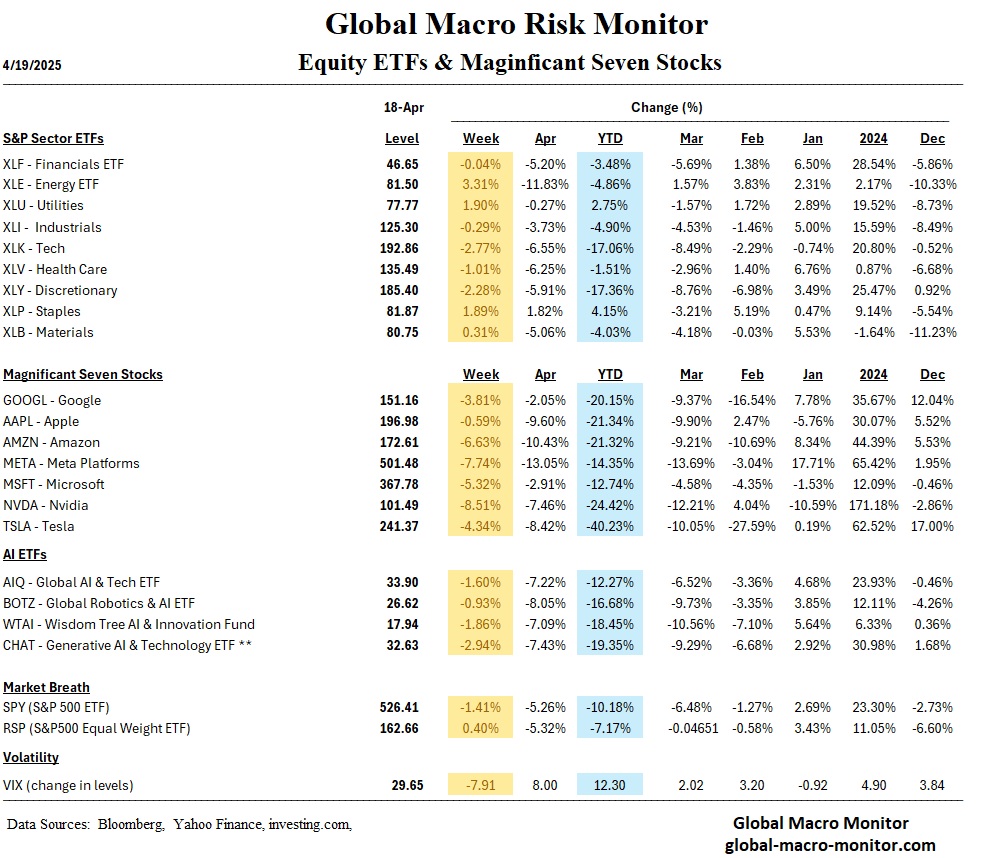
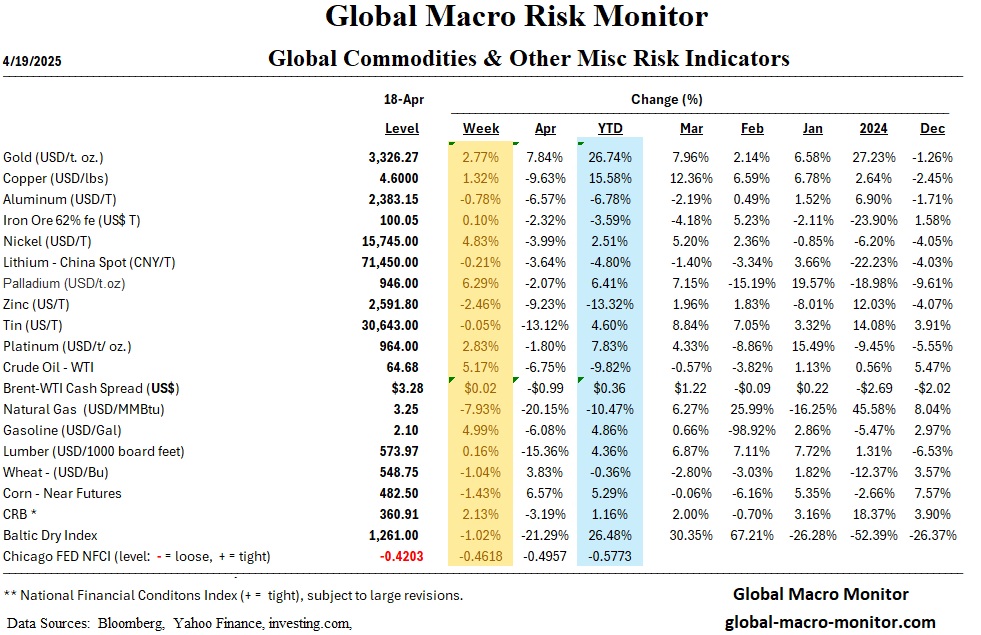
The Trump administration’s tariff strategy continues to function less as a deliberate trade policy and more as a volatile, reactionary experiment. Markets are grappling with a growing realization: there is no unified objective anchoring current U.S. trade actions. Is the administration trying to reshore manufacturing? Raise revenues? Or promote freer and fairer trade? All three goals conflict—and the markets know it. The result has been a weakening dollar, rising gold prices, and diverging capital flows.

This week’s 3% rally in gold, alongside the sixth decline in seven weeks for the U.S. dollar, underscores a broader erosion of investor confidence in the U.S. policy framework. While U.S. bond yields stabilized and credit spreads modestly contracted, the underlying message remains clear: investors are hedging against deeper policy missteps. Until the administration resolves its own internal contradictions, volatility is likely to persist, and global capital will remain in search of clarity elsewhere.

The administration’s approach has produced a confusing cycle: new tariffs imposed, then partially reversed under pressure; sector-specific exemptions offered one week, then threatened again the next. The pause on semiconductor and electronics tariffs has done little to reassure investors given the lack of a consistent framework. Meanwhile, tariff-driven inflation threatens to stall growth just as the Fed tries to preserve monetary flexibility.

Market pressures may eventually force a strategic retreat. But until then, the White House appears more responsive to market headlines than to long-term macroeconomic outcomes. The central lesson of this week: instability is becoming structural.


Markets

U.S. Market Analysis

  • Major indexes mixed: S&P 500 –1.5%, Dow –2.6%, Nasdaq –2.6%, Russell 2000 +1.1%.
  • Sector rotation: Non-energy minerals and utilities outperformed; tech and consumer durables lagged.
  • Gold surges: +2.8% % for the week, now up 26.7% YTD as investors seek protection from U.S. policy risk.
  • Dollar decline accelerates: USD hits a three-year low, now down 8.5% YTD.
  • Bond market stable: Yields declined across maturities. 10Y Treasury at 4.33%, credit spreads modestly narrower.

Global Market Analysis

  • Europe: STOXX 600 +3.9%. ECB cuts deposit rate to 2.25%, signals more easing. Italy +5.74%, Germany +4.08%.
  • Asia:
    • Japan: Nikkei +3.4%, cautious BoJ; yen strengthens amid trade tension.
    • China: Shanghai +1.19%; Q1 GDP +5.4%, but driven by pre-tariff demand. Stimulus expected.
  • Emerging Markets: Risk-off sentiment persists, but no major capital dislocations yet.

Economics

U.S. Economic Overview

  • Retail sales jump 1.4%, possibly boosted by pre-tariff buying.
  • Fed holds line: Powell warns tariffs will raise inflation and lower growth. June rate cut still base case.
  • Housing deteriorates: Housing starts –11.4% in March; builder confidence remains weak.
  • Dollar weakness raises inflation risk, complicating Fed strategy.

Global Economic Overview

  • ECB turns dovish: Rate cut to 2.25%, signals 2.0% likely by June.
  • BoJ cautious: Trade risk delays rate hikes.
  • BoC stays on hold: Canada acknowledges potential recession in trade war scenario.
  • UK inflation drops to 2.6%, labor data softens. BoE likely to cut in May.

Week Ahead (April 21–25)

Key U.S. Events:

  • Economic Data:
    • Mon: Leading Indicators
    • Wed: New Home Sales, Crude Inventories
    • Thu: Jobless Claims, Durable Goods, Existing Home Sales
    • Fri: University of Michigan Sentiment
  • Earnings Highlights:
    • Tesla (Tue), Alphabet (Thu), IBM, Intel, P&G, Boeing, PepsiCo, Merck

Key Global Events:

  • Japan CPI: Friday – gauge of BoJ direction
  • Eurozone PMIs: Wednesday – growth and inflation barometer
  • Tariff Headlines: Potential trade deal news remains the primary wildcard

Posted in Uncategorized | Tagged , , , , | Leave a comment