I went on to explain, yes, he was partially right, COVID-19 is a type of the flu, but a new or novel flu, which probably originated from animals and the human body has yet to build up immunities to help fight it off, unlike the seasonal flu. Still many unknowns about this corona beast now infecting the world.
Exponential Growth
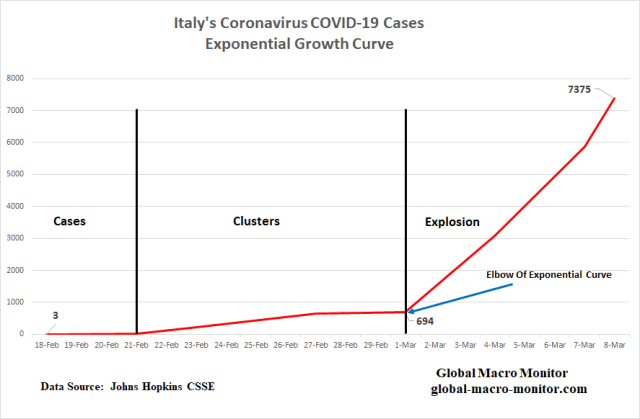
What struck me most was that he, like many of us have difficulty grasping the concept of exponential growth in a real-world context beyond finance. I shared with him what is happening in Italy, which had only 3 reported cases less than three weeks ago to now 7,335 cases as of March 8th. Of course, it is difficult to unpack the true growth of transmission and distinguish it from the ramping up of testing and counting.
We suspect the numbers will look much higher as governments begin and ramp up testing, which almost surely is and will be the case in the United States.
Elbow Of The Curve
COVID-19 starts with a few cases, morphs into clusters before moving beyond the elbow of the curve to an explosion of cases. We both agreed there is so much we don’t know, such as how many people in our area are currently infected, and that we will survive and get through this crisis.
By the way, he is first-generation Italian.
Dow futures are down 900 points and April crude oil is down over 20 percent and printed at $30 bbl., stunning.
The Saudi-Russian Oil War is going to set the deflationistas hair on fire. What is wrong with the relative price of oil collapsing?
A big flop in the price of a headline commodity almost always brings out a deflation panic. We have yet to see any sustained general deflation in our lifetime, however.
Yes, the price of big-screen televisions is tanking but rents and health care are screaming higher. Furthermore, we have a strong conviction that the price inflation is under measured. Please, folks, don’t mix relative price moves with deflation, where the general level of prices is falling over a sustained period.
It does seem the Fed, and, for sure, the market geniuses define deflation as falling stock prices, which is one of the very reasons they find themselves in the current unpleasant situation. The central bank can’t even attempt to close the oven door due to fears the Japanese soufflé pancake will collapse.
Politics Of Falling Crude Prices
The fall in the price of oil is a very similar dynamic of the trade-off between the winners and losers of international trade. More than 225 million American automobile drivers will benefit from the drop in price but the roughnecks and real estate speculators in, say, Midland, Texas are going to get hurt bad.
Should the U.S. government then implement policies to prop up oil prices to protect oil and gas mining jobs, which total only around 157K? By now, I think you know our view.
Nevertheless, it depends on the political strength of domestic oil producers.
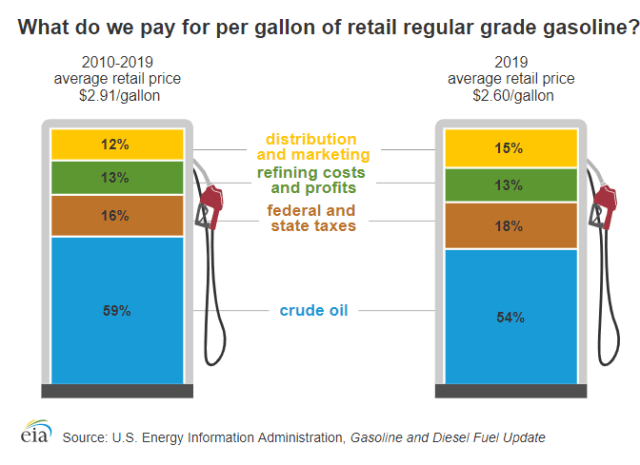
In 2019, about 142.23 billion gallons (or about 3.39 billion barrels1) of finished motor gasoline were consumed in the United States, an average of about 389.68 million gallons (or about 9.28 million barrels) per day. – EIA
For every $.25 drop in the price of gas as a result of the crude price flop, domestic consumers are set to save about $100 million per day. A nice tax cut, indeed.
Saudi Arabia plans to increase oil output next month, going well above 10 million barrels a day, as the kingdom responds aggressively to the collapse of its OPEC+ alliance with Russia.
…“This is going to get nasty,” said Doug King, a hedge fund investor who co-founded the Merchant Commodity Fund. “OPEC+ is going to pump more, and the world is facing a demand shock. $30 oil is possible.”
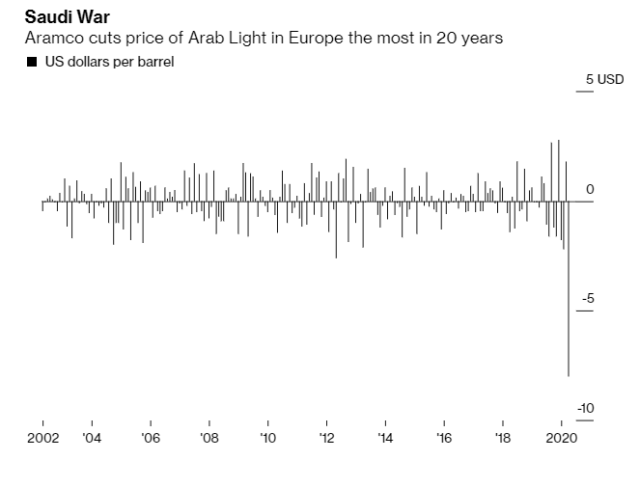
Oil traders are looking to historical charts for an indication of how low prices could go. One potential target is $27.10 a barrel, reached in 2016 during the last price war. But some believe the market could go even lower.
“We’re likely to see the lowest oil prices of the last 20 years in the next quarter,” said Roger Diwan, an oil analyst at consultant IHS Markit Ltd. and a veteran OPEC watcher, implying that the price could fall below $20 a barrel. — Bloomberg
It just ain’t so, Joe, as our M.O. is to try and panic before everyone else.
What will be the big negative shock that shakes the tree loose? Your guess is as good as ours but it shall come. – GMM, Nov 25, 2019
The stock market was a bubble in search of a pin. The coronavirus was that pin.
Moreover, GMM was out with one of the first analyses of the impact of coronavirus on the global economy in late January when most still thought it was a yuppie beer from Mexico.
There is a supply shock to global manufacturing as many factories in the world’s supply chain will be shuttered for longer, which shifts the global supply curve left, increasing-price and production pressures. Ergo component shortages, higher prices, and lower production.
The 2 percent decline in the U.S. stock market and collapse in bond yields are signaling a potential global aggregate demand shock that offsets inflationary pressures of the supply shock. – GMM, Jan 31st
Do The Math
We suggest those in denial and still can’t grasp exponential growth read the following thread — 8 million cases in the U.S. by the end of May? Double yikes!
Where do you think the S&P will be if that happens, which could move us from the current state of denial to peak fear?
I think most people aren’t aware of the risk of systemic healthcare failure due to #COVID19 because they simply haven’t run the numbers yet. Let’s talk math. 1/n
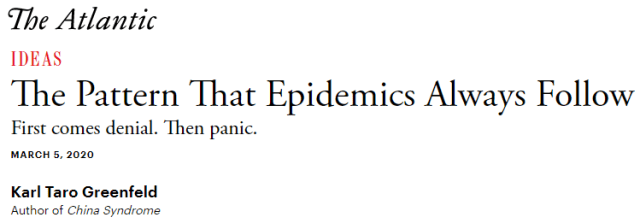
We also suggest you have a quick read of the following Atlantic article, which keeps the current crisis in perspective. We have pulled out the money quotes for you.
Whenever a new microbial killer emerges, we go through each of these stages, starting with denial as government officials insist that there is no outbreak. When smallpox appeared in the Roman Empire in a.d. 189, one local prefect attributed the upsurge in deaths to a displeased Jupiter, while another assigned blame to a poisoned barrel of wine.
…denial led to panic. Denial always leads to panic.
…With an outbreak like COVID-19, everything from the source, to the means of transmission, to recovery rates remains essentially unknown. So each new piece of information—even data that should be reassuring, like the downward revision of mortality rates—elicits more panic.
...“A pestilence isn’t a thing made to man’s measure,” Albert Camus observed in The Plague. “Therefore we tell ourselves that pestilence is a mere bogey of the mind, a bad dream that will pass away.” Panic is exhausting. Only so many witches can be tossed into wells or rolls of toilet paper hoarded before knee-jerk anxiety progresses to a steady state of fear.
...Fear dissipates eventually, replaced by a more realistic sense of the risks. An epidemic, even one of a disease as seemingly easy to transmit as COVID-19, while burdening public-health systems and potentially deadly for the elderly and those with compromised immune systems, is eminently survivable by the majority of the population.
…Which brings us to the last stage of epidemic grief: rational response. After denial, panic, and fear, we can finally get down to the business of basic sanitary measures and infection protocols.
...If you want to panic, go right ahead. It’s what we do. It’s what your ancestors did. Then be afraid. Eventually, however, roll up your sleeves and get to work, scrubbing this bug back to whatever its host species happens to be. We’ll get there. Humanity has so far survived every microbe that has jumped the species barrier, and we will survive this one. – Atlantic
Finally, Chris Martenson has been all over and right about the coronavirus since Day One. We can learn from anybody and don’t engage in the ad hominem attacks to discredit his work just because many accuse him of being a doomster and prepper. Those who were mocking him last week are probably out shopping and hoarding toilet paper as we write.
Even his latest video from a few days prior is outdated. That is what exponential growth does, folks. The data moves at a lightning-fast speed.
“The United States is going to have a lot of self-inflicted wounds. – Chris Martenson”
As the Atlantic piece concludes, we — well most of us — will survive this. Not before some very dark days and much lower stock prices, in our opinion.
It feels like the country is right at the tipping point of full blown panic.
Closer to home,
Keysight Technologies, the county’s third-largest employer with about 1,500 workers, Thursday said it was closing indefinitely its Santa Rosa campus over worries one of its employees may have been exposed to coronavirus. – Press Democrat
And this,
Sutter Santa Rosa Regional Hospital issued quarantine orders to at least 30 of its hospital workers who came in contact with a patient with coronavirus, according to the union representing most front-line hospital staff. – Press Democrat
Yet we get this, the mentality and antics of a third grader as many Americans are forced to contemplate life with mass school closures,
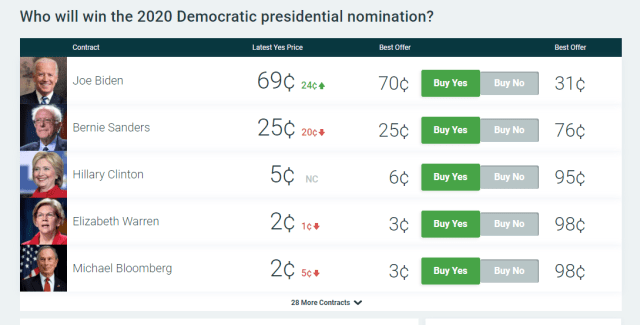
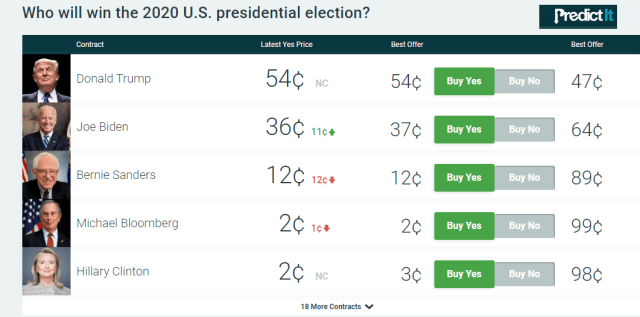
Stunning moves in the prediction market on who will be at the top of the Ticket in November. Joe Biden, who was running behind Bernie at the time of our post last night has rocketed ahead to a 70 percent probability. Amazing.
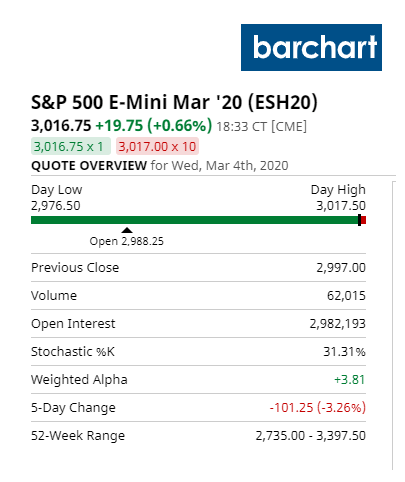
Politics, like the current markets, is all about momentum. The S&P futures are showing some pep after opening down almost 1 percent in overnight trading. It may be the result of the political polls and it may not.
Still, no move in President Trump’s probability of being reelected, however, which remains slightly above 50 percent
The price action in stocks continues its remarkable volatility.
The cash S&P500 traded in a 160 point range just today, or 5.4 percent. They sold the Fed 50 bps emergency cut hard to close the S&P at 3003.37, down 2.8 percent on the day.
The S&P500 is now down 11.5 percent from its peak just ten days ago.
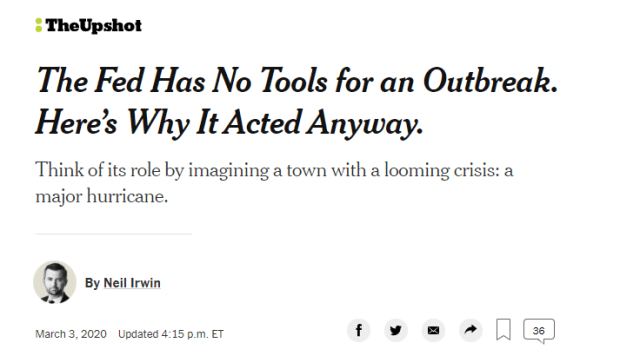
The following headline sums up why we think know stocks were sold after the Fed cut.
Back to the analogy of the town facing a hurricane: We are in an unusual situation in which the local government doesn’t seem to be laying sandbags effectively, and many of the local businesses in charge of the top priority response are moving slowly and failing to inspire confidence.
So people in this town might put more focus on the actions of the bankers than is warranted.
That is exactly where the Federal Reserve found itself Tuesday morning — doing what central bankers do, and hoping that public health authorities and fiscal policymakers in Congress do their jobs as well. – NY Times
The upshot is the markets are losing confidence that the Trump administration is doing its job and was ill-prepared, or even negligent, for this coronavirus health and economic shock. It is now delivering the Trump administration a margin call.
Let’s hope they hear it, quit beating on the Fed, and right the course.
V.P. Pence Off The Ticket?
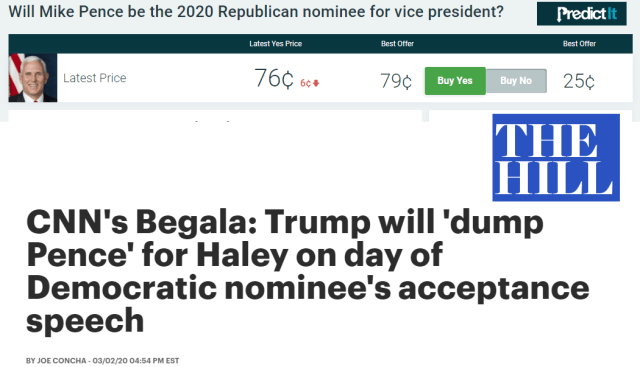
The only thing falling faster than the Dow is the odds of Mike Pence remaining on the ticket in November. See our latest post here. Some definitely believe the VEEP is being set up to be the scapegoat if the current crisis moves sideways.
“This is not a prediction. It’s a certainty. On Thursday, July 16 — that’s the date the Democrat gives his or her acceptance address — on that day, to interrupt that narrative, Donald Trump will call a press conference at Mar-a-Lago. He’s going to dump Mike Pence and put Nikki Haley on the ticket to try to get those suburban moms,” Begala predicted during a panel discussion at the American Israel Public Affairs Committee’s (AIPAC) conference in Washington, D.C. — The Hill
We don’t have much confidence in the current government and expect more scapegoating, which will only make markets slide further. He just can’t help himself.
So, the Coronavirus, which started in China and spread to various countries throughout the world, but very slowly in the U.S. because President Trump closed our border, and ended flights, VERY EARLY, is now being blamed, by the Do Nothing Democrats, to be the fault of “Trump”.
Rep. Mark Pocan has condemned the CDC for its "inexplicable" decision to stop publicly disclosing the number of Americans who have been tested for the novel coronavirus. Their site apparently no longer discloses the number of tests or the number of deaths. https://t.co/oyczK5o3qG
As the government ramps up testing for the coronavirus, the number of cases will spike, which will put further pressure on the market and rattle a nervous public.
Most disturbing of all: Did a failure to provide adequate testing give the coronavirus time to gain a toehold in the United States?
“Clearly, there have been problems with rolling out the test,” said Dr. Thomas Frieden, former director of the C.D.C. “There are a lot of frustrated doctors and patients and health departments.” – NY Times
Gaining the public and markets’ confidence the government is taking this health crisis seriously and have a viable plan to bring it under control will be much more powerful than moving the Fed Funds rate to zero resulting in the Japanification of the U.S. economy.
Key Levels
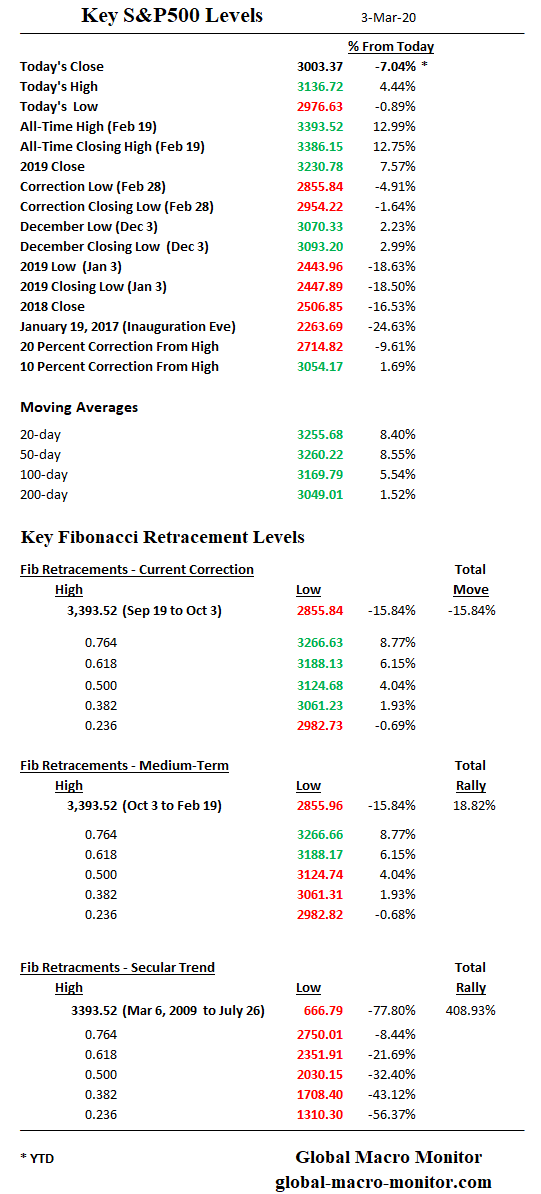
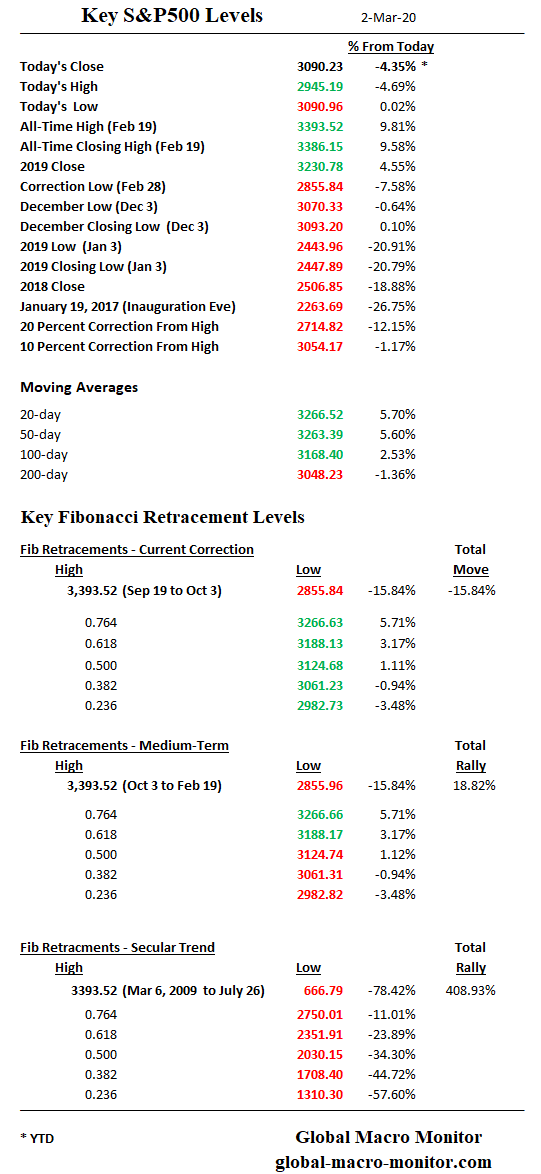
So, the first level to the downside is 2982.73, then the correction low at 2855.84, another must hold.
To the upside, it would be nice if the index can put in a few days above the 200-day at 3049.01. The 3050-60 range is big.
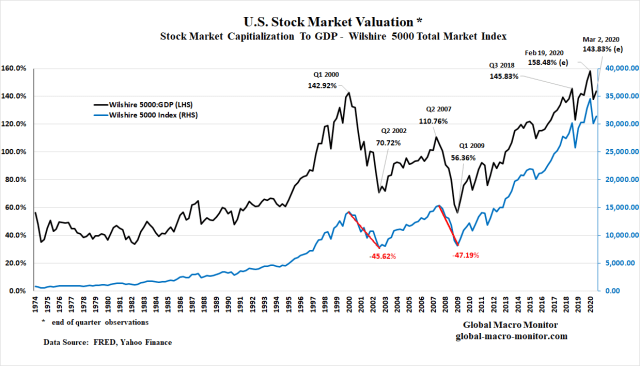
However this health crisis unfolds, the market still has to deal with its big valuation problem.
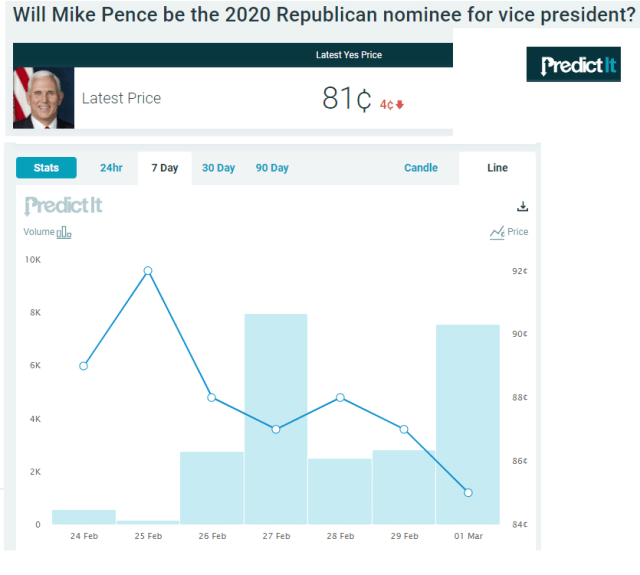
We noted how V.P. Mike Pence, the Administration’s coronavirus czar, is tanking in the prediction markets that he will remain on the Republican ticket in November. Sixpence lower today and down over 17 percent since he was appointed to be, what looks like, the scapegoat. Watch this space.
By the way, Biden now leading Bernie 54-40 to take the Democratic nomination compared to 42-44 just yesterday. Somebody got to the exit polls early.
Longtime CNN political analyst Paul Begala predicted on Monday that President Trump is “gonna dump [Vice President] Mike Pence in favor of former South Carolina Gov. Nikki Haley” on July 16 when the Democratic nominee is slated to give his or her acceptance speech.
The former “Crossfire” co-host “guaranteed” Trump will throw Pence “under the bus” because of his handling of the coronavirus, which the president tapped Pence to lead a task force on last week.
“This is not a prediction. It’s a certainty. On Thursday, July 16 — that’s the date the Democrat gives his or her acceptance address — on that day, to interrupt that narrative, Donald Trump will call a press conference at Mar-a-Lago. He’s going to dump Mike Pence and put Nikki Haley on the ticket to try to get those suburban moms,” Begala predicted during a panel discussion at the American Israel Public Affairs Committee’s (AIPAC) conference in Washington, D.C. — The Hill
Load up the Greyhound, folks. More and more gonna be thrown under the bus.
Joe making a big move on PredictIt to head the Democratic Ticket in November. Super Tuesday on deck.
Pence, The Fall Guy?
This really caught our eye. The probability or price that Mike Pence will be on the Republican ticket with Trump in November has fallen 14 percent since he was appointed the Corona Czar. Traders betting he may be set-up to be the scapegoat if things go sideways.
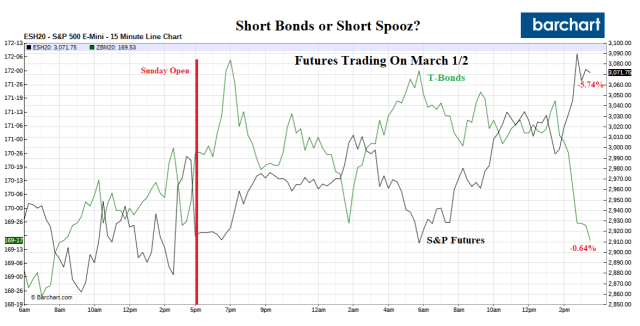
Today is a classic example of why smart money buy bonds as a proxy for shorting stocks. Bear market bounces, such as today’s, are much too violent and can, including for many today, be fatal.
Here is a post about Stan Druckenmiller’s strategy right around the 2018 Nightmare Before Christmas Bear Market,
If you listened to the Druckenmiller interview we posted on New Year’s Day, he thrives in bear markets, not by shorting stocks but being long bonds. Shorting stocks in a bear market, though more profitable, he has learned is riskier due to the higher propensity for nutcracking short squeezes. Druck also worries about the level he is buying at. – GMM, Jan 2, 2019
Our Twitter feed was full of stories about traders who shorted S&P futures at the Globex open last night blowing up just a few hours later. If you shorted Spooz at the open last night, for example, you lost 5.74 percent by the close. A long T-Bond position would have lost you 0.64 percent. Of course, what matters is your relative position size and the extra leverage you take on with the bond trade versus the stock short.
Key Levels
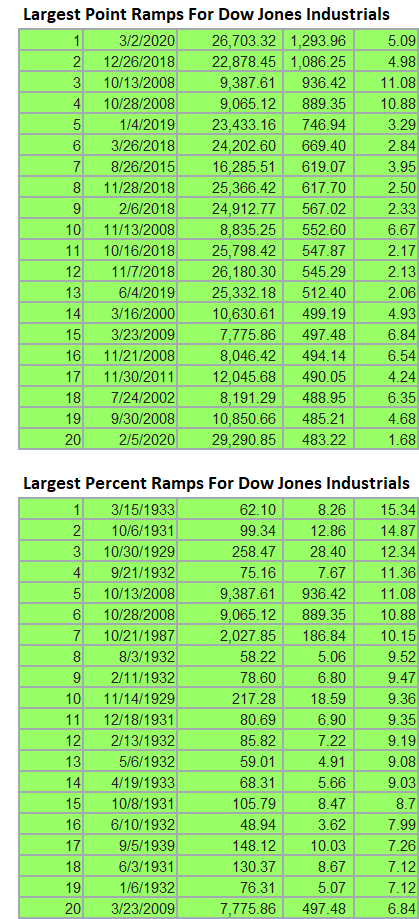
The Dow had its biggest one day gain today (see tables below) with the S&P recapturing the 200-day moving average. A very interesting low in this correction at 2855.84, right at the October low and launch point for the Fed’s No QE ramp. That is the level the bears will now be gunning for. Pay attention.
At the end of the day, the central banks are fundamentally irrelevant in this crisis, in our opinion, and we really won’t get a handle until the Feds start testing en masse for the coronavirus. Note we said “fundamentally,” folks, not technically. Spare the hate mail.
The low COVID-19 count in the U.S. is largely the result of not testing, i.e., “Don’t Test, Don’t Tell.”
In the United States, tests have taken place at a far slower pace. A genetic analysis suggested that the coronavirus, which causes a highly infectious respiratory disease called covid-19, has been spreading undetected for about six weeks in Washington state. The U.S. Food and Drug Administration on Saturday took steps to sharply expand testing. – Wash Post
Wait, there’s more if you want to be outraged,
South Korea had tested a total of 66,652 people for the COVID-19 coronavirus virus as of 4 p.m. local time Thursday, whereas Japan had reported administering roughly 1,890 tests and the U.S. only 445. The huge discrepancy compared to other countries reflects how quickly South Korea’s numbers have been rising, experts say. – ABC
Valuation As Our Gas Gauge
So, after the 15 percent crash from the February 19th high to February 28th low, the S&P is still down 9 percent.
Are we buyers? Check out the black line on the chart below, which shows valuations still at extreme historical valuations. We saw one comparison of today’s price action to March 2009. No, no, no. Not much gas left in the tank.
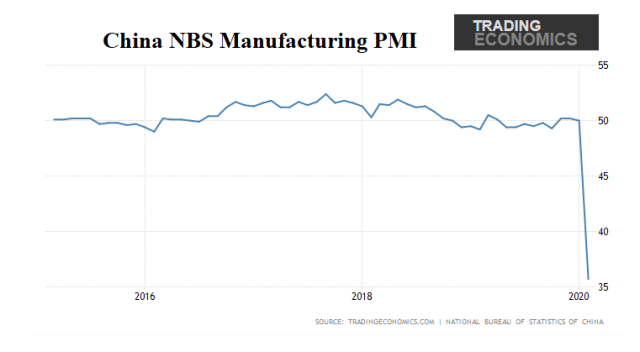
Those are some ugly numbers, folks, and as a matter of fact, the lowest on record. Not totally unexpected but much worse than anticipated. The February print came in much lower than the median forecast of 43 by economists surveyed by the Wall Street Journal.
China’s official manufacturing PMI dropped to 38.8 in November 2008 at the start of the global financial crisis. The composite PMI, which combines the manufacturing and services indices, dropped to 28.9 from 53.0 in January
The export order sub-index dropped to 28.7 from 48.7 in January, while imports fell to 31.9 from 49.0. The sub-index for manufacturing production nosedived to 27.8 in February from January’s 51.3, while the reading for new orders plunged to 29.3, down from 51.4 a month earlier.
The low employment sub-index illustrates the difficulty of finding and recruiting labor, while the high input price sub-index pointed to higher costs for manufacturers due to disrupted logistics and supply chains.
Foxconn’s biggest iPhone plant has struggled to return to full production because of housing problems for workers in need of quarantine. Foxconn and other manufacturers often house workers on-site in large dormitories.
Separately, Taiwan on Saturday reported a cluster of infections in a hospital, the most significant instance of local spread of the disease since the epidemic began. The infections brought Taiwan’s count of confirmed cases to 39. – FT




 Global Macro Monitor