A Short Stay At The Bear Trap Inn

As we suspected in last night’s post,

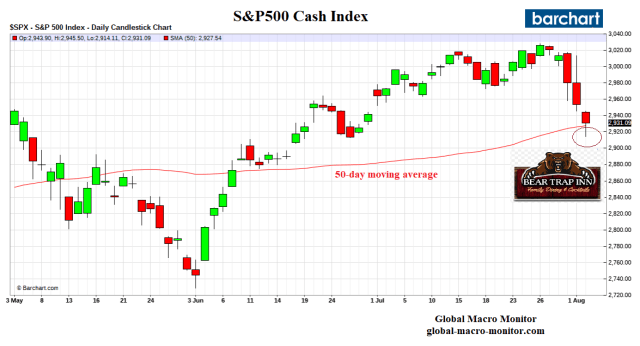
A break of today’s low at 2945.23 cinches a beeline move to the 50-day, where algos will likely set their bear trap and try and bounce the market.  We expect a feeble bounce at best, which should be spanked. — GMM, August 1st

Right on schedule, the 50-day breaks this morning, human emotions run amok, shorts pile in, and the Bear Trap Inn Algo comes in and puts the big hurt on short selling day traders.   If you have been watching the markets over the past ten years, it is so predictable

However, as we stated last night,

We expect a feeble bounce at best, which should be spanked.

The S&P must then hold the 2867-2889 level, which is huge support coinciding with the first Fibo and 200-day moving average, respectively.   We think that is where the index is heading over the next week probably after some strum und drang after tomorrow’s employment report.  — GMM,  August 1st

The talking head traders are way too bullish.  Not even thinking about a tradeable bounce until the 200-day, then will only keep it on a very tight leash.

Can The Fed Solve All?  

Do you think if the Fed acted preemptively in August 1914 and April 1939, we could have averted the two World Wars?   We know the Fed was young in 1914, but surely its cyclical tools could have solved the structural global economic and political forces driving nations to war, no?

Totally assinine thinking by Mr. Market channeling some mystical and omnipotent powers to the central banks.  But, hey, everybody needs a Savior when you got nuttin’ else.

Nobody knows the future.

Expecting the Fed to see all, know all and precisely fine-tune the economy and markets is tantamount to having someone thread a needle with boxing gloves on and blindfolded during a rollercoaster ride.   The belief that they can have distorted markets beyond all repair.  — GMM, July 31

I think it was Milton Freidman, who first applied the boxing glove analogy to monetary policy, but can’t find the quote.

Japan And QE

Just a side note.

Japan has had 20-years of ZIRP and QE, and its central bank is now buying stocks outright, lots of ’em, yet the NIKKEI remains 45 percent below its high made in December 1989.  Interest rates on saving deposits have been at zero for almost an entire generation.

More importantly, and sadly,  here is the end result for many, who were in their prime working years when the NIKKEI broke,

“I reached pension age and then I ran out of money. So it occurred to me – perhaps I could live for free if I lived in jail,” he says.

“So I took a bicycle and rode it to the police station and told the guy there: ‘Look, I took this.'”

The plan worked. This was Toshio’s first offence, committed when he was 62, but Japanese courts treat petty theft seriously, so it was enough to get him a one-year sentence.

Small, slender, and with a tendency to giggle, Toshio looks nothing like a habitual criminal, much less someone who’d threaten women with knives. But after he was released from his first sentence, that’s exactly what he did. – BBC

There is your case against indexing and putting it on autopilot, folks.   Stay alert.
Bear_Trap

Posted in Economics, Equities, S&P500, Uncategorized | Tagged , , , , | Leave a comment

Seat Belts

Seat Belts_Mar24

Posted in Uncategorized | Leave a comment

S&P Breaks With A Tariff Tweet

After a nice morning bounce from yesterday’s Fed sell-off, the market got slapped in the face with some real fundamental news with President Trump’s tweet threatening to raise tariffs.   Not a done deal yet but can’t see President Xi scrambling to make concessions to make Trump look like a winner as Mexico did, or as Trump said Mexico did.

In fact, the Chinese may look to the Mexico example as another instance of Trump not following through on his threats, which makes negotiations even more unstable. In other words, America is likely viewed by China as a Paper Tiger.  Does Trump now have to prove them wrong?  HTF did we ever get here?   Pass the Kafka, please.

An escalation of the trade war with additional tariffs will do real damage to the global economy.   Nobody wins a trade war.

Hey, but Trump is standing up to China, right?  How idiotic.

Can you imagine if Trump was president during the 1962 Cuban Missile Crisis?  None of us would be here to imagine.

Key Levels

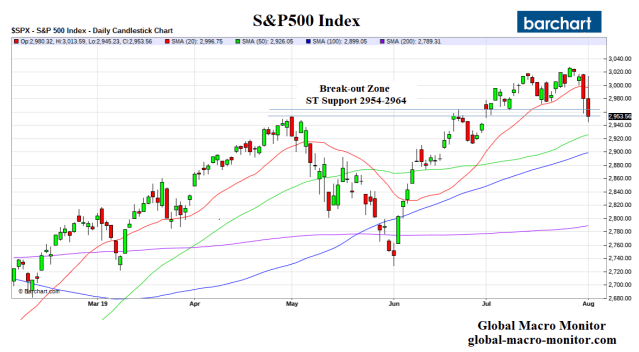
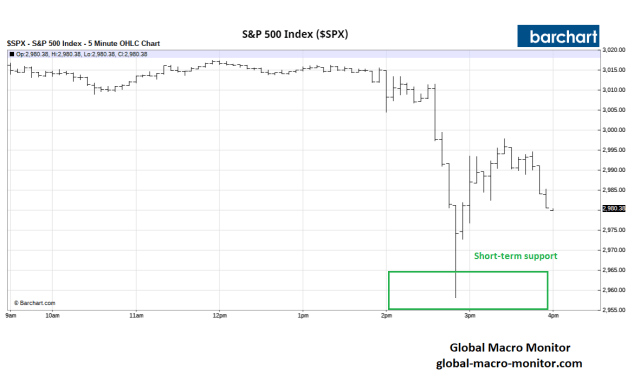
The S&P closed at 2953.56, just through the bottom of the “breakout zone” of 2954-2964, which brings the 50-day moving average in play at 2926.06.  A break of today’s low at 2945.23 cinches a beeline move to the 50-day, where algos will likely set their bear trap and try and bounce the market.  We expect a feeble bounce at best, which should be spanked.

The S&P must then hold the 2867-2889 level, which is huge support coinciding with the first Fibo and 200-day moving average, respectively.   We think that is where the index is heading over the next week probably after some strum und drang after tomorrow’s employment report.

To the upside, the S&P must first takeout 2964, the top of the “break-out zone” and then eyes on the 20-day at 2996.78.  Not achievable, in our opinion,  unless Trump tweets “April Fools” tonight.

Looks like a lot August holidays are going to be ruined with this new round of escalation in the trade war.

Big sellers.

S&P

S&P_Chart

Posted in Uncategorized | 1 Comment

Sign of the Times

If true….

https://twitter.com/1984to1776/status/1156260010994864139?s=21

Posted in Uncategorized | Leave a comment

Why Did Stocks Fall After Rate Cut?

Gravity.  Stock prices are waaay too high.

Stocks went down not because the Fed messed up.  If they needed to cut 50 bps and signal more to come because of coming economic weakness, what in heavens name were stocks doing at record highs and extreme valuations?   Nobody knows the future.

Expecting the Fed to see all, know all and precisely fine-tune the economy and markets is tantamount to having someone thread a needle with boxing gloves on and blindfolded during a rollercoaster ride.   The belief that they can have distorted markets beyond all repair.

S&P

Seriously, folks, the lack of price discovery in all things financial is a big problem.

Valuations

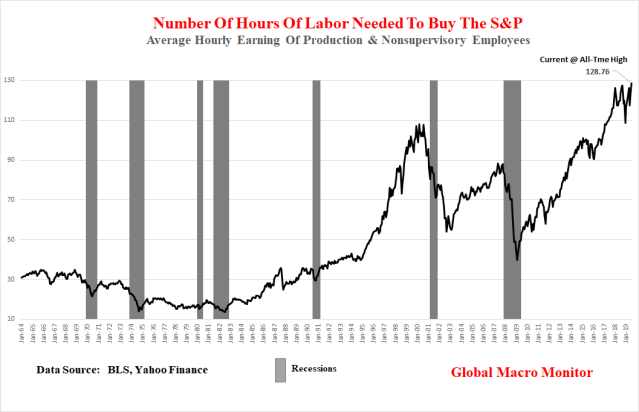
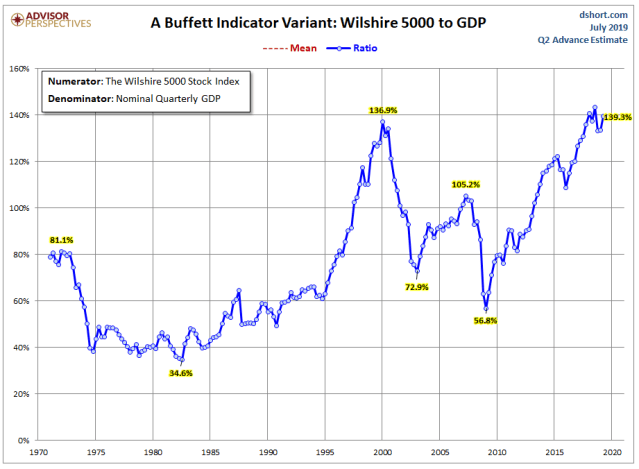
Check out the following macro valuation charts at historical extremes.

Earnings are slowing, we believe the economy is at secular peak margins and the international economic order is in tatters.  The S&P is shattered!

Rally on, Garth, if you want to.  Not with our long-term book, however.

The pressure on the Fed from the market socialists (see our last post) will intensify.

Moreover, given the New Economy’s feedback between asset prices, Jay Powell will soon be talking about QE if stocks are headed where we think they are.

Call it an unstable equilibrium, a stable disequilibrium, or an unstable disequibrium.  You decide.

Valuations_4

Valuations_3

Posted in Equities, Politics, Uncategorized | Tagged , , | 3 Comments

Fed To Cut With “Loose As A Goose” Financial Conditions

It is absolutely clear to us this rate cut is motivated to placate a clueless and unprincipled president and also including Wall Street traders.  We call them the “market socialists” who look for government intervention to set prices rather than allowing the market to work its invisible hand.

Housing And Shelter Now Unaffordable For Many, Especially The Young

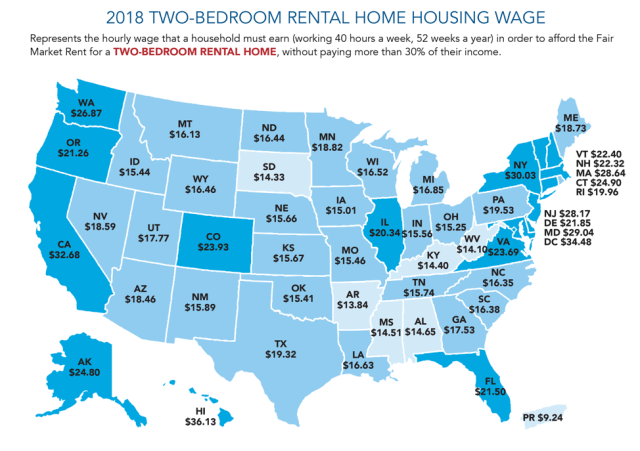
If you are dumbfounded why young families are priced out of the housing market and it takes a $70k annual salary to rent a 2-BR apartment in California,  your understanding will begin with today’s interest rate cut.

Only in 22 counties in the United States is a one-bedroom home affordable to someone working 40 hours per week at federal minimum wage.  —  CityLab

We suspect the Fed’s cave to the White House and the market whining for easier financial conditions will only complicate the above problems.

We Are Data-Driven

If economic and financial conditions were tighter we would be less harsh but they are not.

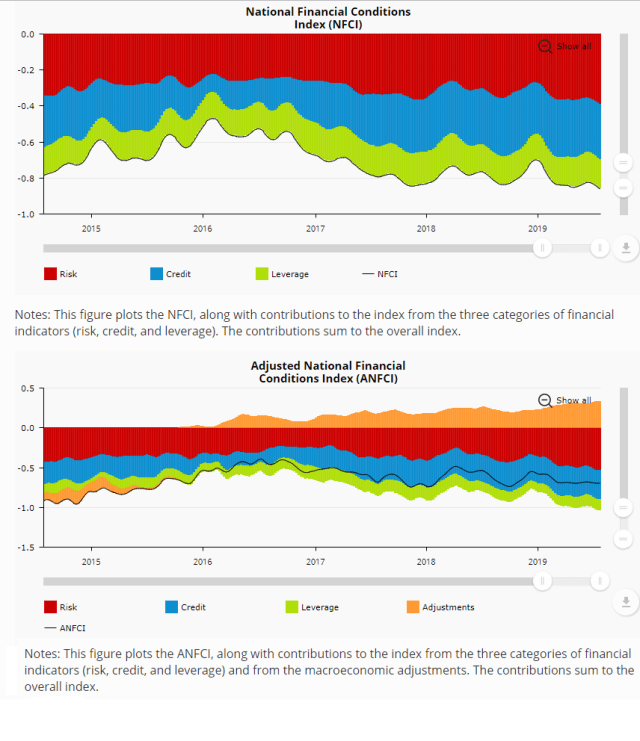
The Chicago Fed’s National Financial Conditions Index (NFCI) shows financial conditions are over 20 percent easier than when the Fed tightened in December.   Yes, their pivot eased without acting but come on, man!

Let markets clear, let prices mean something!

We suspect, even if the Fed cuts today, conditions are going to tighten, in part, because of the cut.  Stranger things, no?

Trading 

This the hand traders and investors are dealt, however.   Trade accordingly.

We believe it is time to spank the strength as the S&P moves into our selling zone.


           Chicago Fed’s National Financial Conditions Index (NFCI)

Financial Conditions Index

Posted in Uncategorized | 1 Comment

Why Is Apple Rallying?

For iPhone, we generated $26 billion in revenue. While this is down 12% from last year’s June quarter, it is a significant improvement to the 17% year-over-year decline in Q2. – Tim Cook, Earnings Conference Call, July 30

This is why Apple stopped reporting iPhone sales and breaking out revenue by components.  Does the market really believe Apple is now “Beyond Meat iPhones?”

If he can convince the market of this and maintain Apple’s close to $1 trillion market cap, Tim Cook is the Master Chef of earnings presentations.  One Helluva Cook!

Posted in Uncategorized | Leave a comment

Deflation? Not Even Close

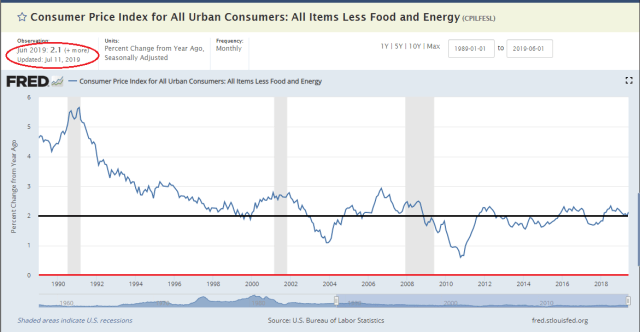
Core CPI consistently prints around 2 percent, the average over the past eight years, with the latest reading of the June core rate coming in at 2.1 percent.  Sure, we can find another index to show lower or higher rates of inflation.  Your choice for your confirmation bias.

We maintain the Fed has achieved their targets of 2 percent inflation and full employment.   Many on Wall Street and in the White House do not believe the Fed has hit the Dow and S&P500 targets, however, thus we will get a rate cut next week.

Go ahead, call us cynical.

CPI_CORE

Housing And Shelter In Basket

We’re not big fans on how the government measures inflation, in the first place,  as the largest portion of any consumer basket is housing (42 percent in CPI basket), which includes shelter (33 percent), and just doesn’t pass the smell test in terms of a true metric of price changes or even a cost of living measurement.

Because the majority of families own their homes, the government uses a proxy called owners equivalent rent (OER)  to measure housing inflation,  which is 24 percent of the CPI basket.   The BLS changed how housing was measured in the CPI basket after the big inflation of the late 1970s, in an attempt to separate housing as an investment versus the shelter services it provides.

We haven’t formally tracked it but our priors are OER doesn’t come close to the changes in the monthly mortgage payments of average urban consumers.  Furthermore, the BLS makes hedonic adjustments to rents (7 percent of the basket).

With each passing year, the dwellings in the CPI housing sample deteriorate, losing some value (depreciate), and deliver less shelter service to their occupants. If this were not taken into account, the CPI would have a downward bias. To offset this quality loss, the aging bias due to depreciation, staff at BLS developed an age-bias adjustment.  This tool, which BLS began using with the CPI for January 1988, makes a monthly incremental adjustment to each housing unit in the sample to maintain a constant quality index over time.

The theoretical basis for the hedonic method used in estimating age bias is found in Randolph (1988). Randolph estimated that the age bias due
to depreciation was 0.3 to 0.4 percent annually.  — BLS

Whether it’s an upward or downward adjustment, the fact is none of the shelter prices are real prices paid, which seems absurd to us.

Younger Generations Priced Out Of Housing 

Moreover, the reflation of the housing bubble coupled with the rapid increase in student debt has priced much of the younger generation out of the housing market.

For generations, the wealth of U.S. households was built on the foundation of homeownership. That is changing.

Homeownership rates for younger Americans have fallen sharply over the last decade. The median age of a home buyer is 46, the oldest since the National Association of Realtors began keeping records in 1981. Economists, policy makers and mortgage lenders expect the trend to extend to younger generations. The decline illustrates what for many Americans is the real legacy of the financial crisis.  – WSJ

That 7 percent weight for rents in the CPI basket is going to have to be increased.  See here how weights in the basket have changed over the years.

$70k Annual Salary Required To Afford 2-BR Apartment In California

Take a look at the map below and then ask yourself, “are the official inflation statistics capturing the real cost of living and price changes?”  We believe the answer is so freaking obvious.

For most Americans, access to decent, affordable rental housing remains cruelly beyond reach. Only in 22 counties in the United States is a one-bedroom home affordable to someone working 40 hours per weekat federal minimum wage.  —  CityLab


Rents_Wages.png


See here why some argue that the CPI actually “overstates” inflation and why the Fed’s preferred measure of inflation is the PCE deflator. We disagree, as we are more interested in measuring true inflation not a hypothetical cost of living index,  but provide the argument and let you decide.

inflation – a persistent, substantial rise in the general level of prices related to the volume of money and resulting in the loss of value of currency – dictionary.com


Posted in Inflation/Deflation, Uncategorized | Tagged , | 4 Comments

Why The Tour de France Is So Brutal – Vox

Posted in Uncategorized | Leave a comment

Good v. Evil

Yes, that is what 2020 is shaping up to be all about.

Watch the videos and read the tweets below and you decide, then act…


Posted in Uncategorized | Leave a comment