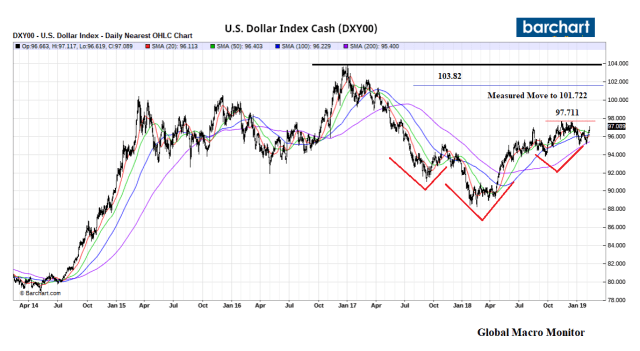
Fed’s Failure To Communicate, Markets’ Failure To Count

Not to beat a dead horse but the following example just reinforces our last post.

What the market perceives,

Investors who are hoping the Federal Reserve signals a change or adjustment in its balance sheet policy on Wednesday are likely to be disappointed, economists said.

To reduce its $4 trillion holdings of Treasurys and mortgage-backed securities amassed during the financial crisis, the Fed has been letting $50 billion in maturing securities “roll off” its balance sheet each month.  – MarketWatch

Versus reality,

fed_11


Time to move on.

Posted in Fed, Monetary Policy, Uncategorized | Tagged , , | 1 Comment

How Chair Powell Could Spark A Massive Rally By Doing Nothing

Summary

  • The market is irrationally obsessed with the “$600 billion” annual roll-off in the Fed’s balance sheet
  • The actual reduction in the balance sheet will be much smaller and is determined by the profile of monthly Treasury and MBS securities maturing in the SOMA portfolio
  • The balance sheet reduction will not come even close to the zip code of a $600 billion annual reduction
  • The asymmetrical liability accounting of QT versus QE makes the runoff look similar to a quasi-deficit financing
  • By conveying to the market the balance sheet will not be reduced by $600 billion annually and announcing an annual cap of, say, $450 billion, the Fed Chair could spark a massive nutcracking short-covering rally, in our opinion
  • Maybe he should.  Maybe he will

It is truly stunning to watch, what some academics believe to be, an efficient market come unglued over the Fed’s “$600 billion annual balance sheet reduction”

Recall the Fed announced to its “Normalization Principles and Plans” at the June 2017 FOMC meeting,

fed_6

Source:  FOMC

Those are frickin’ caps, not levels!

The Fed began their balance sheet reduction in October 2017 and has reduced, as of January 23rd, its holdings of Treasury securities by $252 billion and MBS by $140, which is only 78.40 percent of the cumulative monthly caps mentioned in the normalization statement.  Why is this so?


fed_1

Maturity Profile Verus Monthly Caps

Simply because the balance sheet run-off depends on the profile of Treasury and MBS securities maturing in the SOMA portfolio in any given month.  For example, this month – January 2019 – only $11.7 billion of Treasury securities mature in the Fed’s SOMA portfolio, not even close to the $30 billion cap, which the market tends to get all worked up over.

Next month, however, $56 billion will mature.  The Fed will not rollover $30 billion — that is the cap will be binding — reducing the Treasury’s cash balance held at the Fed (the liability side) by $30 billion.  The remaining $26 billion will be rolled over into the February monthly Treasury auctions across a spectrum of maturities.

Only four out of the twelve months in 2019 will the $30 billion cap on Treasury securities be binding and gets better in the out years.

fed_2

The MBS portfolio is less transparent and harder to measure due to prepayment uncertainty.  Moreover, we don’t have the data on the maturity profile and use an assumption that MBS maturities are equal to around 55 percent of the Treasury securities. which has been the case since October 2017 beginning of QT.

Our estimates are very sensitive to this assumption and could likely be too low.  Only the Fed know, or knows better.

Fed’s Accounting Difference of QE versus QT

Given the asymmetric liability accounting of quantitative tightening (QT) – a reduction of Treasury cash balances at the Fed  – versus quantitative easing – an increase in bank reserves – we conclude that QT is much more like a fiscal operation than monetary policy.   There is little evidence the balance sheet reduction is restricting credit and loan creation.

The Treasury has to issue more bonds and notes to maintain its cash balances (checking account) at the Fed, which makes it similar to quasi-deficit financing.

During QE, however, the Fed bought Treasury securities in the secondary market through increasing reserves in the financial system (liability), allowing among other things, investors to reallocate into riskier securities while keeping interest rates down.

The extra liquidity in the banking system did not translate into credit expansion (an increase in endogenous money), no surprise, but counter to our expectations, no panic over money printing as it would have in an emerging market resulting hot potato money.    Ergo no goods and services inflation, only asset inflation and FOMO panic.  The advantages of a reserve currency.

We are not so sure the next round of QE will be so benign, however.  Sorry,  my MMT brothers and sisters.

Changing Mr. Market’s Perception

Nevertheless, as illustrated in the tables and chart, and unless our estimates are wrong, Mr. Powell and the FOMC can ease the market fears by simply announcing the annual cap on the balance sheet will be reduced to $450 billion from $600 billion through 2022.  Markets will rally on this nonsense even though the $600 billion annual cap was never binding in the first place, simply due to the maturity profile of the SOMA portfolio.

There are times when Mr. Market doesn’t do its homework and is repulsed by the details and the minutiae of monetary policy.  We believe this is one of those times.

fed_10

Totally absurd but it’s today’s reality and we have seen much worse.

Potemkin monetary policy.  Just as in the Korea-U.S. Free Trade Agreement.

South Korea, meanwhile, negotiated a permanent steel-tariff exemption in exchange for allowing additional U.S. auto imports. But the claim of a “renegotiated” Korea-U.S. free-trade agreement should be viewed with skepticism. U.S. automakers already don’t export the allowable number of cars into South Korea today, let alone the expanded number. And South Korean car exports, the main sources of the trade imbalance, were left alone. It was a limited, face-saving deal that everyone can tout as “preventing” a trade war.  – New Republic

Posted in Monetary Policy, Uncategorized | Tagged | Leave a comment

How A Market Trends


Posted in Uncategorized | Leave a comment

Inside China’s High-Tech Dystopia – Bloomberg

In part three of Hello World Shenzhen, Bloomberg Businessweek’s Ashlee Vance heads out into a city where you can’t use cash or credit cards, only your smartphone, where AI facial-recognition software instantly spots and tickets jaywalkers, and where at least one factory barely needs people. This is the society that China’s government and leading tech companies are racing to make a reality, with little time to question which advancements are net positives for the rest of us.

Part One – Inside China’s Future Factory
https://www.youtube.com/watch?v=eLmaI…

Part Two – China’s High Stakes Robot Wars
https://www.youtube.com/watch?v=qrhvZ…

https://www.bloomberg.com/hello-world

Posted in Automation, China, Technology, Uncategorized | Tagged , , , | Leave a comment

Venezuela, Debt, and Gunboat Diplomacy 2.0

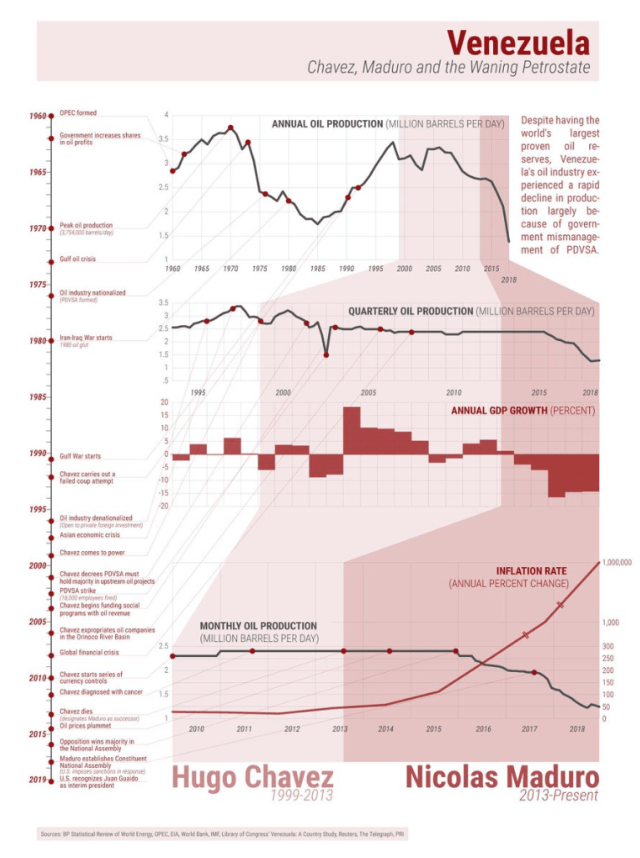
Traders bought up Venezuelan bonds last week on the announcement of the U.S. administration’s policy shift to delegitimize President Nicolás Maduro and recognize the opposition leader,  Juan Guaidó.

venezuela_bond prices

When was the last major sovereign debt restructuring in Venezuela?

venezuela_ny times

The Brady Plan in 1990, which, I helped design and negotiate as a young economist/investment banker as part of my bank’s excellent negotiating team and member of Venezuela’s bank advisory committee of international creditors.

My main contribution to the deal was to set the pricing of the menu – discount and equivalent interest rate – after the final haircut was negotiated;  calculate the foreign currency equivalent coupon rates — 6.66 percent for the Deutschmark equivalent to the 6.75 percent dollar coupon rate, for example.  The German bankers and I agreed to round up to 6.67 percent for religious obvious reasons.  I also designed and helped negotiate the oil warrants, which Hugo Chavez really didn’t want to pay.

Current Situation And Outlook

The current situation in Venezuela couldn’t be more different than during the country’s last debt workout.

First, Venezuelan debt is now mostly owed to China and Russia and the remainder in the form of bonds, which are in default.  In 1990, most of Venezuelan debts were instrumented as loans and with exception of a short period, where the country tried to increase its negotiating leverage, were current on interest payments.

Second, the United States was hugely influential, not just in Venezuela, but throughout the world.  The Berlin Wall was no more and it was peak America.  Venezuela was the third Brady Plan restructuring, after Mexico and Costa Rica, of Bush #41’s hallmark developing country emerging market debt plan, which reignited capital flows from the core back to the periphery.

Third, Venezuela is now a dismal failed state after years of mismanagement with a significant presence and influence of foreign powers often hostile to American interests.  It is more similar to the Venezuela of the 1901 debt default than the Venezuela of the late 1980s.

venezuela_map

Moreover, reports and rumors of foreign influence in Venezuela are ubiquitous. Chinese naval ships docking in Venezuelan ports; rumors of Russian mercenaries on the ground to protect the Maduro government (though they deny it) and the arrival nuclear-capable Russian bombers, and threats by the Iranians to send special naval ships and helicopters to Venezuela.

The Chinese are in Venezuela for more pragmatic and commercial reasons while the Russian presence is motivated more by geopolitical considerations.  By setting up a beachhead in the Americas close to the United States, Putin is trying to send a message and copycatting the U.S. and NATO foreign policy of what he perceives as meddling in Russia’s sphere of influence, particularly in Ukraine.

The domestic situation is so untenable in Venezuela, however, there is probably little these countries can do to prop up Maduro and their saber rattling is largely symbolic. Let’s hope so.

Rumors are the Russians are already willing to talk

Venezuela On The Hook For Big Money To China and Russia

As of 2016, Venezuela owed China, the country’s largest creditor,  approximately $62 billion, much of which Caracas pays, or paid,  in-kind with oil. Moscow has provided Venezuela $17 billion in loans and investment, and in December the two governments signed a new deal in which Russia will invest $6 billion in Venezuela’s oil and gold sectors.

No Sovereign Balance Sheet/Captial Structure To Determine Seniority

This, once again, raises the age-old problem of sovereign debt.  There is no transparent sovereign balance sheet or national capital structure to determine the seniority of each claim on the country.

Traditionally, the sovereign debtor would carve out an informal seniority structure, usually based on the net transfers flowing into the country from each of its creditor groups.  The net transfer to private creditors is always negative during periods of economic and political distress, which lead to sudden stops of capital inflows, and thus they are usually first in line for default.

The International Monetary Fund, the World Bank, and other official creditors, whose raison d’etre is to lend into countries in distress are almost always deemed senior creditors and paid first.   In Venezuela’s case, however, its all academic as the country paid off its debts to the IMF and World Bank during the Chavez regime and currently has no relationship with either.

The Coming Battle Over Preferential Treatment 

We suspect a coming donnybrook between Venezuelan creditor groups, including China and Russia, which is still a long way off,  about who will have preferential treatment and be paid first.

The current situation is very complex and complicated and the preconditions of the future and far out debt restructuring look eerily familiar to the gunboat and debt diplomacy of Venezuela’s debt default of 1902.  Though we don’t expect China and Russia to blockade Venezuela’s ports.

tr_center

Venezuela Debt Crisis

The Venezuela debt crisis began in 1901 when Cipriano Castro, Venezuela’s president, defaulted on millions of dollars in bonds owed to European nations.  The creditors, especially Germany, Italy, and Great Britain, threatened military intervention if the debts were not repaid.  President Castro, who refused to engage in settlement talks, did little to resolve the escalating crisis.

Initially, President Theodore Roosevelt believed that that the European nations were justified in intervening in Venezuela in order to protect their citizens and property.  In fact, Hermann Speck von Stenberg, a German diplomat and personal friend of the president, wrote the president to explain Germany’s intention to collect its debt.  TR’s response in July 1901 approved of Germany’s plans. He also warned the Germans not to annex any territory.

Later, Castro ignored a final ultimatum demanding payment of the debt. In response, German, British, and Italian forces seized several Venezuelan vessels, bombarded coastal forts, and established a naval blockade of the country in December 1902.  President Roosevelt became leery of continued European intervention in the region. He responded to the crisis by pressuring all parties to reach a settlement.

By January 1903, the boycott had devastated Venezuela’s economy.  A desperate Castro asked President Roosevelt to negotiate a settlement.  Not surprisingly, Roosevelt jumped at the opportunity to restore order in the western hemisphere.  The British were eager to get out of Venezuela and endorsed the proposal.  The crisis abated in February 1903 when Venezuelan leaders agreed to reserve 30% of the country’s custom duties until all of the debt claims had been settled.  Theodore Roosevelt did not wish to see European intervention in the western hemisphere again so he announced the Roosevelt Corollary to the Monroe Doctrine in 1904. – TR Center

Details Of The Final Deal 

After agreeing to arbitration in Washington, the United Kingdom, Germany and Italy reached a settlement with Venezuela on 13 February, resulting in the Washington Protocols. Venezuela was represented by US Ambassador in Caracas Herbert W. Bowen. Venezuela’s debts had been very large relative to its income, with the government owing Bs120 million in principal and Bs46m in interest (and another Bs186m claimed in war-related damages), and having an annual income of Bs30m. The agreement reduced the outstanding claims by Bs150m, and created a payment plan taking into account the country’s income.  Venezuela agreed in principle to pledge 30% of its customs income at its two major ports (La Guaira and Puerto Cabello) to the creditor nations.  Each power initially received $27,500, with Germany promised another $340,000 within three months. The blockade was finally lifted on 19 February 1903.  The Washington agreements foresaw a series of mixed commissions to adjudicate claims against Venezuela (of respectively one Venezuelan representative, one representative from the claimant nation, and an umpire), and these “worked, with a few exceptions, satisfactorily; their awards were accepted; and the dispute was widely regarded as settled.”

However, the blockading nations argued for preferential treatment for their claims, which Venezuela rejected, and on 7 May 1903 a total of ten powers with grievances against Venezuela, including the United States, signed protocols referring the issue to the Permanent Court of Arbitration in The Hague The Court held on 22 February 1904 that the blockading powers were entitled to preferential treatment in the payment of their claims.  The US disagreed with the decision in principle, and feared it would encourage future European intervention to gain such advantage.  As a result, the crisis produced the Roosevelt Corollary to the Monroe Doctrine, described in Theodore Roosevelt‘s 1904 message to Congress. The Corollary asserted a right of the United States to intervene to “stabilize” the economic affairs of small states in the Caribbean and Central America if they were unable to pay their international debts, in order to preclude European intervention to do so.  The Venezuela crisis, and in particular the arbitral award, were key in the development of the Corollary.   – Wikipedia

We don’t know, nor does anyone else, what a final Venezuelan debt restructuring will look like or even the path to getting to one.  One thing is certain, however, Venezuela’s debt workout will be one of the most complicated and complex in history, full of international intrigue and global power politics.  Just as it was during 1901-1904, which almost led to war.

Recovery Value Of The Bonds

Given all of the above, the risk-arbitrage  trade is not so simple and much more uncertain.  A simple calculation of the recovery value of Venezuelan bonds based on past deals and then calculating the expected value of the final restructuring is exponentially more complicated and really doesn’t apply here, in our opinion.

Nevertheless, the market isn’t there yet and Venezuelan bonds will continue to rally on any positive news, which seems to be in the pipeline.

In other words,  the bonds are tradeable but not investable.

free rider_2

Help keep the lights on at the Global Macro Monitor.   Contribute any amount based on your perception of our value added by clicking the PayPal donate widget at the right side of the screen.  You don’t need a PayPal account just a credit card.  Thank you!


Posted in Emerging Markets, Uncategorized | Tagged , , | 1 Comment

Week In Review – January 25

Summary

  • Modest gains for most risk markets last week
  • Big rallies in Turkey and Mexico bond markets. Mexico inflation comes in better than expected
  • Some weakness in lower-end of U.S. credit.  See our post on the corporate bond market.
  • Euro periphery stable
  • EM FX continues to strengthen as capital flows to the periphery
  • China RMB strong shutting up the Panda Bears
  • Sterling, our favorite global macro trade, up big
  • Most EM equities up
  • S&P shows surprising resilience after huge January bounce.  Shorts, including us, have taken big facials
  • U.S. semis now showing leadership, and our bet, it leads the next leg to the 100-day moving average
  • Financial conditions are easing markedly
  • Lumber continues to rebound
  • CRB now up 6.41 percent YTD.  Still waiting for Godot Deflation

Commentary:  Difficult S&P trading around political events.  The government shutdown is now yesterday’s story.  We have no doubt the POTUS threat to close down the govie again is paper tiger talk.  Move on.

China is coming to town and with Trump weakened and their awareness the administration can’t stand a 10 point drop in the S&P.  They will play hard.  The administration is going to have to cave on almost all big issues and settle for another Potemkin trade deal.  You never know with these guys, however.  If talks stall or tank, the market tanks, increasing the odds Trump caves.  The Chinese aren’t stupid and know their game theory.  Nonetheless,  the government shutdown is an example of how incompetent and destructive the administration negotiates. They are impulsive and divided, inflict huge pain on the country and get nothing at the end of the day. Watch this space.

Nevertheless, the market feels like it wants to go higher. Buoyed by the  Friday’s WSJ article the Fed is rethinking the balance sheet – big hat, no cattle, in our opinion – decent earnings and better sentiment on China’s economy, which is reflected in RMB appreciation.  We expect the S&P to take out the recent high at 2675.47 and then set its sight on 2710-2720, which is the zip code of a yuuuge Fibo level and the 100-day moving average.  Probably the place to sell but will revisit when we get there.   This, of course, assumes no rupture in China trade talks.

On the downside, the big, big, big number is last week’s low of 2612.86, which is now the 50-day moving average.

Huge week for earnings and China trade.

That’s our short-term view, folks, and, as always, we reserve the right to be wrong, which we often are.  All of us have no idea of the future and are driving in the fog.  We can only use our imprecise instruments to guide us.   Happy hunting next week.


week_chart_8

We’ve got to do better than this


week_chart_5

Brazil Country ETF keeps on Rockin’ In The Free World

week_2019_etfs

week_table


free rider_2


Help keep the lights on at the Global Macro Monitor.   Contribute any amount based on your perception of our value added by clicking the PayPal donate widget at the right side of the screen.  You don’t need a PayPal account just a credit card.  Thank you!

Posted in Uncategorized, Week in Review | Tagged , , , , , , , , | Leave a comment

Why India Is A Better Long-Term Bet Than China

Posted in Uncategorized | Leave a comment

Global Risk Monitor – January 25

riskmon_1

riskmon_2

Help keep the lights on at the Global Macro Monitor.   Contribute any amount based on your perception of our value added by clicking the PayPal donate widget at the right side of the screen.  You don’t need a PayPal account just a credit card.  Thank you!

Posted in Daily Risk Monitor, Uncategorized | Tagged , , , , , | Leave a comment

Sector ETF Performance – January 25

etf_d

etf_w

etf_m

etf_2018

Posted in Sector ETF Peformance, Uncategorized | Tagged , | Leave a comment

Bears [Can Now] Eat

weekend_cartoon

Posted in Politics, Uncategorized | Tagged , | Leave a comment