Prepare For Much Higher Long-Term Rates

There has been a huge drain of liquidity from the U.S. Treasury market over the past few years, and may signal a structural change to how the United States finances budget deficits.

The government will always find a way to fund itself and will siphon and drain liquidity and buying power from other asset markets.  During the past 20 years, the Treasury market has been dominated by foreign and official sector buyers   That is changing and may explain why the stock market is trading so poorly even with, what appears, to be stellar earnings.

Read on.

Determination Of The 10-year Yield

There will be many posts to come on this topic as we believe it is the most critical issue investors need to grapple with and get right over the next year.

What is the right price for the U.S. 10-year Treasury yield?

Moreover,  how is the yield determined, and how has it been distorted over the past 20 years by central banks, both foreign and the Federal Reserve?

What does the future hold?

Capital Flows

We agree that inflation, growth expectations, and other fundamental factors weigh heavily on determining bond yields but we alway maintain, first, and foremost,

“asset prices are always and everywhere determined by capital flows.” 

New Issuance,  Foreign, and Fed Flows Into The Treasury Market

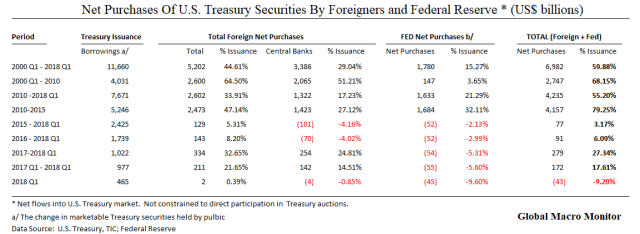
The following table illustrates the new issuance of marketable Treasury securities held by the public and net purchases by foreign investors, including central banks, and the Federal Reserve over various periods.
May2_Flow Tables

The data show since the beginning of the century, foreign investors, mainly central banks, and the Federal Reserve net purchase of Treasury securities, those which trade in the secondary market, is equivalent to 60 percent of all new marketable debt issued by the Treasury since 2000.

We do not suggest all these purchases were made directly in Treasury auctions, though many of the foreign buys certainly were.

From 2000-2010, foreign central banks were recycling their massive build of foreign exchange reserves back into the Treasury market.  During this period, the foreign central banks bought the equivalent of 50 percent of the new issuance.  Add foreign private investors and the Fed’s primary open market operations, and the total equated to 70 percent of the debt increase over the period.

Alan Greenspan blames the foreign inflows into the Treasury market during this period for Fed losing control of the yield curve, a major factor and cause of the housing bubble, and not excessively loose monetary policy.

Given the decoupling of monetary policy from long-term mortgage rates, accelerating the path of monetary tightening that the Fed pursued in 2004-2005 could not have “prevented” the housing bubble. – Alan Greenspan, March 2009

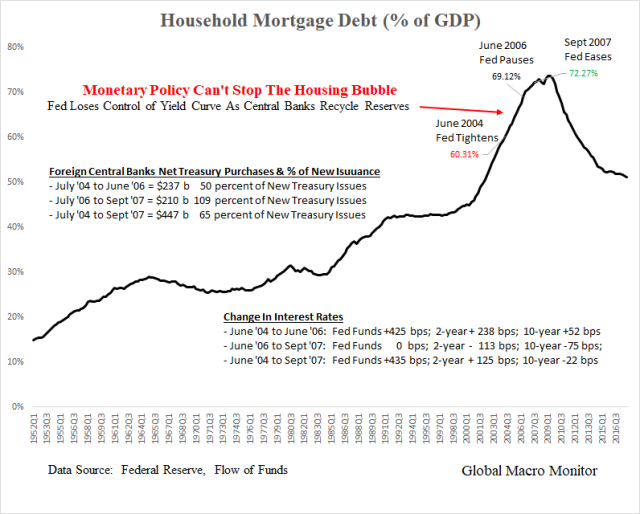
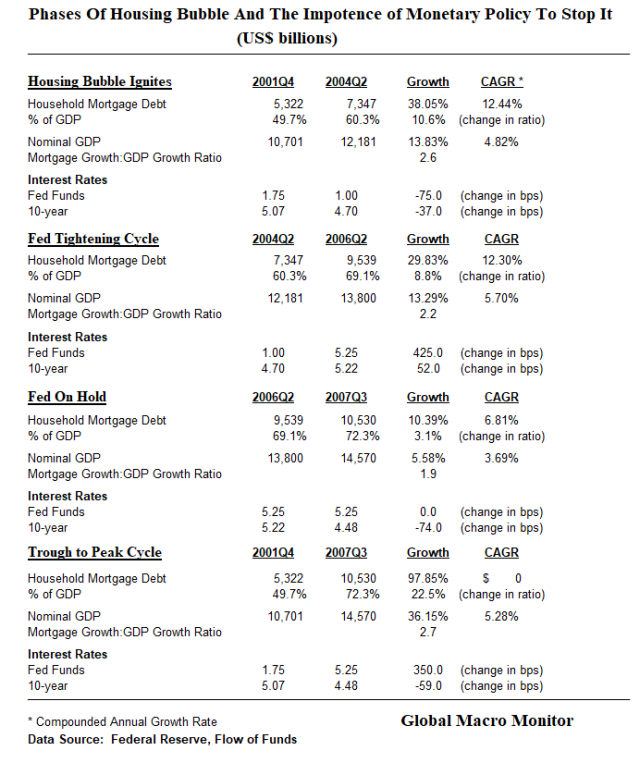
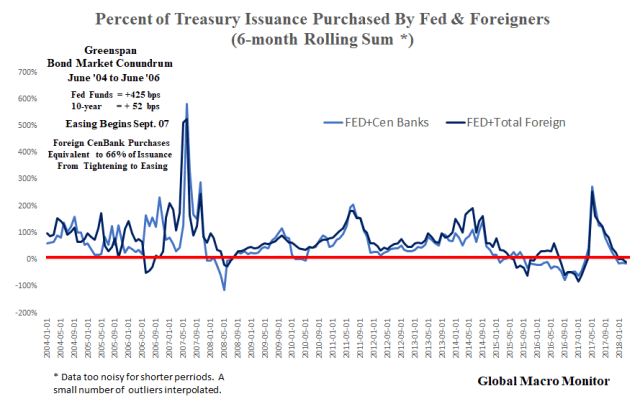
Greenspan raised the Fed Funds rate 425 bps from June 2004 to June 2006 and the 10-year barely budged, rising only 52 bps.  More on this later.

Fed Plus Total Foreign Purchases
May2_FED_TotalForeign_TreasuryBorrowings

Fed Plus Foreign Central Banks

May2_FED_CENBANK_TreasuryBorrowings

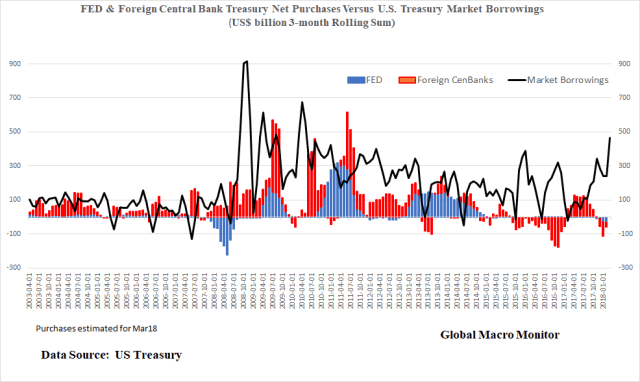
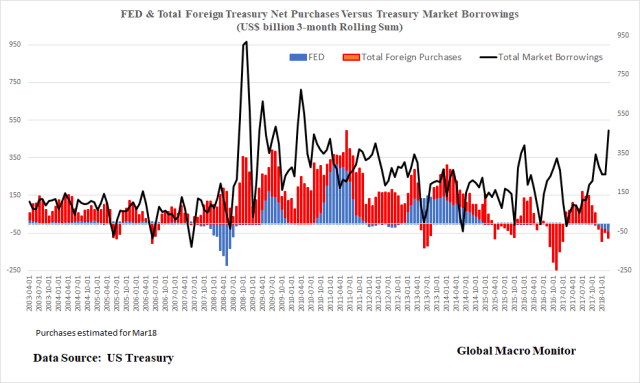
During the Fed’s QE period,  2010-2015,  foreign investors and the Fed took down the equivalent of 80 percent of  the new debt issuance.

The charts also illustrate that for several of the 3-month rolling periods, net purchases were significantly higher than 100 percent of new supply, distorting not only the 10-year yield, but the valuation of all other asset prices.

Interest rate repression also cause economic distortions, which have political consequences.  Most notably, wealth and income disparities.

Rapid Technical Deterioration

Since 2015, flows into the Treasury market have deteriorated markedly, and the timing could not be worse as new Treasury issuance is ballooning with skyrocketing budget deficits.

During the past twelve months, for example,  net foreign and Fed flows collapsed to just 17.6 percent of new borrowings.  Even worse, the net flows were negative (we estimated March international flows) during the first quarter during a record new issuance of Treasury securities of almost $500 billion.

Can we say, “Gulp”?

Stock Of Outstanding Treasury Securities

Given the rapidly deteriorating technicals and fundamentals — rising inflation –, we believe the 10-year yield should be and will be much higher sometime soon.

That is we are looking for a “super spike” in bond yields, and expect the 10-year to finish the year between 4-5 percent.   The term premium, which has been repressed due to all of the above,  should begin to normalize.

Why is it taking so long?

Aside from the record shorts and natural inertia of markets, the stock of Treasury securities remains favorable, as the bulk is still held by the Fed and foreign central banks, who are not price sensitive.

Debt Stock Shortage,  Debt Flow Surplus 

Ironically,  there remains an artificial shortage of the stock of  Treasuries but now a huge glut in the flow.   See here for a must read.

The Bund And JGB Anchor?

Treasuries are at almost record spreads on some  maturities vis-à-vis the German bund, and foreigners are on a buying strike as the above data show.

How can an anchor be an anchor if there are no buyers?   One asset arbitrage?

It is also not normal for the 10-year to be trading in such a tight range with a record short position in the futures market.  The average daily move in the VIX has increased from 0.20 percent in 2016, to 1.37 percent in 2017, and shorts are now hardly spooked by a 500 point flop in the Dow.

Something must be going on beneath the earth’s crust.  We have our ideas.

Dollar Strength

The recent dollar strength may be a signal foreigners are getting yield-hungry again, however.   We are not so sure the rally has legs.

Market concerns over the political stability in the U.S may trump yield-seeking for the rest of the year.

How Foreign Flows Contributed To The Housing Bubble

We are not going to spend much time here but we are starting coming around to Mr. Greenspan’s reasoning.  The lack of response of long-term yields to a 425 bps increase in the Fed Funds rate from 2004-2006  greatly contributed to the housing bubble.  The 10-year yield only moved up 52 bps from when the Fed started their tightening to when they paused.

Take a look at the chart.
 

May2_Mortgage Debt_GDP


The Fed’s interest rate hikes didn’t even put a dent in the momentum of the housing bubble.   Household mortgage debt continued to rise from 60 to 72 percent of GDP from the first interest rate hike before the market collapsed on itself.

Bubbles are hard to pop.
 

May2_Phases of Housing Bubble

Why Long-Term Yields Didn’t Respond

Simple.

As, always and everywhere, capital flows or the recycling thereof.

The biggest economic event in the past 25 years, in our opinion, is the exchange rate regime shift that took place in the emerging markets in the late 1990’s.  These countries now refuse to allow their currencies to appreciate in any significant magnitude as the result of capital inflows.

They learned some hard lessons in the mid-1990’s with Mexican Peso and Asian Financial Crisis, and the Russian Debt Default.

Balance of payments surpluses are now reconciled with dirty float currency regimes, where central banks intermittently intervene if their currency becomes too strong.

The result was a massive build of global currency reserves, much of which were recycled back into the U.S. Treasury market in the mid-2000’s.
May2_CENBANK_Treasury_Purchases

The chart illustrates that foreign central bank net purchases of Treasury securities, alone, were equivalent to the over 66 percent of net Treasury issuance during the Fed 2004-2006 tightening cycle.

International  Reserves Drive Gold

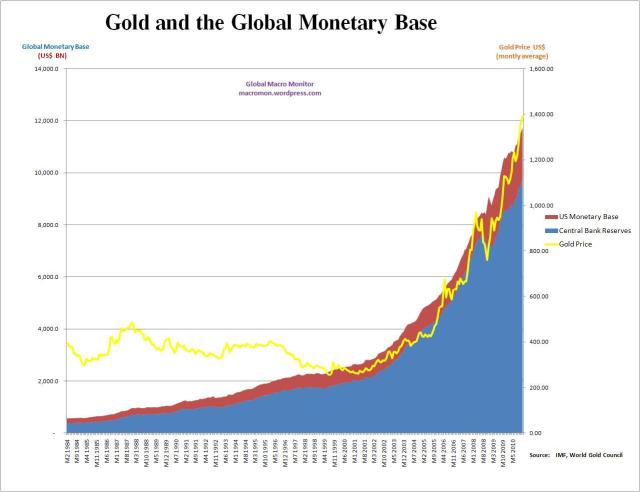
The gold price also ramped with international reserves during this period.

We believe the global monetary base, mainly international reserves,  are the main driver of gold.   See here.

Reserves have not been growing witness the punk trading range in gold.  This may change as the U.S. current account blows out again.
 

Gold and Monetary Base

Current Account And Trade Deficits

The Mnuchin crowd are wasting their time in China trying to negotiate lower trade deficits.  Trade deficits are the result of macro internal imbalances where investment exceeds savings.  See here for another must read.

Introducing trade distortions to artificially lower the external deficit will only accelerate stagflaton, which is already starting to take hold.  Then we will all be worse off.   See here.

Besides, where is Mr. Mnuchin going to obtain the financing for his proliferating budget deficits if his goal is to run trade surplus or balances with our trading partners?

We are all for better terms of trade and protecting are intellectual property rights,  but know and understand thy national income accounting before starting trade wars.

Upshot

We have laid out why we believe, and we could be wrong, long-term yields are unlikely to behave as they did during the last monetary tightening.   That is the a further collapse in Treasury term premia and a yield curve inversion until something breaks.

Unless the U.S. blows up its current account again,  credit expansion accelerates significantly, creating another blast of capital flows into the emerging markets, to be recycled back to the U.S,,  the foreign and Fed financing of the U.S. budget deficit is over.  Punto!

We are preparing for a significant move higher in bond yields.

What Is The Right Real Yield?

Do you really think with the deteriorating flows in the bond market, coupled with rising inflation warrants a 0.5 percent real 10-year yield?

Au contraire!   We believe a 2-3 percent real yield is closer to fair value.

Tack on another 2.5 percent for inflation,  generous as shortages seem to be breaking out everywhere,  and that gets the 10-year to at least 4 1/2 percent.

Timing

A little CYA.   Yields could be move a little lower, maybe to 2.80 percent (a stretch),  given the dollar strength as Europe slows, and shorts get spooked.

Our suspicions, however, it is going to be a hot summer.   Higher interest rates and lower stock prices.

If stocks really crack hard,  there will be a flight to quality keeping a lid on interest rates, however.

Disclaimer

Now let us add our disclaimer.

Even if all our facts are correct,  our conclusions may be completely wrong.

If you have been reading the Global Macro Monitor over the years, you have probably seen it several times.

To illustrate our point, we like to tell the story Abraham Lincoln used to persuade juries when he was an Illinois circuit court lawyer.

The story goes that Lawyer Lincoln was worried he had not convinced the jury during the closing argument of a civil case against a railroad.   The jurors had gone to lunch to deliberate.  Lincoln followed them and interrupted their dessert with a story about a farmer’s son gripped by panic,

“Pa, Pa, the hired man and sis are in the hay mow and she’s lifting up her skirt and he’s letting down his pants and they’re afixin’ to pee on the hay.” “Son, you got your facts absolutely right, but you’re drawing the wrong conclusion.”

The jury ruled in Lincoln’s favor.
Stay Frosty, Oscar Mike!

Posted in Bonds, Charts, China, Credit, Geopolitical, Interest Rates, Sovereign Debt, Uncategorized | Tagged , , , | 36 Comments

FOMC Statement – May 2

May 02, 2018

Federal Reserve issues FOMC statement

For release at 2:00 p.m. EDT

Information received since the Federal Open Market Committee met in March indicates that the labor market has continued to strengthen and that economic activity has been rising at a moderate rate. Job gains have been strong, on average, in recent months, and the unemployment rate has stayed low. Recent data suggest that growth of household spending moderated from its strong fourth-quarter pace, while business fixed investment continued to grow strongly. On a 12-month basis, both overall inflation and inflation for items other than food and energy have moved close to 2 percent. Market-based measures of inflation compensation remain low; survey-based measures of longer-term inflation expectations are little changed, on balance.

Consistent with its statutory mandate, the Committee seeks to foster maximum employment and price stability. The Committee expects that, with further gradual adjustments in the stance of monetary policy, economic activity will expand at a moderate pace in the medium term and labor market conditions will remain strong. Inflation on a 12-month basis is expected to run near the Committee’s symmetric 2 percent objective over the medium term. Risks to the economic outlook appear roughly balanced.

In view of realized and expected labor market conditions and inflation, the Committee decided to maintain the target range for the federal funds rate at 1-1/2 to 1-3/4 percent. The stance of monetary policy remains accommodative, thereby supporting strong labor market conditions and a sustained return to 2 percent inflation.

In determining the timing and size of future adjustments to the target range for the federal funds rate, the Committee will assess realized and expected economic conditions relative to its objectives of maximum employment and 2 percent inflation. This assessment will take into account a wide range of information, including measures of labor market conditions, indicators of inflation pressures and inflation expectations, and readings on financial and international developments. The Committee will carefully monitor actual and expected inflation developments relative to its symmetric inflation goal. The Committee expects that economic conditions will evolve in a manner that will warrant further gradual increases in the federal funds rate; the federal funds rate is likely to remain, for some time, below levels that are expected to prevail in the longer run. However, the actual path of the federal funds rate will depend on the economic outlook as informed by incoming data.

Voting for the FOMC monetary policy action were Jerome H. Powell, Chairman; William C. Dudley, Vice Chairman; Thomas I. Barkin; Raphael W. Bostic; Lael Brainard; Loretta J. Mester; Randal K. Quarles; and John C. Williams.

Implementation Note issued May 2, 2018

Posted in Monetary Policy, Uncategorized | Tagged | Leave a comment

Inflation Rising…Super Spike In Yields Coming?

Yield curve flattening trades will flatten you in the next six months.  The march toward 4 percent on the 10-year will continue after record shorts square up positions just a little bit more.

Inflation moving higher.

Moreover, the supply/demand flow in the cash market is the most bearish it has been in almost 30 years.  Real interest rates are much too low for such rapidly deteriorating technical conditions.  We will expand on this tomorrow with some  beautiful charts and data.

Would’t be surprised to see a  “super spike” in long-term rates sometime soon.

Sorry,  Secretary Mnuchin.

…recently introduced tariffs were reportedly key factors behind greater cost burdens in April. Moreover, the rate of input price inflation accelerated to the sharpest in almost seven years.

…“Warning lights are being flashed in relation to inflation, however, with factories reporting the strongest rise in prices for nearly seven years. Suppliers are hiking prices in response to surging demand, while tariffs and higher oil prices are also exerting upward pressure on costs. With the average price of goods leaving factories rising at the fastest rate since 2011, consumer price inflation looks set to accelerate.” – US PMI, May 1

Posted in Inflation/Deflation, Uncategorized | Tagged , , | Leave a comment

Apple Reports Solid Earnings, But…

Key Takeaways

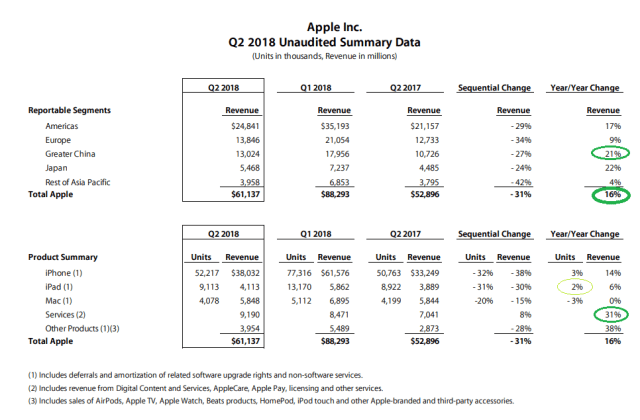
  1. Revenues up 16 percent – It amazes us that a company so large can grow earnings at 16 percent y/y.
  2. China Revenues up 21 percent –  This compares to down 14 percent in Q2 2017.  Worries unwarranted unless the CFO is playing three-card monte with the data.
  3. Services Revenues up 31 percent –  Service revenues accounted for 15 percent of total revenues versus 62 percent for iPhones.
  4. iPhone unit sales up 2.86 percent –  Back in positive territory but still punk (see chart).  The straw bears can grasp at in this report.

May1_APPL_Release

Apple’s Fundamental Problem

Apple’s problem is that iPhone unit sales are stalled.  The company sold 217.1 million iPhones in the last four quarters, which is down from 231.5 million in Q1 2016.

Apple has stunningly sold a total of 1.34 billion iPhones since Q1 2010.  That equates to almost 20 percent of the world’s population!

Maybe the global market is finally saturated,  Maybe iPhones are losing their chic, lit, swank, mod, bossness, or whatever the prevailing generation calls it (we doubt it, however).  Maybe competition is increasing.  Maybe Apple has priced itself out of the market.  Maybe all of the above. Maybe none of the above.

Apple needs to spend more time on innovation and introduce a new life-changing product(s) and focus less on financial engineering and shifting earnings across borders under the new tax law.    No doubt they are trying.


May1_iPhoneL_Growth

Stock up about $6.50, or 3.8 percent in AH.   We aren’t buying here.


Posted in Apple, Uncategorized | Tagged | 6 Comments

How Good, or Bad, Will AI Get?

Even as the use of artificial intelligence has grown over the past decade, outsized predictions about it destroying humanity or creating utopia haven’t come to pass, at least not yet. Bloomberg QuickTake explains what AI does for us now and why people like Elon Musk are so wary about its future. Video by Henry Baker and Christian Capestany

https://www.bloomberg.com/news/videos…

Posted in Algos, Technology, Uncategorized | Tagged , , , , , | Leave a comment

What To Watch In The Apple Release

Ahh, the good old days of trading billions of dollars in Apple stock.

Apple Getting Too Big

The company has almost become a utility due to its sheer size.

Apple’s relatively small recurring revenue stream (some argue iPhone upgrades are – Uncle Carl)  forces Tim Cook to wake on the first day of every year and begin to generate annual revenues larger than the GDPs of 75 percent of the counties in the world (see table below).

God Bless Tim Cook, he is really trying to turn Apple into a services company, which really turned around Microsoft, when they moved their software to the cloud.

Nevertheless, imagine the pressure on senior management.   Growing gadget sales and revenues every year to a level larger than the size of Peru or Greece’s GDP.   That is one big nut, comrades.

Last Quarter’s Release

Clearly the release of the iPhone 10 was a flop, and we suspect due to its $1,000 price tag.  That is a lot of scratch for a phone even for the 5 percenters.   iPhone unit sales were down 1.2 percent y/y last quarter.


Apple_Feb1

Monitor These Two Items

  1. Q2 iPhone unit sales to see if they can bounce back.  The last two Q2s have seen negative y/y growth, however.
  2. Q2 China revenues, which may be more important.  Lots of noise in last week about Apple losing market share to local firms.   We also hear of boycotts of Apple products by the Chinese as they are upset at the U.S. bullying their country on the trade issue.  Maybe that it why Tim Cook was in the Oval Office last week.  Greater China revenues average around 20-25 percent of total revenues and have grown y/y for the past two quarters over 10 percent.  It is critical that y/y growth quarterly remains above or around 10 percent.

Where Is The Stock Headed Tomorrow?

As they say at the tables,  “Place your bets.”


Apple_Mar24


Mar25_Apple's China Revenues


May1_APPL_Revs

Posted in Apple, Uncategorized | Tagged , | 12 Comments

QOTD: So Churchill!

Contemplate this for “the moment in the garden.” 

Apr30_Churchill Quote

Posted in Quote of the Day, Uncategorized | Tagged , | Leave a comment

Take Our Rorschach Test

Watch Brazilian surfer Rodrigo Koxa ride an 80-foot wave in Portugal last November. Koxa was recently recognized for the feat at the Big Wave Awards in Santa Monica, California.

Subscribe to the CBS News Channel HERE: http://youtube.com/cbsnews

Please view the video below and respond and choose the best answer which most closely represents your perception of the ink blots big wave surfer video.  Free association is welcome.

We will run the algorithm to analyze your personality.

Q:   What do you see in the big wave surfing video?

  1. Investors riding the coming breakout rally in the S&P500
  2. Traders long stocks about to be crushed by a vicious bear market
  3. “Blue Wave” November election where Democrats take the House and Senate
  4. President Trump surfing opinion polls to a 50 plus percent approval rating
  5. Bernie Sanders about to get crushed politically
  6. The inflation wave about to break on the U.S. economy
  7. The deflation wave about to break on the U.S. economy
  8. Google recording your internet surfing
  9. FX traders riding the coming dollar rally
  10. Gold traders riding the coming rally
  11. Bitcoin traders about to get candy crushed
  12. The Clintons finally going down in the Whitewater
  13. Bitcoin traders riding the price up to $1 million
  14. Bond investors about to be destroyed by a U.S. debt crisis
  15. A Brazilian surfer killing it
  16. Other
  17. All of the above (WTF?)

Tweet or email your results.


Posted in Economics, Uncategorized, Video | Tagged , | 10 Comments

David Tepper Dishes On Markets…

David Tepper, MBA ’82, [spoke] at the Cohon University Center on April 26 for a university-wide event.

The Tepper School of Business welcome[d] David Tepper, founder and president of Appaloosa Management, L.P. Tepper [who] join[ed] students for a Q&A session, which [was] open to the entire Carnegie Mellon community.

The Tepper School Graduate Business Administration President, Victoria Lopez, and Undergraduate Business Administration Student Body President, Neal Choudhary, moderate[d] the session, which will [took] place on April 26, 2018, at 5:30-6:30 p.m., McConomy Auditorium, Cohon University Center.

Tepper, who earned his MBA from CMU in 1982, will be this year’s keynote speaker at Commencement. He also receive[d] an honorary degree in business practice. – Carnegie Mellon

Part 1 – 15.18 minutes

Part 2 – 15.27 minutes

Part 3 – 10.58 minutes


Posted in Equities, Uncategorized, Whales | Tagged , | Leave a comment

“Deja Vu All Over Again” In Korea

That was then (2005),

North Korea vows to abandon nuclear weapons project

· Cautious welcome by Bush for road map deal
· Aid and US promise not to invade seals agreement

 North Korea has agreed in principle to end its nuclear weapons programme and rejoin the international non-proliferation treaty, marking the biggest breakthrough in its three-year stand-off with the US.

Under a draft accord issued by North Korea and five other countries in Beijing yesterday, the reclusive state promised to give up its main bargaining chip in return for energy, economic aid and a US promise not to attack.  – The Guardian,  Sept 19, 2005


This is now, 

Kim Prepared to Cede Nuclear Weapons if U.S. Pledges Not to Invade

SEOUL, South Korea — North Korea’s leader, Kim Jong Un, told President Moon Jae-in of South Korea when they met that he would abandon his nuclear weapons if the United States would agree to formally end the Korean War and promise that it would not invade his country, a South Korean government spokesman said Sunday.

In a faith-building gesture ahead of a summit meeting with President Trump, Mr. Kim also said he would invite experts and journalists from South Korea and the United States to watch the shutdown next month of his country’s only known underground nuclear test site.  – NY Times, April 29, 2018

Eyes Wide Open

This administration has its eyes wide open. We know the history. We know the risks. We’re going to be very different. We’re going to negotiate in a different way than has been done before.  We use the word irreversible with great intention. We’re going to require those steps that demonstrate that denuclearization is going to be achieved. We’re not going to make promises. We’re not going to take words. We’re going to look for actions and deeds. – Secretary of State Mike Pompeo, April 29

Like Father, Like Son

How do you know that the North Korean regime is lying? Answer: Their lips are moving. – National Security Adviser John Bolton 

Curb Your Enthusiasm 

George W. doesn’t have a Nobel Peace Prize that we know of.

We also hope it is not an all or nothing negotiation with Trump and Kim.  The environment seems ripe  to make the world safer and the lives better for the Koreans even if it just incremental and without achieving total victory as the administration sees it.

Posted in General Interest, Uncategorized | Tagged , , , , | 34 Comments